You reduce vendor risk by doing four things in order: sort vendors by how much damage they could do, match the depth of your review to that tier, write the protections into the contract, and keep checking after signature. The step most teams skip is the one that tells you how a vendor behaves once the contract is signed: talking to real, verified customers. This guide covers the full routine, and it works whether you are buying a tool for your sales and marketing stack or selling to buyers who will run this process on you.
TL;DR
- Risk follows access, not spend. A cheap vendor that touches customer data can cost you more than a large vendor that touches nothing.
- Tier every vendor with a few yes/no questions, then give high-tier vendors a full review and low-tier vendors a light one.
- Put security, incident notice, subcontractor and exit terms in the contract before you sign.
- Verified customer references show you what questionnaires cannot: how a vendor performs in a real account.
- Re-review on triggers (renewal, scope change, incident), not only on a calendar.
Table of Contents
- Why vendor risk is a revenue problem, not just a security one
- Step 1: Tier your vendors by what they can touch
- Step 2: Match due diligence to the tier
- Step 3: Write the protections into the contract
- Step 4: Verify with real customers, not just paperwork
- Step 5: Monitor, and re-review on triggers
- Where Clareefai fits
- Our perspective
- FAQ
- Sources
Why vendor risk is a revenue problem, not just a security one
Every vendor you add extends your exposure to someone else’s controls. A SecurityScorecard and Cyentia Institute study of more than 235,000 organizations found that 98% had a relationship with at least one third party that had been breached in the prior two years. The same study found that each vendor typically brings 60 to 90 indirect fourth-party relationships with it.
The World Economic Forum’s Global Cybersecurity Outlook 2024 reports that 41% of organizations hit by a material cyber incident traced it to a third party, and 54% said they do not understand the vulnerabilities in their supply chain well enough. In the U.S., the Identity Theft Resource Center’s 2025 report found about 30% of all breaches involved at least one third party, and the number of entities affected by supply chain attacks nearly doubled in a year.
Most teams also undercount. PwC’s board guidance says companies underestimate how many third parties they deal with by a factor of three to five. Deloitte reports that 60% of organizations depend on more than 1,000 third parties.
For a sales or marketing leader this matters in two ways. The tools in your stack (CRM add-ons, video hosting, review and testimonial software, analytics) hold customer names, contact data and sometimes recorded calls. And the companies you sell to are running the same checks on you, which slows deals when you cannot prove you are a safe choice.
Step 1: Tier your vendors by what they can touch
The Federal Reserve Bank of Minneapolis, summarizing U.S. bank regulator guidance, lists four kinds of vendor risk: compliance, reputational, operational and legal. Banks cannot outsource responsibility for them, and the same logic holds for any company: if a vendor fails, your customers blame you.
Start with an inventory of every vendor, including the ones a team bought on a company card. Then ask four questions about each:
- Does the vendor hold or process customer or employee data?
- Does it connect to your systems, such as your CRM or single sign-on?
- Would its failure stop a customer-facing service?
- Would it be hard to replace?
A “yes” to any of them moves the vendor up a tier. Three tiers are enough for most mid-size companies:
| Tier | Typical profile | Depth of review |
|---|---|---|
| Light | No data, no integration, easy to replace | Inventory entry, standard terms |
| Standard | Some data or integration | Security questionnaire or an independent report such as SOC 2 |
| Full | Sensitive data, deep integration or hard to replace | Financial check, continuity testing, penetration test results, subcontractor list, negotiated terms, executive sign-off |
This mirrors the published approach in a third-party risk program guide and the tiering rubric in NIST’s supply chain guidance, which says mission criticality, data sensitivity and operating environment should drive how much risk you accept. PwC adds a point that surprises finance teams: spend is not the only criterion, because a minor expense can carry major risk depending on the service.
Step 2: Match due diligence to the tier
NIST’s July 2026 due diligence quick-start guide (SP 1326) describes due diligence as the minimum reasonable research on a supplier, prioritized by criticality. It covers five areas: ownership and control, provenance, resilience, foundational cyber practices and supply chain tiers. Basic due diligence uses public information. Enhanced due diligence adds commercial datasets and specialist tooling.
For a standard or full-tier software vendor, a practical checklist looks like this:
- Security evidence. Ask for a current SOC 2 report or ISO 27001 certificate and read the scope, not just the cover page. Our guide to SOC 2 for marketing tools shows what to look for.
- Access controls. Confirm multi-factor authentication and single sign-on support. Our SSO setup and security guide covers the basics.
- Data handling. Where is data stored, who can see it, and how is it deleted? For tools that touch customer stories, see our notes on testimonial data security and video hosting privacy.
- Incident history and response. Ask how the vendor tests its incident response and how fast it notifies customers.
- Fourth parties. Ask which subcontractors process your data.
- Financial stability. A vendor that disappears is an operational risk even if it never gets breached.
New York’s financial regulator lists nearly the same factors in its October 2025 guidance: system and data access, cybersecurity history, financial stability, incident-response testing, fourth-party practices and external audits. You may not be a regulated bank, but a list built for regulators is a solid benchmark.
If you are a marketer judging whether a vendor’s promises add up, apply the same discipline to its value claims. Tie the purchase to measurable outcomes, as in this look at marketing analytics and ROI. A vendor you cannot measure is a vendor you cannot defend at renewal.
Step 3: Write the protections into the contract
Due diligence tells you what a vendor does today. The contract decides what it must keep doing. NIST’s supply chain guidance recommends security requirements as a condition of award, flow-down of controls to subcontractors, periodic revalidation, incident reporting protocols and termination rights when risk cannot be brought to an acceptable level. It also warns against choosing the lowest-priced technically acceptable bidder for technology purchases.
The NYDFS guidance adds terms that translate well to any software contract: multi-factor authentication, encryption, timely event notification, data-location limits, subcontractor disclosure with a right to object, and certified data deletion or migration at exit.
In practice, push for these five:
- A named notification window for security incidents.
- A list of subcontractors with a right to be told when it changes.
- Clear data ownership, export in a usable format and certified deletion.
- Audit or evidence rights, such as annual delivery of a current SOC 2 report.
- Month-to-month or short commitments where you cannot yet judge fit, so that exit is cheap.
That last point is a risk control of its own. The easier it is to leave, the less any single vendor can hold you hostage.
Step 4: Verify with real customers, not just paperwork
Questionnaires and certificates describe controls. They do not describe service. Will the vendor answer a ticket at 6 p.m. on quarter-end? Did the implementation finish on schedule? Did the tool deliver the result the demo implied? Only people already using the product can tell you.
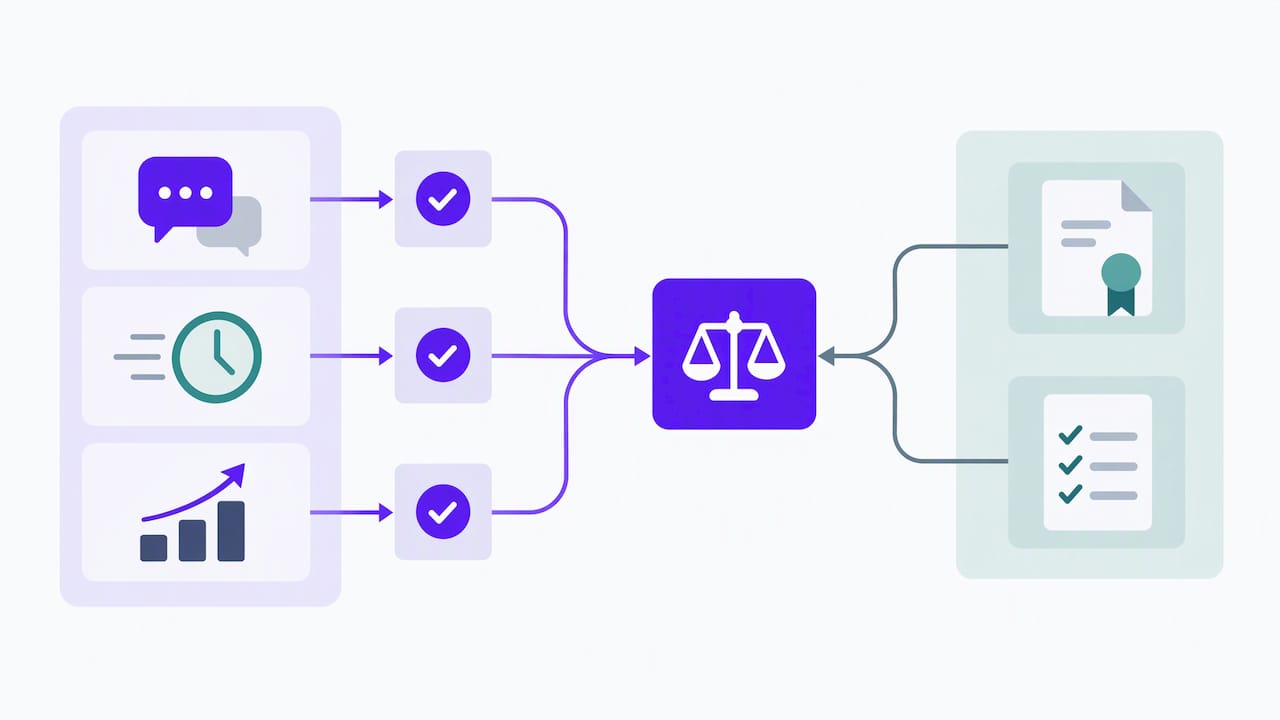
That is why experienced buyers ask for references. The weakness is that references are usually hand-picked, anonymous or hard to reach. A quote with no name, title or company gives a buyer nothing to check, and generic five-star reviews give them even less. We cover the problem in why anonymous reviews put your brand at risk.
Three habits make customer evidence useful in a vendor review:
- Ask for a reference from a similar company. Same size, same integrations, same use case. A reference from a very different account tells you little.
- Ask operational questions. How long did onboarding take? What happened during the last incident or outage? How did renewal go?
- Check that the person is real. A verified name, role and company turns a testimonial into evidence you can weigh.
If you sell to B2B buyers, this is also how you lower the risk they feel about you. Prospects who run vendor reviews want verified advocates they can reach quickly. Clareefai is built for this: it verifies customer identities, adds context to each testimonial, and lets prospects reach real customers for reference calls. For the sales side of this argument, see why secure reputation platforms matter in B2B sales.
Customer proof is itself data, and handling it well is part of your own vendor-risk story. Consent, retention and audit trails matter, as our testimonial privacy checks and testimonial data governance checks for FTC rules explain.
Step 5: Monitor, and re-review on triggers
A review done at signing goes stale. NIST says the initial due diligence assessment should not be treated as exhaustive and should be refreshed as supplier conditions change. NYDFS tells covered entities to periodically reassess active providers based on risk, using evidence such as SOC 2 and ISO 27001 attestations, penetration-test summaries and patching practices, and to escalate material or unresolved issues.
A workable cadence:
- Full-tier vendors: review evidence annually and at every renewal.
- Standard-tier vendors: refresh the questionnaire or report every one to two years.
- Light-tier vendors: confirm they still belong in the inventory.
- Any tier: re-review when the scope changes, ownership changes, or the vendor reports an incident.
Plan for failure too. The Federal Reserve’s 2025 study of large U.S. financial institutions concluded that business interruption, not data theft, drives most losses in catastrophic third-party scenarios. For your highest-tier vendors, write down the fallback: who takes over, how you export your data, and how long you can operate without the tool.
Customer success teams can add a useful signal here. Account health, support tone and advocate sentiment shift before a formal incident does. Our page for customer success teams shows how advocate data supports that view.
Where Clareefai fits
Clareefai is a SaaS platform that helps B2B sales and marketing teams collect, verify and publish customer testimonials, reviews, video stories and reference calls. AI identifies your strongest promoters, and CRM and review integrations carry their stories into the channels where buyers look. Dashboards by role and advocacy analytics show what the proof is worth. Data management is GDPR-compliant, and the platform offers real-time data synchronization.
Plans are billed monthly or annually with no long-term contracts, and a free trial is available. Pricing is published on the pricing page: Basic is $250 per month, Professional is $624 per month and Enterprise is $1,250 per month. You can also see how the pieces fit on our solutions page.
If your buyers run vendor reviews on you, the fastest way to answer them is a library of verified customer voices ready before they ask. Start from Clareefai.
Our perspective
We see vendor risk as a trust problem as much as a control problem. A questionnaire can confirm that a vendor has multi-factor authentication. It cannot tell you whether the people running the product keep their promises after the sale.
That is why we built Clareefai around verified customer voices. Every testimonial should come from a real, identifiable person, with the context of who they are and what they use the product for. Anonymous praise cannot be weighed. A named customer who will take a reference call can.
We also think advocacy should be managed like any other business asset. It needs consent, security, analytics and an owner. When your promoters are organized in one secure place, you can show buyers evidence on request, and you can show your own security reviewers how that evidence is handled.
The strongest vendors do not wait to be asked for proof. They make it easy to verify, and that shortens the deal for everyone.
ClareefAi
FAQ
What does third-party vendor risk mean?
It is the exposure you take on by giving outside companies access to your data, systems, customers or operations. That includes vendors, suppliers, partners and contractors. Their weaknesses become yours, and you have limited visibility into their controls.
How do I decide which vendors need the deepest review?
Ask whether the vendor holds customer data, connects to your systems, could stop a customer-facing service if it failed, or would be hard to replace. Vendors with more “yes” answers get a full review, and the rest get lighter checks. Spend alone is a poor guide.
Do I need vendor risk management software?
It helps when you have enough vendors that an inventory, workflow and audit trail are hard to keep in a spreadsheet, and when you have people who can review the evidence. For a smaller portfolio, a tiered inventory and a calendar of re-review triggers can cover the basics.
Which U.S. rules shape vendor risk management?
Banks follow the June 2023 interagency guidance on third-party relationships, which the regulators have proposed to replace, so check the agencies’ pages for the current status. New York financial entities follow NYDFS Part 500 and its 2025 guidance on third-party providers. Other industries have their own rules, such as HIPAA business associate contracts in healthcare. If you are unsure which apply, ask your counsel.
How can sellers reduce the vendor risk buyers see in them?
Give buyers verifiable evidence early: a current security report, clear data terms, and named customers who will talk to them. Verified testimonials and reference calls answer the questions a security questionnaire cannot.
Sources
- SecurityScorecard and Cyentia Institute, third and fourth party research
- World Economic Forum, Global Cybersecurity Outlook 2024
- Identity Theft Resource Center, 2025 Data Breach Report
- PwC, How your board can oversee third-party risk
- Deloitte, The rising importance of third party risk management
- Federal Reserve Bank of Minneapolis, compliance risk management considerations for vendors
- Building a third-party risk program
- NIST SP 800-161 Rev. 1 Update 1
- NIST SP 1326, Due Diligence Quick-Start Guide
- NYDFS, Guidance on Managing Risks Related to Third-Party Service Providers
- Federal Reserve, Cyber Vulnerabilities at Large US Financial Institutions