Match Buyers in 48 Hours: Procurement Reference Prep for B2B Vendors
Ready means this: you have a robust number of active references segmented by industry and use case, each verified recently, backed by a named CSM owner, and capped to prevent any advocate from being overused. If any of those four pieces is missing, procurement will find the gap before you do. Clareefai exists to keep that inventory centralized and current, so you never scramble the week a buyer’s evaluation team asks for proof.
TL;DR:
- References should be verified for current job titles, company status, and insurance coverage before sharing, to prevent misleading procurement teams.
- Independent checks like business registration, insurance certificates, and credit reports should supplement reference calls to verify regulatory and financial health.
- Limiting advocates to no more than six requests per year and tracking asset types prevents burnout and maintains reference quality.
- Standardized request and debrief forms help streamline the process, improve response accuracy, and facilitate quick reference matching.
- Centralized platforms like Clareefai automate verification, enforce usage caps, and provide instant, relevant testimonial assets to accelerate deal closure.
Table of Contents
- What Does Procurement Reference Checks Prep Actually Require?
- What Verification Checks Will Procurement Run, and What Are the Red Flags?
- How Do You Prevent Reference Fatigue and Keep the Program Healthy?
- Templates You Can Copy Today
- Why Verified, Managed Reference Programs Close Deals Faster
- Get Your Reference Program Procurement-Ready
- Sources
What Does Procurement Reference Checks Prep Actually Require?
Procurement reference checks prep is the discipline of organizing, verifying, and staging customer references and testimonial assets so they survive scrutiny from a buyer’s evaluation team, not just a friendly sales call. Most vendors treat reference readiness as an afterthought, something you scramble to assemble after a prospect asks. That approach fails the moment procurement asks for a second contact or a specific delivery metric you can’t produce on the spot.
Here’s the checklist to run before you hand any contact information to a buyer’s team:
Inventory targets:
- Maintain a sufficient number of active references overall, with several per major industry or use-case segment, so you can match a prospect’s profile without stretching the truth about relevance.
- Keep multiple live contacts per critical use case who have agreed in advance to take calls.
- Stock supporting assets for each segment: short written quotes, one video testimonial, a case study PDF, and a specific ROI or performance statistic.
Pre-handoff verification steps:
- Confirm the reference’s current title and company still match your records, since job changes are the single most common cause of an awkward call.
- Re-verify one piece of documentation, such as an insurance certificate or business registration, if the account has changed structure since your last review.
- Test-run a quick two-minute check-in with the reference to confirm availability and reset expectations before the buyer reaches out.
Ownership breakdown:
- The CSM owns the relationship, confirms consent, and tracks how many times the advocate has been used.
- The sales rep owns the match: confirming the reference’s industry, size, and scope actually fit the prospect’s deal.
- Marketing owns the asset library, keeping quotes, videos, and case PDFs tagged and searchable so nobody has to hunt through old email threads.
Skipping the ownership split is how references get double-booked or, worse, contacted twice in one quarter by different teams who didn’t talk to each other.
What Verification Checks Will Procurement Run, and What Are the Red Flags?
Buyer diligence teams rarely stop at the phone call. They triangulate references with independent checks, including business registration status, litigation searches, and insurance confirmations, precisely because a friendly reference will never volunteer a lawsuit or lapsed coverage. Run these checks yourself before procurement does:
- Confirm business registration and registered-agent status through your state’s Secretary of State portal or equivalent.
- Request a current certificate of insurance directly from the reference’s account manager, not secondhand.
- Pull a basic business-credit snapshot if the deal size warrants it, looking for late-payment patterns that a phone call would never surface.
A trade reference reliably speaks to payment terms, delivery consistency, and responsiveness to problems, but it won’t confirm regulatory compliance or product quality. That’s exactly why the independent checks above sit alongside the call notes, not instead of them.
Document every verification result in the same file as your call notes, dated and initialed. This single habit is what separates a program procurement trusts from one they treat with suspicion after the first inconsistency.
Watch for these red flags, each of which should knock a reference out of rotation until resolved: an account history under six months old, reluctance to share a second contact, answers that sound rehearsed word for word, or a pattern of billing complaints across multiple references in the same segment.
How Do You Prevent Reference Fatigue and Keep the Program Healthy?
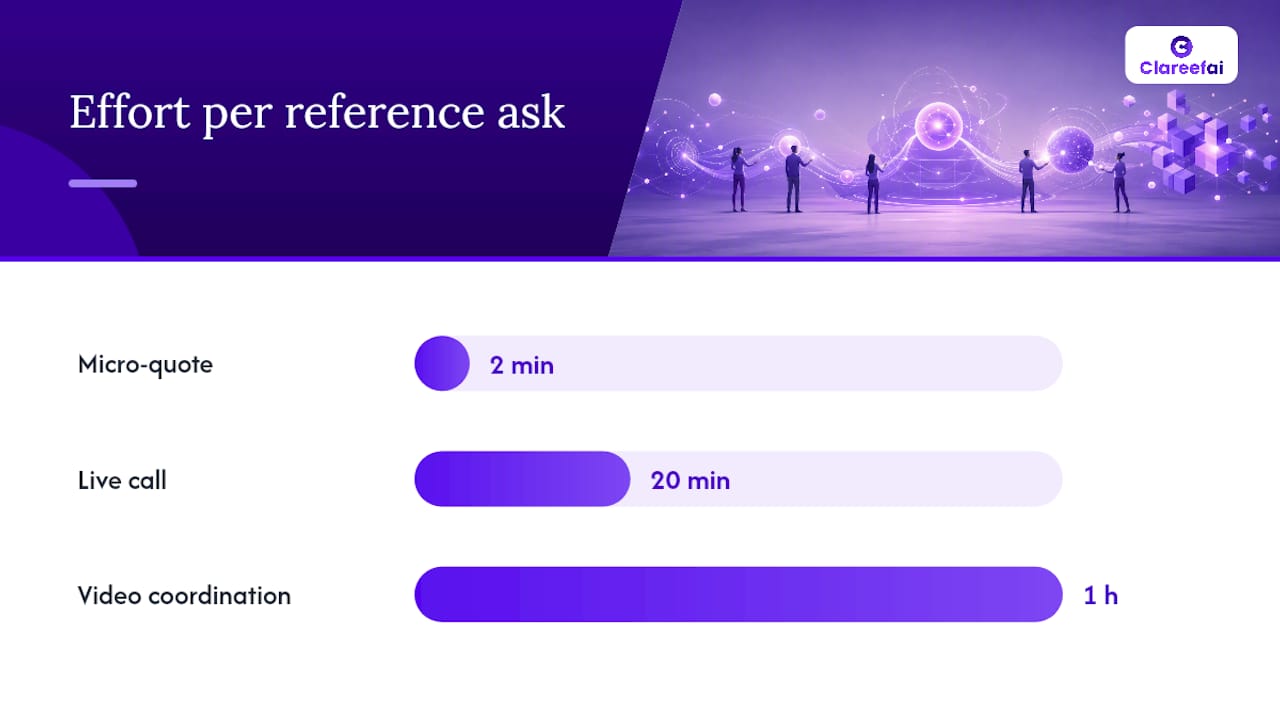
Advocates burn out fast when the same five logos get every call. A practical hard cap is six asks per advocate per year, tiered by effort: a micro-quote costs an advocate two minutes, a live call costs twenty, a video costs an hour of coordination, and an advisory-board seat costs an ongoing commitment. Spend that budget deliberately.
- Set a named CSM as the single approval gate for every request, so sales can’t quietly ask the same customer twice in one month.
- Require an intake form before any request reaches an advocate, capturing prospect context and urgency.
- Log last-used date, ask count, and asset types delivered in one shared system to avoid double-booking.
Pro Tip: Track “average time-to-serve” (how long it takes to match and schedule a reference once requested). If that number creeps past 48 hours, your inventory is too thin for your deal volume.
Watch advocate retention and available references per segment monthly. A segment with zero active references is a blind spot that will surface at the worst possible moment, mid-negotiation.
Templates You Can Copy Today
Standardizing the paperwork is what makes a reference program repeatable instead of reinvented every quarter. Qualify every request through a form before it reaches an advocate.
Reference request form fields:
- Prospect industry, size, and deal stage
- Desired match criteria (industry, use case, comparable scope)
- Urgency (call needed within how many business days)
- Business justification (why this deal needs a live reference, not just a case study)
Customer prep email should cover:
- Expected call length and who’s attending from the buyer’s side
- Topics likely to come up, without scripting specific answers
- A thank-you note confirming the ask counts against their annual cap
Post-call debrief checklist:
- Log which topics the buyer probed hardest
- Note any hesitation or vague answers worth following up on internally
- Confirm with the buyer which calls were completed, then summarize feedback before it affects deal terms
Name every asset with industry, use case, and last-used date so a rep can find a match in under two minutes instead of scrolling through a shared drive.
Why Verified, Managed Reference Programs Close Deals Faster
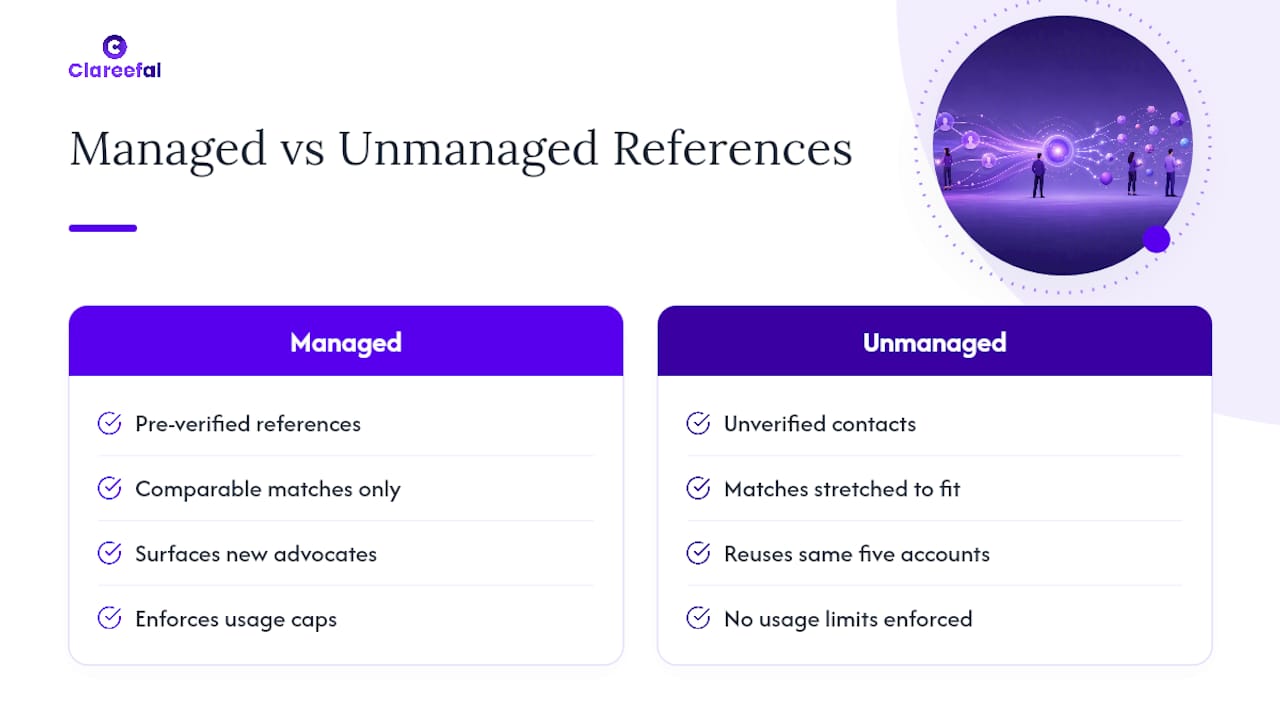
Procurement teams move faster when every reference they reach is pre-verified and every match is genuinely comparable, not stretched to fit. That’s the entire logic behind tiering and AI-driven advocate matching: it surfaces new, high-sentiment advocates instead of wearing out the same five accounts.
Clareefai centralizes that verification, enforces the usage caps this article recommends, and hands sales teams on-demand testimonial assets without a scramble…
— ClareefAi
Get Your Reference Program Procurement-Ready
Chasing down references manually, cross-checking spreadsheets, and hoping nobody double-books your best advocate is not a program, it’s a fire drill that repeats every sales cycle. Clareefai replaces that scramble with a centralized system that verifies customer identities, tracks usage caps automatically, and surfaces the right testimonial or video the moment a deal needs it.
If your team is managing references in shared docs and hallway conversations, you already know where the gaps are. Clareefai’s platform gives sales, marketing, and customer success one shared source of truth, matched by industry and use case, with verification status visible before anyone picks up the phone. See how it fits your pipeline with a demo of Clareefai for sales teams and put your next procurement evaluation on stronger footing.
Sources
Matching by logo size alone is the most common mistake in reference programs. A 20-person account and a 2,000-person account never answer questions the same way, even when they’re both satisfied customers. Match on four dimensions instead: industry, company size, tenure with your product, and scope comparable to what the prospect is evaluating. A reference who bought a single module last quarter can’t speak credibly to a full-platform rollout.
Once matched, run a tight 15 to 20 minute call built around questions that force specifics rather than praise. Ask specific, open-ended questions that require examples rather than generic satisfaction checks.
- Trade References in Vendor Qualification: What to Ask For
- Reference Customer Programs: Managing Customer Reference Requests
- How do you build a customer reference program in 2027?
- What Buyers Ask in Customer Reference Calls (And What They’re Really Looking For)
Numeric prompts like the second question produce far more actionable intelligence than vague reliability questions, because a percentage is harder to fudge than a feeling. Question four also does double duty: it triangulates the reference against a second internal contact, which matters when a buyer suspects you’ve only prepped one enthusiastic champion.
Pro Tip: Never rehearse answers with a reference. Prep the format (call length, topics likely to come up, who’s joining) but never the content. A coached answer is the fastest way to lose procurement’s trust once they cross-check it against a second contact.
Recommended
Share Article
Stay Updated
Get the latest insights on customer advocacy and SaaS growth delivered to your inbox.