Close More Deals With a B2B Case Study Format and Five Field Snapshot
The winning B2B case study format follows one sequence: outcome-led headline with a metric, a three-bullet executive summary, a client snapshot, the challenge, evaluation criteria, the solution and implementation timeline, results, and a verified testimonial with a clear CTA. This order works because it mirrors how buying committees actually evaluate vendors, scanning for risk and ROI before reading a single sentence of narrative. Get this structure right, and platforms like Clareefai make the proof behind it verifiable.
TL;DR:
- Including specific evaluation criteria like integration, security, and deployment time enhances a case study’s credibility with procurement teams.
- Presenting results as a timeline over several months demonstrates the durability and sustained impact of the solution.
- Verifying customer identities and permissions through platforms like Clareefai ensures all testimonials and metrics are trustworthy and legally compliant.
- Using a detailed, outcome-focused structure with clear data points and owner timelines boosts the case study’s trustworthiness, especially for skeptical buyers.
- Repurposing case studies into multiple assets, such as slide decks and email snippets, maximizes their utility in sales enablement efforts.
Table of Contents
- What goes in the executive summary snapshot?
- How do you structure a copyable case study template?
- What questions should you ask in a case study interview?
- How specific should the implementation timeline be?
- How do you present results that buying committees trust?
- What evaluation criteria should you include?
- How should you format the case study for different channels?
- How do you repurpose a case study for sales enablement?
- How does Clareefai support the verification workflow?
- Why transparency in case studies drives more conversions than polish
- Getting your case studies verified and published with Clareefai
- Sources
What goes in the executive summary snapshot?
Buyers skim before they read. A top-of-asset snapshot with named testimonials does more to build credibility than three paragraphs of context ever will, which is why your “baseball card” needs to sit above the fold, not buried after a background section.

The snapshot itself needs five fields, nothing more: company name, industry, company size, project timeframe, and the top one or two metrics. Think of it like a stat line on a trading card. A reader should quickly determine whether this story applies to their situation.
Below the snapshot, three executive-summary bullets carry the weight of the entire case study for time-poor executives:
- Problem bullet: name the specific operational pain in one sentence (“Manual testimonial collection was costing the sales team six hours per rep, per month”).
- Solution bullet: state what was implemented and by whom, in plain language, no jargon.
- Result bullet: lead with the single most persuasive number, tied to a timeframe.
Keep each bullet under 20 words. Anything longer defeats the purpose of a snapshot built for skimmers.
How do you structure a copyable case study template?
Here’s the exact template, in order, with prompts you can paste directly into a CMS draft or a sales one-pager:
- Headline. Lead with the outcome and a number: “How [Company] Cut Sales Cycle Time by 30% in 90 Days.” Avoid generic titles like “A Success Story” — they get skipped in a scroll.
- Snapshot. Company, industry, size, timeframe, top metric. Five lines, formatted as a small card or table.
- Background. One paragraph, two sentences max: who the customer is and why their situation is relevant to your reader. “Founded in 2014, [Company] runs a 40-person outbound sales team competing in a crowded mid-market SaaS category.”
- Challenge. Frame the problem the way the customer described it in the interview, not the way your product solves it. “The team had no reliable way to surface recent wins to prospects mid-funnel, so reps defaulted to generic case studies that didn’t match the buyer’s vertical.”
- Evaluation criteria. List the two to four requirements the customer used to shortlist vendors. This section reads as a checklist to procurement reviewers rather than marketing copy, which is exactly why it belongs here.
- Solution. Describe what was implemented, referencing specific features or modules by name. Keep this factual, not promotional.
- Implementation. Phase by phase, with owners and week ranges (detailed in the next section).
- Results. Metrics tied directly to the goals stated in the challenge section, shown as a trajectory over time rather than a single snapshot.
- Quote. One verified, named testimonial with a title and, ideally, a LinkedIn link.
- Call to action. A specific next step: “Book a 20-minute walkthrough” beats “Learn more” every time.
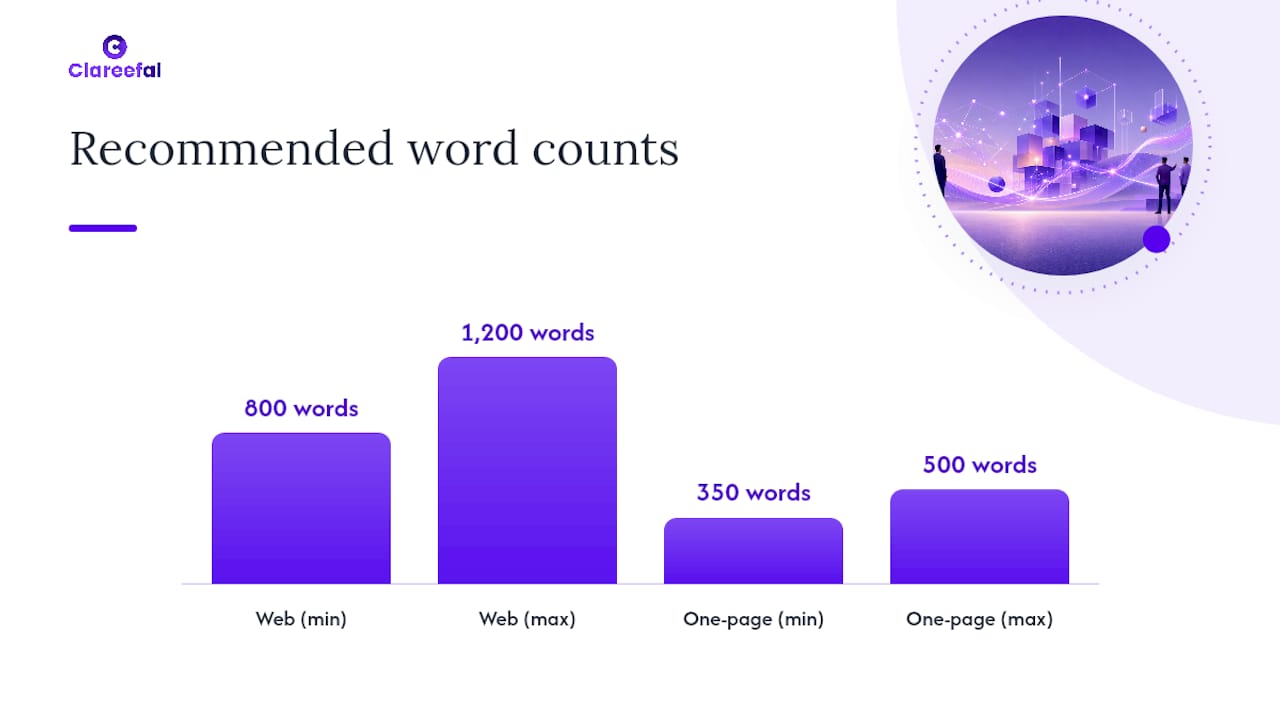
For word counts, aim for 800 to 1,200 words on the web version and 350 to 500 words on the one-page sales PDF, cutting background and implementation detail first when trimming. The core structure, context, challenge, approach, results, and takeaway, stays intact regardless of format; only the depth of each section changes.
Pro Tip: Draft the headline and result bullet before you write anything else. If you can’t state the win in one sentence after the interview, you don’t have enough data yet, and that’s a signal to go back and ask better questions.
What questions should you ask in a case study interview?
Bad interviews produce vague case studies. Before you get on the call, pull the customer’s usage analytics, identify every stakeholder who touched the buying decision, and confirm which KPIs the customer actually tracks internally, not just the ones that make your product look good.
Split your question bank into five categories:
- Problem: “What was the cost of not solving this, in time or dollars, before you started looking for a vendor?”
- Vendor selection: “What were the two or three requirements you couldn’t compromise on when you evaluated options?”
- Implementation: “Who owned the rollout on your side, and what took longer than expected?”
- Metrics: “What number changed that you’d point to if your CFO asked whether this was worth it?”
- Recommendation: “What would you tell someone in your position who’s on the fence?”
Close every interview with a permissions checklist: written quote approval, logo usage rights, and confirmation the interviewee’s name, title, and LinkedIn profile can appear publicly. Skipping this step is how case studies get pulled after publication, which costs you far more time than asking upfront.
How specific should the implementation timeline be?
Vague timelines read as marketing fluff. Specific ones read as proof. State week ranges and named owners for each phase rather than a generic “smooth rollout” claim that tells the reader nothing about actual effort.
A realistic 12-week example looks like this:
- Weeks 1 to 2 (Kickoff, customer’s IT lead): Requirements gathering, CRM integration setup, access provisioning.
- Weeks 3 to 5 (Configuration, vendor’s implementation manager): Custom fields mapped, initial data migration, internal training for the customer’s core team.
- Weeks 6 to 8 (Pilot, customer’s sales ops manager): Rollout to a subset of reps, feedback collected, adjustments made to workflows.
- Weeks 9 to 10 (Full deployment, both teams): Company-wide rollout, dashboards activated, support escalation path confirmed.
- Weeks 11 to 12 (Optimization, customer success manager): Early metrics reviewed against original goals, minor configuration tweaks finalized.
Document friction honestly. If data migration took two weeks longer than planned because of a legacy CRM export issue, say so, and name the mitigation (“a phased import schedule kept sales operations running during the transition”). A case study that admits one hiccup and shows how it was resolved reads as more credible than one claiming a flawless rollout, and buying committees notice the difference.
How do you present results that buying committees trust?
Match the metric to the reviewer. Technical evaluators want integration and uptime data; financial reviewers want cost per outcome; sales leaders want cycle time and win rate. A single case study should carry at least one metric from each category rather than five variations on the same number.
Show results as a trajectory, not a single point-in-time win. Presenting month 1, month 3, and month 6 figures demonstrates the gain held up over time, which matters far more to a skeptical buyer than a one-time spike that might not repeat.
By the numbers: A results section built around a trajectory (month 1 → month 3 → month 6) rather than a single after-figure signals durability, not a lucky quarter, according to guidance from Wordable’s case study framework.
For visualization, keep it simple:
- A small results card at the top of the asset, three numbers max, placed near the snapshot.
- A mini trajectory chart if you have three or more data points over time.
- One honest limitation or learning stated plainly, such as a metric that improved more slowly than expected.
That last point matters more than most writers assume. A case study with zero caveats reads as sanitized, and sophisticated buyers discount it accordingly. One qualifier does more for trust than another glowing superlative.
What evaluation criteria should you include?
Procurement teams treat a case study differently when it includes the actual decision matrix the customer used. This is the single highest-leverage addition you can make to an otherwise ordinary case study, because it converts the asset from marketing copy into something resembling a vendor reference.
List three to five criteria the customer named during their evaluation:
- Integration: Did the solution connect cleanly with the CRM or tech stack already in place?
- Security and compliance: Was data handling, GDPR compliance, or SOC 2 status a stated requirement?
- Total cost of ownership: How did pricing compare against the alternative the customer nearly chose instead?
- Support and customer success: Was there a named CSM, and how fast was initial response time?
- Deployment time: How long from contract signature to first value realized?
State each criterion in one line, then tie it directly to how your solution met it. This section reads as a checklist a procurement lead can compare against their own requirements, not a testimonial, and that distinction is exactly what makes it persuasive to a skeptical buying committee.
How should you format the case study for different channels?
Format follows use case, not preference. The web version runs 800 to 1,200 words and stays ungated, since gating a case study behind a form hurts organic discovery and keeps it from ranking for the exact searches your prospects are running. A one-pager PDF at 350 to 500 words works as the gated complement for sales outreach, where a rep wants something specific to attach to an email.
Visually, prioritize a snapshot card near the top, one pull quote set apart from body text, and result cards showing the top two or three metrics. Add alt text to any screenshots so the asset stays accessible to screen readers, an easy step that gets skipped constantly.
Pro Tip: Keep your web version and one-pager as separate files with separate word counts. Trying to cram a 1,200-word web story into a one-page PDF just produces tiny, unreadable text nobody will actually read.
How do you repurpose a case study for sales enablement?
One well-built case study should generate five or six distinct assets, not sit as a single blog post.
- Slide deck excerpt: Pull the snapshot, one result chart, and the testimonial into three slides a rep can drop into any deck.
- Two one-pagers: One general version, one industry-specific version with adjusted language for that vertical.
- Video clips: If the interview included video, cut 30-second clips highlighting the quote for social and email use, as covered in guidance on video testimonial advantages for B2B marketers.
- Email snippets: Lift the result bullet and quote into a short paragraph reps can paste into outbound sequences.
- Content library tagging: Tag by industry, use case, and company size so reps can search and find the right story fast, an approach covered in more depth in this B2B social proof workflow guide.
Track influence with UTMs on every distributed link and a conversion event tied to case-study page views in your CRM, so you can prove which stories actually move deals forward.
How does Clareefai support the verification workflow?
Clareefai’s role sits upstream of the writing itself: it verifies the customer identities behind testimonials, matches AI-identified promoters to the right story, and centralizes video and text feedback so nothing gets lost between the interview and the final draft.
A practical workflow looks like this:
- Use Clareefai to identify which customers are already engaged enough to be strong advocates, before you request an interview.
- Collect and verify the testimonial and metrics through the platform’s dashboards, so quote approval and identity verification happen in one place.
- Publish the verified case study across channels through automated display, keeping the same proof point consistent from the web page to the sales one-pager.
(Insert your team’s specific customer example and verified metrics here once collection is complete.)
Why transparency in case studies drives more conversions than polish
Most marketing teams treat case studies as a writing exercise. That’s the wrong frame. The best-performing ones behave more like documented evidence than persuasive copy, and the difference shows up in how they’re built, not how they’re worded.
Here’s the editorial pledge worth holding yourself to: every testimonial carries a real name and title, every metric traces back to a source the customer can confirm, and every permission gets documented before publication, not chased down after a legal team flags it. That discipline borrowed from academic case study structure, executive summary, findings, recommendations, isn’t overkill for a marketing asset. It’s what separates a case study a procurement lead trusts from one they skim past.
The most persuasive case study is not the one with the boldest metric. It’s the one that would survive a skeptical buyer calling the customer directly to check the story. Build for that bar, and the metrics take care of themselves.
— ClareefAi
Getting your case studies verified and published with Clareefai
Clareefai gives you the missing piece most case study templates leave out: proof that survives scrutiny. Instead of chasing quote approvals over email or guessing which customers are happy enough to feature, Clareefai’s AI-driven promoter matching flags your strongest advocates automatically, verifies their identity, and keeps testimonial permissions documented in one place.
That means the evaluation criteria section, the named testimonial, and the metrics in your next case study can all trace back to a verified source instead of a marketing team’s word for it. Dashboards built for sales, marketing, and customer success teams keep everyone working from the same verified data, with GDPR-compliant handling built in from collection to publication. If you’re building your next case study and want the verification layer already solved, explore the Clareefai platform and see how verified proof gets collected, matched, and published without the manual chase.
Sources
For deeper structural guidance, the B2B case study template from WebCoreLab covers evaluation-criteria formatting in more depth. Wordable’s step-by-step guide offers additional trajectory examples, and Monash University’s case study resource is worth reviewing for the underlying academic structure this format borrows from.
- B2B case study template: write winning stories fast!
- How to Write a Case Study: A Step-by-Step Guide | Wordable
- 11 fantastic case study examples: proven structures and standout results
- How to write a case study (Monash University)
Recommended
Share Article
Stay Updated
Get the latest insights on customer advocacy and SaaS growth delivered to your inbox.