How to Boost Sales Credibility: A Playbook for B2B Reps
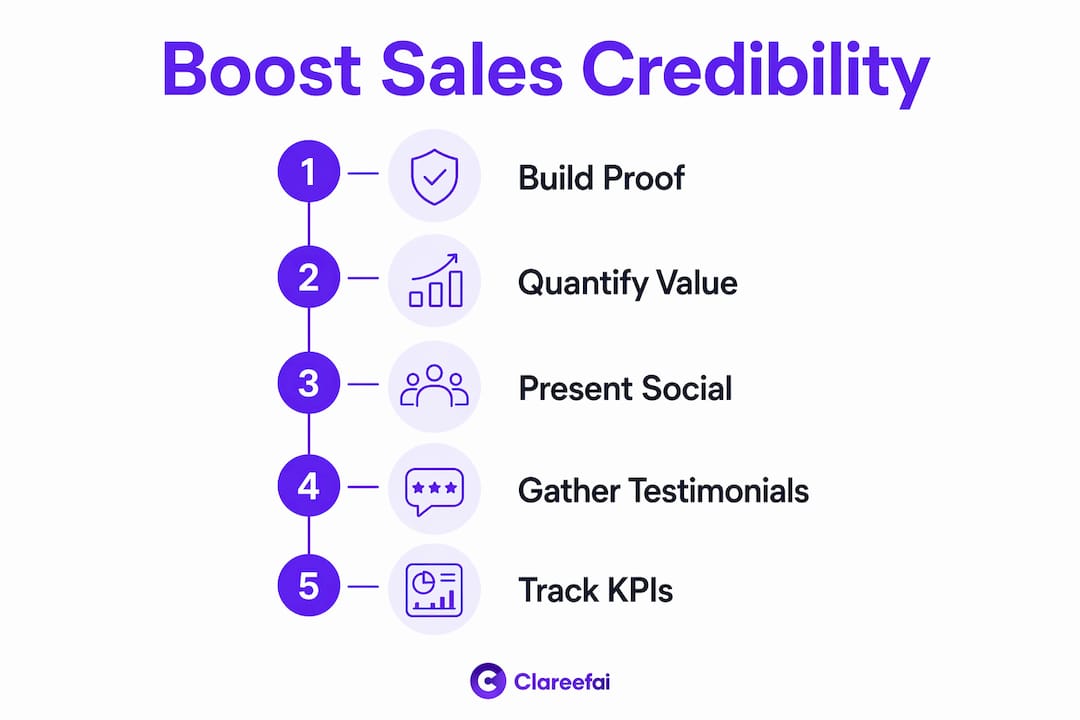
The fastest way to boost sales credibility is to replace claims with verifiable proof: specific metrics, short case stories, third-party validation, and consistent follow-through. Only 24% of U.S. adults view salespeople as credible, which means the gap between a rep who wins and one who stalls often comes down to proof, not polish.
Start here. These are the highest-leverage moves you can make today:
- Build a proof bank of short stories, each mapped to a common buyer fear (risk, effort, politics, switching cost, “will it work here?”).
- Capture verifiable metrics. Every case story needs a named outcome rather than vague claims.
- Set a 24-hour follow-through SLA. Deliver every promised recap, pricing sheet, or security doc within one business day.
- Run an Up-Front Contract at the start of every call. One sentence that sets the agenda and confirms mutual next steps.
- Ask diagnostic questions, not feature questions. Questions that quantify the cost of a problem build more credibility than any demo.
- Publish third-party proof. Active G2, Capterra, or Gartner Peer Insights profiles give buyers independent confirmation before they ever talk to you.
Track two KPIs from day one: your 24-hour SLA hit rate (target: 95% or higher) and your next-step scheduling rate (target: 80% or higher).
Table of Contents
- How to collect and present social proof that buyers actually believe
- How do you quantify value and show ROI in a sales conversation?
- Does your LinkedIn profile actually build credibility before the first call?
- What conversation tactics actually build trust in discovery?
- How do you use third-party validation to close the trust gap?
- Daily habits that turn competence into perceived reliability
- How to operationalize testimonial management at scale
- Key Takeaways
- Proof over polish: a perspective on what actually moves buyers
- Clareefai helps you turn customer proof into a sales asset
- Sources and further reading
How to collect and present social proof that buyers actually believe
54% of B2B buyers engage with case studies during their buying process, and 29% rate them among the most valuable sources they consult. That makes a tight, metric-driven case story one of the highest-ROI assets a rep can carry.

What goes into a credible B2B case study
A case study earns trust when it includes five specific elements:
- Customer context: industry, company size, and the specific problem they faced before your solution.
- Precise metric with a timeframe: “reduced customer churn by 18% in the first quarter” beats “improved retention significantly.”
- Stakeholder role: name the function (VP of Sales, Head of Customer Success) even if you anonymize the company.
- Your role in the outcome: what specifically did your product or team do to produce the result?
- Anonymization rules: if the customer has not approved public naming, use “[SaaS company, 500+ employees]” as a placeholder. Never fabricate specifics.
Verification checklist before you publish
Before a case study or testimonial goes into a proposal or onto your website, confirm each of these:
- Written consent from the customer contact and their legal or marketing team
- Identity verified (LinkedIn profile, company email, or signed release)
- Permission to share the specific metrics cited
- Approval of the final wording from the customer
The one-paragraph case story format
Structure every verbal story and one-slide visual the same way: situation → problem → action → result. Here is the template:
That fits in 45 seconds spoken and one slide in a deck.
Sample metrics capture table
| Field | What to capture | Where it lives |
|---|---|---|
| Customer name / alias | Full name or approved alias | CRM account record |
| Industry and size | Vertical, employee count | CRM account record |
| Problem statement | One sentence, buyer’s words | Case file / proof bank |
| Metric achieved | Number, unit, timeframe | Case file / proof bank |
| Stakeholder role | Title, not name if anonymous | Case file |
| Consent status | Date and approver | Legal / marketing folder |
| Published locations | Website, G2, deck, CRM | Content calendar |
How do you quantify value and show ROI in a sales conversation?
Buyers trust numbers they helped create more than numbers you hand them. The goal is a conservative, collaborative calculation, not a polished marketing claim.
Three formulas reps can use immediately
Time saved:
Hours saved per week × hourly fully-loaded cost × 52 weeks = Annual time value
Cost avoided:
Current process cost − projected cost with solution = Annual savings
Revenue gained:
Incremental conversion rate improvement × average deal value × annual deal volume = Revenue impact
Two worked examples
| Input | Mid-market example | Enterprise example |
|---|---|---|
| Hours saved per week | 5 hours / rep | — |
| Reps on team | 8 | — |
| Fully-loaded hourly cost | $50 | — |
| Annual time value | $90,000 | — |
| Conservative rounding applied | $90,000 | — |
For the mid-market example, the rep says: “Based on the numbers your ops lead shared, we estimate roughly $90,000 in recovered rep time annually. That’s before any revenue impact.” The buyer’s own inputs anchor the figure.
Where to get each input: ask the buyer’s ops lead or finance contact for headcount, hourly cost, and current process time. Never estimate these yourself. When you use the buyer’s numbers, the calculation becomes their calculation.
Pro Tip: Always round your ROI estimates down by 10–15% before presenting them. A conservative number you can defend beats an optimistic one that invites skepticism. Buyers remember when you undersold and overdelivered.
Does your LinkedIn profile actually build credibility before the first call?
Sales reps who align their online and offline messages reinforce the key points buyers hear on calls. When a prospect Googles you after a cold email and finds the same narrative, your credibility compounds before you speak again.
The five LinkedIn elements that matter most
- Headline: lead with the outcome you create, not your title. Pattern: “I help [buyer type] achieve [specific outcome] — [proof point or credential].”
- Featured section: pin one named case study or a short video testimonial.
- Recent posts: three to five posts per month that share an opinionated take on a buyer-relevant trend, not product announcements.
- Recommendations: two to three from customers that mention specific outcomes, not just “great to work with.”
- About section: mirror the language you use in discovery calls so buyers hear the same story twice.
5-minute profile audit before outreach
Run this before you send a sequence to a new account:
- Does your headline name a buyer outcome, not a job title?
- Is your featured section showing a case study or customer proof?
- Are your three most recent posts relevant to this buyer’s industry?
- Do you have at least two customer recommendations with metrics?
- Does your About section match what you plan to say on the first call?
Thought leadership content that names real outcomes and takes a clear position builds the kind of authority that generic product posts never will. Post once per week minimum. Engage on two to three prospect posts per week. That cadence keeps you visible without requiring a full content operation.
What conversation tactics actually build trust in discovery?
Diagnostic conversations that quantify the cost of a problem generate credibility by turning buyer answers into diagnosable outcomes. Jeff Thull’s expert-diagnostician model argues that asking high-level observational and opinion questions creates privileged insight that generic discovery scripts never reach.

The Up-Front Contract in one sentence
This one sentence reduces buyer anxiety because it signals you are not there to pitch at all costs. It also gives you permission to ask harder questions.
Diagnostic question bank
Opinion questions (build peer-level credibility):
- “What’s your read on why this problem has persisted despite the fixes you’ve tried?”
- “If you were designing the ideal solution from scratch, what would it have to do?”
Diagnostic questions (quantify the cost):
- “How many hours per week does your team spend on [problem area]?”
- “What does a lost deal cost you on average, and how many do you attribute to this issue?”
Observational questions (create privileged insight):
- “I noticed your team recently [trigger event]. How has that changed your priorities here?”
- “Most [buyer type] I talk to struggle with [specific pattern]. Is that showing up for you?”
The 45-second proof story structure
Map each story to a buyer fear:
| Buyer fear | Story opening |
|---|---|
| “Will it work here?” | “A [similar company type] in your industry had the same concern…” |
| “Too risky” | “One of our customers almost didn’t move forward for that exact reason…” |
| “Too much effort” | “Their ops team was stretched thin, just like yours sounds…” |
Pro Tip: Observational questions work best when you have done pre-call research. Reference a LinkedIn post, a press release, or a recent product launch. Buyers immediately recognize that you prepared, and that recognition is itself a credibility signal.
How do you use third-party validation to close the trust gap?
Third-party validation, peer mentions, and named case studies carry strong weight in purchase decisions. Independent proof works because it removes the self-interest problem: a buyer knows you believe in your product, but they want to know what someone with nothing to gain thinks.
Which validation type works at each stage
- Early funnel: G2, Capterra, or Gartner Peer Insights profile with recent, verified reviews. Buyers check these before responding to outreach.
- Mid-funnel: Named case studies with metrics in proposals and follow-up emails.
- Late funnel: Reference calls with a prepared customer who can speak to outcomes relevant to this specific buyer.
- Throughout: Video testimonials on your website and LinkedIn, which drive meaningful revenue lift for businesses that use them consistently.
Reference request email template
Subject: Quick favor — reference call for [Prospect Company]
Hi [Customer Name], I’m working with a [similar company type] evaluating [your product]. They’re focused on [specific outcome you helped this customer achieve]. Would you be open to a 15-minute call with them? I’ll send a short brief so you know exactly what they’re likely to ask. Happy to return the favor anytime.*
Referee briefing checklist
Before the call, send your reference contact:
- The prospect’s company name, size, and industry
- The two or three outcomes they care most about
- Two or three questions they are likely to ask
- A reminder of the specific metric they achieved with you (so they can cite it confidently)
Store all reference assets, tagged by industry, company size, and use case, in your CRM or a shared proof bank. Quick retrieval during a live sales cycle is what separates a rep who uses references from one who means to.
Daily habits that turn competence into perceived reliability
Credibility is not just what you know. It is what you do, consistently, after every interaction. A 24-hour follow-through SLA for any promised deliverable creates a predictability signal that buyers notice even when they do not say so.
The daily rep habit checklist
- Pre-call enrichment (10 minutes): check LinkedIn, news, and CRM notes before every call. Reference one specific detail in the first two minutes.
- Same-day recap: send a written summary of every discovery call within two hours. Include what you heard, what you promised, and the confirmed next step.
- Calendar next step live: before ending any call, open your calendar and confirm the next meeting date and time with the buyer on the line.
- 24-hour delivery: send every promised document, pricing sheet, or customer example within one business day. No exceptions.
- Weekly CRM hygiene: update every open opportunity with the last interaction, next step, and any new stakeholder information.
Credibility KPIs to track at rep and team level
- 24-hour SLA hit rate: percentage of promised deliverables sent within one business day. Target: 95% or higher.
- Next-step scheduling rate: percentage of calls that end with a confirmed next meeting. Target: 80% or higher.
- Reference readiness: number of prepared, briefed references available per industry vertical. Target: two to three per vertical.
Small reliability wins compound. A buyer who receives three consecutive same-day recaps starts to trust that you will deliver post-sale too.
How to operationalize testimonial management at scale
Collecting proof ad hoc does not scale. Playbook elements like a proof bank and repeatable processes connect directly to measurable indicators like call-to-call conversion and SLA hit rates. The answer is a structured workflow.
Step-by-step testimonial workflow
- Identify advocate: use NPS data, CRM health scores, or customer success check-ins to flag promoters (score 9–10 or strong renewal/expansion signals).
- Request verification: send a structured request that captures the customer’s role, company, and the specific outcome they experienced. Confirm identity and consent.
- Capture metrics: collect the before/after numbers, timeframe, and stakeholder role. Store in a centralized proof bank.
- Approve usage: route for customer approval of the final wording. Log consent date and approver.
- Publish across channels: push the verified testimonial to your website, CRM, G2/Capterra profile, LinkedIn, and sales decks via integrations.
Platform feature checklist for testimonial management
| Feature | Why it matters | Clareefai |
|---|---|---|
| Identity verification | Prevents anonymous or fabricated reviews | ✓ |
| Consent and GDPR compliance | Required for B2B publishing in regulated industries | ✓ |
| Role-based dashboards | Sales, marketing, and CS teams see relevant proof | ✓ |
| CRM and review-platform integrations | Keeps proof current across channels automatically | ✓ |
| AI-driven advocate identification | Surfaces your best promoters without manual effort | ✓ |
| Analytics and win-rate tracking | Measures the commercial impact of your proof program | ✓ |
Clareefai’s testimonial management platform handles verification, consent, cross-channel publishing, and analytics in one place, making it a practical fit for mid-size and large B2B teams that need to scale proof without adding headcount. You can see how the unified testimonial workflow maps directly to win-rate improvement.
Measuring ROI of your proof program
Track three metrics to know whether the program is working:
- Time-to-publish: days from customer approval to live testimonial. Target: under seven days.
- Reference response rate: percentage of reference requests that result in a completed call.
- Influence on win rate: compare win rates on deals where proof was shared versus deals where it was not.
Forrester predicts over 50% of B2B buyers will use product trials as a critical decision point in 2026, which means demonstrable, verified outcomes are becoming the baseline expectation, not a differentiator.
Key Takeaways
Replacing generic claims with verifiable, metric-backed proof is the single highest-leverage action a B2B sales rep can take to build credibility and win more business.
| Point | Details |
|---|---|
| Build a proof bank first | Five 45-second stories mapped to buyer fears reduce pitch variability and scale credibility across the team. |
| Verify before you publish | Every case study needs written consent, identity confirmation, and metric approval before it enters a proposal or website. |
| Track two KPIs immediately | Monitor your 24-hour SLA hit rate (target: 95% or higher) and next-step scheduling rate (target: 80% or higher) to measure credibility in operational terms. |
| Use third-party proof at every stage | G2/Capterra reviews, reference calls, and video testimonials each serve a different buyer stage and remove the self-interest problem. |
| Clareefai scales the workflow | Clareefai automates advocate identification, verification, consent, and cross-channel publishing so teams can run a proof program without manual overhead. |
Proof over polish: a perspective on what actually moves buyers
Most credibility advice focuses on presentation: how you dress, how you speak, how confident you sound. That matters at the margins. What actually moves a skeptical B2B buyer is evidence they did not have to take your word for.
The reps who consistently win complex deals are not the most polished. They are the ones who show up with a named customer in a similar situation, a specific number, and a willingness to say “we’re probably not the right fit if X is your primary constraint.” That last part, the willingness to disqualify, is the credibility signal most reps skip because it feels counterintuitive. It is not. Buyers have been sold to enough times to recognize when someone is protecting their commission versus protecting the buyer’s outcome. Integrity, demonstrated through honest limits and consistent follow-through, compounds faster than any pitch technique.
The operational piece, collecting proof, verifying it, and getting it in front of the right buyer at the right moment, is where most teams fall short. Not because they lack good customers, but because they have no system. A B2B social proof workflow that runs automatically is worth more than a hundred polished decks.
Clareefai helps you turn customer proof into a sales asset
Verified, published customer proof is the fastest way to close the credibility gap at scale. Clareefai gives B2B sales and marketing teams a single platform to collect, verify, and publish authentic testimonials, case studies, and video reviews across every channel where buyers look.
Here is what the platform does for your team:
- AI-powered advocate identification: surfaces your highest-impact promoters automatically, so you spend time on the right customers.
- Verified testimonials and video reviews: every piece of proof is identity-checked and consent-logged, so you can publish with confidence.
- Cross-channel publishing: push verified proof to your CRM, website, G2, LinkedIn, and sales decks from one place.
- Role-based dashboards: sales reps, marketers, and customer success managers each see the proof most relevant to their work.
- Analytics and win-rate tracking: measure how proof influences pipeline and closed revenue, not just page views.
Ready to build a proof program that scales? Start with Clareefai and see how verified customer advocacy moves the needle on win rates. You can also explore the solutions built for sales and marketing teams to find the right fit for your organization.
Sources and further reading
The following sources informed this article and are worth bookmarking for deeper implementation:
- Only 24% of U.S. adults view salespeople as credible — SalesFuel research on credibility rankings and what reps can do about it.
- How Important Is Credibility in B2B Sales — SyncGTM’s guide covering third-party validation, trials, and buyer trust signals.
- How to Build Credibility in Sales: Playbook + Scripts — Prospeo’s operational playbook including the Up-Front Contract and 24-hour SLA framework.
- Gaining Credibility Through Exceptional Sales Conversations — Growth Institute on Jeff Thull’s diagnostic conversation model.
- Mastering Credibility: The Key to Winning Sales Trust — The Sales Blog on digital persona and thought leadership alignment.
- 11 Ways to Increase Credibility with Prospects — HubSpot’s practitioner-sourced guide with rep-level tactics.
Internal resources from Clareefai for implementation:
- Why credibility matters in B2B sales — context and framing for building a proof-first sales culture.
- Review verification: what it means and why it matters — step-by-step guide to verifying testimonials before publishing.
- Multi-channel social proof for B2B trust — how to publish proof across every channel buyers use.
- How to use social proof to accelerate the sales cycle — timing and placement of proof at each funnel stage.
Use the Clareefai resources above to implement the verification and publishing workflow described in the operationalization section. Each page maps directly to a step in the process.
Recommended
Share Article
Stay Updated
Get the latest insights on customer advocacy and SaaS growth delivered to your inbox.