Improving B2B Trust Process: A 2026 Guide for Sales Teams
TL;DR:
- Trust has been the top factor in B2B buying decisions for three years, surpassing price and performance. Most companies focus on messaging rather than operational processes, which weakens external credibility and trust. Building trust requires aligning internal teams, improving handoffs, and providing specific, verifiable proof of reliability at every stage.
Trust is defined as the single most powerful driver of B2B purchase decisions, outranking price, innovation, and functional performance for three consecutive years. Yet most sales and marketing teams still treat trust as a messaging problem rather than an operational one. The improving b2b trust process requires a shift from polished brand language to a structural foundation that buyers can feel at every touchpoint. When your internal teams are misaligned, your external credibility signals collapse, no matter how good your content looks. This guide gives you a practical framework to build trust from the inside out.
What is B2B trust building and why does operational infrastructure matter?
B2B trust building is the process of reducing buyer risk at every stage of the purchase journey through consistent, verifiable signals of competence and reliability. The standard industry term for this is “trust infrastructure,” and it covers far more than testimonials or case studies. It includes the internal processes, shared language, and cross-team coordination that make your external promises believable.

Most organizations treat trust as a communications task. That framing is the root of the problem. Poor internal operations, such as inaccurate forecasting and fragmented handoffs, create credibility risks that external marketing cannot fix. A buyer who receives a polished proposal but then experiences a chaotic onboarding will not renew, and will not refer.
The data on this gap is striking. Only 8% of organizations have a formal warm handoff from sales to customer success. That means the highest-risk trust moment in the entire buyer relationship is almost universally mismanaged. The consequence is a trust gap that opens exactly when buyers are most vulnerable and most likely to second-guess their decision.
Here is what that gap looks like in practice:
- Mismatched expectations: Sales promises features or timelines that customer success cannot deliver.
- Repeated introductions: Buyers must re-explain their context to a new team, signaling internal disorganization.
- Delayed responses: No clear owner during the handoff period creates silence, which buyers interpret as indifference.
- Inconsistent messaging: Different teams use different language to describe the same product capabilities.
Pro Tip: Map your current sales-to-customer success handoff on paper before you redesign it. You will almost always find that the handoff exists only in email threads, not in a documented process.
Organizations must shift trust from a communications task to an operational infrastructure embedded in go-to-market functions. That shift is where durable competitive advantage lives.
How do you audit and align your teams to build a trust infrastructure?
Auditing your trust infrastructure starts with a direct question: do your sales, marketing, and customer success teams use the same language to describe your product’s value? If the answer is no, buyers will notice the inconsistency before you do.
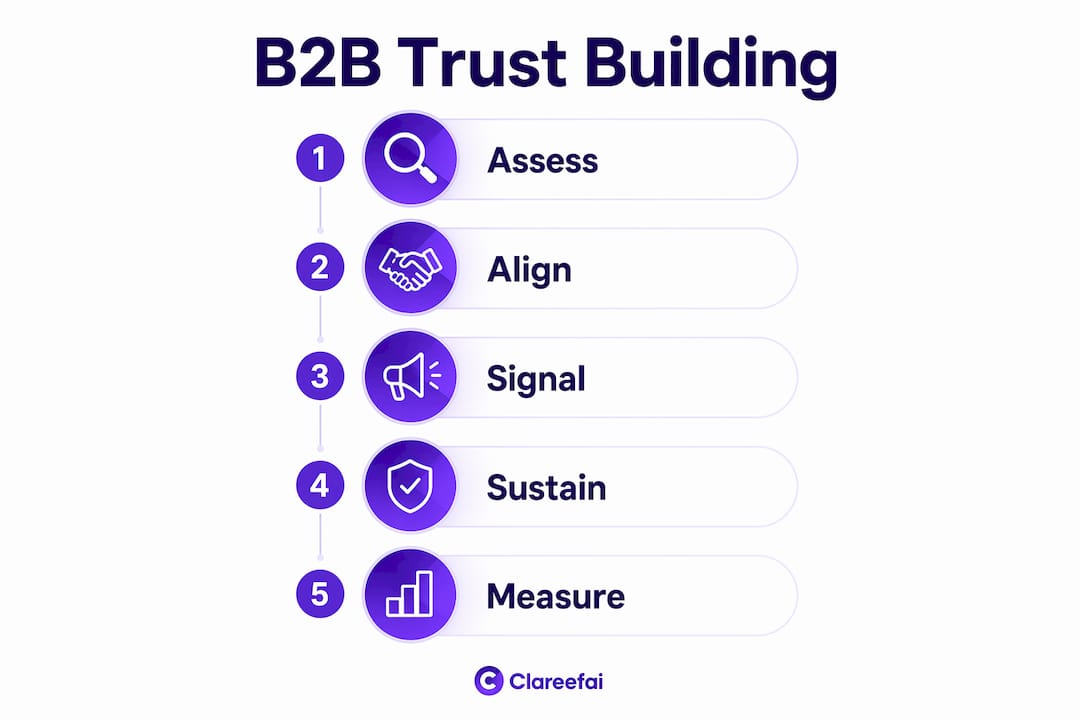
A structured audit covers four areas. Work through each one in sequence.
-
Develop a shared trust lexicon. Identify the five to ten core claims your organization makes about its product. Write down exactly how each team phrases those claims. Where the language diverges, create a single agreed-upon version and document it in a shared resource all teams can access.
-
Review your forecasting practices. Buyers trust suppliers who set accurate expectations. Audit your last 12 months of deals and measure how often your stated timelines matched actual delivery. Gaps here are trust liabilities. Fix the forecasting process before you fix the messaging.
-
Design a formal warm handoff. A warm handoff is not a forwarded email. It is a structured call or meeting where the sales rep introduces the customer success manager, summarizes the buyer’s stated goals, and transfers documented context. Build a template for this call and make it mandatory for every new account.
-
Build internal communication rhythms. Schedule a monthly cross-team sync between sales, marketing, and customer success. The agenda should cover three things: what promises are being made in the field, what customers are actually experiencing, and where the gap between the two is widening.
Pro Tip: Use a simple “trust audit scorecard” with five yes/no questions for each team. Share the results openly. Teams that see their own gaps in writing act faster than teams that hear about them in meetings.
B2B buyers trust suppliers who help them build internal business cases and reduce career risk. Your internal alignment directly determines whether your buyers can make that case confidently to their own leadership.
What specific tactics build credible external trust signals?
External trust signals are the proof buyers use to justify their decision to stakeholders who were not in the sales conversation. Generic testimonials do not do this job. Named case studies with specific metrics and verifiable outcomes build more credibility than vague praise. A case study that says “we reduced onboarding time by 40% for a 200-person SaaS company” gives a buyer something concrete to share internally.
Here are the tactics that move the needle most:
- Named case studies with measurable outcomes. Include company size, industry, specific metrics, and a named contact where possible. Buyers need evidence they can stand behind in an internal meeting.
- Trial offers and formal reference checks. More than half of B2B buyers use trials and formal references before signing. Treat reference calls as a structured trust checkpoint, not an afterthought. Proactive customer reference management gives you control over which stories get told and how.
- Admitting real product limitations. This is the counterintuitive one. Admitting real product limitations increases trust more than vague claims of perfection. Psychologists call this the “pratfall effect.” When you tell a prospect that your platform is not the right fit for companies under 50 employees, you signal honesty. That signal is worth more than a feature list.
- Personalized outreach using firmographic context. Reference the buyer’s industry, company stage, or recent news in your outreach. Generic messaging signals that you have not done the work to understand their situation.
- Independent reviews on third-party platforms. Buyers check these before they contact you. Your content must answer the questions they are already asking.
B2B buying committees use an invisible trust scorecard with 10 questions to assess vendors before direct contact. Your digital presence and content must answer those unspoken questions before a prospect ever speaks to your sales team. If your website, case studies, and reviews do not address these questions, you are losing deals you never knew you were in.
Providing specificity and measurable outcomes in sales and marketing content is the single most effective way to overcome buyer skepticism. Specificity is not a style choice. It is a trust mechanism.
Which tools and metrics help sustain improvements in the B2B trust process?
Sustaining trust-building efforts requires the right tools and a clear way to measure progress. The table below maps the core tool categories to their primary trust function.
| Tool category | Primary trust function | Example metric to track |
|---|---|---|
| CRM with data hygiene controls | Accurate forecasting and consistent buyer records | Forecast accuracy rate |
| Testimonial and reference management | Centralized, verified social proof for sales use | Reference call conversion rate |
| Video testimonial platforms | Human, credible proof for buying committees | Video view-to-meeting rate |
| Content audit tools | Identifying gaps in external trust signals | Percentage of trust questions answered |
| Cross-team alignment dashboards | Visibility into handoff quality and messaging consistency | Handoff completion rate |
Clean CRM data is the foundation. If your buyer records are incomplete or outdated, your sales team cannot personalize outreach, your forecasts will be wrong, and your handoffs will miss critical context. Audit your CRM quarterly and assign ownership for data quality to a specific role.
For external trust signals, platforms that unify testimonial collection and reference management give your sales team a library of verified proof they can deploy at the right moment in the sales cycle. Multi-channel social proof across email, website, and sales decks creates a consistent trust experience that buying committees notice.
Pro Tip: Track your “trust question coverage rate” by listing the 10 questions your buying committee is likely asking and checking how many your current content explicitly answers. Aim for 100% coverage before your next product launch.
78% of senior GTM leaders see trust infrastructure as a competitive advantage, but only 6% prioritize building it. That gap is your opportunity. The teams that instrument and measure their trust infrastructure now will compound that advantage over the next two to three years.
Common pitfalls that undermine your B2B trust improvement efforts
The most common mistake is treating trust as a communications problem and investing only in external content while ignoring internal dysfunction. External signals amplify your internal reality. They do not replace it.
Watch for these specific failure patterns:
- Stale social proof. Case studies older than 18 months lose credibility fast. Buyers assume your best results are in the past. Refresh your proof library on a rolling basis.
- Messaging incoherence across teams. When your sales deck says one thing and your onboarding materials say another, buyers notice. Conduct a messaging audit every quarter.
- Anonymous or unverifiable reviews. Generic five-star ratings without context do not reduce buyer risk. Verified, named reviews with specific outcomes do. The difference is significant in competitive deals.
- Ignoring the silent buying committee. Most B2B deals involve stakeholders who never attend a sales call. If your content does not answer their questions, they will block the deal internally.
- Treating the handoff as a one-time event. Trust erodes when the customer success team does not follow up on the specific goals the sales team documented. Build a 30-day post-handoff check-in into your process.
Early warning signs of trust erosion include longer sales cycles with no clear objection, increased requests for references late in the deal, and rising churn in the first 90 days post-close. Each of these signals a gap between what you promised and what buyers experienced. Address the operational root cause, not just the symptom.
Learning how to build trust online through consistent digital signals reinforces the internal work you do. Both dimensions must move together.
Key Takeaways
The most effective B2B trust strategy combines internal operational alignment with specific, verifiable external proof that buyers can use to justify their decisions to their own organizations.
| Point | Details |
|---|---|
| Trust is operational, not just messaging | Fix internal handoffs and forecasting before investing in external content. |
| Formal handoffs are rare and critical | Only 8% of organizations have a formal sales-to-customer success handoff process. |
| Specificity beats generic claims | Named case studies with measurable outcomes outperform vague testimonials in every deal stage. |
| Admitting limitations builds credibility | The pratfall effect shows that honest disclosure of fit limitations accelerates buyer trust. |
| Measure trust infrastructure maturity | Track handoff completion rates, forecast accuracy, and trust question coverage to gauge progress. |
Why trust infrastructure is the most underrated competitive advantage in B2B
Working with B2B sales and marketing teams over time, I have seen the same pattern repeat. A company invests heavily in content, brand, and demand generation. Results plateau. The team assumes the problem is the message. The real problem is almost always the infrastructure behind the message.
The companies that break through are not the ones with the best copywriting. They are the ones where sales and customer success speak the same language, where handoffs are documented and warm, and where every external proof point is specific enough to survive a skeptical CFO’s review. That combination is rare. Authenticity in branding is not a marketing tactic. It is the visible output of an organization that has done the internal work.
The 6% of GTM leaders who are actively building trust infrastructure right now are not doing it because it is easy. They are doing it because they understand that trust compounds. Every verified case study, every warm handoff, and every honest conversation about product fit adds to a reputation that is genuinely hard for competitors to copy. That is the kind of advantage worth building.
— ClareefAi
How Clareefai helps you activate trust at every sales stage
Clareefai is built for sales and marketing teams that want to move beyond generic reviews and put verified, specific customer proof to work in every deal. The platform collects, verifies, and organizes testimonials, video reviews, and success stories in one place, so your team always has the right proof for the right buyer at the right moment. AI-driven analysis identifies your most credible advocates and surfaces their stories automatically across your public channels. If you want to see how unified testimonial management translates into faster decisions and higher win rates, the Clareefai platform is worth a close look. You can also explore customer reviews and stories from organizations already using it in their sales process.
FAQ
What is B2B trust building?
B2B trust building is the process of reducing buyer risk through consistent, verifiable signals of competence and reliability across every stage of the sales cycle. It includes both internal operational alignment and external proof such as case studies, references, and verified testimonials.
Why does trust outrank price in B2B decisions?
Trust has been the #1 driver of B2B choice for three consecutive years because B2B buyers carry personal career risk in every purchase decision. Suppliers who reduce that risk win more deals, regardless of price.
What is the pratfall effect in B2B sales?
The pratfall effect is the documented tendency for honest disclosure of limitations to increase trust faster than claims of perfection. Admitting that your product is not the right fit for a specific use case signals competence and honesty, which accelerates buyer confidence.
How do you measure B2B trust-building progress?
Track handoff completion rates, forecast accuracy, reference call conversion rates, and the percentage of buying committee trust questions your content explicitly answers. These metrics reveal the health of your trust infrastructure more accurately than brand sentiment scores alone.
Which B2B trust building tools should sales teams prioritize?
Sales teams should prioritize a CRM with strong data hygiene controls, a testimonial and reference management platform, and a content audit process that maps existing assets against the questions buying committees ask before direct contact.
Recommended
- How to Increase Conversion Rates in 2025: B2B Guide | Clareefai Blog
- Multi-Channel Social Proof: Maximizing B2B Trust | ClareefAI Blog
- How (and When) to Use Social Proof to Accelerate the Sales Cycle - ClareefAI Blog
- AI Outreach + Verified Social Proof: Nexuscale & Clareefai B2B Sales Strategy - ClareefAI Blog
Share Article
Stay Updated
Get the latest insights on customer advocacy and SaaS growth delivered to your inbox.