How to Increase Conversion Rates in 2025: B2B Guide
TL;DR:
- Conversion rate optimization focuses on systematically increasing the percentage of visitors who complete desired actions. It relies on reliable data, continuous testing, and fixing friction points in the user journey to boost B2B conversion rates. Verified social proof near primary calls-to-action significantly improves trust and results in higher conversions.
Conversion rate optimization (CRO) is defined as the systematic process of increasing the percentage of visitors who complete a desired action, whether that is submitting a form, booking a demo, or signing up for a trial. For B2B marketing and sales professionals, knowing how to increase conversion rates in 2025 is not optional. Average website conversion rates sit between 1.7% and 2.0%, while top performers exceed 4.7%. That gap represents real revenue. Closing it requires a structured, repeatable approach, not guesswork or one-off redesigns.
What are the prerequisites for effective conversion rate optimization?
Before you run a single test, you need a reliable baseline. Your current conversion rate is the starting point for every decision you make. Without it, you cannot measure whether a change moved the needle or hurt performance.
The right tools make this process measurable and repeatable. A practical CRO toolkit includes:
- Analytics platform: Google Analytics 4 (GA4) tracks traffic sources, goal completions, and funnel drop-off points.
- Behavior tracking: Hotjar or Microsoft Clarity records session replays and heatmaps, showing exactly where visitors lose interest.
- Sample size calculators: Tools like Evan Miller’s A/B test calculator confirm whether your traffic volume supports statistically valid tests.
- Statistical significance tools: These prevent you from calling a winner too early, which is one of the most common and costly CRO mistakes.
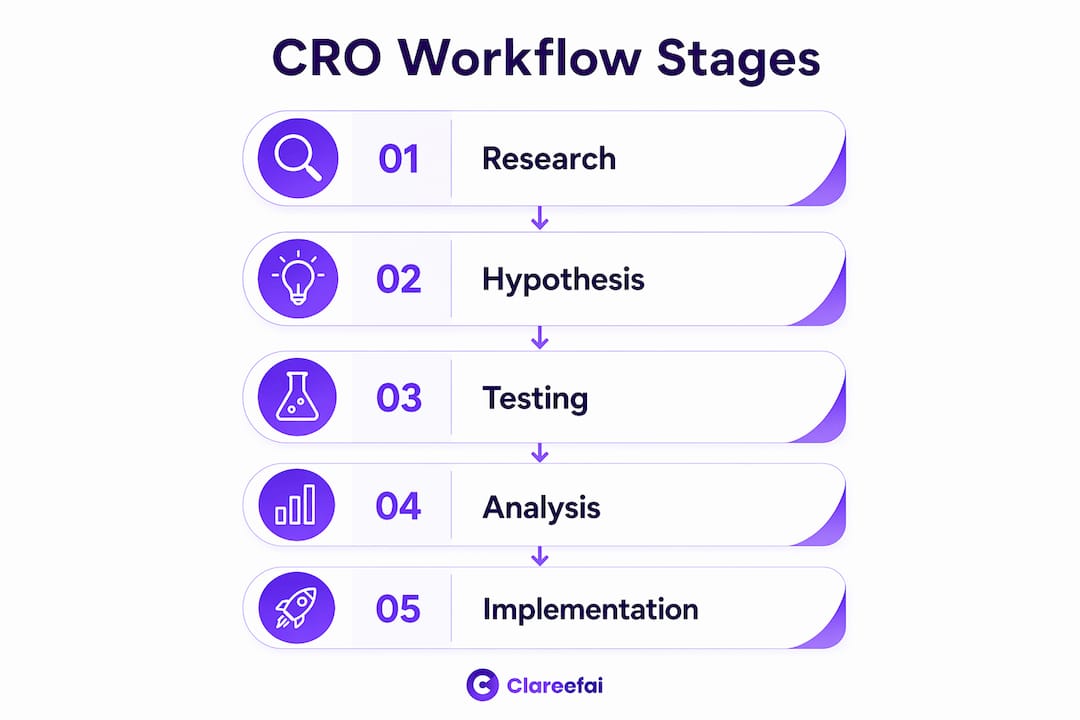
The most effective CRO teams treat optimization as a continuous workflow, not a project with a start and end date. The cycle runs like this: research, hypothesize, test, analyze, document. Each completed cycle feeds the next one with better data and sharper hypotheses.
Pro Tip: Document every test outcome, including failures. A losing test tells you what your audience does not want, and that knowledge prevents you from repeating the same mistake six months later.
| CRO Workflow Stage | Core Activity |
|---|---|
| Research | Analyze GA4 funnels, session replays, and user surveys |
| Hypothesize | Form a specific, testable prediction based on data |
| Test | Run A/B or multivariate tests with adequate sample sizes |
| Analyze | Review results by segment, not just aggregate totals |
| Document | Record outcomes, learnings, and next hypotheses |
Which user journey elements should you optimize first?
The highest-impact conversion improvements come from fixing friction in the user journey, not from cosmetic redesigns. Start with the elements that directly affect whether a visitor takes the next step.
-
Fix messaging mismatches. When your ad or email promises one thing and your landing page delivers another, visitors leave immediately. Fixing messaging mismatches boosts conversion by 28% and lowers cost-per-acquisition by 22%. That is a double win: more revenue and lower spend.
-
Reduce form fields aggressively. Long forms kill completion rates. Reducing form fields from 11 to 4 increased conversion rates by 120% in documented tests. Ask only for what you need at that specific stage of the funnel.
-
Improve page load speed. A 1-second delay in page load reduces conversions by 7%. On mobile, the impact is even sharper. Use Google PageSpeed Insights and follow website speed best practices to identify and fix the biggest performance bottlenecks first.
-
Simplify navigation and checkout flow. Cart abandonment averages 70%, and surprise fees at checkout are the primary cause. Display total costs upfront. Remove unnecessary steps between intent and conversion. Every extra click is an exit opportunity.
Pro Tip: Run a five-second test with a tool like Usability Hub. If a new visitor cannot tell you what your page offers within five seconds, your messaging needs work before you test anything else.
Poor conversion often results from misaligned traffic intent rather than technical or design flaws. Before you redesign a landing page, confirm that the traffic arriving on it actually matches the offer. A technically perfect page fails when the wrong audience sees it.

How can social proof and trust signals boost conversion rates?
Social proof is one of the most direct levers for increasing B2B conversion rates. Buyers who see verified evidence that peers have succeeded with your product face far less friction in their decision.
Displaying customer reviews near primary CTAs increases conversions by 18–25%. Placement matters as much as presence. A testimonial buried in the footer does almost nothing. A verified customer quote placed directly above or beside your demo request button creates confidence at the exact moment a prospect decides.
The most effective types of social proof in B2B contexts include:
- Named customer testimonials with job title, company, and a specific outcome (not generic praise)
- Case study summaries showing measurable results, such as revenue growth or time saved
- Client logos from recognizable companies in the prospect’s industry
- Video reviews that show a real person speaking about a specific problem your product solved
- Ratings and review counts from third-party platforms that prospects already trust
Generic or anonymous reviews do not move B2B buyers. Verified, contextualized testimonials do. Clareefai is built specifically for this: it organizes, verifies, and displays customer testimonials in a way that connects prospects with real promoters. Its AI-driven analysis identifies the most impactful advocates and surfaces them automatically at the right funnel stages. The result is social proof that feels personal, not manufactured.
Pro Tip: Place a short, specific customer quote directly above your primary CTA button. Test it against a version without the quote. The lift is often immediate and significant.
What are best practices for running meaningful conversion tests?
A test that produces unreliable results wastes time and can send you in the wrong direction. Statistical validity is non-negotiable.
-
Calculate your required sample size before you start. Underpowered tests yield unreliable results. Use a sample size calculator and commit to running the test until you hit that number, regardless of early trends.
-
Run tests for full business cycles. Tests need 2–4 weeks minimum to account for weekly traffic patterns. A test that runs only on weekday traffic may not reflect your full audience’s behavior.
-
Focus on high-impact elements. High-leverage tests target value proposition headlines, pricing presentation, and checkout flow, not button colors or font sizes. Testing superficial elements wastes resources and rarely moves revenue.
-
Segment your results. Segment-level analysis by device type, traffic source, and visitor type (new vs. returning) can reveal hidden impacts. A test that looks flat in aggregate may show a strong lift on mobile and a drop on desktop. Acting on aggregate data alone leads to bad decisions.
-
Document every test in a shared knowledge base. Record the hypothesis, test design, results, and what you learned. This institutional knowledge prevents teams from re-testing the same ideas and builds a compounding advantage over time.
Pro Tip: Never stop a test early because results look promising. Early data is almost always misleading. Commit to your predetermined sample size and duration before drawing any conclusions.
How do you build a CRO process that compounds over time?
The biggest mistake B2B teams make is treating CRO as a one-time project. CRO as a continuous workflow consistently outperforms one-off efforts because each cycle produces better data for the next. Compounding small gains over 12 months beats a single large redesign.
A sustainable CRO process rests on four practices:
- Align tests with campaign cycles. When you launch a new campaign targeting a specific audience segment, test landing page variants built for that segment simultaneously. Traffic quality and page relevance compound each other.
- Use ethical urgency and scarcity. Urgency tactics such as limited-time offers and real-time stock displays boost conversions by 8–12% when used honestly. Manufactured urgency erodes trust and increases churn.
- Share test results across teams. Sales, product, and marketing all benefit from knowing what messaging and proof points actually convert. Siloed CRO data is wasted CRO data.
- Revisit your customer reference strategy regularly. As your customer base grows, new advocates emerge. Keeping your social proof current and relevant to your active buyer personas prevents testimonial fatigue.
The teams that win at CRO long-term are the ones that treat every test as an investment in future learning, not just a search for a quick lift.
Key Takeaways
Systematic, continuous CRO built on verified social proof, friction reduction, and statistically valid testing is the most reliable path to moving B2B conversion rates from average to top-performer levels.
| Point | Details |
|---|---|
| Establish a baseline first | Measure your current conversion rate before making any changes or running tests. |
| Fix friction before testing aesthetics | Reduce form fields, improve page speed, and align messaging to see the largest gains. |
| Place social proof near CTAs | Verified testimonials beside your primary CTA can increase conversions by 18–25%. |
| Run statistically valid tests | Use sample size calculators and run tests for 2–4 weeks to get reliable results. |
| Treat CRO as a continuous cycle | Document every test and build institutional knowledge that compounds over time. |
What B2B teams consistently get wrong about CRO
Working with B2B clients across different industries, I have seen the same pattern repeat: teams invest heavily in driving traffic and almost nothing in converting it. They redesign their homepage, change button colors, and call it optimization. Then they wonder why revenue does not move.
The real leverage in B2B CRO is almost never on the homepage. It is in the mid-funnel: the demo request page, the pricing page, the proposal follow-up sequence. These are the moments where a buyer is closest to a decision, and they are the most neglected.
The second thing I see consistently: teams test in isolation. Marketing runs a landing page test. Sales runs a different email sequence. Nobody connects the data. The result is a fragmented picture of what actually drives conversion. Cross-team alignment on a single source of conversion data is not a nice-to-have. It is the difference between incremental gains and compounding growth.
The third overlooked opportunity is social proof quality. Most B2B companies have satisfied customers who would gladly provide a testimonial. But the testimonials they collect are generic, unverified, and placed where no one sees them. Verified, specific, well-placed social proof is one of the fastest ways to move conversion rates without changing a single line of code. Platforms like Clareefai exist precisely to solve this problem, and the teams using unified testimonial management are seeing it show up directly in their win rates.
— ClareefAi
Clareefai and the social proof advantage in B2B conversions
B2B buyers do not convert on features alone. They convert when they trust that your product has worked for someone like them.
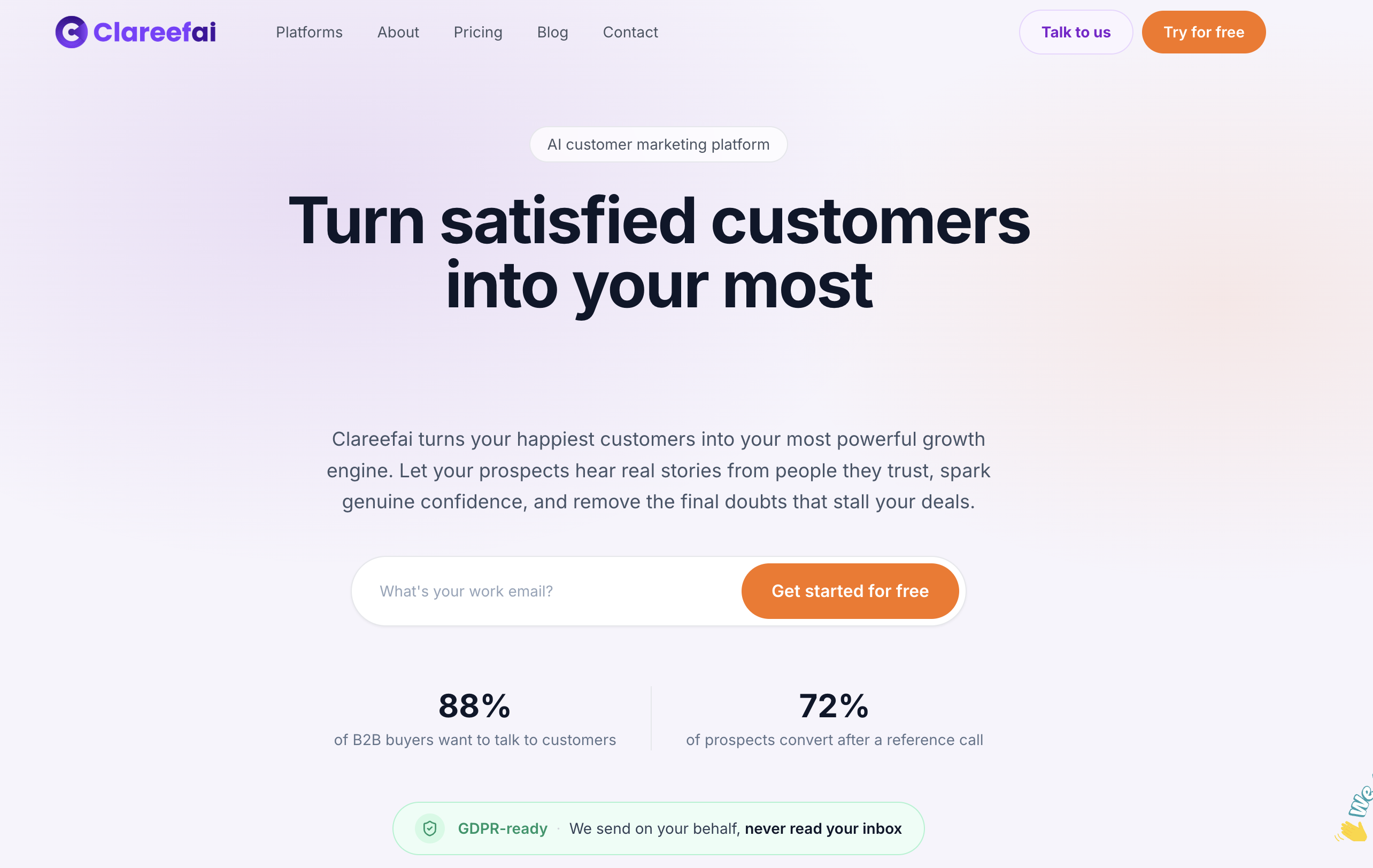
Clareefai gives B2B marketing and sales teams a centralized platform to collect, verify, and display customer testimonials at every stage of the funnel. Its AI-driven analysis identifies your most persuasive advocates and surfaces their stories automatically on the channels where prospects are making decisions. Every testimonial is verified and contextualized, so prospects see real outcomes from real customers, not anonymous praise. If you want to see how verified social proof translates into shorter sales cycles and higher win rates, explore Clareefai’s platform and see what your satisfied customers can do for your pipeline.
FAQ
What is a good B2B conversion rate to target?
Average website conversion rates sit between 1.7% and 2.0%, while top performers exceed 4.7%. Targeting the top-performer threshold is a realistic goal with systematic CRO.
How do I improve my sales funnel conversion rate quickly?
Fix messaging mismatches between your ads and landing pages first. Aligning message and intent has been shown to boost conversion by 28% while lowering acquisition costs by 22%.
How long should I run an A/B test?
Run tests for at least 2–4 weeks to account for weekly traffic patterns and reach statistical significance. Stopping a test early based on promising early data almost always produces unreliable results.
Does social proof really impact B2B conversion rates?
Displaying verified customer reviews near primary CTAs increases conversions by 18–25%. In B2B, named testimonials with specific outcomes outperform generic ratings by a wide margin.
What is the most common reason for high cart or form abandonment?
Surprise fees and unexpected costs at checkout drive the majority of abandonment, which averages 70% across sites. Displaying total costs upfront is the single most effective fix.
Recommended
Share Article
Stay Updated
Get the latest insights on customer advocacy and SaaS growth delivered to your inbox.