Why Credibility Matters in B2B: A 2026 Guide
TL;DR:
- Credibility is essential for B2B sales because buyers assess trust through digital signals before engaging. Building competence, dependability, and consistency strengthens credibility and reduces sales costs. Transparency and specific proof increase trust, leading to faster deals and better customer retention.
Credibility is the entry condition for every B2B sale. Before a buyer schedules a discovery call, reviews a proposal, or invites you to a shortlist, they have already formed a judgment about whether you are worth their time. Trust ranks as the number one driver of B2B brand choice for the third consecutive year in 2026, and 78% of B2B buyers engage with products they already know before formal research begins. That means your credibility is either working for you or against you long before your sales team picks up the phone. This guide breaks down why credibility matters in B2B, what builds it, and how to measure its impact on your sales outcomes.
What are the key components that build credibility in B2B?
Credibility in B2B rests on three pillars: competence, dependability, and consistency. Buyers assess all three simultaneously, and a weakness in any one of them can disqualify you before a formal evaluation even starts.

Competence is your ability to demonstrate real understanding of the buyer’s problem. Generic claims like “we help businesses grow” signal nothing. Specific knowledge, such as naming the exact integration challenge a mid-market SaaS company faces during onboarding, signals that you have done this before. Competence shows up in your content, your case studies, and the precision of your sales conversations.
Dependability is about follow-through. 80% of B2B buyers report dissatisfaction with their chosen vendor post-purchase, traced directly to overselling during the sales cycle. That gap between what was promised and what was delivered is a credibility collapse. Dependability is built by setting accurate expectations, delivering on commitments, and maintaining quality through the post-sale experience.
Consistency means your messaging, your brand experience, and your team’s behavior all tell the same story. When your LinkedIn content contradicts your sales deck, or your marketing team promises outcomes your product cannot deliver, buyers notice. Conflicting signals erode trust faster than any competitor can.
- Competence: demonstrate specific, contextual knowledge of the buyer’s industry and problem
- Dependability: set accurate expectations and deliver on every commitment, pre-sale and post-sale
- Consistency: align messaging across marketing, sales, and customer success touchpoints
- Transparency: admit limitations honestly rather than overpromising
One underused credibility tactic is the pratfall effect. Admitting minor limitations or non-fit scenarios actually increases perceived competence and trustworthiness. Telling a prospect “we are not the right fit for companies under 50 employees” signals confidence and honesty. That kind of transparency builds more trust than a pitch that promises everything.
Pro Tip: In your next sales conversation, name one scenario where your solution is not the best choice. Buyers remember that honesty, and it makes every other claim you make more believable.
How do buyers evaluate credibility before direct sales interactions?
B2B buyers do most of their evaluation before they ever speak to your team. Credibility building begins before any sales interaction, with buyers forming trust impressions from LinkedIn, your website, and third-party reviews well before a discovery call. Your sales conversation does not start at a neutral baseline. It starts at a credibility curve shaped by everything the buyer has already seen.
The research phase is longer and more independent than most sales teams realize. B2B buyers consume up to 15 pieces of content before making a purchase decision, and 61% prefer a rep-free buying experience. That means your content, your reviews, and your digital presence are doing the selling before any human gets involved.
Here is how buyers typically build their credibility assessment:
- Peer recommendations: 82% of B2B buyers trust coworker recommendations, making internal word-of-mouth the most powerful credibility signal available.
- Third-party reviews: 71% of buyers trust third-party opinions over direct brand communication. Platforms like G2 and Capterra carry significant weight in early evaluation.
- Earned media and content: Blog posts, industry publications, and LinkedIn presence signal expertise and staying power.
- AI-driven research: AI tools cross-reference at least six distinct data types before recommending vendors, including third-party reviews, earned media, social platforms, and testimonials.
- Case studies with specificity: Named testimonials with measurable outcomes outperform generic praise in every buyer evaluation context.
“Sales conversations in B2B do not start at a neutral baseline. They begin at a credibility curve shaped by all previous interactions and signals from the vendor before any direct contact.”
Generic claims fail at every stage of this process. A testimonial that says “Great product, highly recommend!” carries almost no weight. A testimonial that names the company, the role, and the specific outcome, such as “We reduced onboarding time by 40% in the first quarter,” gives buyers something concrete to evaluate. Specificity in social proof dramatically outperforms generic praise in both AI-driven credibility ratings and human buyer evaluations.
For a practical framework on placing social proof across channels, the Clareefai guide on multi-channel social proof covers the mechanics in detail.
What are the economic impacts of credibility on B2B sales?
Trust is not a soft skill. Trust functions as an economic asset that reallocates risk from the buying organization to the vendor, simplifying governance and accelerating buying decisions. When a buyer trusts you, they spend less time building internal defenses against the risk of choosing you. That time savings translates directly into faster deal cycles and lower cost of sale.
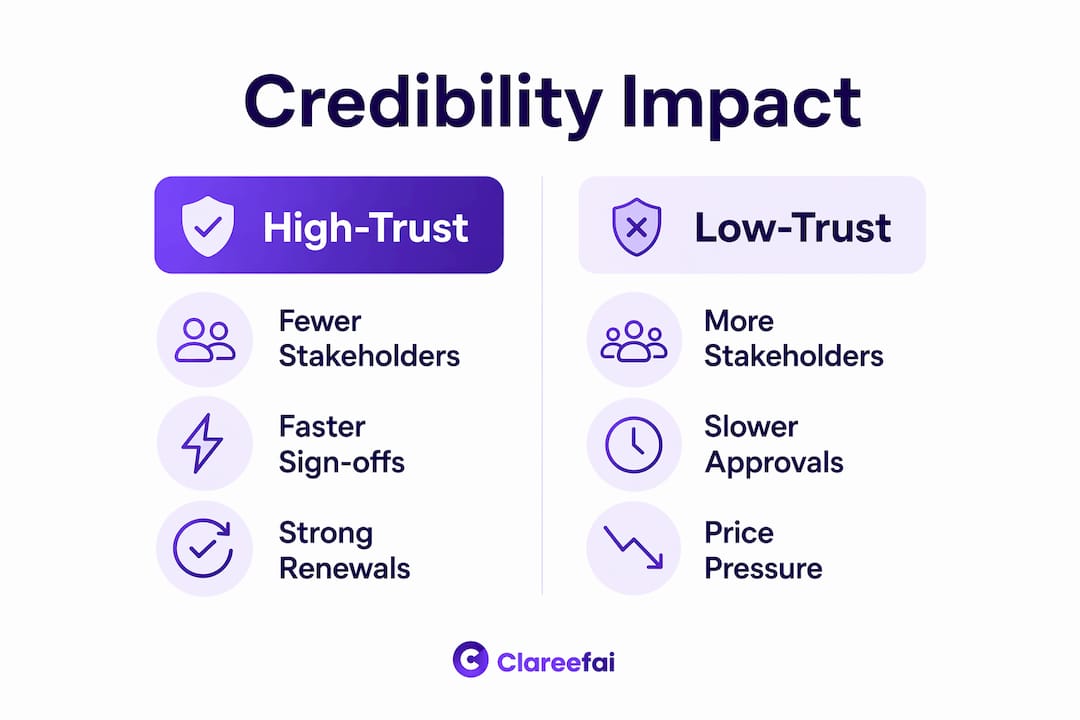
The economic contrast between high-trust and low-trust vendor relationships is significant.
| Scenario | High-trust vendor | Low-trust vendor |
|---|---|---|
| Stakeholders involved | Fewer, faster sign-off | More, slower escalation |
| Procurement scrutiny | Minimal | Extensive due diligence |
| Price sensitivity | Lower, value-focused | Higher, cost-focused |
| Renewal speed | Fast, often automatic | Slow, re-evaluated annually |
| Crisis resilience | Buyer extends goodwill | Buyer exits at first problem |
Low trust leads to more stakeholders and escalated reviews. That is not just a sales problem. It is a margin problem. Every additional stakeholder meeting, every extra security review, and every price negotiation round adds cost to your sales cycle. Price pressure is almost always a symptom of a trust deficit, not a budget problem.
High-trust B2B organizations experience lower procurement friction, faster renewals, and resilience during crises. A buyer who trusts you gives you the benefit of the doubt when something goes wrong. A buyer who does not trust you uses the first problem as justification to exit.
Pro Tip: Track the number of stakeholders involved in your last five deals. If that number is growing, your credibility signals are not reaching the right people early enough in the buyer’s research phase.
Institutional memory compounds this advantage over time. A vendor that has delivered consistently for three years carries a credibility reserve that a new entrant cannot replicate with a single campaign. Trust is built by predictability and consistency over time, not by persuasion, and that compounding effect creates a durable competitive position.
How can B2B companies build and sustain credibility?
Building credibility requires a deliberate system, not a one-time campaign. The most effective approach is a credibility-first philosophy that treats every customer touchpoint as a trust signal, not just a conversion opportunity.
The T.R.U.S.T. framework, referenced in B2B digital trust strategy, aligns messaging, proof loops, and brand experience across all channels. The core idea is that credibility cannot live in one department. Marketing, sales, and customer success must tell the same story with the same evidence.
Here are the credibility-building practices that move the needle:
- Publish specific case studies: Include the client’s name, industry, challenge, and a measurable result. Vague success stories do not build trust.
- Collect and display verified testimonials: Anonymous reviews carry little weight. Named, verified testimonials with context perform significantly better in buyer evaluations.
- Maintain content consistency: Publish regularly on LinkedIn and your blog. Gaps in content signal instability to both buyers and AI-driven search tools.
- Align sales and marketing messaging: Buyers who hear different claims from your content and your sales team lose confidence immediately.
- Use video testimonials: Video adds a human dimension that text cannot replicate. The Clareefai resource on video testimonial advantages explains why video outperforms written reviews in B2B credibility contexts.
Measuring credibility before a sale closes is also possible. Watch for reduced defensive questioning in early sales calls. When buyers stop asking “why should we trust you?” and start asking “how does implementation work?”, your credibility signals are landing. Speed of trust development, measured by time from first contact to proposal acceptance, is another reliable indicator.
The credibility killers to avoid are equally clear: inconsistent messaging, outdated case studies, irrelevant outreach, and anonymous or generic reviews. Each one signals to the buyer that you are not paying attention. For a broader look at managing your digital reputation, the guide on online reputation management covers the foundational steps for B2B companies of any size.
Key Takeaways
Credibility in B2B is a measurable economic asset that determines whether buyers engage, how fast they decide, and whether they stay.
| Point | Details |
|---|---|
| Credibility precedes every sale | Buyers form trust impressions from digital signals before any sales contact occurs. |
| Three pillars drive trust | Competence, dependability, and consistency must all be present to build lasting credibility. |
| Specificity beats generic proof | Named testimonials with measurable outcomes outperform anonymous praise in buyer evaluations. |
| Trust reduces cost of sale | High-trust vendors face fewer stakeholders, faster renewals, and less price pressure. |
| Consistency compounds over time | Predictable, aligned messaging across channels builds a credibility reserve competitors cannot copy quickly. |
What I’ve learned about credibility after working with B2B sales teams
The most common mistake I see B2B companies make is treating credibility as a marketing problem. They invest in brand campaigns and content calendars, then wonder why their sales cycles are still long and their win rates are flat. Credibility is not a marketing output. It is a company-wide operating standard.
The vendors who win consistently are the ones who have built what I call institutional memory with their buyers. Their customers remember exactly what was promised, exactly what was delivered, and exactly how problems were handled. That track record travels. It shows up in peer recommendations, in third-party reviews, and increasingly in AI-generated vendor shortlists.
The pratfall effect is one of the most underused tools in B2B sales. Admitting that your product is not right for every use case does not cost you deals. It earns you trust from the buyers who are the right fit, and it saves everyone time with the ones who are not. Transparency is not a vulnerability. It is a differentiator.
My honest view on the future: AI-driven buyer research is accelerating the credibility gap between vendors who have built a consistent, multi-source digital presence and those who have not. If your testimonials are anonymous, your case studies are vague, and your LinkedIn presence is inconsistent, AI tools will simply not surface you. The companies that invest in verified, specific, human social proof right now will hold a compounding advantage through the rest of this decade.
— ClareefAi
How Clareefai helps you build credibility that closes deals
Credibility does not build itself. You need a system that collects, verifies, and deploys customer proof at every stage of the buyer’s journey.
Clareefai is built for exactly that. The platform organizes verified testimonials, video reviews, and customer success stories into a centralized system that your sales and marketing teams can deploy in real time. AI-driven analysis identifies your most impactful customer advocates and surfaces their stories where buyers are already looking. Every testimonial is verified, named, and contextualized, turning informal praise into a credible sales asset. If you want to see how unified testimonial management boosts win rates in practice, or you are ready to put your customer proof to work, explore the full Clareefai platform to see what is possible.
FAQ
Why does credibility matter more in B2B than in B2C?
B2B purchases involve multiple stakeholders, larger budgets, and longer evaluation cycles, making trust the primary risk-reduction mechanism. A single credibility failure can stall a deal across an entire buying committee.
How do B2B buyers evaluate credibility before talking to sales?
Buyers rely on coworker recommendations, third-party reviews, case studies, and AI-driven research tools that cross-reference multiple sources before forming a vendor opinion.
What is the fastest way to build B2B credibility?
Publishing specific, named case studies with measurable outcomes and collecting verified customer testimonials are the fastest credibility signals you can deploy. Generic claims and anonymous reviews do not move the needle.
How does low trust affect B2B pricing negotiations?
Low trust increases the number of stakeholders involved and shifts buyer focus to price as a risk proxy. Price pressure in B2B is almost always a symptom of a trust deficit, not a budget constraint.
Can admitting weaknesses actually improve B2B credibility?
Yes. The pratfall effect shows that admitting minor limitations increases perceived competence and trustworthiness. Buyers interpret honesty about non-fit scenarios as a signal of confidence and integrity.
Recommended
Share Article
Stay Updated
Get the latest insights on customer advocacy and SaaS growth delivered to your inbox.