Review Verification: What It Means and Why It Matters
What is review verification?
Review verification is the process of confirming that an online review comes from a real customer who genuinely purchased or used the product or service being reviewed. At its core, it answers a simple question: did this person actually have the experience they are describing?
The process typically involves several layers of authentication:
- Purchase confirmation: Matching the reviewer’s account or email to a completed transaction
- Identity checks: Confirming the reviewer is a real, unique individual rather than a bot or duplicate account
- Digital footprint analysis: Examining IP addresses, device data, and behavioral patterns
- Platform governance: Applying badges or labels to signal verified status to other consumers
Platforms like Trustpilot and major e-commerce sites use verified badges as a governance mechanism, transferring trust from the transaction itself to the review. Clareefai applies this same principle in B2B contexts, verifying customer identities and contextualizing feedback so that testimonials carry real weight with prospects.
How review verification works on digital platforms
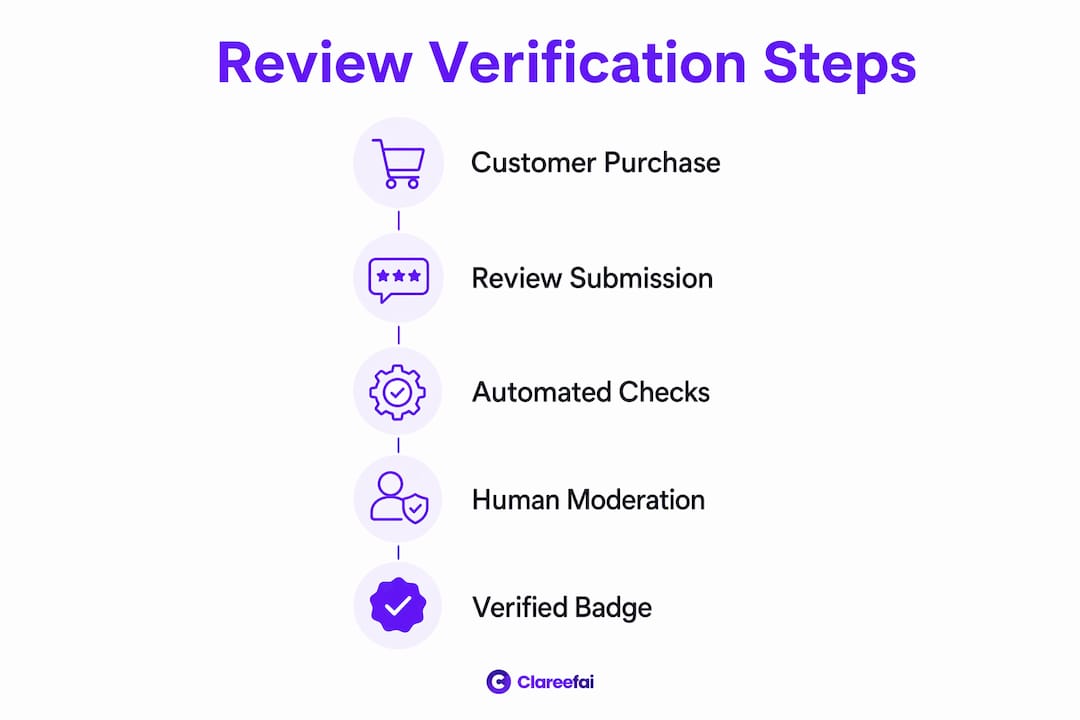
The mechanics of verification vary by platform, but most systems combine automated checks with human oversight to catch what algorithms miss.
Common verification methods include:
- Verified purchase badges: The platform cross-references the reviewer’s account against order records. On Amazon, this appears as “Verified Purchase” in orange text; similar badges exist on Best Buy and Walmart.
- Email and order matching: Even when automated review invitations are turned off, some platforms check whether the reviewer’s email matches an order in the system. If a match is found within a recent purchase window, the review is automatically verified.
- Manual moderation: Human reviewers examine flagged content, looking for patterns like duplicate language, suspicious timing, or mismatched product details.
- User reporting systems: Consumers flag suspicious reviews, prompting platform teams to investigate.
AI and machine learning play a growing role here. Algorithms detect anomalies like multiple reviews originating from the same IP address, clusters of five-star reviews posted within a 24-hour window, or language patterns that match known fake-review templates. These automated signals help platforms prioritize which reviews need a closer human look.
Pro Tip: Some platforms use a sliding window approach to auto-verify reviews. If a customer visits a product page, clicks to write a review, and enters the email address tied to a recent order, the system checks purchase history automatically. A matching order triggers instant verification, even without a direct invitation from the seller.

The most effective verification systems layer these methods rather than relying on any single filter. Automated tools catch volume-based fraud fast; human moderators catch the nuanced cases that algorithms miss. Together, they form a more complete picture of review authenticity.
Why review verification matters for trust and business reputation
Consumer trust in online reviews is remarkably high. 79% of consumers trust online reviews as much as personal recommendations from friends or family. That level of trust puts enormous pressure on the integrity of the review ecosystem.
Statistic to know: Approximately 25% of online reviews are suspected to be fraudulent or manipulated. When one in four reviews may be fake, verification is not a nice feature to have. It is the baseline for any credible review system.
Verified badges do more than label a review. Research shows they act as diagnostic anchors that help consumers overcome uncertainty, particularly when they are unfamiliar with a product or brand. The badge transfers credibility from the purchase transaction to the review itself, giving readers a concrete reason to trust what they are reading.
Verification also changes reviewer behavior. When reviewers know their identity is tied to their feedback, they tend to write more balanced and credible reviews rather than extreme praise or unfounded criticism. That accountability produces a healthier review ecosystem for everyone.
Benefits of verified reviews for consumers and businesses:
- For consumers: Faster, more confident purchasing decisions based on feedback from real buyers
- For businesses: A stronger reputation built on authentic social proof rather than anonymous noise
- For platforms: Higher user trust and reduced liability from fraudulent content
Unverified reviews carry real risks. Fake reviews can originate from competitors posting negative feedback, sellers inflating their own ratings, or paid review farms generating generic five-star content. Understanding why anonymous reviews hurt brands is the first step toward building a review strategy that actually holds up under scrutiny.
Best practices and risks in the review verification process
Effective verification requires more than technology. It requires a commitment to transparency and ongoing vigilance.
Industry best practices:
- Publish your verification criteria: Clearly explain what qualifies a review as verified. Consumers trust platforms more when the rules are visible.
- Conduct regular audits: Periodic reviews of flagged, removed, or verified content signal that the system is actively maintained, not just set and forgotten.
- Make public disclosures: Companies that openly disclose their verification processes build stronger consumer confidence than those that operate behind closed doors.
- Respect privacy boundaries: Verification should confirm a purchase, not expose personal data. GDPR-compliant systems can verify identity without overreaching.
The risks are real and evolving. A verified purchase badge confirms a transaction, but it does not guarantee authenticity. Some fake review operations actually purchase the product, leave a five-star review, and then return the item. The badge helps narrow the field, but it is the first filter, not the last.
The FTC reinforces this point directly. Its guidance recommends combining verification badges with other authenticity signals, such as review timing, language patterns, and reviewer history, rather than treating any single badge as definitive proof.
Pro Tip: Combine automated verification tools with human moderation for the strongest results. Algorithms catch scale-based fraud fast, but a human reviewer will catch the subtle case where a competitor posts a fake negative review using a legitimate purchase. Neither approach alone is sufficient.
Clareefai addresses these challenges by verifying customer identities at the source, using AI-driven analysis to surface the most credible advocates, and maintaining GDPR-compliant data practices throughout. Rather than relying on post-hoc badge systems, Clareefai builds verification into the testimonial collection process itself, so the authenticity of each piece of feedback is established before it ever reaches a prospect. You can see how this works in practice by exploring verified testimonial management on the platform.
Building trust online goes beyond any single tactic. Pairing strong verification practices with a broader trust-building strategy gives businesses a more durable foundation for customer confidence. For a deeper look at the practical steps involved, the how to verify reviews guide from Clareefai walks through the specific methods and tools worth considering.
How Clareefai turns verified feedback into a sales asset
Clareefai was built specifically for the problem that most review systems leave unsolved: collecting verified, contextualized customer feedback and putting it to work in the sales process. The platform connects prospects with real, named advocates through verified testimonials, video reviews, and success stories, all organized in a centralized system with role-based dashboards and real-time analytics.
If you are ready to move beyond anonymous reviews and build a reputation on feedback that actually holds up, explore Clareefai’s approach to verified social proof.
Key Takeaways
Review verification is the foundation of trustworthy online feedback, and without it, a substantial share of reviews may be fraudulent.
| Point | Details |
|---|---|
| Core definition | Review verification confirms a reviewer genuinely purchased or used the product before their feedback is published. |
| Consumer trust at stake | 79% of consumers trust online reviews as much as personal recommendations, making verification accuracy critical. |
| Fraud is widespread | Approximately 25% of online reviews are suspected to be fraudulent, underscoring the need for active verification systems. |
| Badges have limits | A verified purchase badge is the first filter, not the last. Fake operations can purchase and return items to earn the badge. |
| Best practice | Combining automated verification tools with human moderation and transparent public disclosure produces the most credible review systems. |
Recommended
Share Article
Stay Updated
Get the latest insights on customer advocacy and SaaS growth delivered to your inbox.