Why Avoid Anonymous Reviews: Risks for Your Brand
TL;DR:
- Anonymous reviews pose significant trust and security risks because they lack identity verification and accountability. They distort perceptions through bias, negativity, and extreme ratings, which can harm brand reputation and revenue. Implementing verified, identity-backed feedback systems improves credibility, trust, and sales outcomes.
Anonymous reviews are defined as feedback submitted without a verifiable identity, and they represent one of the most significant trust risks your brand faces today. Platforms built on unverified input attract bias, manipulation, and misinformation at scale. Research shows that anonymous platforms drew roughly 9.5 million unique visitors in march 2026 alone. That reach means the damage from a single coordinated wave of fake reviews can spread fast and far. For business professionals, marketers, and sales teams, understanding why avoid anonymous reviews is not optional. It is a core part of protecting your pipeline and your reputation.
Why avoid anonymous reviews: the accountability gap
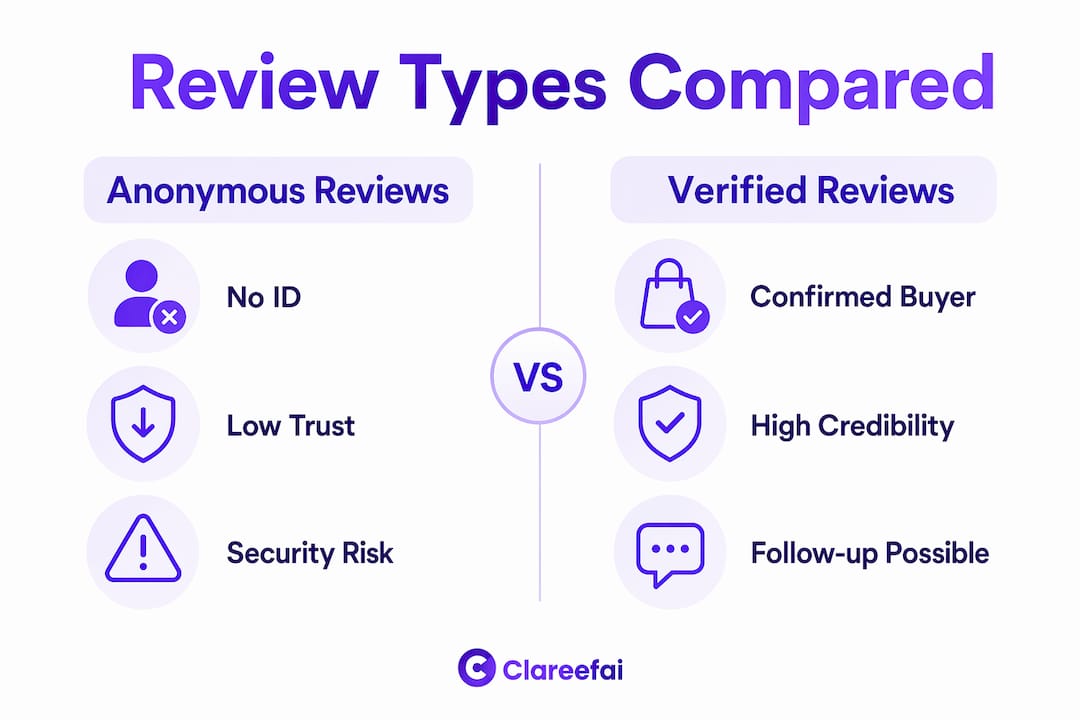
Anonymous reviews are feedback submissions that carry no verified identity. They differ from verified reviews in one critical way: there is no mechanism to confirm that the reviewer is a real customer, a genuine stakeholder, or even a human being.
That gap creates serious problems:
- No identity verification. Any person, bot, or competitor can submit a review without proof of purchase or relationship.
- No accountability for false claims. Reviewers face zero consequences for inaccurate or malicious content.
- No history or reputation. Anonymous review systems reset reputations with every new entry, so dishonesty goes unpunished and users learn to discount the input as noise.
- No follow-up possible. You cannot contact an anonymous reviewer to clarify, resolve, or learn from their experience.
The result is a feedback channel that looks like social proof but functions like an open door for bad actors. Industry standards in Q1 2026 recognize anonymity as a security and trust risk, and the shift toward verified review models is accelerating across B2B and B2C markets alike. When your sales team points prospects to reviews, those prospects are increasingly sophisticated enough to ask: “Can I trust this?” Anonymous reviews cannot answer that question.
Pro Tip: Before auditing your review channels, map every platform where your brand appears. Identify which ones allow unverified submissions. That list is your risk register.
How do anonymous reviews bias perceptions and damage brand trust?
The psychological effects of anonymity on feedback quality are well documented. When people believe they cannot be identified, their behavior changes. The result is not honest feedback. It is distorted feedback.
“Anonymous feedback often acts like a grenade that amplifies bias rather than promoting growth. Recipients focus on the unknown source rather than the content, eroding trust rather than building it.” — HR consultant Jeracah Lawless, via Zensai
Three specific distortions show up consistently in anonymous review environments:
- Negativity bias amplification. Anonymous commenters are significantly more likely to post vulgar, rude, and hateful comments than identified reviewers. The false sense of protection removes the social cost of cruelty.
- Extreme feedback skew. Anonymous platforms incentivize only the most passionate reviewers, those who are either very positive or very negative. Average experiences go unrepresented, and your aggregate rating becomes a distorted picture of reality.
- Gender and identity bias. Female professors receive 28% more poor reviews on anonymous platforms compared to formal institutional evaluations. That gap does not reflect performance. It reflects the bias that anonymity enables.
These distortions matter for your brand because prospects use reviews to make purchase decisions. If your review profile is dominated by extreme outliers and biased submissions, it does not reflect your actual customer base. Sales teams lose deals not because of product quality but because the review signal is broken. Marketers spend budget defending a reputation that anonymous reviewers manufactured. The impact of anonymous feedback is not just reputational. It is measurable in lost revenue.
Consumer trust is also being repriced. The rise of AI-generated content has made buyers more skeptical, and anonymous reviews are losing value unless connected to a persistent, accountable identity. Buyers want to know who is speaking. A nameless five-star rating no longer moves the needle the way it once did.
What security and business risks do anonymous reviews create?
Beyond perception, anonymous reviews create concrete operational and security risks. These are the dangers that keep compliance teams and brand managers up at night.
- Coordinated sabotage. Without identity verification, competitors or bad actors can flood your profile with negative reviews. There is no provenance to challenge, and platforms are slow to remove content without clear evidence of fraud.
- Vendetta reviews. Anonymous platforms are exploited for personal vendettas, producing massive disparities between external anonymous ratings and internal verified customer satisfaction data.
- Inability to reconcile data. When your NPS scores and CRM data show strong customer health but your public review profile shows the opposite, you face a credibility crisis with no clean resolution path.
- Conflicts of interest go unchecked. Anonymous reviews lack accountability, making it impossible to identify or address conflicts of interest. A reviewer with a financial stake in a competitor can post freely with no disclosure requirement.
- Regulatory exposure. As GDPR and consumer protection frameworks tighten, businesses that rely on unverified review data face growing scrutiny. Verified review systems offer a cleaner compliance posture.
The practical challenge is that acting on anonymous feedback is nearly impossible. You cannot follow up, you cannot verify the claim, and you cannot close the loop with the reviewer. Your customer success team ends up chasing ghosts instead of building relationships. That is a direct cost to your retention and expansion metrics. Verified customer feedback drives 20–40% revenue growth, precisely because it is actionable and trustworthy in ways anonymous input never can be.
How can businesses reduce reliance on anonymous reviews?
The good news is that the shift away from anonymous reviews is practical and well-supported by current tools and frameworks. Here is what works:
- Build accountability into your feedback systems. Require login or purchase verification before a review is accepted. Persistent identities create reputational stakes for reviewers, which improves quality and honesty.
- Create transparent feedback loops. When customers know their feedback will be read and responded to, they write more constructively. Public responses to named reviews also signal to prospects that you take feedback seriously.
- Use verified badges and testimonials. Verified review labels signal to prospects that the feedback is real. Platforms that display reviewer names, job titles, and company context convert at higher rates because the social proof is credible.
- Collect testimonials proactively. Do not wait for reviews to appear organically on anonymous platforms. Use a testimonial collection checklist to gather attributable feedback at key moments in the customer lifecycle.
- Moderate with clear standards. Publish your review guidelines publicly. Remove content that violates them and document your process. Transparency in moderation builds trust with both reviewers and readers.
- Invest in workplace culture. Internally, anonymous feedback tools often signal that employees do not feel safe speaking up. Fixing the culture reduces the need for anonymous channels and produces better, more usable feedback.
Pro Tip: Transition your highest-value customers to a named testimonial program first. Their credibility anchors the shift and gives your sales team verified proof points to use in active deals.
The risks of anonymous reviews are not solved by removing all feedback channels. They are solved by replacing low-accountability systems with high-accountability ones. Verified review practices give your team data you can act on and social proof that actually closes deals.
Key Takeaways
Anonymous reviews undermine brand trust, distort customer perception, and create security risks that verified, identity-backed feedback systems are designed to prevent.
| Point | Details |
|---|---|
| Accountability gap | Anonymous reviews have no identity verification, making fake and malicious submissions impossible to challenge. |
| Bias and distortion | Anonymity amplifies negativity bias and extreme feedback, skewing your brand’s public rating away from reality. |
| Security risk | Coordinated sabotage and vendetta reviews are far easier to execute on anonymous platforms with no provenance controls. |
| Revenue impact | Verified customer feedback drives measurable revenue growth; anonymous reviews cannot be acted on or followed up. |
| Verified alternatives | Accountability-based systems with persistent identities produce higher-quality, more credible social proof for sales teams. |
The uncomfortable truth about anonymous feedback
Working with B2B sales and marketing teams, I have seen the same pattern repeat: a brand invests heavily in customer success, earns strong NPS scores, and then watches prospects hesitate because a handful of anonymous reviews paint a different picture. The reviews cannot be verified, cannot be removed easily, and cannot be responded to in a way that fully restores confidence.
The uncomfortable truth is that anonymous reviews do not protect honest feedback. They protect dishonest feedback. Real customers with real experiences are generally willing to put their name on what they say. The people who demand anonymity are often the ones with the least legitimate stake in the outcome.
I have also seen the flip side. Brands that proactively build verified testimonial programs, where customers are named, their roles are listed, and their stories are told in context, close deals faster. Prospects do not need to wonder if the social proof is real. They can see exactly who is speaking and why it matters to them.
The balance between privacy and transparency is real, and it deserves respect. Not every customer wants to be a public advocate. But the solution is a well-designed opt-in program, not a system that defaults to anonymity for everyone. Proactive reputation management, built on verified social proof, is the only approach that consistently moves the needle in competitive B2B markets.
— ClareefAi
How Clareefai turns verified testimonials into sales assets
Clareefai is built for exactly this challenge. The platform organizes, verifies, and displays customer testimonials, reviews, and success stories in a way that gives prospects the confidence to move forward. Every piece of social proof is tied to a real identity, a real role, and a real outcome. That context is what separates a credible reference from an anonymous rating that buyers increasingly ignore.
Clareefai uses AI-driven analysis to identify your most impactful customer advocates and surfaces their testimonials automatically across your public channels. Sales teams get verified proof points ready for active deals. Marketers get content that converts. If you want to see how unified testimonial management improves win rates, the use case is worth a close look. You can also explore the full Clareefai platform to see how verified social proof fits into every stage of your sales funnel.
FAQ
Why are anonymous reviews considered unreliable?
Anonymous reviews carry no identity verification, so anyone can submit them without proof of a real customer relationship. This makes them vulnerable to fake submissions, coordinated sabotage, and extreme feedback bias that distorts your brand’s actual reputation.
How do anonymous reviews affect brand trust?
Anonymous feedback erodes trust because buyers cannot verify who is speaking or why. Research shows that anonymous review systems reset reputations with every new entry, giving dishonest reviewers no long-term cost for inaccurate submissions.
What is the difference between anonymous and verified reviews?
Verified reviews are tied to a confirmed identity, purchase record, or professional role, while anonymous reviews have no such link. Verified reviews produce more constructive, accurate, and credible feedback that sales teams can use as social proof.
Can anonymous reviews hurt revenue?
Anonymous reviews create a credibility gap between your internal customer satisfaction data and your public profile. That gap causes prospects to hesitate, which directly affects conversion rates and deal velocity.
How can marketers reduce the risks of anonymous reviews?
Marketers reduce these risks by building proactive testimonial programs that collect named, verified feedback at key customer lifecycle moments. Platforms like Clareefai automate this process and display verified social proof across sales and marketing channels.
Recommended
- How to Verify Reviews: A Practical 2026 Guide | Clareefai Blog
- ClareefAI - Drive Sales Growth Using Customer Testimonials and Word-of-Mouth Marketing
- How Customer Testimonials Build Trust and Differentiate Your SaaS Brand | ClareefAI Blog
- Why Authentic Feedback Wins in Business Leadership | Clareefai Blog
Share Article
Stay Updated
Get the latest insights on customer advocacy and SaaS growth delivered to your inbox.