Account-Based Social Proof: A B2B Playbook That Converts
Account-based social proof is curated, role-targeted evidence shown to specific named accounts to reduce adoption risk and speed decisions. Prioritize it when average contract value is high, the sale involves a multi-stakeholder buying committee, or the sales cycle stretches past a quarter. Public ABM case studies compiled by CXL indicate a significant jump in booked meetings at Snowflake once targeted proof entered the mix, and peer-validation frameworks from Decaseo explain why that lift happens: buying committees trust evidence from companies that look like them.
Key Takeaways
Account-based social proof works because it matches verified, role-specific evidence to a named account’s exact context, cutting perceived risk for every buyer on the committee.
| Point | Details |
|---|---|
| Match proof to role | A CFO needs payback data, not the same case study you send a CTO. |
| Verify before you publish | Confirm identity and reference rights to avoid legal friction and stale claims. |
| Automate matching, not judgment | Use matching logic for volume, but keep human review for high-stakes accounts. |
| Track the right KPIs | Report pipeline value and time-to-close to sales, engagement lift to marketing. |
| Clareefai runs this workflow | The platform automates collection, verification, tagging, and dynamic insertion in one system. |
Table of Contents
- What Is Account-Based Social Proof and Why It Matters for ABM
- What Formats Work Best for Account-Based Case Studies?
- How Do You Collect and Verify Customer Proof at Scale?
- How Should You Personalize Proof Across ABM Motions?
- Which Metrics Prove Account-Based Social Proof Is Working?
- What Do Real ABM Wins Look Like With Targeted Proof?
- Do’s and Don’ts for an Account-Based Proof Program
- How Do You Launch an Account-Based Proof Program in 90 Days?
- Why Social Proof Has to Be Engineered, Not Just Written
- Turn Verified Customer Wins Into Your Best ABM Asset
- Frequently Asked Questions
- Sources
What Is Account-Based Social Proof and Why It Matters for ABM
Generic social proof puts a logo wall on your homepage and hopes for the best. Account-based social proof does the opposite: it matches the audience, the format, and the timing to a specific named account and the person reading it. A CFO at a healthcare company doesn’t need to see a manufacturing client’s uptime stats. She needs a payback-period story from another healthcare CFO.
That specificity matters because B2B buying committees operate on group security. Decaseo’s research on buying-circle psychology frames peer-validated proof as a survival mechanism, reducing the anxiety of being the one person who championed a bad decision. Account-based proof works best when:
- The deal has a long sales cycle with multiple approval gates.
- The buying committee spans functions (IT, finance, operations) with different risk concerns.
- Average contract value justifies a bespoke reference or one-page case study.
- The prospect account closely mirrors an existing customer in industry or size.
Statistic callout: ABM programs using AI-matched proof cut the manual search and assembly process from a complex, multi-step slog down to a streamlined flow finished in significantly fewer hours, according to Pedowitz Group. That’s time reps get back for selling instead of digging through shared drives for the “right” case study.
What Formats Work Best for Account-Based Case Studies?
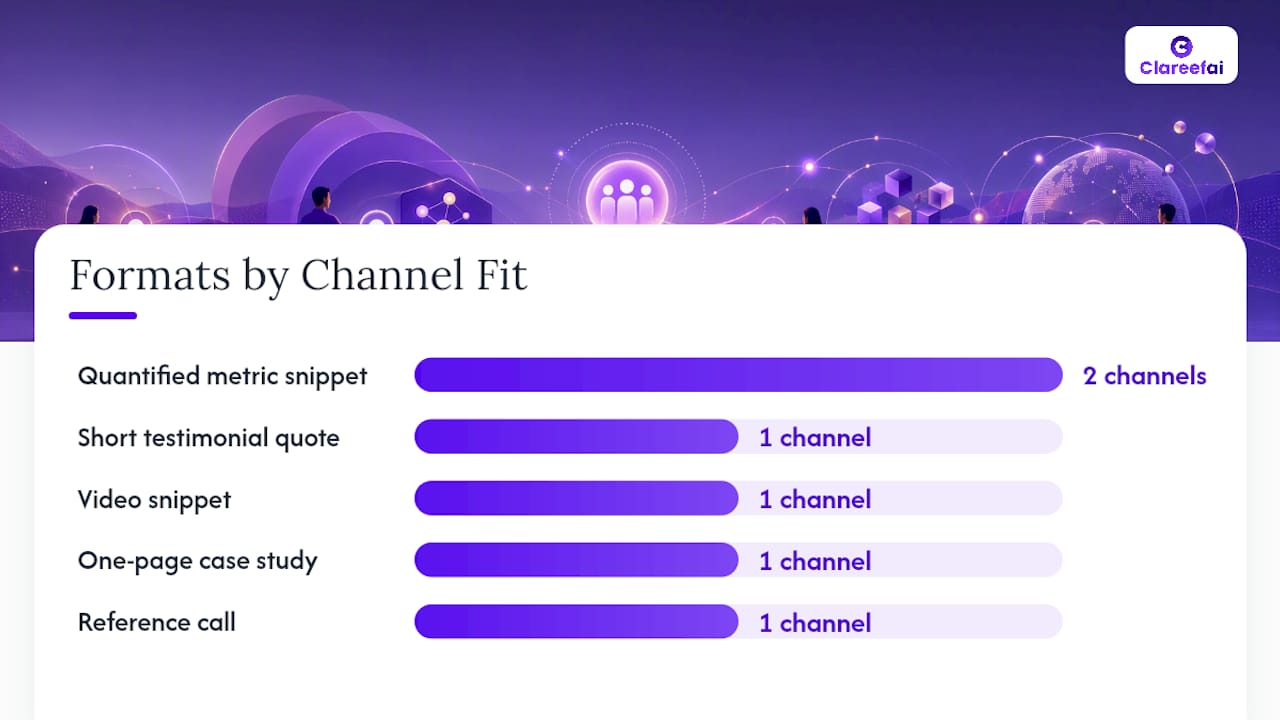
Not every piece of proof belongs in every channel. A 90-second video testimonial dies in a cold email but thrives on an ABM landing page. Here’s the format catalog and where each one earns its keep.
- Short testimonial quotes: one or two sentences, ideal for email signatures or ad copy.
- Quantified metric snippets: “Cut onboarding time 40%,” great for subject lines and follow-ups.
- One-page role-targeted case studies: built for a specific persona, ideal for AE decks.
- Video snippets: 30 to 90 seconds, best for landing pages and retargeting ads.
- Reference-call offers: high-trust, low-volume, reserved for late-stage opportunities.
- Analyst or third-party validation: strong for CFO and procurement audiences.
- Anonymous aggregated proof: useful when a named reference isn’t cleared yet (“87% of enterprise customers in your industry saw X”).
| Channel | Best proof format | Why it fits |
|---|---|---|
| Outbound email | Metric snippet | Scannable in a 5-second read |
| SDR cadences | Short quote | Builds credibility without overselling |
| Landing pages | Video snippet | Shows a real person, holds attention |
| Paid ads | Quantified stat | Stops the scroll with a hard number |
| Sales decks | One-page case study | Gives AEs a leave-behind |
| Gated assets | Full case study or reference call | Rewards high-intent prospects |
Happy to connect you with their VP of Ops if useful.
How Do You Collect and Verify Customer Proof at Scale?
Most testimonial programs die not from a lack of happy customers, but from a broken collection process. Here’s a workflow that keeps proof flowing without pestering your best accounts.
- Identify trigger points. QBRs, NPS survey responses above a set threshold, and 30/60/90-day onboarding milestones are natural moments to ask for a quote or metric.
- Use a capture template. Ask for the specific outcome, the buyer’s role, and permission to use their name, not a vague “how’s it going?”
- Tag metadata on intake. Log industry, company size, buyer role, use case, the metric achieved, the date, and reference rights granted.
- Route through an approval queue. Legal or customer success confirms reference rights before anything goes public.
- Ingest into a proof-point database. Store structured fields so the asset is matchable later, not just filed away in a folder no one opens.
Pro Tip: Capture reference-rights language directly in your onboarding contract or QBR follow-up email. Asking for permission after a prospect requests a reference call almost always creates delay, and delayed references cost deals.
Governance matters as much as collection. Pedowitz Group recommends confidence and relevance scores per asset, a “do not use” list for outdated claims, and a human approval step before any high-impact reference goes to a prospect. Skipping that step is how a stale statistic ends up in a live sales deck.
- Verify identity before publishing any named quote.
- Refresh metrics on a set cadence (quarterly for fast-moving industries).
- Retire assets automatically once reference rights expire.
Clareefai’s platform handles this exact workflow (automated collection, identity verification, tagging, and governance rules) as one example of what a mature proof operation looks like end to end.
How Should You Personalize Proof Across ABM Motions?
The proof you send a cold, unengaged account should look nothing like what you send an account three calls deep. Octave’s GTM engineering guide recommends light-touch proof in early outreach, metric-driven proof in middle-stage follow-ups, and a full case study once an account is genuinely engaged.

| Motion | Early touch | Mid-stage | Late-stage |
|---|---|---|---|
| One-to-one (named account) | Personalized quote referencing their industry | Custom one-pager with matched metric | Reference call offer |
| One-to-few (segment) | Segment-relevant stat | Video testimonial from a peer company | Gated case study |
| One-to-many (ABM landing page) | Rotating logo carousel | Aggregated stat block | Full case study library |
To operationalize this: build matching logic that pulls proof by industry and company size, insert dynamic fields into email templates and landing pages, and set a website personalization trigger for known target accounts. Set a freshness rule (proof older than 12 to 18 months gets flagged) and a human review threshold for anything going to a strategic or six-figure account. Automation handles volume; a person should still eyeball the proof going to your biggest fish.
Which Metrics Prove Account-Based Social Proof Is Working?
Track a tight set of KPIs instead of drowning in vanity metrics:
- Meetings booked and response rate lift on sequences using matched proof versus generic outreach.
- Opportunities created and pipeline value tied to accounts exposed to targeted proof.
- Time-to-close compared against your historical average for similar accounts.
- Campaign-level ROI, calculated against ad spend or program cost.
The cleanest attribution method is a before/after cohort: compare a group of target accounts that received matched proof against a control group that didn’t, and track engagement signals like asset views and time-on-page. ZenABM’s case study with FlowFuse found that account-level ABM reporting on LinkedIn campaigns produced $4.02 in pipeline for every $1 spent, a number that justified scaling ad budgets with real confidence instead of a hunch. Report pipeline value and time-to-close to sales leadership; report engagement lift and cost-per-opportunity to marketing leadership. They care about different halves of the same story.
What Do Real ABM Wins Look Like With Targeted Proof?
Public ABM results give you a sense of realistic upside, and a few are worth stealing for your next internal pitch.
- Snowflake saw a 75% increase in booked meetings after layering in targeted account proof, according to CXL’s ABM compilation. Lesson: matched proof in outbound sequences moves meeting rates more than volume alone.
- iRidium generated 34 sales-qualified opportunities from an ABM push that leaned on case-study evidence. Lesson: a well-targeted case study can outperform broad-based lead gen for niche technical buyers.
- Invoca posted a 33X ROI on an ABM campaign built around proof-driven messaging. Lesson: quantified outcomes in outreach copy convert skepticism into pipeline faster than feature claims.
- FlowFuse, working with ZenABM, hit $4.02 in pipeline per ad dollar once account-level reporting exposed which accounts were actually engaging. Lesson: attribution infrastructure is what turns “it seems to be working” into a defensible budget ask.
Companies like Billingtree, Payscale, Auth0, and Mindtickle show up across the same body of ABM research for a similar reason: role-specific proof, delivered at the right stage, consistently outperforms generic outreach in named-account programs.
Do’s and Don’ts for an Account-Based Proof Program
Do: target evidence by role, tag every asset by use case, automate matching wherever volume justifies it, enforce freshness rules, and capture consent early.
Don’t: drop a generic logo wall into a highly targeted ABM sequence, cram five proof points into one email, publish a claim you haven’t verified, or ignore that a CFO and a CTO need entirely different evidence.
Build in one compliance checkpoint: confirm reference rights and GDPR-compliant data handling before any named quote or metric leaves your proof database.
Red flags to watch for: metrics older than 18 months, quotes you can’t trace to a verified contact, missing reference-rights documentation, and assets nobody has clicked on in six months. Any one of these should trigger a review before the asset goes back into rotation.
How Do You Launch an Account-Based Proof Program in 90 Days?
- Audit existing testimonials, quotes, and case studies for usable, verified proof.
- Set up a collection workflow tied to QBRs, NPS surveys, and onboarding milestones.
- Verify identity and capture reference rights for every asset before publishing.
- Tag each piece with industry, company size, persona, use case, and metric.
- Build matching rules that connect tagged proof to target account attributes.
- Deploy matched proof across email, landing pages, decks, and ad creative.
- Measure meeting lift, pipeline value, and time-to-close against a control cohort.
90-day milestones: weeks 1 to 2, audit and tag existing assets. Weeks 3 to 6, build the collection workflow and verification queue. Weeks 7 to 10, launch matching logic across two channels. Weeks 11 to 13, measure and report initial lift.
Two copy-ready outreach lines: “[Matched customer] in your industry saw [metric] within [timeframe] — happy to share how.” Or: “Since you’re evaluating [category], here’s how a similar team solved for [pain point].”
Why Social Proof Has to Be Engineered, Not Just Written
Most teams still treat social proof as a content task: write a nice case study, post it, move on. That’s a mistake. The accounts that see the biggest lift from proof treat it as structured data with metadata, matching rules, and a governance layer behind it. When proof is matched correctly to buyer role and account context, the ROI shows up in the metrics that actually get reported to leadership, not just in warm feelings from a happy customer.
Turn Verified Customer Wins Into Your Best ABM Asset
You’ve now got the framework: collect proof at the right trigger points, verify it, tag it, and match it to the account in front of you. Clareefai builds exactly that architecture into one platform so your team isn’t stitching together spreadsheets, shared drives, and a Slack channel of unverified quotes.
The platform covers the full workflow this guide walks through: automated collection at onboarding and QBR touchpoints, identity verification so every quote traces back to a real customer, tagging by industry and persona, CRM integration for dynamic insertion into outreach, freshness rules that retire stale metrics, and analytics dashboards that report the KPIs your leadership actually wants to see. You can see this in practice on live pages like Origaly’s customer story or in a use case on unifying testimonial management to see the workflow end to end.
If you’re ready to stop assembling proof by hand, start a pilot on the Clareefai platform and see how matched, verified proof performs in your next ABM sequence.
Frequently Asked Questions
What is account-based social proof? It’s role-targeted evidence, such as a testimonial, metric, or case study, shown to a specific named account to reduce the perceived risk of choosing your product.
How is it different from regular customer testimonials? Regular testimonials are generic and published for anyone. Account-based social proof is matched to the prospect’s industry, company size, and buyer role before it’s ever shown to them.
What’s the fastest way to start collecting usable proof? Trigger requests at QBRs and post-onboarding milestones, using a template that captures the outcome, the buyer’s role, and explicit reference permission.
Which metrics should I track first? Start with meeting lift and response rate on sequences using matched proof, then expand to pipeline value and time-to-close once you have enough volume for a control comparison.
Do I need a big case-study library before I start? No. A handful of verified, well-tagged testimonials matched correctly will outperform a large library of generic, unverified quotes.
Sources
- Deal-Specific Social Proof: AI-Matched Case Studies & References · Pedowitz Group
- The Social Proof Architecture: Engineering Consensus in the B2B Buying Circle · Decaseo
- Account-based marketing case studies · CXL
- FlowFuse + ZenABM case study · ZenABM
Recommended
Share Article
Stay Updated
Get the latest insights on customer advocacy and SaaS growth delivered to your inbox.