Why Leverage Success Stories for B2B Sales Teams
TL;DR:
- Success stories persuade B2B buyers by increasing credibility and reducing perceived risk. They activate emotional transportation, encouraging behavioral change and decision-making. Leveraging verified, well-structured stories improves sales efficiency and content reuse.
Leverage success stories because they convert skeptical B2B buyers faster than any brand message you can write. A verified customer narrative removes the sales motive entirely, and that shift in perceived credibility is what moves deals forward.
TL;DR:
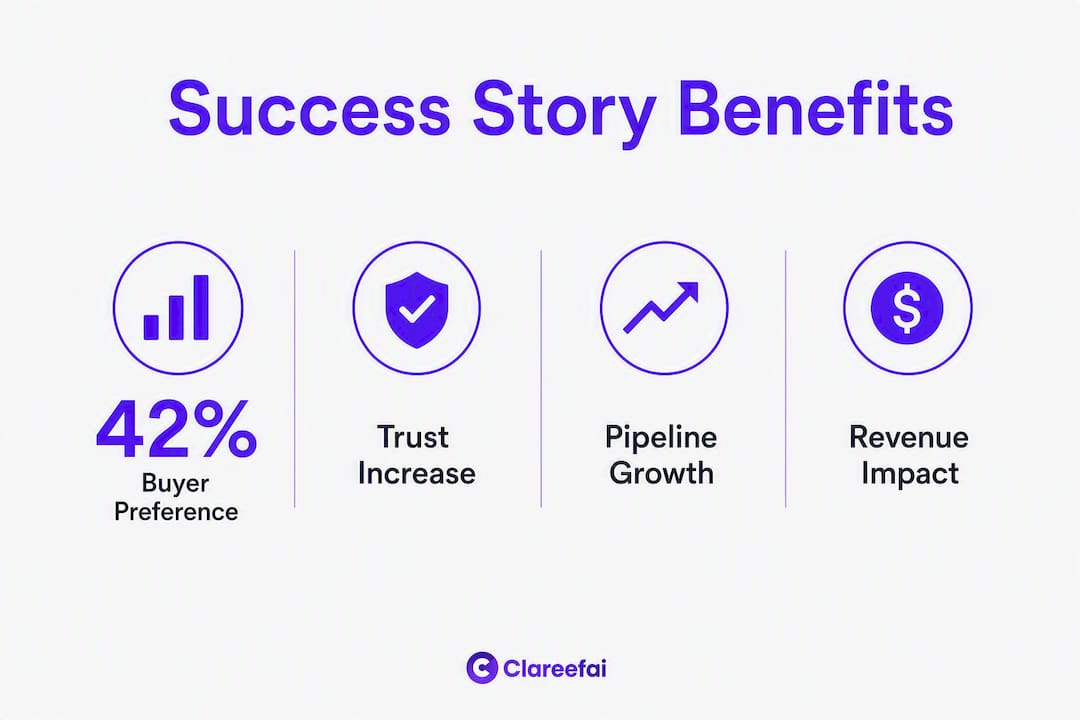
- 42 % of B2B buyers identify case studies and success stories as the most influential content in their purchase decision.
- A meta-analysis published in the Journal of the Academy of Marketing Science found narrative processing correlates with persuasion at 0.39 versus 0.24 for analytical messages — and blended story-plus-fact formats perform best in written channels.
- Clareefai’s platform is built specifically to collect, verify, and publish these stories at scale, so your team always has the right proof point ready when it matters.
Table of Contents
- Why do success stories persuade B2B buyers so effectively?
- What are the concrete business benefits of leveraging customer stories?
- What elements make a success story genuinely persuasive?
- Where should you deploy success stories across the buyer journey?
- How do you collect, verify, and scale success stories ethically?
- How do you measure the impact of success stories on revenue?
- What mistakes undermine your success story program?
- Five steps to start leveraging success stories today
- Key Takeaways
- The case for making verification non-negotiable
- Clareefai turns your customer wins into a scalable sales asset
- Research and sources for further reading
Why do success stories persuade B2B buyers so effectively?
The answer is neurobiological before it is strategic. When a reader becomes absorbed in a story, a state researchers call emotional transportation, their tendency to counterargue drops. Oxytocin-primed subjects in experimental conditions donated significantly more to charities after story exposure than placebo groups — a finding that illustrates how narrative engagement shifts behavior, not just attitude.
For B2B buyers, that mechanism matters because complex purchases carry real perceived risk, which aligns with visual storytelling tips that boost your brand’s impact by engaging audiences more effectively. A peer success story functions as a vicarious rehearsal: the reader mentally walks through the implementation, the friction, and the outcome before committing a budget. That cognitive simulation reduces the burden of decision-making in a way that a product spec sheet simply cannot.
The meta-analysis finding on narrative versus analytical messages reinforces a practical rule: in written formats like case studies and email sequences, blending story with facts outperforms either format alone. Lead with the customer’s journey, then anchor it with a measurable outcome.
Key persuasion mechanisms at work:
- Narrative transportation reduces counterargument and increases openness to belief change.
- Vicarious experience lets buyers simulate outcomes without personal risk.
- Motive removal — when a customer speaks in their own voice, buyers discount the sales motive and trust the message more.
- Social learning helps audiences extract generalizable lessons from peer journeys.
What are the concrete business benefits of leveraging customer stories?
Trust and credibility are the most immediate payoffs, but the downstream effects on revenue metrics are what make success stories worth treating as a core asset class.
Core benefits for B2B teams:
- Shorter sales cycles: Buyers who encounter verified proof points earlier in the funnel arrive at the demo already partially convinced.
- Higher win rates: Centralized testimonial management gives reps verified proof points at the right moment in a deal.
- Improved content ROI: A single well-crafted story can be repurposed across email, paid social, sales decks, and your website — created once, deployed many times.
- Cross-team alignment: Marketing generates pipeline with stories, sales closes with them, and customer success uses them to reinforce renewal conversations.
| Benefit | Who gains most | Typical application |
|---|---|---|
| Increased trust | Marketing | Website, paid social, ABM campaigns |
| Shorter sales cycles | Sales | Proposal inserts, demo follow-ups |
| Higher win rates | Sales leadership | Reference calls, competitive deals |
| Content reuse | Marketing / CS | Email sequences, onboarding materials |
What elements make a success story genuinely persuasive?
Structure and credibility markers separate a story that moves buyers from one that gets skimmed and forgotten.
The narrative arc every story needs:
- Protagonist and context — name the customer’s role, company size, and industry so readers self-identify.
- The conflict — describe the specific problem or risk the customer faced before your solution.
- The turning point — explain what changed and why they chose your product.
- Measurable outcome — quantify the result (time saved, revenue gained, churn reduced).
Credibility markers to include:
- Named customer with verified identity and title (when consent permits).
- Specific metrics with documented sources, not rounded estimates.
- Supporting artifacts: screenshots, dashboard exports, or third-party review links.
- Direct quotes in the customer’s own words, lightly edited for clarity only.
Format guidance: Video testimonials capture facial expression and vocal tone, which amplify empathy in ways text cannot replicate. Use video when the customer is willing and the story is high-stakes. For written formats, embed the narrative arc and close with a hard metric. Short pull quotes work well for social proof snippets on landing pages.
Pro Tip: Ask customers: “What were you most worried about before you bought, and what actually happened?” That single prompt reliably produces a journey narrative — skepticism to resolution — that resonates with buyers at the same stage of doubt.

Where should you deploy success stories across the buyer journey?
Placement and timing determine whether a story accelerates a deal or gets ignored.
Funnel-stage mapping:
- Awareness: Short social proof snippets and stat-backed quotes on LinkedIn and paid social to generate initial credibility.
- Consideration: Full case studies on your website and in nurture sequences, where buyers are actively comparing options.
- Decision: Video testimonials, reference calls, and story-backed proposal inserts that address final objections.
Specific sales touchpoints:
- Post-demo follow-up email with a case study matching the prospect’s industry.
- Proposal cover page featuring a one-paragraph customer outcome relevant to the buyer’s stated goal.
- Reference call prep: brief the reference customer on the prospect’s specific concern before the call.
- Account-based campaigns: match story to the prospect’s vertical, company size, and pain point for maximum relevance.
For marketing teams, turning advocacy into campaign content means having stories tagged by industry, use case, and outcome so the right asset surfaces automatically.
How do you collect, verify, and scale success stories ethically?
A repeatable collection process is what separates teams with one great case study from teams with a library of 40.
Step-by-step collection flow:
- Identify candidates at peak satisfaction — post-onboarding, after a renewal, or following a measurable win.
- Send a structured ask with context: explain the format, time commitment, and how the story will be used.
- Use targeted prompts that force a journey narrative rather than generic praise.
- Capture in the best available medium — video first, written interview second.
- Obtain written consent covering publication channels, identity use, and any metric disclosure.
Verification and compliance essentials:
- Confirm customer identity before publishing any attributed quote.
- Use a signed release that specifies which channels and formats are approved.
- For GDPR-covered contacts, document the legal basis for processing and storing their data.
- Never publish a metric the customer has not explicitly approved in writing.
Scaling and governance:
- Tag every story with metadata: industry, company size, use case, outcome type, and format.
- Assign ownership — typically customer success collects, marketing publishes, sales requests.
- Automate distribution via CRM integration so reps receive relevant stories in their workflow without hunting for them.
Pro Tip: Build a testimonial collection checklist into your customer success handoff process. When collection is a standard step, not an ad hoc request, participation rates climb and quality stays consistent.
How do you measure the impact of success stories on revenue?
Stories are assets. Treat them like paid campaigns and measure their contribution to pipeline and closed revenue.
Primary KPIs to track:
| KPI | What it measures | How to capture it |
|---|---|---|
| Conversion rate lift | Story vs. no-story landing page | A/B test with CTA variant |
| Win rate by story use | Deals closed with vs. without case study | CRM field tagging |
| Time-to-close | Average days in stage for story-influenced deals | CRM pipeline report |
| MQL-to-SQL velocity | Speed through nurture with story content | Marketing automation data |
| Reference call scheduling | Volume and outcome of customer reference calls | CS dashboard |
Dashboard design by role:
- Marketing leaders: engagement rate on story content, MQL volume from story-gated assets, assisted pipeline.
- Sales managers: win rate on deals where a case study was shared, reference call conversion, competitive displacement stories used.
The 42% buyer preference for case studies gives you a baseline expectation: if stories are not influencing nearly half your closed-won deals, your distribution or tagging system likely has a gap. Testimonial dashboards built for analysts make it straightforward to surface those gaps before they cost you pipeline.
What mistakes undermine your success story program?
Even well-intentioned teams make errors that erode the credibility stories are supposed to build.
- Over-editing customer voice: Polishing out the rough edges removes authenticity. Buyers trust imperfect, specific language more than marketing-smooth prose.
- Anonymous or unverifiable quotes: A quote attributed to “a VP at a mid-size SaaS company” carries almost no persuasive weight. Named, verified customers convert.
- Asking at the wrong time: Requesting a story during onboarding or after a support ticket produces reluctant, thin responses. Ask at peak satisfaction.
- Misleading metrics: Citing a number the customer did not verify or approve damages your credibility if a prospect asks the reference customer directly.
- Poor consent practices: Publishing a story without a signed release exposes your company to legal risk and can damage the customer relationship.
Five steps to start leveraging success stories today
- Identify three high-impact customers who have achieved a measurable outcome and ask for permission at their next satisfaction peak.
- Use a journey-based prompt (“What were you most worried about before buying, and what actually happened?”) to elicit a narrative, not a generic endorsement.
- Capture in the most persuasive format available — video if the customer is willing, a structured written interview if not.
- Tag and store in a central system with metadata (industry, use case, outcome, format) so sales can find the right story in seconds.
- Measure impact within 90 days by tracking at least one conversion or win-rate metric on deals where the story was used.
Key Takeaways
Success stories convert B2B buyers because they reduce perceived risk, remove the sales motive, and give prospects a vicarious path to the outcome they want.
| Point | Details |
|---|---|
| Stories outperform brand claims | Narrative processing correlates with persuasion at 0.39 vs. 0.24 for analytical messages; blended formats work best in writing. |
| Buyer preference is documented | 42 % of B2B buyers say case studies and success stories are the most influential content in their decision process. |
| Treat stories as long-term assets | Collect once with proper consent and metadata, then reuse across email, sales decks, website, and paid social. |
| Measure like a campaign | Track win rate, time-to-close, and conversion lift on story-influenced deals to prove and improve ROI. |
| Clareefai centralizes the process | Clareefai automates collection, verifies identity, tags stories, and surfaces them in CRM workflows so reps always have the right proof point ready. |
The case for making verification non-negotiable
The most common objection to investing in success stories is operational: “We don’t have a system for this.” That objection is worth taking seriously, because an ad hoc process produces exactly the problems this article warns against — anonymous quotes, missing consent, stories that sit in a shared drive no one can find.
What actually moves the needle is treating story collection as a governed, repeatable motion rather than a one-off marketing project. Teams that build verification and tagging into their customer success workflow from the start end up with a library that compounds in value. Each new story adds coverage for a new industry, use case, or objection. Sales reps stop asking marketing for proof points because the right story surfaces automatically in their CRM.
The research supports the investment. Narrative persuasion is not a soft benefit — it is a documented mechanism that reduces counterargument and accelerates belief change. The operational question is simply whether your team has the infrastructure to deploy it consistently.
Clareefai turns your customer wins into a scalable sales asset
Verified, tagged, and ready to deploy — that is what separates a testimonial library that closes deals from a folder of PDFs no one opens. Clareefai gives B2B sales and marketing teams a single platform to collect authentic customer stories, confirm identities, and publish proof points across every channel where buyers are evaluating you.
The platform handles automated collection requests, video testimonial capture, consent management, and CRM integration so your reps receive the right story at the right stage without manual effort. Role-specific dashboards let marketing track content performance while sales managers monitor reference call outcomes and win-rate attribution. See how unified testimonial management works in practice, or visit the platform overview to explore the full feature set and start your free trial.
Research and sources for further reading
The findings below informed this article. Use them to benchmark your own program and build internal alignment around the value of customer advocacy.
- How stories change the brain — Greater Good, UC Berkeley: Oxytocin and emotional transportation research; explains the neurobiological basis for story-driven persuasion.
- Narrative vs. analytical marketing meta-analysis — Science of Money: Correlation coefficients for narrative (0.39) vs. analytical (0.24) persuasion; guidance on blended formats.
- 42% B2B buyer preference for case studies — Content Matterz: Mixology AI B2B Buyer Report stat on most influential content types.
- Stories in Action — SAGE Journals: Comprehensive review of narrative social learning, vicarious experience, and counterargument reduction.
- A customer’s story could be worth your entire marketing budget — Inc.: Practical guidance on prompts and motive removal; supports collection and editing best practices.
- Customer Success Stories: Your Complete B2B Guide — Clareefai Blog: Platform-centered examples for collection timing, prompts, and cross-team workflows.
- Advantages of Video Testimonials for B2B Marketers — Clareefai Blog: Why video amplifies empathy and how to capture it effectively.
- Boosting Win Rates with Unified Testimonial Management — Clareefai: Use-case demonstrating operational and sales benefits from centralizing testimonials.
| Source | Why it matters |
|---|---|
| Greater Good / UC Berkeley | Neurobiological evidence for story-driven behavior change |
| Science of Money meta-analysis | Quantified persuasion advantage of narrative over analytical messages |
| Mixology AI B2B Buyer Report | Buyer-stated preference data for benchmarking content investment |
| SAGE Journals — Stories in Action | Academic foundation for vicarious experience and social learning |
| Clareefai use-case page | Practical proof point for centralized testimonial operations |
Recommended
Share Article
Stay Updated
Get the latest insights on customer advocacy and SaaS growth delivered to your inbox.