Customer Success Stories: Your Complete B2B Guide
What are customer success stories and why do they matter?
Customer success stories are detailed, results-focused narratives that show how your product or service solved a specific business challenge and delivered measurable outcomes. They go well beyond a one-line testimonial. A strong story walks prospects through the before state, the solution path, and the concrete results, giving buyers something they can map onto their own situation.

In B2B marketing and sales, that specificity is what moves deals. Buyers don’t make decisions on enthusiasm alone. They look for evidence that your solution works for companies like theirs, facing problems like theirs. A well-crafted success story provides exactly that kind of social proof that shortens sales cycles and builds trust faster than any product brochure.
Here’s what customer success stories do for your team:
- Build credibility by showing measurable results that matter to decision-makers
- Reduce buyer uncertainty by letting prospects picture themselves achieving the same outcomes
- Accelerate deal closure by giving sales reps ready-made proof to address objections
- Support retention by helping existing customers see more value in your product
- Align sales and marketing around a shared library of reusable proof assets
Your guide to customer success stories: the key components
The difference between a forgettable case study and one that actually closes deals comes down to structure and specificity. Effective case studies show customers facing clear challenges and solutions that prospects can mirror, not just happy customers giving praise.
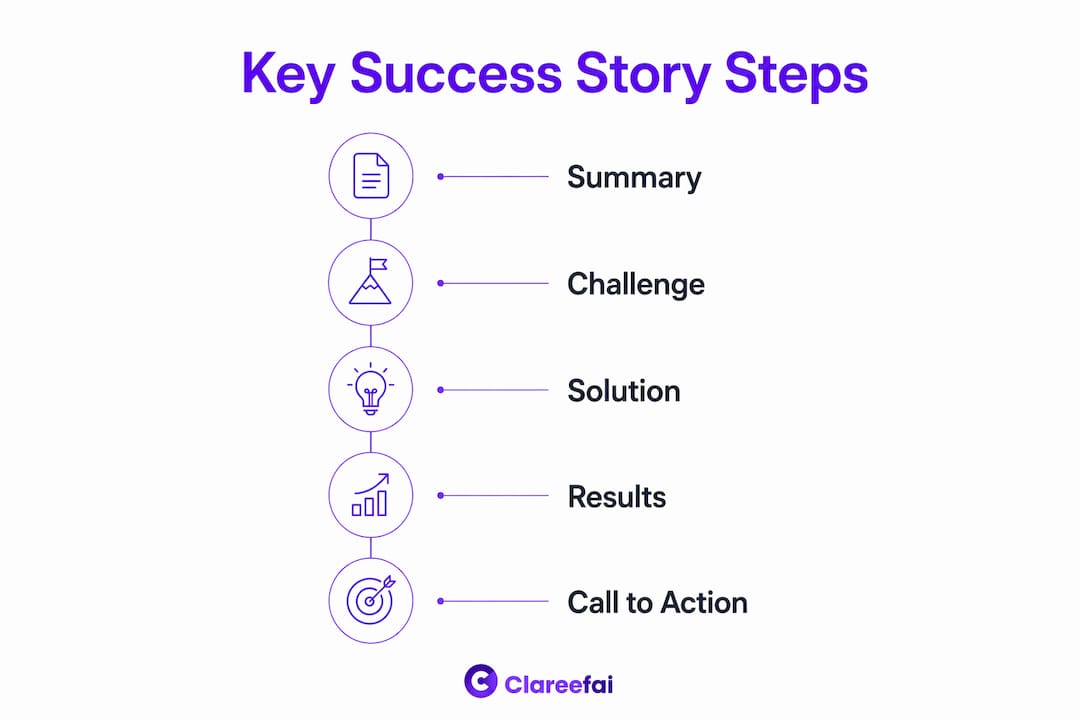
Every high-performing success story contains these core elements:
- Customer context: Company size, industry, and role of the person featured. This lets prospects quickly recognize themselves.
- The challenge: A specific, concrete problem the customer faced before finding your solution. Vague pain points don’t resonate. “We were losing 8% of accounts quarterly because our team couldn’t monitor 2,000 customers at once” is far more compelling than “we had churn issues.”
- The solution: What changed, how it was implemented, and why your approach was the right fit. Keep this in business terms, not feature lists.
- Measurable results: Numbers, percentages, time saved, revenue retained. The results section is where buyers judge business impact.
- Direct customer quotes: Authentic words from the customer add credibility that your own marketing copy cannot replicate.
Pro Tip: Don’t wait until the end to reveal the results. Pull your strongest proof point into the headline or opening summary. Buyers scan before they read, and a buried result is a missed conversion.
Common do’s and don’ts when writing success stories
Getting the structure right is only half the battle. How you write each section determines whether a prospect reads to the end or clicks away.
Do these:
- Focus the story on the customer’s challenge, not your product’s features
- Use quantifiable results wherever possible (“reduced onboarding time by 24%” beats “improved onboarding”)
- Include direct quotes that reflect the customer’s emotional reaction, not just operational outcomes
- Choose stories that match the challenges your target prospects are currently facing
- Get written approval from the customer before publishing anything
Avoid these:
- Writing a story that reads like a product brochure. If every paragraph mentions your features, you’ve lost the customer’s voice.
- Selecting customers based purely on satisfaction. Prioritizing alignment with prospect needs over simple happiness produces more relevant and impactful stories.
- Skipping the tension. A story where everything went smoothly from day one isn’t believable. Real implementation has friction, and showing how you navigated it builds trust.
- Ignoring legal and ethical requirements. Always obtain explicit written consent before featuring a customer’s name, logo, or data. Specify exactly how their information will be used and give them review rights before publication.
Pro Tip: When selecting which customer to feature, ask yourself: “Would a prospect reading this story recognize their own problem in the first paragraph?” If the answer is no, find a different story or reframe the challenge section.
How to structure your success story for maximum impact
A proven structure makes your story easy to follow and hard to ignore. The challenge-solution-results framework works because it mirrors how buyers think: “Do I have this problem? Did this solution fix it? What happened?”
Here’s how each section should function:
- Opening / challenge: Set the scene fast. Name the specific problem, quantify its impact if possible, and make it relatable. This is where prospects decide whether to keep reading.
- Solution: Explain what changed without turning it into a feature list. Focus on what the customer did, why they chose your approach, and what the implementation path looked like.
- Results: Lead with your strongest number. Use visuals like charts or callout boxes to make key metrics impossible to skim past.
- Customer quote: Close with a direct quote that captures the emotional shift, not just the operational win.
| Story section | Primary purpose | What to include |
|---|---|---|
| Challenge | Create recognition and tension | Specific problem, business impact, timeline |
| Solution | Build credibility and clarity | Implementation path, why it fit, key decisions |
| Results | Prove business value | Hard metrics, qualitative improvements, before/after |
| Customer quote | Add authenticity | Emotional reaction, specific outcome, customer’s own words |
A practical example outline: open with a one-paragraph summary of the result (the “so what”), then move into the challenge, walk through the solution in business terms, present results with visual emphasis, and close with a quote that ties the emotional and operational wins together. Effective case studies typically run 500–1,500 words, which gives you enough room for context and data without losing the reader.
How success stories function as performance assets across sales and marketing
A finished success story sitting in a shared drive helps no one. The teams that get the most value treat each story as a performance asset that bridges sales and marketing, helping reps overcome objections with specific proof points at exactly the right moment in the sales cycle.
Here’s how to put stories to work across your organization:
- Sales enablement: Tag each story by industry, company size, pain point, and buying stage. Give reps a one-line summary (“best for buyers worried about implementation complexity”) so they can find the right story in seconds during a call.
- Marketing campaigns: Break one story into multiple formats. The full case study becomes a blog post, a pull quote for social media, a slide in a webinar deck, and a stat callout in an email sequence.
- Website proof pages: Group stories by use case or industry so prospects can self-select the most relevant example.
- Objection handling: Build a quick-reference guide that maps common objections to the story that answers each one most directly.
- Sales and marketing alignment: A shared story library gives both teams visibility into which stories resonate, which gaps exist, and where new stories are needed.
The power of storytelling in B2B settings goes beyond content marketing. When sales and marketing operate from the same proof library, deal progression accelerates because reps aren’t reinventing the wheel for every prospect conversation. Clareefai’s platform supports this alignment by centralizing verified testimonials and success stories so both teams can surface the right proof at the right moment. You can see how this works in practice on the for marketers page.
How AI and customer success platforms improve story creation in 2026
AI is changing how teams identify, build, and deploy customer success stories. B2B SaaS firms using AI-enabled customer success agents have achieved notable operational gains, including reduced churn and the ability to manage significantly more accounts per success manager without sacrificing quality.
On the story creation side, the gains are equally concrete. Adopting customer success platforms with AI workflows cuts manual data tasks by 30% and speeds up onboarding by nearly a quarter. That time savings translates directly into more stories produced, faster.
Stat callout: Customer success platforms with AI workflows reduce manual customer success manager data tasks by 30%, freeing teams to focus on high-value story creation and customer conversations.
| Operational area | Without AI | With AI-enabled platform |
|---|---|---|
| Manual data tasks | High volume, time-consuming | Reduced by 30% |
| Churn prediction accuracy | Reactive, limited visibility | Proactive, early signal detection |
| Story identification | Ad hoc, relationship-dependent | Automated, data-triggered |
| Business review prep | Days of manual effort | Minutes with automation |
Integrated data dashboards are central to this shift. High-performing customer success teams use unified data streams to proactively identify which accounts are thriving and which are at risk, giving them a clear signal for which customers are ready to be featured in a story. The role of AI in marketing extends to story curation: AI can surface accounts showing strong health scores and expansion signals, flagging them as ideal story candidates before a CSM even thinks to ask.
Clareefai applies this same logic to testimonial and story management. Its AI-driven analysis identifies the most impactful customer advocates automatically, then surfaces their stories on the right channels at the right time. Rather than relying on a CSM to remember which customer had a great result last quarter, the platform keeps your proof library current and accessible.
Pro Tip: Use your customer success platform’s health scoring data to prioritize story candidates. Accounts with high adoption rates, recent expansion, and strong NPS scores make the most credible and compelling stories, and they’re usually the most willing to participate.
How to gather and interview customers for authentic stories
The fastest way to write a weak success story is to start with the wrong customer or ask the wrong questions. Authentic stories come from a structured process, not a casual email asking for a quote.
Finding the right customer: Look for accounts with a clear before-and-after arc. The customer needs a real problem, a real implementation path, and a result that means something to future buyers. Happy isn’t enough. You need tension, resolution, and proof.
Reaching out the right way: Keep your outreach simple and respectful. Tell the customer why you chose them, what the process involves, how long it will take, and that they’ll review everything before it’s published. Transparency increases participation rates.
Running the interview: Use open-ended questions that move in sequence:
- What was happening before you found our solution? What wasn’t working?
- What made the problem worth solving at that point?
- What alternatives did you consider, and what concerns did you have?
- Walk me through what the implementation looked like.
- What changed in your business, team, or workflow after going live?
- What felt different once the new approach was in place?
Having fallback metrics ready: Not every customer tracks the exact metric you’d ideally quote. Prepare a list of alternative proof points before the interview: revenue generated, hours saved, incidents reduced, or SLA improvements. Capture both the operational result and the customer’s emotional reaction. The emotional piece is what makes the story human.
The best timing for outreach is when results are visible and the experience is still fresh. Asking at a scheduled check-in or after a clear milestone (“you just hit your first renewal”) produces richer, more specific answers than a cold request months later.
How to measure the impact of your success stories
A success story should be judged by whether it influenced buying behavior, not just whether it was published. Did sales use it? Did prospects mention it during calls? Did it help a deal move forward faster?
Track these metrics to evaluate story performance:
- Sales usage rate: How often are reps sharing a specific story during active deals?
- Prospect engagement: Are prospects clicking, downloading, or referencing the story in follow-up conversations?
- Deal velocity: Do deals where a story was shared close faster than those where it wasn’t?
- Objection resolution rate: Does sharing a relevant story reduce the frequency of a specific objection in later stages?
- Content attribution: Which stories appear in the pipeline of deals that ultimately closed?
On the marketing side, track page views, time on page, and conversion rates for each story page. Stories that consistently drive traffic but low conversion may need a stronger results section or a clearer call to action.
Building a portfolio of stories over time compounds these gains. Each new story gives a different buyer a different point of entry. A story targeting a mid-market operations team won’t resonate with an enterprise IT buyer, but having both means your proof library covers more of your pipeline. Clareefai’s analytics dashboard makes it straightforward to see which stories are driving engagement and which need refreshing, so your library stays relevant as your market evolves. For teams focused on boosting win rates through unified testimonial management, that visibility is what separates a reactive content library from a proactive sales tool.
Clareefai turns your best customers into your strongest sales asset
Collecting great customer stories is only half the work. The other half is making sure those stories reach the right prospect at the right moment. Clareefai centralizes, verifies, and deploys your customer testimonials and success stories across every stage of the sales funnel, so your team always has the right proof on hand.
From AI-driven advocate identification to verified video testimonials and real-time analytics, Clareefai gives sales and marketing a shared foundation of trusted social proof. See how it works with real customer examples on the Clareefai platform.
Key Takeaways
Effective customer success stories combine a clear challenge, a credible solution path, and measurable results to shorten B2B sales cycles and build lasting buyer trust.
| Point | Details |
|---|---|
| Structure drives impact | Use the challenge-solution-results framework; lead with your strongest proof point, not your product features. |
| Alignment beats satisfaction | Select story candidates based on how well their challenge mirrors your target prospect’s situation, not just how happy they are. |
| Stories are reusable assets | One strong story can become a blog post, social proof, email content, and a sales objection-handling tool simultaneously. |
| AI accelerates story operations | AI-enabled platforms cut manual customer success data tasks by 30% and speed up onboarding by nearly 25%, freeing teams to identify and produce more stories faster. |
| Measure what moves deals | Track sales usage rate, deal velocity, and objection resolution to evaluate which stories actually influence buying behavior. |
Recommended
Share Article
Stay Updated
Get the latest insights on customer advocacy and SaaS growth delivered to your inbox.