
Voice of the customer (VoC) is the practice of capturing what customers say, analyzing it, and acting on it. For a B2B team, the strongest version does two jobs at once: it tells product, success and marketing what to fix, and it turns your happiest customers into verified proof that shortens sales cycles. Clareefai is built for that second job: organizing, verifying and publishing testimonials, reviews and reference calls so feedback becomes a sales asset instead of a slide in a quarterly deck.
This guide covers what VoC means, what a program needs, how to launch one in a B2B company, what a dashboard should show, and how sales, marketing and customer success use the output.
TL;DR
- VoC is an ongoing program with owners and actions, not a survey. It is judged by what it changes, not by what it collects.
- In B2B, the verbatim comments and scores from people in key buying roles matter more than an account average.
- Start with a few sources and a few decisions, then add more. Close the loop with every customer who speaks up.
- The same feedback feeds three teams: product fixes, retention plays and public proof such as reviews, case studies and reference calls.
- Clareefai verifies customers, finds promoters with AI and publishes their voices through your CRM and review channels.
Table of Contents
- What voice of the customer means
- Voice of the customer program versus a survey
- How to build a VoC program in a B2B company
- What a voice of the customer dashboard should show
- How sales, marketing and customer success use VoC
- Common mistakes to avoid
- Where Clareefai fits
- Our perspective
- FAQ
- Sources
What voice of the customer means
MIT Sloan’s working paper on the subject describes VoC as a product-development process that captures customer requirements in a hierarchy, ranked by importance and by how well current alternatives satisfy them. It gives a team a common language and a solid basis for design and marketing decisions.
The modern business definition is wider. The American Society for Quality lists the sources: online surveys, interviews, social media, website behavior, reviews, complaints, focus groups, sales and technical trip reports, warranty claims and support forums. It adds that a successful program needs organization-wide commitment and workgroups focused on closing the loop.
In plain terms: VoC is everything your customers tell you, directly or indirectly, plus the discipline of doing something with it.
Why B2B teams invest in it
The usual reasons are fewer surprises and better decisions. Feedback shows which accounts are slipping before they churn, where the product creates friction, and which customers are enthusiastic enough to vouch for you. That last point is where many programs stop short. The same customer who gave a 10 on a survey can become a review, a case study or a reference call, but only if someone captures that goodwill while it is fresh.
Voice of the customer program versus a survey
A survey is one input. A program is the system around it: goals, listening points across the customer journey, named owners, a path from insight to a shipped change, and a message back to the customer.
New York State’s guidance on VoC lists five components: data collection across channels, analysis of trends and recurring issues, actionable insights that change processes or services, closing the loop by telling customers how their feedback was used, and continuous improvement through regular collection.
A quick self-check for your own company:
- Goals: can you name the two or three business numbers the program should move (renewal, expansion, win rate)?
- Sources: is every feedback channel assigned to a person and a cadence?
- Action: can you point to a decision changed by feedback last quarter?
- Loop: did the customers who spoke up hear back?
If two answers are no, you have a survey habit, not a program. That is fixable in a quarter.
How to build a VoC program in a B2B company
B2B differs from consumer VoC in one important way: you have fewer customers, each worth far more, and several people inside each account who see you differently. Bain’s work on B2B loyalty makes the point that individual scores from people in key buying roles matter more than the aggregate account score, and that the verbatim comments matter more than the number.
Step 1: Set goals you can measure
Pick outcomes, not activities. “Raise our survey response rate” is an activity. “Increase expansion revenue from promoters” or “cut time to reference for late-stage deals” is an outcome. Write the three to five decisions the program must inform, such as which features to prioritize, which accounts need an executive call, and which customers to invite into a reference program.
Where you take it wrong: tracking only feedback metrics such as response rate and NPS. When budget season arrives, those numbers do not defend the program. Revenue-linked ones do.
Step 2: Choose a small set of listening posts
Map sources to the customer journey: onboarding, first value, renewal, expansion. Mix three types of data: what customers are asked (surveys, interviews), what they volunteer (support tickets, reviews, call comments) and what they do (product usage, CRM activity). Start with three or four sources, at least two of them unsolicited, rather than connecting everything at once.
For surveys, New York State’s guidance covers the common formats: CSAT, Customer Effort Score, transactional surveys triggered by an interaction, and longer relationship surveys. Its best practices are to keep surveys short, mix relationship and transactional types, and follow up with respondents.
In B2B, add the sales side. Win and loss conversations, objections recorded in the CRM and the reasons deals stall are customer voice too, just from people who have not bought yet.
Step 3: Name an owner for every source
Every feedback source needs one accountable person and a stated rhythm: weekly review of support themes, monthly review of survey comments, quarterly review of reviews and references. A source without an owner decays into a one-time effort.
Bain recommends account teams place follow-up calls to detractors (scores of 0 to 6), anyone who asks for follow-up, and anyone with something significant to say. Those calls should be about listening and explaining how the issue will be addressed, not selling or defending.
Step 4: Categorize and prioritize
Raw comments are not insight. Give every piece of feedback a label from a short shared list (product, onboarding, pricing, support, sales process) and tie it to the account, the role and the journey stage. Aggregate statements like “satisfaction dipped” become useful only when they turn into a located problem that someone can own.
Then rank. A simple method weighs how many accounts raise a theme, how severe it is and how valuable those accounts are, so a blocker hitting five enterprise accounts can outrank an annoyance hitting twenty-five small ones. If you want a deeper look at turning customer requirements into ranked priorities, this piece on customer feedback and revenue growth is a good companion read.
Keep each cycle to three to five prioritized actions. Fifteen “top priorities” means nothing gets done.
Step 5: Act, then close the loop
There are two loops. The inner loop is a personal reply to the customer who flagged something. The outer loop is a broader message, such as a release note, telling everyone what changed because of what you heard. The loop is the step most programs skip, and it is the one that makes customers willing to speak again.

This is also the moment to ask your happiest respondents for more. A customer who has just been thanked and heard is the best candidate for a testimonial, a review or a reference call. Our playbook on turning survey feedback into testimonials shows the handoff in detail.
A 90-day shape for the launch
| Period | Focus | Output |
|---|---|---|
| Weeks 1 to 4 | Foundation | Decisions defined, three or four sources live, first label list, owners named |
| Weeks 5 to 8 | First readout | Weekly coding of feedback, first monthly summary, first loop-closing replies |
| Weeks 9 to 13 | Operationalize | Revised labels, account value weighting, readout added to planning meetings, baselines set |
The timeline is a reasonable pattern, not a rule. A smaller team can compress it, a larger one will stretch it.
What a voice of the customer dashboard should show
A dashboard is where the program becomes visible to leaders. Bain describes the reports operating managers need: scores, granular response rates, summaries of verbatim comments and the status of follow-up. That is a good minimum, and you can build on it with four questions:
- Sentiment: how do customers feel, by segment and over time?
- Themes: what are they talking about, and is each topic growing or shrinking?
- Context: which accounts, roles, contract values and lifecycle stages sit behind each theme?
- Action: who owns each issue, what is its status and how long did it take to resolve?
A score alone is a scorecard. The context and action layers are what make it a working tool. Different roles need different views: a VP Sales wants references and win-rate signals, a customer success manager wants at-risk accounts, a marketer wants approved quotes and stories. Build the simplest automatic view first, add monthly theme analysis later, and only then a quarterly look at how feedback correlates with churn and revenue.
Clareefai includes dashboards for different roles, real-time data synchronization and detailed analytics, so advocacy results sit alongside the rest of your customer data.
How sales, marketing and customer success use VoC
VoC pays off when it leaves the research team. Insight Partners’ guide maps survey results to team actions: marketing asks promoters for G2 and Capterra reviews and case studies, sales invites promoters into a formal reference program, and customer success runs early renewal plays with them. The same guide notes that unhappy respondents get outreach to reduce churn risk.
Sales gets a growing pool of references and sharper objection handling. A prospect hesitating over integration risk is far more convinced by a verified peer in their industry than by a generic claim. Our post on testimonial examples mapped to deal stage shows which proof fits which conversation.
Marketing gets approved, attributable quotes, video and case studies. Anonymous or unattributed praise carries little weight, so the identity and context behind each quote matter. Read how we think about feedback contextualization and secured feedback.
Customer success gets an early warning system and a list of advocates to involve in renewals and expansions. Our list of customer success metrics for B2B teams helps tie VoC to retention numbers.

Review sites are the public face of VoC. A steady stream of recent reviews builds credibility with buyers who research before they ever talk to you. Our 30/60/90 playbook for G2 reviews and review management strategies cover the routine.
Common mistakes to avoid
- Collecting without a destination. Every feedback source should feed a named decision or a named asset.
- Treating the account as one voice. Separate champions, economic buyers and daily users.
- Building everything at once. Early wins from a few sources earn the budget for more.
- Leaving promoters unasked. Satisfied customers rarely volunteer a review. Someone has to invite them at the right moment.
- Skipping the reply. Silence after feedback teaches customers not to give it.
Where Clareefai fits
Most VoC tools stop at insight. Clareefai carries the program through to proof. It organizes, verifies and displays customer testimonials, reviews, video and success stories, verifies customer identities and contextualizes each piece of feedback. Its AI-driven analysis identifies the customer advocates likely to have the most impact, and it supports instant reference calls with real customers, ambassador programs and cross-channel publishing through CRM and review integrations. Data management is GDPR-compliant.
Plans are published at our pricing page: Basic is $250 per month, Professional is $624 per month and Enterprise is $1,250 per month. A free trial is available and there are no long-term contracts. Marketing teams can see how it works on the solution page for marketers, and leaders can explore how to measure advocacy ROI.
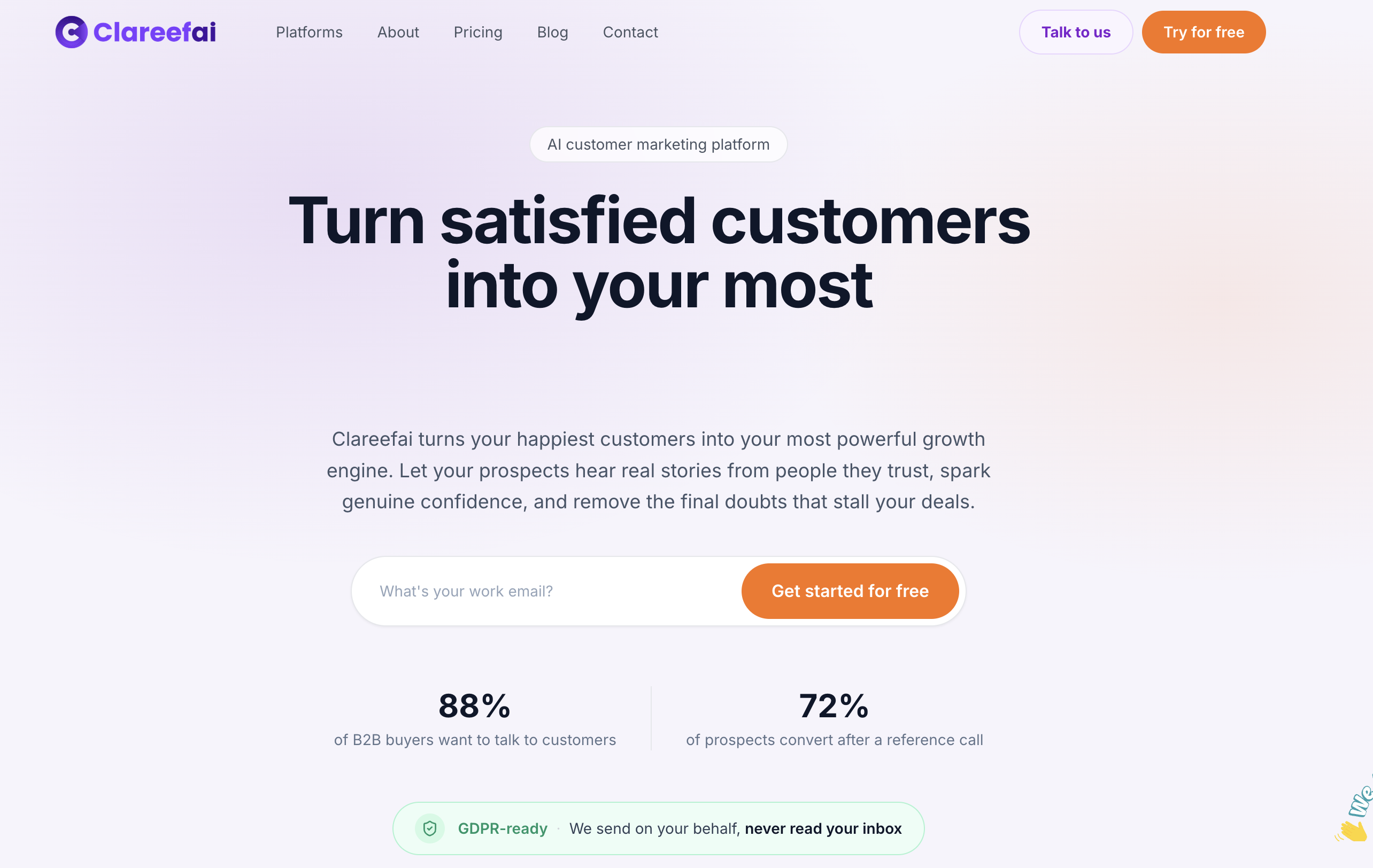
If your VoC program already produces happy customers and good comments, the fastest next step is to put them to work. Start with Clareefai and turn feedback into verified proof your sales team can use this quarter.
Our perspective
We believe a voice of the customer program should end where a buyer’s decision begins. Collecting feedback is the easy part. The harder, more valuable part is making sure the right customer voice reaches the right prospect at the right moment.
That is why we focus on verification and context. A testimonial from a named, confirmed customer in a relevant role carries weight that an anonymous five-star rating never will. Our platform is designed to organize that feedback, show who said it and why it matters, and put it in front of prospects through the channels your team already uses.
We also think advocacy deserves its own measurement. When you can see which promoters were identified, which references were used and which deals they touched, VoC stops being a cost center and becomes a measurable sales asset. Our approach is to give sales, marketing and customer success one shared view, so a happy customer is never a missed opportunity.
ClareefAi
FAQ
What is the difference between voice of the customer and customer experience?
Voice of the customer is the feedback itself and the process of capturing and using it. Customer experience is the overall impression customers have of your company across every interaction. VoC is one of the main ways you measure and improve that experience.
How many sources does a new VoC program need?
Three or four is enough to begin, ideally including at least two that customers volunteer rather than answer on request, such as support tickets and reviews. Add sources only once each existing one has an owner and a regular review rhythm.
Who should own a voice of the customer program?
One executive sponsor should receive quarterly results, and every individual source should have a named owner. Follow-up works best when it sits with the people who know the account, such as the account manager or customer success manager, rather than a distant central team.
How do I turn VoC feedback into testimonials and references?
Watch for promoters in your survey and conversation data, thank them, close any loop first, then ask for a short quote, a review or a reference call tied to a specific result. Clareefai automates testimonial and reference collection and identifies likely advocates with AI.
Sources
- The Voice of the Customer, MIT Sloan
- Voice of the Customer Table and Tools, ASQ
- Voice of Customer Programs and Survey Methods, State of New York
- Loyalty Insights: Get Real Feedback from Your B2B Customers, Bain
- Voice of Customer Guide, Insight Partners
- Customer feedback and revenue growth