What Is Secured Feedback? A Guide for B2B Sales Teams
TL;DR:
- Secure feedback systems protect data integrity through encryption, identity verification, and tamper-proof audit logs. Verified testimonials build trust, accelerate deals, and reduce reputational risks in B2B sales. Clareefai offers a platform that ensures verified, consent-backed testimonials seamlessly support sales and marketing efforts.
Secured feedback is the collection and transmission of customer or employee insights through platforms that use encryption, identity verification, and tamper-evident audit logs to protect data confidentiality, integrity, and authenticity. For B2B sales and marketing teams, that definition has a direct commercial implication: a testimonial only becomes a usable sales asset when you can prove who gave it and that it hasn’t been altered. Before you evaluate any platform, run a quick gap check on your current testimonial sources — email threads, LinkedIn DMs, form responses — against these three elements:
- Encryption: Is feedback encrypted in transit (TLS/HTTPS) and at rest (AES-256)?
- Identity verification: Can you confirm the submitter’s identity via email domain, SSO, or manual review?
- Tamper-evident audit logs: Does the system record an append-only trail that proves the testimonial hasn’t been edited after submission?
If any of those three are missing, you have a gap worth closing.
Table of Contents
- Why verified testimonials move deals faster in B2B
- How secured feedback systems protect authenticity
- When should you use verified feedback versus anonymous channels?
- What features should you require from a testimonial platform?
- How to implement a secured feedback system across your team
- How do you measure the impact of secured testimonials?
- U.S. legal and privacy considerations for secured feedback
- How Clareefai implements secured feedback for sales and marketing teams
- Key Takeaways
- The case for treating secured feedback as a revenue asset
- Clareefai turns verified testimonials into your strongest sales asset
- Useful sources and further reading
Why verified testimonials move deals faster in B2B
Buyers trust verified sources more than anonymous praise. That’s the core commercial case for secured feedback. When a mid-market procurement team is evaluating a SaaS vendor, a video testimonial from a named, verified customer at a recognizable company carries more weight than a five-star rating with no attribution. Verified references can compress evaluation timelines because they answer the buyer’s implicit question — “Can I trust this?” — before the first discovery call.
Stat to know: Organizations that actively use customer feedback to guide sales and marketing report revenue growth, according to growth marketing research.
The benefits of secured feedback compound across the funnel:
- Higher conversion on proposal pages when verified testimonials replace generic star ratings
- Faster procurement sign-off because legal and procurement teams can audit the source
- Stronger reference programs where named advocates are matched to prospects by industry or use case
- Reduced reputational risk from fabricated or unverifiable reviews surfacing in sales cycles
How secured feedback systems protect authenticity
Secured platforms combine encryption, identity verification, access controls, and tamper-evident audit logs. Here’s how each layer works in practice:
- Encryption in transit: TLS 1.2+ on all API calls, form submissions, and dashboard connections
- Encryption at rest: AES-256 at the database level, with passwords hashed using bcrypt
- Identity verification methods: Email domain checks, SSO/ID token authentication, or manual verification workflows for high-value advocates
- Tamper-evidence: Append-only audit logs with timestamps and user attribution; digital signatures on submitted content
- Role-based access control (RBAC): Admin and viewer roles so only authorized team members can modify or publish testimonials
- Data residency options: Secure APIs with configurable storage locations for enterprise customers
For vendor evaluation, build this checklist into your RFP:
| Control | What to ask the vendor |
|---|---|
| Encryption | “What TLS version and at-rest cipher do you use?” |
| Identity verification | “Which verification methods are supported — SSO, email domain, manual?” |
| Audit logs | “Are logs append-only and exportable for dispute resolution?” |
| Data residency | “Can we specify storage region for CCPA/CPRA compliance?” |
| Incident response | “What is your SLA for breach notification?” |
Pro Tip: Request third-party evidence — a SOC 2 Type II report or ISO 27001 certificate — rather than accepting marketing claims. Independent security audits are the only credible proof that controls actually work under examination.

When should you use verified feedback versus anonymous channels?
Use secured, attributed feedback when the testimonial must be publishable, attributable, and usable in active sales cycles. Use anonymous channels for safety reports, whistleblowing, and candid culture issues where identity protection matters more than follow-up capability.
Anonymous channels tend to yield higher submission volumes and more candid reports on sensitive issues. Attributed channels enable recognition, follow-up, and accountability. Neither is universally better — the right choice depends on the use case.
| Dimension | Attributed/Secured | Anonymous |
|---|---|---|
| Honesty level | Moderate (social desirability bias) | Higher for sensitive topics |
| Follow-up capability | Yes — direct contact possible | No — submitter not identifiable |
| Accountability | High — submitter known | Low by design |
| Publishable for sales | Yes | No |
| Best fit | Customer testimonials, video references, case studies | Safety reports, HR concerns, culture surveys |
Three quick signals to choose anonymous over attributed:
- The topic involves potential retaliation risk (HR, safety, compliance)
- You need volume over attribution (culture pulse surveys)
- The submitter’s identity adds no value to the outcome
For a video case study or a named reference call, always request attributed consent. For an employee engagement survey or a product safety report, keep the channel anonymous and be transparent about what metadata you do not collect.
What features should you require from a testimonial platform?
Prioritize identity verification, tamper-evident audit logs, end-to-end encryption, consent management, and CRM integrations. Everything else is a nice-to-have until those five are confirmed.
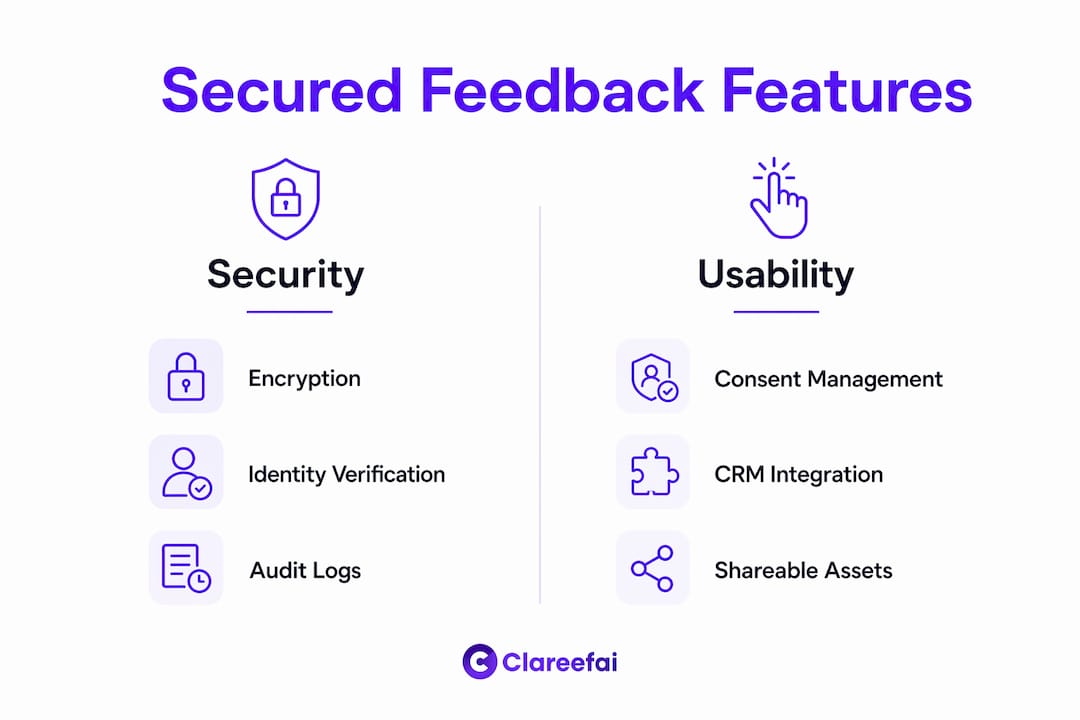
| Must-Have | Nice-to-Have |
|---|---|
| Identity verification (SSO, email domain, manual) | AI-powered promoter identification |
| Tamper-evident, exportable audit logs | Sentiment analysis and NPS delta tracking |
| TLS + AES-256 encryption | White-label embeds for landing pages |
| Consent capture and retention management | Multi-language testimonial collection |
| CRM integration (Salesforce, HubSpot) | Video testimonial recording and hosting |
| RBAC with admin/viewer roles | Automated reference matching by industry |
Sample evaluation questions to ask vendors:
- “How do you verify that a testimonial submitter is who they claim to be?”
- “Can your audit logs be exported and used as evidence in a contract dispute?”
- “How do you handle video file metadata — is EXIF data stripped before storage?”
- “What is your data retention default, and can we configure it per customer contract?”
Sales teams need quick, shareable assets — a verified quote card or a one-click reference request. Marketing teams need embeddable media, analytics on testimonial engagement, and consent records that satisfy legal review.
How to implement a secured feedback system across your team
People and process must accompany any technology purchase. A secure platform with no response workflow, no consent playbook, and no legal alignment will erode trust faster than having no system at all.
- Define pilot scope. Start with one sales pod and one customer success manager. Pick five to ten satisfied customers as initial advocates.
- Assign stakeholder roles. Designate a testimonial owner (usually marketing ops), a legal reviewer, and a CS liaison who manages advocate relationships.
- Build the consent playbook. Draft a short consent form covering: what the testimonial will be used for, where it will be published, and how the customer can request removal. Loop in legal before launch.
- Configure integrations. Connect the platform to your CRM (Salesforce or HubSpot) and your CMS so verified testimonials sync automatically to proposal templates and landing pages.
- Set response SLAs. Every testimonial request should receive a status update within 72 hours. Every published testimonial should be reviewed for accuracy annually.
- Run rollout communications. Brief the sales team on how to request references through the platform, not through personal email threads.
Pro Tip: Run a closed pilot with one sales pod first. Publish the quick wins — a faster close, a new reference — before rolling out company-wide. Proof of value beats a policy memo every time.
How do you measure the impact of secured testimonials?
Measure both leading and lagging indicators. Asset-level engagement tells you what’s resonating; pipeline influence tells you what’s closing.
Key metrics to track:
- Reference-to-deal conversion rate: What percentage of deals that used a verified reference closed versus those that didn’t?
- Time-to-close for reference-backed opportunities: Are deals with named testimonials closing faster?
- Testimonial-driven content engagement: Views, shares, and time-on-page for pages featuring verified social proof
- Net Promoter Score deltas: Are customers who participate in advocacy programs scoring higher on satisfaction surveys?
A practical example: place a verified video testimonial on a proposal page and run an A/B test against the same page without it. Track conversion rate and average time-to-signature. That single test can quantify the revenue impact of authenticated social proof in your specific sales motion.
U.S. legal and privacy considerations for secured feedback
Consent and data-retention policies must align with CCPA/CPRA before you publish any customer testimonial. Here’s what your team should have in place:
- Consent capture: Obtain explicit written consent before publishing any testimonial, specifying the channels and duration of use
- Retention schedule: Define how long testimonial data is stored and when it is deleted; align this with your customer contracts
- Data residency: If enterprise customers require U.S.-only storage, confirm your vendor supports it and document the configuration
- Audit log preservation: Retain logs long enough to support dispute resolution; consult your legal team on the appropriate window
- HR and legal alignment: A secure channel alone won’t help if the internal response to sensitive feedback is punitive — align non-retaliation policies with your technical controls
This article is general information, not legal advice. Confirm current requirements with qualified counsel for your specific situation.
How Clareefai implements secured feedback for sales and marketing teams
Clareefai offers a centralized platform for verified testimonial collection with identity verification, tamper-evident logs, and CRM integrations designed for sales enablement. The platform addresses the core gap most B2B teams have: testimonials collected over email or LinkedIn have no chain of custody, no consent record, and no way to prove authenticity to a skeptical procurement team.
Core capabilities that satisfy the must-have checklist:
- Identity verification workflows that confirm customer identity before a testimonial is published
- Tamper-evident audit logs with timestamps and user attribution for every action
- Video testimonial support with secure hosting and embeddable players for landing pages and proposals
- AI-powered promoter identification that surfaces your most impactful advocates automatically
- Role-specific dashboards for sales, marketing, and customer success with real-time data sync
- GDPR-compliant data management with consent capture and configurable retention settings
- CRM and review platform integrations so verified testimonials flow directly into your sales stack
For teams ready to see it in action, Clareefai’s unified testimonial management use case shows how verified references translate into measurable win-rate improvements.
Key Takeaways
Secured feedback requires encryption, identity verification, and tamper-evident audit logs to be trustworthy and commercially usable in B2B sales cycles.
| Point | Details |
|---|---|
| Three core elements | Every secured feedback system needs encryption, identity verification, and tamper-evident audit logs. |
| Attributed vs. anonymous | Use attributed feedback for publishable testimonials; use anonymous channels for HR, safety, and culture issues. |
| Must-have platform features | Require SSO/email verification, exportable audit logs, AES-256 encryption, consent management, and CRM integration. |
| Measure what matters | Track reference-to-deal conversion rate and time-to-close for reference-backed opportunities to prove ROI. |
| Clareefai | Clareefai provides verified testimonial collection, AI-powered advocate identification, and CRM-connected analytics for B2B teams. |
The case for treating secured feedback as a revenue asset
Most B2B teams treat testimonial collection as a marketing task and security as an IT task. That split is where the value leaks. When a testimonial has no verifiable chain of custody, it can’t survive procurement scrutiny, can’t be used in regulated industries, and can’t be matched to a specific prospect’s context. The security layer isn’t overhead — it’s what makes the asset usable.
The teams that move the needle on win rates aren’t just collecting more testimonials. They’re collecting better ones: attributed, consented, verified, and stored in a system that can prove all three. That’s the difference between a quote in a slide deck and a reference that closes a deal.
Clareefai turns verified testimonials into your strongest sales asset
Your buyers are already skeptical of generic reviews. Clareefai gives your sales and marketing teams a direct path to verified, consent-backed testimonials that hold up under procurement scrutiny — complete with video support, CRM sync, and analytics that show exactly which references are driving pipeline.
Sales teams get shareable, verified proof at the moment it’s needed. Marketing teams get embeddable media with engagement analytics and a consent record that satisfies legal. No manual chasing, no email threads with no audit trail. See how Clareefai’s sales solution fits your current stack, or explore the marketer-focused features to start building a testimonial program that actually moves deals.
Useful sources and further reading
- Secure Digital Feedback — Sustainability Directory: Canonical definition of secured feedback covering confidentiality, integrity, and authenticity requirements.
- Ensuring Data Security: Best Practices for Feedback Data — SurveyConnect: Multi-layered security controls including encryption, RBAC, incident response, and retention policies for feedback platforms.
- How to Maintain Confidentiality and Security in Feedback Systems — LazyMonkey: Practical technical controls: MFA, HTTPS, AES encryption, and audit logging for feedback confidentiality.
- Anonymous vs. Attributed Feedback: Complete Guide — PulseFeed: Trade-off comparison of honesty, follow-up capability, and volume between anonymous and attributed feedback modes.
- Anonymous Employee Feedback Guide — PulseFeed: Guidance on true anonymity guarantees, metadata transparency, and third-party audits for anonymous channels.
- Secure Testimonial Management: A Guide for Marketers — Clareefai Blog: Clareefai’s guidance on aligning HR and legal playbooks with technical testimonial management systems.
- Review Verification: What It Means and Why It Matters — Clareefai Blog: Explains verification methods, audit logs, and why verification matters for trust in published testimonials.
Recommended
Share Article
Stay Updated
Get the latest insights on customer advocacy and SaaS growth delivered to your inbox.