Secure Testimonial Management: A Guide for Marketers
TL;DR:
- Secure testimonial management involves systematically collecting, storing, and deploying customer testimonials with strict consent and legal controls. It ensures that testimonials remain current, authentic, and legally compliant, thereby building trust and accelerating sales. Proper governance, including lifecycle policies and intelligent software tools, is essential for maintaining credibility and maximizing social proof effectiveness.
Secure testimonial management is defined as the systematic process of collecting, storing, approving, and deploying customer testimonials with strict controls over consent, authenticity, and legal compliance. The term “testimonial governance” is the recognized industry standard for this practice, though “secure testimonial management” captures the full operational scope marketers actually work with. 72% of B2B buyers prioritize peer-sourced evidence over vendor claims. That single statistic explains why managing testimonials carelessly is not just a missed opportunity. It is a direct threat to your pipeline. Structured management tracks consent status, usage rights, metadata, and content freshness as core pillars, not afterthoughts.
What is secure testimonial management and why does it matter?
Secure testimonial management is the practice of treating every customer quote, video review, or success story as a managed asset with defined permissions, expiration dates, and deployment rules. Without this structure, testimonials become legal liabilities and credibility risks rather than sales tools.
The business case is direct. When a prospect evaluates your product, they trust what other customers say far more than what you say about yourself. Unmanaged testimonials undermine that trust in three specific ways:
- Outdated content: A testimonial from a customer who has since churned or changed their opinion actively damages credibility.
- Missing consent records: Using a testimonial without documented permission exposes your company to intellectual property and privacy claims.
- Generic praise: Vague statements like “great service” carry no weight with a skeptical buyer. Specific use case proof mapped to real objections is what moves deals forward.
“Testimonial quality mapped to customer objections is more valuable than sheer quantity. Generic praise lowers credibility. Specific, context-rich proof is high-signal evidence that accelerates buyer decisions.”
The benefits of testimonial management extend beyond marketing. Sales teams close faster when they can pull a verified, relevant customer story that directly addresses a prospect’s hesitation. Legal teams sleep better when every testimonial has a documented consent trail. Secure management connects both outcomes.
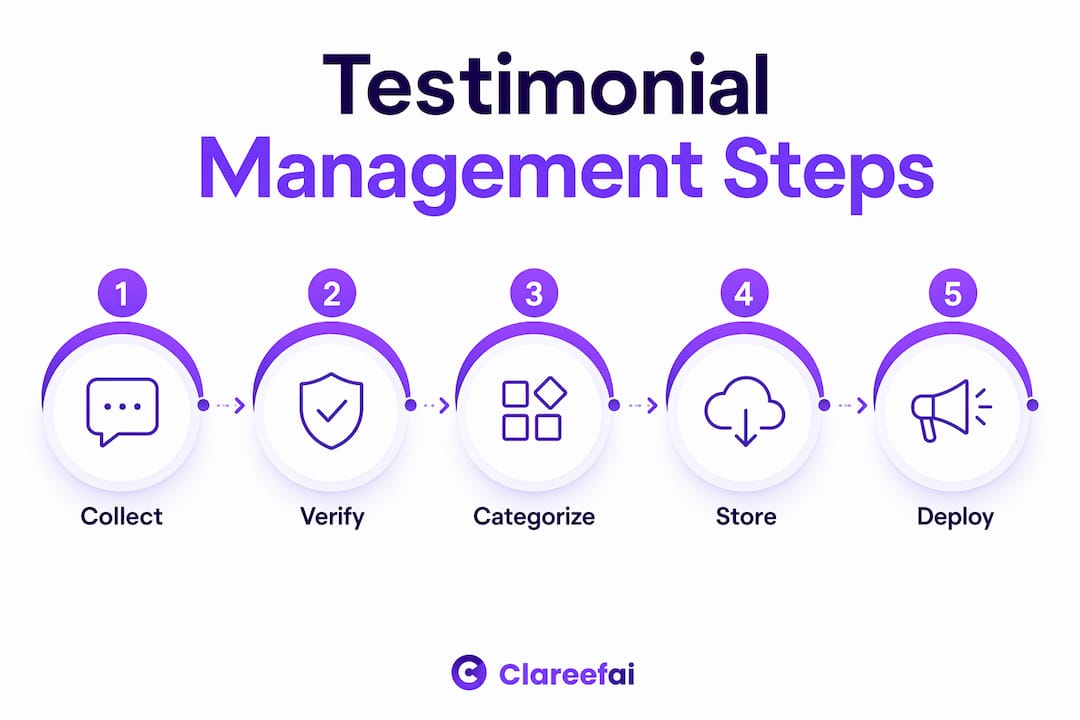
What are the best practices for collecting and categorizing testimonials securely?
Collecting testimonials without a system produces a folder of disconnected quotes that nobody uses. The best practices for testimonials start before you send a single request.
-
Identify your promoters first. Use Net Promoter Score (NPS) or Customer Experience Index (CXI) surveys to find customers who are already satisfied. Targeted outreach yields 3–5x more usable testimonials than cold requests. Asking a detractor for a testimonial wastes time and creates awkward situations.
-
Time your requests at meaningful moments. The best time to ask is immediately after a successful outcome: a product milestone, a renewal, or a support resolution. Timing the request to a positive experience increases both response rate and testimonial quality.
-
Automate consent capture inside your survey workflow. One-click e-signatures embedded in the request process reduce approval time from weeks to days. Consent collected at the point of enthusiasm is also more legally defensible than consent requested after the fact.
-
Classify every submission before it enters your library. Tag each testimonial by product line, customer segment, buyer objection it addresses, and sales funnel stage. A testimonial that answers “Is this platform secure enough for enterprise?” belongs in a different folder than one that answers “Will implementation take too long?”
-
Moderate before publishing. Moderation filters factual errors, removes vague language, and confirms brand alignment. This step protects you from publishing inaccurate claims that could later embarrass the customer or expose you to compliance issues.
Pro Tip: Ask customers a specific question rather than an open-ended one. “What specific result did you achieve in the first 90 days?” produces a far more usable testimonial than “Tell us about your experience.”
You can find a structured testimonial collection checklist that covers each of these steps in detail.

How to maintain testimonial security while managing permissions and legal compliance?
Consent is the foundation of testimonial security, and it is not a one-time checkbox. Rights must cover post-production editing, channel syndication, and geographic distribution for any video or audio testimonial. A customer who approved a quote for your website did not automatically approve it for a paid ad campaign.
A sound permission framework covers four areas:
- Scope of use: Which channels are approved? Website, email, paid media, trade shows, and partner co-marketing each require explicit authorization.
- Duration: Set an expiration date on every consent agreement. Perpetual rights are rarely granted and rarely enforceable without clear documentation.
- Editing limits: For video testimonials, specify what you can cut, reorder, or subtitle. Customers who feel their words were distorted will revoke consent publicly.
- Revocation terms: Define how a customer can withdraw consent and what happens to published content when they do.
Endorsement disclosure is a separate but equally critical requirement. When a customer receives compensation, a discount, or any promotional benefit in exchange for a testimonial, that relationship must be disclosed. Transparency here builds trust with prospects and keeps you compliant with Federal Trade Commission (FTC) guidelines.
Metadata tagging ties the legal and operational layers together. Every testimonial in your library should carry tags for: approved channels, expiration date, geographic restrictions, compensation status, and whether the original unedited content is archived. This metadata prevents misuse and makes audits straightforward.
Pro Tip: Store the original, unedited version of every testimonial alongside the published version. If a customer disputes how their words were used, the original recording or transcript is your clearest defense.
What strategies ensure testimonial content stays current and effective?
Stale testimonials are a credibility risk that most marketing teams underestimate. A quote from a customer who referenced a product feature you discontinued two years ago tells prospects you are not paying attention.
The solution is a formal lifecycle policy. Testimonials should be refreshed every 18–24 months to remain accurate, relevant, and compliant with current privacy laws. That refresh cycle should be built into your content calendar, not handled reactively.
Practical lifecycle management includes:
- Sunset rules: Any testimonial older than your defined threshold gets flagged automatically for review. The default action is either re-approval from the customer or archiving.
- Performance monitoring: Track which testimonials actually get used by sales, which ones appear in winning deals, and which ones sit untouched. Low-use testimonials are candidates for replacement.
- Re-approval workflows: When a customer’s role, company, or situation changes, re-approval protects you from publishing content that no longer reflects their current position.
- Sector and service line tagging: As your product evolves, testimonials need to stay aligned with current offerings. A testimonial about a legacy feature misleads prospects and wastes sales time.
The danger of ignoring lifecycle management is concrete. A prospect who notices that your most prominent testimonial references a product version from three years ago will question whether your customer base is still engaged. Treating testimonials as living managed data with scheduled refreshes is what separates a credible social proof program from a static quote wall.
What tools and software features support secure testimonial management?
Testimonial management software earns its place when it removes the manual work that causes teams to skip consent steps and let libraries go stale. The right platform handles collection, storage, permissions, and deployment in one place.
Key features to evaluate in any testimonial management platform:
- In-browser video and text capture: Customers submit testimonials without installing software or navigating complex portals. Lower friction means higher completion rates.
- Automated consent capture: Consent forms are embedded directly in the collection workflow. The customer approves usage rights at the moment of submission, not days later via a separate email chain.
- Centralized, searchable library: Role-based permissions let sales reps find and share testimonials without accessing sensitive consent records. Marketing admins manage the full library. Legal teams audit the metadata layer.
- Embed options: Testimonials should be deployable directly into landing pages, email sequences, and sales decks without manual reformatting.
- Audit trails: Every action taken on a testimonial, from submission to publication to archiving, should be logged with a timestamp and user ID.
Clareefai combines all of these capabilities with GDPR-compliant consent management, AI-driven promoter identification, and real-time data synchronization across channels. The platform’s unified testimonial management approach gives sales and marketing teams a shared library that stays current, compliant, and ready to deploy at every stage of the buyer journey. For teams managing video testimonials, the platform’s rights management features are particularly valuable.
Key Takeaways
Secure testimonial management requires verified consent, structured categorization, and a formal lifecycle policy to deliver lasting trust and sales impact.
| Point | Details |
|---|---|
| Define consent scope clearly | Every testimonial needs documented permissions covering channels, duration, editing rights, and revocation terms. |
| Target promoters first | NPS-based outreach yields 3–5x more usable testimonials than untargeted requests. |
| Categorize by buyer objection | Tag testimonials by the specific concern they address to make them useful at the right sales stage. |
| Refresh every 18–24 months | Stale testimonials undermine credibility; a formal sunset policy keeps your library accurate and compliant. |
| Use metadata to prevent misuse | Tagging each asset with channel approvals, expiration dates, and compensation status protects you legally and operationally. |
What most teams get wrong about testimonial governance
The most common mistake I see is treating testimonials as a one-time marketing task rather than an ongoing data management responsibility. Teams collect a batch of quotes after a product launch, publish them, and then forget them for two years. By the time someone notices the library is outdated, the damage to credibility is already done.
The second mistake is siloed ownership. When sales owns some testimonials, marketing owns others, and customer success collects a third set independently, you end up with duplicates, conflicting consent records, and no single source of truth. Cross-team shared ownership with clearly defined roles is the only structure that works at scale.
The insight that actually moves the needle is this: testimonials are conversion assets, and they should be tested like any other conversion asset. Rotate them. Measure which ones appear in closed-won deals. Replace underperformers. The teams that treat testimonials as trust-building tools with measurable impact consistently outperform those that treat them as decorative content. Consent workflow optimization and renewal scheduling are not legal overhead. They are the operational foundation that makes your social proof program credible enough to actually influence buyers.
— ClareefAi
How Clareefai helps you manage testimonials securely at scale
Clareefai is built for marketing professionals and business leaders who need a consent-aware, sales-ready testimonial program without the manual overhead.
The platform automates promoter identification using AI-driven analysis, embeds consent capture directly in collection workflows, and organizes every testimonial in a centralized library with role-based access. Sales teams get a searchable, categorized proof library they can deploy in real time. Marketing teams get a compliant, current asset base. Management gets analytics that show which testimonials actually influence deals. See how Clareefai’s customer advocacy solutions connect verified customer proof to every stage of your sales funnel, and explore real customer stories that show the platform in action.
FAQ
What is secure testimonial management?
Secure testimonial management is the process of collecting, storing, and deploying customer testimonials with documented consent, metadata tracking, and lifecycle controls to maintain authenticity and legal compliance.
How often should testimonials be refreshed?
Testimonials should be reviewed and refreshed every 18–24 months to stay accurate, relevant, and compliant with current privacy regulations.
What consent information must a testimonial record include?
Every testimonial record should document the approved channels, usage duration, editing permissions, geographic restrictions, compensation status, and revocation terms.
Why does testimonial quality matter more than quantity?
Generic praise carries no weight with skeptical buyers. Specific testimonials mapped to real buyer objections are high-signal proof that directly addresses purchase hesitation and accelerates decisions.
What is endorsement disclosure and when is it required?
Endorsement disclosure is a statement that a customer received compensation or a promotional benefit in exchange for their testimonial. FTC guidelines require this disclosure to maintain transparency and advertising compliance.
Recommended
Share Article
Stay Updated
Get the latest insights on customer advocacy and SaaS growth delivered to your inbox.