Get More G2 Reviews: 30/60/90 Playbook for B2B SaaS
The fastest way to get more G2 reviews is to stop treating requests as a one-off email blast and instead trigger asks at high-success customer moments while running a G2-managed campaign alongside your own outreach. Combine three levers: a customer success trigger right after a support win or renewal; an in-app review widget; and a G2-run campaign for scale. Teams doing this consistently see review counts climb month over month instead of spiking once a quarter.
TL;DR:
- Trigger review requests immediately after support wins, renewals, or onboarding to capitalize on high customer satisfaction moments.
- Maintaining a steady, high-velocity flow of recent reviews outperforms sporadic, large campaigns in boosting visibility and AI recognition.
- Using G2-managed campaigns yields approximately three times higher response rates compared to vendor-led outreach, with minimal effort required.
- Automating review collection with verification platforms reduces operational workload and ensures reviews are relevant, verified, and compliant for external use.
- Embedding reviews into sales content and accurately verifying reviewer identity enhances their impact on prospects and shortens sales cycles.
Table of Contents
- Why G2 Reviews Matter for SaaS Growth
- Priority Checklist: Top 6 Tactics to Start This Week
- How Do You Run a G2 Review Campaign That Actually Converts?
- What Does a 30/60/90-Day G2 Review Campaign Look Like?
- How Do You Turn G2 Reviews Into Sales Assets?
- Cultural and Operational Practices That Sustain Review Growth
- Why Automated Verification Beats Building It Yourself
- Sources
- FAQ
Why G2 Reviews Matter for SaaS Growth
Buyers don’t read your homepage first anymore. They ask an AI tool to compare vendors, and that tool pulls from review platforms to build its answer. G2’s own research found that Many B2B buyers say AI search has changed how they research software, and G2 consistently ranks as a top source those AI tools cite for software comparisons.
That shift changes what “good enough” looks like. A profile with 40 reviews from two years ago reads as stale to both a human buyer and an AI summarizer. Recency now carries as much weight as volume, because both signal whether current customers still stand behind the product.
The recency signal: G2 has documented customer examples where automated, always-on collection produced increases in reviews measured in multiples, not percentages, alongside tracked gains in lead volume and ARR. Vendors like Xactly and FloQast are among the cases G2 points to for this kind of sustained review velocity.
The takeaway: prioritize velocity and freshness over chasing a single big push. A steady drip of new reviews does more for your ratings and your AI visibility than one campaign that goes quiet for six months.
Priority Checklist: Top 6 Tactics to Start This Week
You don’t need a fully built program to see movement. Start with these six, ranked by how fast they pay off:
- Trigger a CS ask after a support win. Low effort, high impact. Track: reviews submitted within 48 hours of resolution.
- Add an in-app review widget. Medium effort, high impact. Track: widget click-through rate.
- Launch a G2-run campaign. Low effort (for you), high impact. Track: campaign conversion rate.
- Convert NPS promoters into reviewers. Medium effort, medium impact. Track: promoter-to-review conversion rate.
- Ask at renewal or QBR. Low effort, medium impact. Track: reviews tied to renewal cohort.
- Refresh outreach to lapsed customers. Medium effort, medium impact. Track: reactivation response rate.
How Do You Run a G2 Review Campaign That Actually Converts?
Timing beats persuasion. A well-timed ask to a satisfied customer converts far better than a perfectly worded one sent at a random moment. The insight from G2’s own success research is straightforward: link the ask to a moment of high emotion. Right after onboarding completion, right after a support ticket closes, right after a customer scores you a 9 or 10 on an NPS survey. Renewal and QBR conversations work too, since the customer is already reflecting on value received.
Email cadence matters more than most teams assume. G2’s outreach guidance recommends an initial ask plus up to two reminders, spaced roughly a week apart, rather than one email and silence. Personalize with tokens like first name, product tier, and the specific feature or outcome the customer achieved. Keep subject lines short and benefit-oriented rather than transactional.
Compliance isn’t optional. G2’s community guidelines require a representative sample of customers, not just your happiest ones, and outreach that conditions rewards on positive content risks removal. A $25 Amazon gift card as a thank-you for any honest review is standard practice; offering it only if the review is favorable is not.
For in-app prompts, the goal is friction reduction, not persuasion copy. Trigger the widget after a clear success event (a report generated, a workflow completed), prefill what you already know (name, company, plan tier), and never interrupt an active task. A prompt that appears mid-workflow gets dismissed; one that appears right after a “task complete” screen gets clicked.
Survey-to-review flows work well when you treat NPS as a funnel, not an endpoint. Route promoters (9s and 10s) directly to a G2 review link in the same confirmation screen, while routing detractors to a private feedback form instead.
On G2-run versus vendor-run campaigns: letting G2 manage the outreach typically produces roughly three times the response rate of a vendor sending the same ask from its own domain. G2-managed campaigns need only a first name and email per contact, and G2 handles the three-email cadence and compliance guardrails on your behalf.
- Route review requests through Pendo or Delighted to trigger asks based on in-app behavior or survey score, not a calendar date.
- Sync review status back into your CRM so sales and CS know which accounts have already been asked, avoiding duplicate or poorly timed requests; refer to the Marketing Automation Checklist: Step-by-Step Guide for SMBs for practical automation workflows to help with this process.
- Use the Review Generation API if your team wants asks embedded directly in existing product workflows rather than a separate email tool.
- Build a refresh cadence: re-approach customers from your oldest published reviews at 12 to 18 months to keep the profile current.
A common integration pitfall: connecting Pendo or Delighted but never routing the data anywhere actionable, so the trigger fires and nobody follows up. Automation without an owner is just noise in a dashboard.
Pro Tip: Segment your ask list by contract value before you launch a campaign. Your highest-ARR accounts deserve a personal note from their CSM, not the same templated email going to a self-serve trial user.
For a deeper breakdown of timing and templates, Clareefai’s guide to step-by-step review collection walks through send sequencing in more detail.
What Does a 30/60/90-Day G2 Review Campaign Look Like?
A structured rollout beats sporadic asks. Here’s a schedule you can adapt starting Monday.
Days 1 to 30: Foundation
- Marketing exports a segmented customer list (by tenure, plan, and NPS score).
- CS flags accounts in a support win or successful onboarding this month.
- Launch a G2-run campaign for the broad list; CS handles high-value accounts personally.
- Set up the in-app widget with prefill data.
Days 31 to 60: Scale
- Add NPS-to-review routing for new promoter scores.
- Send the first reminder wave to non-responders.
- Marketing reports initial review velocity to leadership.
Days 61 to 90: Optimize
- Review which channel (email, in-app, G2 campaign) drove the most published reviews.
- Refresh messaging based on response data.
- Set a recurring monthly cadence instead of a one-time push.
Assign clear owners: CS triggers the moment-based asks, marketing manages the campaign and reporting, and product supports the in-app widget implementation. Track four numbers throughout: review velocity (new reviews per month), response rate, total published reviews, and average review recency. At each 30-day checkpoint, drop the channel that underperformed and double down on whichever drove the most conversions. Clareefai’s review management playbook offers a longer version of this cadence if you want more granular weekly detail.
How Do You Turn G2 Reviews Into Sales Assets?
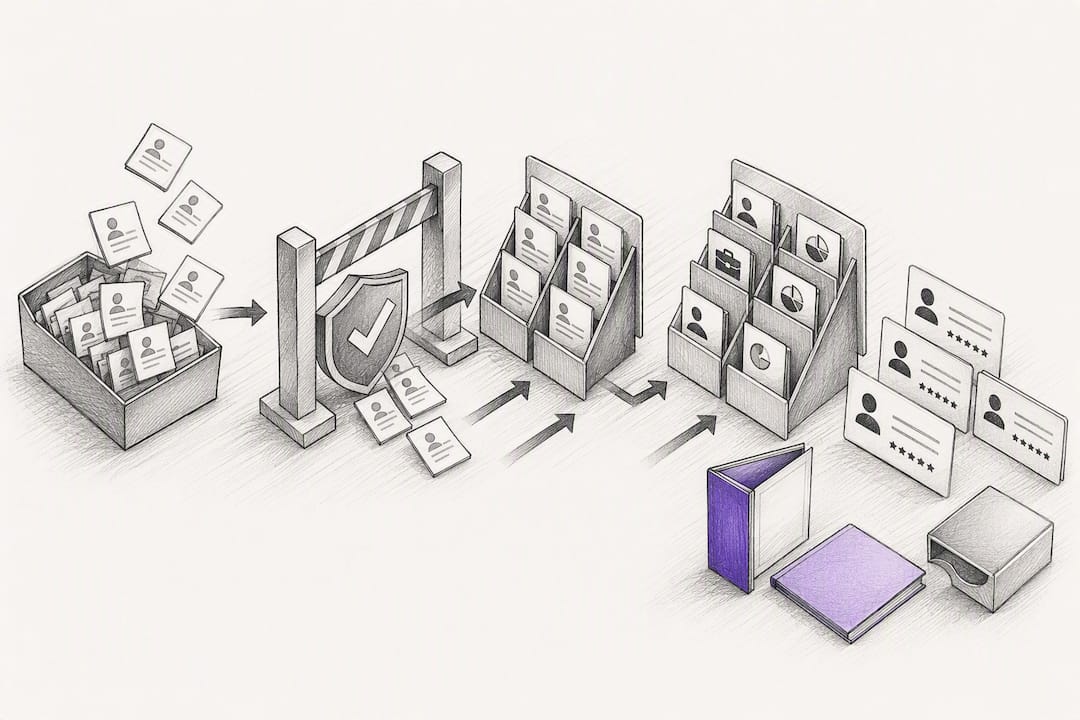
A published review sitting on your G2 profile only works when a prospect happens to visit it. The higher-leverage move is verifying the reviewer’s identity and role, then pulling the strongest quotes into sales decks, demo scripts, and website pages where prospects already are.
The platform applies this logic directly: it verifies reviewer identity, tags feedback by role and use case, and syncs the strongest testimonials into sales collateral automatically. In one applied case, Host U Need used this contextualization approach to move verified customer feedback out of a static review page and into active sales conversations, shortening the credibility gap with new prospects.
Before reusing any review externally, confirm the reviewer consented to public use beyond G2, strip any personally identifiable data not already public, and keep a record of consent for GDPR compliance. A quote pulled into a sales deck without that trail is a liability, not an asset.
Cultural and Operational Practices That Sustain Review Growth
Most teams that get more G2 reviews long term share one trait: review generation isn’t parked in a single department. CS owns the moment-based trigger, marketing owns the campaign and reporting, and both share the metric. Teams that pair this with light incentives, a spiff for the CSM whose accounts generate the most reviews, or a simple leaderboard, keep momentum past the first campaign push. The programs that stall are the ones treating review generation as a quarterly project instead of a standing part of the customer success workflow.
— ClareefAi
Why Automated Verification Beats Building It Yourself
Running review generation across email, in-app prompts, CS triggers, and G2 campaigns generates a lot of raw feedback fast, but sorting which quotes are verified, relevant, and sales-ready takes real operational effort. The platform handles that sorting automatically: it collects testimonials and reviews across channels, verifies reviewer identity, categorizes feedback by role and use case, and publishes the strongest proof points to sales pages and decks without manual tagging.
DIY spreadsheets and shared drives work fine at a handful of reviews a month. Once you’re running the 30/60/90 cadence above across multiple product lines or teams, manually tracking who consented, what’s verified, and where each quote lives becomes its own job. That’s the point where a dedicated platform pays for itself in saved hours, not just in polish.
See how this plays out for a real account on the Boosting Win Rates with Unified Testimonial Management use-case page, then start a trial to connect your first testimonial source this week.
FAQ
Are G2 Reviews Legitimate?
Yes. G2 verifies reviewer identity and requires a representative sample of customers rather than only favorable ones, and it removes reviews tied to evidence of selective solicitation or incentives conditioned on positive content.
How Much Does G2 Pay Per Review?
G2 doesn’t pay for reviews directly, but vendors commonly offer a small thank-you reward, such as a $25 gift card, for any honest review regardless of rating.
What Is G2 Reviews and How Does It Work?
G2 is a software review platform where verified users rate and review B2B products; vendors can request reviews through email outreach, in-app widgets, APIs, or G2-managed campaigns.
What Are G2 Product Reviews?
They’re structured, verified customer evaluations covering ease of use, support quality, and value for money, displayed on a vendor’s G2 profile and increasingly surfaced by AI search tools during buyer research.
How Can Clareefai Help Increase G2 Ratings?
Clareefai verifies and contextualizes existing customer feedback by role and use case, then routes the strongest proof points into sales materials, which supports the same customer moments that drive stronger G2 submissions.
Recommended
Share Article
Stay Updated
Get the latest insights on customer advocacy and SaaS growth delivered to your inbox.