Review Management Strategies 2025: Your Complete Playbook
The most effective review management strategies in 2025 combine proactive collection, AI-assisted responses, and real-time sentiment analysis to build customer trust, lift local SEO rankings, and protect revenue. Businesses that treat reviews as a passive byproduct of good service consistently lose ground to those that treat them as an active growth channel. Here is what that looks like in practice:
- Collect proactively. SMS automation and QR codes at key customer touchpoints generate a steady, representative flow of feedback rather than a trickle of extreme opinions.
- Monitor in real time. Centralized dashboards aggregating Google Business Profile, Yelp, Facebook, and industry-specific platforms catch new reviews the moment they post.
- Respond within 24–48 hours. Prompt responses improve local SEO rankings and shape customer perception before a negative review compounds.
- Analyze for patterns. Sentiment analysis surfaces recurring issues like “slow service” or “shipping delays” before they accumulate into a ratings problem.
- Balance AI with human judgment. AI drafts responses at scale; a human reviews anything sensitive or complex to keep the brand voice authentic.
- Stay compliant. Review solicitation must align with TCPA and GDPR requirements to avoid legal exposure.
Online reviews influence 93% of consumer purchasing decisions. That single figure explains why review management is no longer a customer service function. It is a core marketing discipline.
Table of Contents
- Why review management is the foundation of your marketing strategy
- Advanced strategies for proactive review generation and response
- How to choose and build a centralized review management system
- A step-by-step review management process that actually runs
- How AI and human insight work together in review management
- Clareefai turns your best customers into your strongest sales asset
- Key Takeaways
Why review management is the foundation of your marketing strategy
Online review management is the process of monitoring, collecting, responding to, and learning from customer feedback across platforms like Google, Yelp, Facebook, TripAdvisor, and industry-specific sites. For marketing managers, it sits at the intersection of brand reputation, local SEO, and conversion rate optimization.
The business case is direct. A half-star improvement in Google ratings can increase revenue by 5–7%, underscoring the direct financial impact of review management. Review volume, freshness, and response rates all influence how each location ranks in local search results. Ignoring this feedback loop does not just hurt your reputation. It actively constrains growth.
Effective review management rests on four interconnected pillars: collection, moderation, display, and analysis. Siloed approaches, where a team responds to reviews but never analyzes sentiment trends, or collects reviews but never displays them prominently, consistently underperform. The pillars work together or they do not work at all.
Key principles every marketing team should anchor to:
- Multi-platform presence. Not every review site matters equally. Identify where your customers actually search and trust, then build a presence there first.
- Response frameworks. Standardized templates for positive, neutral, and negative reviews maintain brand voice consistency without making every reply feel generic.
- Review volume and recency. Search algorithms weight fresh reviews heavily. A business with 200 reviews from three years ago ranks below one with 80 reviews from the past 90 days.
- Team training and SOPs. Defining who monitors daily, who has response authority, and how escalations flow prevents the brand voice from fracturing across locations or team members.
- Integrated tooling. Platforms like Google Business Profile, Yotpo, Sprout Social, and Birdeye each offer distinct capabilities, from review aggregation to AI-powered sentiment analysis, that support a cohesive workflow.
Review management is also brand currency that powers long-term revenue retention, not just damage control. Businesses that internalize this shift their posture from reactive to proactive, and that shift is where the real competitive advantage lives.
Advanced strategies for proactive review generation and response
Waiting for customers to leave reviews organically produces a skewed sample, mostly people who are very happy or very upset. A proactive approach changes that distribution and gives you more data to work with.

SMS automation is the highest-performing collection channel available right now. Text messages carry open rates that email cannot match, and most are read within minutes of delivery. Triggering an SMS review request immediately after a completed purchase, appointment, or resolved support ticket captures feedback while the experience is still fresh. The timing matters as much as the channel.
QR codes at physical touchpoints, receipts, checkout counters, and service completion points, lower the friction for in-person customers who would otherwise never think to leave a review online. Pair them with a direct link to your preferred review platform and the conversion rate climbs noticeably.
Visual and video review solicitation is one of the most underused tactics in 2025. Photos and videos significantly boost user engagement and help overcome consumer skepticism toward text-only reviews. Actively prompting customers to include an image or short video, especially for product-heavy or hospitality businesses, generates content that performs better in search and converts better on product pages.
AI-assisted response drafting with human review is the standard for any team managing more than a few dozen reviews per week. AI handles the volume and maintains tone consistency; a human catches anything that requires empathy, nuance, or escalation. The combination keeps response times fast without sacrificing authenticity.
Sentiment analysis gives you a predictive edge. Rather than reacting to a wave of negative reviews, proactive sentiment monitoring identifies emerging issues before they escalate publicly. If “wait times” starts appearing in 30% of your reviews over a two-week window, that is an operational signal, not just a reputation problem.
Pro Tip: When blending AI automation with human oversight, create a simple escalation rule: any review mentioning a refund, legal threat, health concern, or named employee goes directly to a human responder before any AI-drafted reply is published. This single guardrail prevents the most damaging automated responses.
Compliance is non-negotiable. Review solicitation must comply with TCPA and GDPR requirements when using SMS automation. Never incentivize reviews in ways that violate FTC guidelines or platform terms of service. Fake reviews and undisclosed incentives carry real legal and reputational consequences.
How to choose and build a centralized review management system
The right review management platform is not about the longest feature list. It is about how well the system fits your existing stack and scales without adding operational complexity.
Core features to evaluate
| Feature category | What to look for |
|---|---|
| Centralized dashboard | Aggregates reviews from Google, Yelp, Facebook, and niche platforms in one view |
| Automation triggers | Sends review requests based on CRM events, purchases, or appointment completions |
| AI response drafting | Generates brand-aligned response drafts for human approval before publishing |
| Sentiment analysis | Identifies trending topics and flags negative patterns across locations |
| CRM and POS integration | Ties review data to real customer records for personalized follow-up |
| API extensibility | Pushes real-time review sentiment into your data lake or enterprise stack |
| Security and compliance | SOC 2 Type II, GDPR support, and HIPAA readiness for regulated industries |
| Multi-location analytics | Tracks performance by location to spot outliers and replicate success |
Integration with CRM, POS, and customer data platforms is what separates a review tool from a review management system. When review data flows into your broader business systems, it can trigger automated workflows, inform customer success outreach, and surface operational priorities that would otherwise stay buried in unread feedback.
Birdeye is built for multi-location businesses that need to monitor, respond to, and analyze reviews across hundreds or thousands of locations from a single dashboard. Its AI agents draft responses, automate review requests, and surface competitive benchmarking data, all while teams maintain approval control.
Google Business Profile remains the highest-priority platform for most businesses. Review volume, recency, and response rates on Google directly influence local pack rankings. Any review management system you choose must integrate with Google Business Profile as a baseline.
Yotpo specializes in e-commerce and product review management, with strong capabilities for collecting visual reviews, syndicating ratings to Google Shopping, and embedding review widgets that convert. Its four-pillar framework of collection, moderation, display, and analysis gives marketing teams a structured way to think about the full review lifecycle.
Sprout Social extends review management into social listening, connecting review data with broader brand mention monitoring across social platforms. For teams that manage both social media and review channels, the unified view reduces context-switching and speeds up response times.
Critical evaluation factors for marketing managers choosing a platform:
- Does it integrate natively with your CRM, help desk, or POS, or does it require custom API work?
- Can it scale to your current location count and your projected growth without a pricing cliff?
- Does it support the compliance requirements of your industry, specifically SOC 2, GDPR, or HIPAA?
- Does it offer outcome-based pricing tied to locations or review growth goals, rather than seat count alone?
- How much human approval control does it give you over AI-drafted responses before they publish?
Multi-location businesses can manage thousands of reviews with AI-powered efficiency while maintaining brand consistency, but only when the platform architecture supports it. A tool that works for a single-location restaurant will not hold up for a 500-location retail chain.
A step-by-step review management process that actually runs
Consistency is what separates businesses with strong review profiles from those that spike and crash. The process below is designed to run as a repeatable routine, not a one-time project.
Daily tasks (15–30 minutes)
- Check for new reviews across all platforms: Google Business Profile, Yelp, Facebook, and any industry-specific sites.
- Respond to every new review, prioritizing negative reviews first, then neutral, then positive.
- Flag any review mentioning a legal threat, health concern, or named employee for immediate escalation.
- Note any recurring themes or keywords that appeared in the day’s reviews.
Weekly tasks (30–60 minutes)
- Review analytics: total new reviews, average rating of new reviews, response time, response rate, and top review sources.
- Identify patterns. Are multiple customers mentioning the same issue? Is a specific location underperforming?
- Audit your review collection process: are QR codes visible, are SMS triggers firing correctly, are follow-up emails sending?
- Check competitor review velocity on your top three platforms to benchmark your own growth.
Monthly tasks
- Audit ratings and review counts across every platform and compare to the prior month.
- Refresh response templates to reflect any product, service, or policy changes.
- Analyze the review-to-revenue connection: did months with higher review volume correspond with more inbound leads or higher conversion rates?
- Evaluate QR code placement effectiveness and test new locations if scan rates are low.
Quarterly strategic review
- Conduct a full competitive analysis across your top 5–10 competitors: star ratings, review counts, response rates, and review velocity.
- Adjust your collection strategy based on data. If volume is low, add collection touchpoints. If ratings are declining, investigate the operational root cause.
- Train or retrain staff on review collection etiquette, response guidelines, and escalation procedures.
- Set specific goals for the next quarter: target review volume, target average rating, target response time, and platform diversification metrics.
Key measurement metrics to track consistently:
- Average star rating across all platforms
- Response rate (percentage of reviews that received a reply)
- Average response time (hours from review posted to reply published)
- Review volume trends by platform and location
- Sentiment shift over time (positive, neutral, negative ratios)
Responding to reviews within 24 hours is the single highest-impact task in this entire process. It directly shapes how potential customers perceive your brand when they read your reviews, and it contributes to local SEO in a way that no other single action matches.
How AI and human insight work together in review management
AI handles volume. Humans handle nuance. The businesses getting the most out of their review programs in 2025 have figured out exactly where that line sits.
AI-assisted review management automates routine tasks like drafting responses, sending collection requests, and categorizing feedback by topic and sentiment. This frees your team to focus on the reviews that actually require judgment: a customer describing a safety issue, a long-time client expressing disappointment, or a review that hints at a systemic operational problem.
The technology stack powering this integration includes:
- Predictive analytics that identify customers likely to leave negative reviews before they post, enabling proactive outreach.
- Real-time alerts that notify your team the moment a critical review appears, so you can respond before the review gains visibility.
- Adaptive sentiment analysis that updates as customer language evolves, catching new complaint patterns that static keyword filters would miss.
- Personalized response templates generated from review content, product type, and customer history, rather than generic copy-paste replies.
AI should draft responses and analyze sentiment, but human review is essential to avoid robotic replies that alienate customers. This is not a limitation of the technology. It is a deliberate design choice that the best-performing teams build into their workflows from the start.
Predictive analytics and proactive outreach shift your brand posture from reactive to predictive. Instead of waiting for a dissatisfied customer to post publicly, you contact them first, resolve the issue, and often convert a potential detractor into a loyal advocate.
Clareefai’s approach reflects this balance directly. The platform uses AI-driven analysis to identify the most impactful customer advocates, then surfaces verified testimonials and video reviews through GDPR-compliant workflows. Role-specific dashboards give marketing managers and sales teams visibility into which customer stories are performing, while real-time data synchronization keeps every touchpoint current. The result is a system where verified social proof replaces anonymous feedback, and every testimonial carries the context and credibility that actually moves prospects forward.

For B2B teams specifically, video testimonials add a layer of trust that text reviews rarely achieve. A verified customer speaking on camera about a specific outcome is a fundamentally different asset than a five-star rating with no context.
Clareefai turns your best customers into your strongest sales asset
Most review management tools help you collect and display feedback. Clareefai goes further: it identifies your most credible advocates, verifies their identity, and puts their testimonials to work at every stage of your sales funnel.
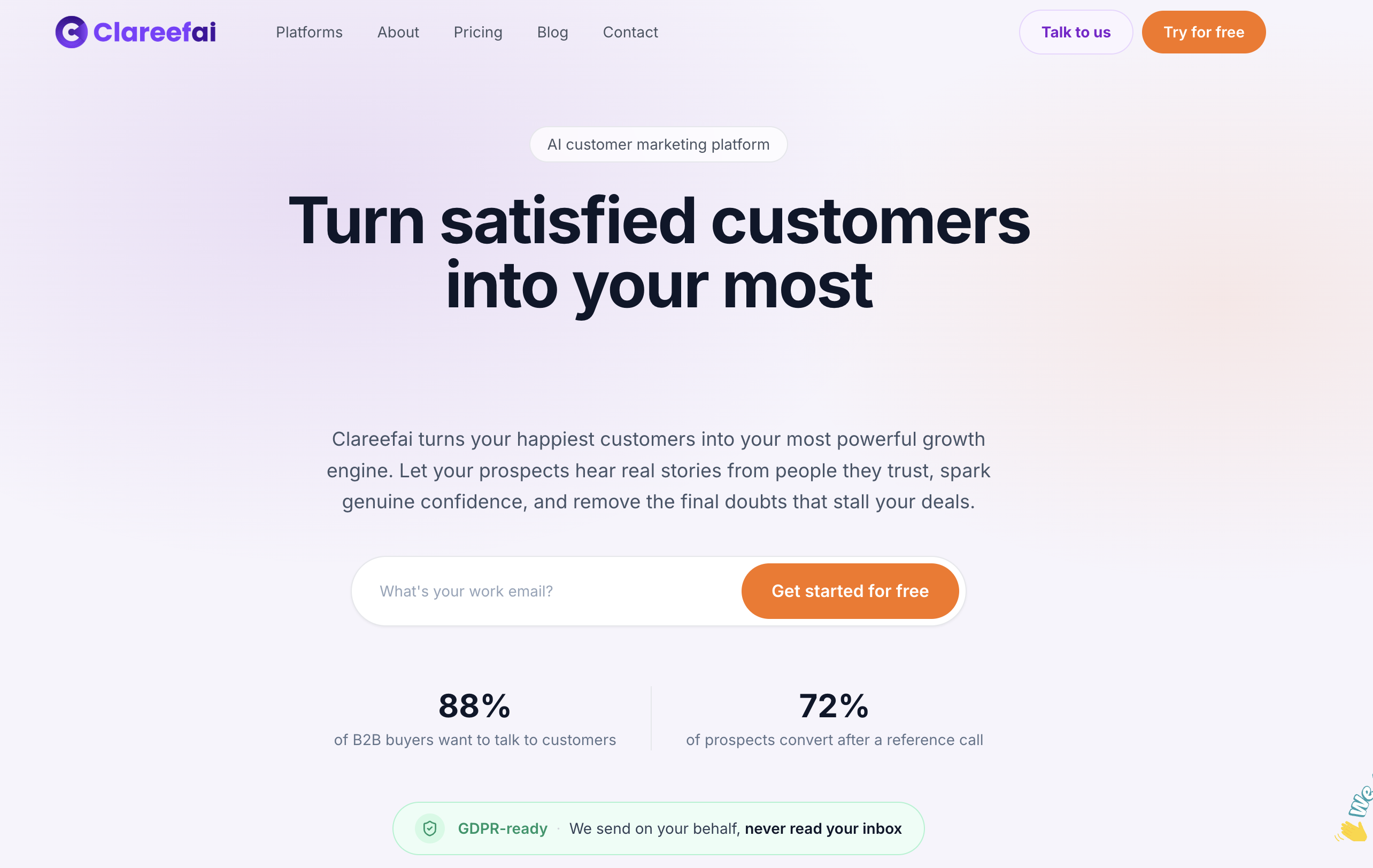
For B2B marketing managers and business owners who need more than a star rating, Clareefai’s platform organizes, verifies, and displays customer success stories in a way that builds real credibility with prospects. AI-driven analysis pinpoints which customer voices carry the most weight for specific buyer profiles. Automated display puts those testimonials on the channels where your prospects are already looking. And because every review is tied to a verified identity, you eliminate the trust gap that anonymous feedback creates.
The platform is GDPR-compliant, integrates with your existing stack, and gives every role, from sales to marketing to leadership, a dashboard view of what your customers are actually saying. If you are ready to turn satisfied customers into active promoters, explore Clareefai’s platform and see how verified social proof moves the needle on conversion rates.
Key Takeaways
The most effective review management strategies in 2025 combine proactive collection, AI-assisted analysis, and human oversight to build trust, improve local SEO, and drive measurable revenue growth.
| Point | Details |
|---|---|
| Reviews drive purchasing decisions | 93% of consumers are influenced by online reviews, making active management a direct revenue lever. |
| Response speed matters | Responding within 24–48 hours improves local SEO rankings and shapes customer perception before negative reviews compound. |
| Half-star rating impact | A half-star improvement in Google ratings can increase revenue by 5–7%, making rating management a financial priority. |
| AI plus human oversight | AI handles volume and drafting; human review catches nuance, emotion, and escalation scenarios that automation misses. |
| Clareefai for B2B social proof | Clareefai verifies customer identities, surfaces top advocates with AI analysis, and displays testimonials across sales touchpoints in a GDPR-compliant workflow. |
Recommended
Share Article
Stay Updated
Get the latest insights on customer advocacy and SaaS growth delivered to your inbox.