Examples of Reputation Management That Actually Work
TL;DR:
- Effective reputation management involves proactive monitoring, rapid response to feedback, and creating authoritative content. Building verified social proof and authentic community engagement sustains a trustworthy brand image over time.
Reputation management is the ongoing process of shaping and protecting how your brand is perceived across every digital touchpoint, from Google reviews to AI-generated search summaries. The best examples of reputation management share three traits: they are proactive, they are consistent, and they treat every piece of feedback as data. Online reputation management operates across four core pillars: monitoring, building, responding, and suppressing negative content. Marketing and communication professionals who master all four pillars build brands that prospects trust before the first sales conversation even begins.
1. Examples of proactive monitoring and listening
Proactive monitoring is the foundation of every effective reputation management strategy. You cannot respond to what you cannot see, and most reputation crises start as small signals on forums, Reddit threads, or niche review sites long before they reach mainstream visibility.

AI-driven monitoring with real-time sentiment alerts gives brands the ability to track thousands of mentions simultaneously and forecast reputation risks before they escalate. That speed advantage is decisive. A brand that spots a complaint thread on a niche forum within two hours can address it before it gets amplified.
Effective monitoring covers:
- Google reviews and Maps listings for local and branded search
- Social media platforms including LinkedIn, X (formerly Twitter), and Instagram
- Community forums like Reddit and industry-specific discussion boards
- AI search summaries from tools like Perplexity and ChatGPT, which now surface brand sentiment directly in results
Social listening tools enable brands to anticipate reputation threats faster than any manual process. The practical implication is that your monitoring stack should feed directly into your CRM and customer success workflows, not sit in a separate dashboard that nobody checks.
Pro Tip: Set up keyword alerts not just for your brand name, but for common misspellings, product names, and the names of your senior leadership. Negative content often targets individuals, not just companies.
2. Rapid response to customer feedback and reviews
Speed and tone are the two variables that determine whether a negative review damages your brand or actually builds trust. Responding within 24 hours to negative reviews reduces reputational damage and signals to prospects that your company takes customer care seriously.
The most effective response framework follows four steps:
- Acknowledge the issue without being defensive. Use language like “We hear you” rather than “You misunderstood.”
- Apologize for the experience, not necessarily for fault. The distinction matters legally and emotionally.
- Offer a concrete next step, whether that is a refund, a follow-up call, or a direct contact name.
- Move the conversation offline by providing a direct email or phone number, which prevents a public back-and-forth.
Brands that follow this framework consistently see their average star ratings improve over time, not because they delete bad reviews, but because their responses demonstrate accountability. Prospects reading those exchanges trust the brand more, not less.
Treating negative feedback as a source for operational improvements shifts your team’s mindset from damage control to continuous improvement. That shift is what separates reactive brands from resilient ones.
Pro Tip: Build an internal response playbook with pre-approved language for your five most common complaint categories. Train every customer-facing team member on it. Consistency across responses builds a recognizable, trustworthy brand voice.
3. Positive content creation and SEO for reputation control
Publishing authoritative content is the most durable way to control what prospects see when they search your brand. Suppressing negative search results through SEO and fresh content means creating assets that outrank negative mentions rather than attempting to delete them.
The content types that move the needle most are:
| Content Type | SEO Benefit | Reputation Impact |
|---|---|---|
| Customer case studies | Targets branded + solution keywords | Builds social proof with specifics |
| Press coverage and earned media | High-authority backlinks | Third-party credibility signal |
| Thought leadership articles | Ranks for industry queries | Positions brand as category expert |
| Video testimonials | Appears in video search results | Human, verifiable trust signal |
| FAQ and help content | Captures long-tail queries | Reduces negative review triggers |
Branded search results directly reflect your reputation and now influence AI-powered search responses. When Perplexity or ChatGPT summarizes your brand, it pulls from the authoritative content that ranks highest. That means every case study and press release you publish is also shaping what AI tells your next prospect about you.
The testimonial collection process matters here too. Systematically gathering genuine customer reviews is one of the most impactful reputation-building activities available to marketing teams. A structured process that asks every satisfied customer for feedback produces a steady stream of positive content that compounds over time.
4. Verified reviews as a trust signal
Anonymous reviews create a credibility problem. Prospects cannot verify who wrote them, and that uncertainty weakens their persuasive power. Verified customer reviews solve this by connecting feedback to real identities and real contexts, which makes the social proof far more convincing.
The practical difference shows up in B2B sales cycles. When a prospect sees a testimonial from a named VP of Operations at a company they recognize, that single data point carries more weight than a dozen anonymous five-star ratings. Verification also protects your brand from fake negative reviews, which are increasingly common and increasingly damaging.
Platforms that centralize, verify, and display customer feedback give marketing teams a controlled environment to build reputation assets. Clareefai does exactly this, connecting prospects with verified promoters through testimonials, comments, and video reviews that are tied to real customer identities.
5. Managing reputation on community platforms like Reddit
Reddit represents one of the hardest channels to manage and one of the most important. Its communities are skeptical of promotional content, and a single high-ranking negative thread can influence thousands of prospects who search your brand name.
Authentic native engagement and platform-compliant methods are the only approaches that work on Reddit. An iGaming brand facing severe negative sentiment on Reddit transformed its reputation through a combination of:
- Removing policy-violating negative posts by identifying content that broke Reddit’s rules and reporting it through official channels
- Building an authentic brand presence by participating in relevant subreddits without promotional language
- Seeding positive discussion by encouraging satisfied customers to share genuine experiences in appropriate communities
The key insight from that case is that Reddit requires a fundamentally different approach than traditional PR. You cannot issue a press release or pay for placement. You earn credibility by being genuinely useful to the community over time. That takes patience, but the payoff is a brand presence that feels organic rather than manufactured.
For managing online reputation across platforms like Reddit, the step-by-step approach matters: identify the specific subreddits where your audience congregates, monitor them consistently, and engage only when you can add genuine value.
6. Using customer advocacy programs to build reputation
Customer advocacy programs turn your most satisfied customers into active reputation builders. This is one of the most underused examples of online reputation control available to B2B marketing teams.
The mechanics are straightforward. You identify customers who are already promoting your brand informally, then give them structured ways to do it publicly. That means video testimonials, written case studies, speaking opportunities at industry events, and referral programs with clear incentives.
Generating genuine customer reviews systematically, by building a process that asks every satisfied customer for feedback, significantly improves your reputation profile. The difference between brands with strong review profiles and those without is rarely satisfaction levels. It is almost always process. Brands that ask consistently get reviews consistently.
Clareefai’s AI-driven analysis identifies your most impactful customer advocates automatically, so your team spends time activating promoters rather than searching for them. That efficiency compounds over time as your library of verified testimonials grows.
7. Reputation recovery through transparent communication
Reputation recovery after a public crisis requires a different playbook than day-to-day management. The brands that recover fastest share one common behavior: they communicate transparently and early, rather than waiting until they have all the answers.
The pattern that works is: acknowledge the problem publicly, explain what you know and what you are still investigating, commit to a timeline for updates, and then deliver on that timeline. Silence during a crisis is interpreted as guilt or incompetence by most audiences.
Feedback channels used for operational improvement are also critical during recovery. When a brand can demonstrate that it identified a problem through customer feedback and made a specific operational change in response, that narrative is far more credible than a generic apology. It shows the feedback loop is real.
The risks of anonymous reviews become especially acute during a crisis. Unverified negative content can amplify a crisis beyond its actual scope, which is why having a foundation of verified, attributed reviews matters before a crisis hits, not after.
8. Reputation marketing as a long-term brand asset
Reputation management and reputation marketing are related but distinct disciplines. Management is defensive: it protects what you have. Marketing is offensive: it turns your reputation into a growth engine.
The most sophisticated marketing teams treat their reputation as a sales asset. Every verified testimonial, every case study, every positive press mention gets cataloged and deployed at the right stage of the sales funnel. A prospect in early research sees thought leadership. A prospect in late evaluation sees specific customer success stories from companies like theirs.
This approach requires a system, not just a collection of files. Clareefai’s platform organizes testimonials and success stories so that sales and marketing teams can surface the right proof at the right moment. That precision is what turns reputation from a background signal into a direct revenue driver.
Pro Tip: Map your reputation assets to your buyer’s journey stages. Awareness-stage prospects need category credibility. Decision-stage prospects need specific, verified proof from peers. Serving the wrong asset at the wrong stage reduces its impact.
Key takeaways
The most effective reputation management combines proactive monitoring, rapid response, and verified content creation into a single, continuous system rather than treating each as a separate initiative.
| Point | Details |
|---|---|
| Monitor across all channels | Track brand mentions on forums, social media, and AI search summaries, not just Google. |
| Respond within 24 hours | Acknowledge issues without defensiveness and move conversations offline quickly. |
| Create authoritative content | Publish case studies, testimonials, and thought leadership to outrank negative results. |
| Verify your reviews | Verified, attributed reviews carry more persuasive weight than anonymous feedback. |
| Treat feedback as improvement data | Use negative feedback to fix operational issues, not just to craft better responses. |
Why reputation management is a system, not a campaign
The biggest mistake I see marketing teams make is treating reputation management as a project with a start and end date. You run a campaign after a bad press cycle, clean things up, and move on. That approach leaves you permanently reactive, always responding to the last fire instead of preventing the next one.
What actually works is building reputation management into your operating rhythm. Monitoring happens daily. Review responses go out within hours. Content gets published on a consistent schedule. Advocacy programs run continuously, not just when pipeline is slow. When these activities compound over months, the effect is a brand that prospects trust before they ever speak to sales.
The AI dimension makes this more urgent than it was even two years ago. AI-powered search tools now synthesize your brand’s reputation into a single paragraph that millions of prospects read. That paragraph is built from the content that ranks highest about your brand. If you are not actively shaping that content, someone else is, and they may not have your interests in mind.
The brands winning at reputation management in 2026 are not the ones with the biggest PR budgets. They are the ones with the most consistent processes and the most verified, specific social proof. That is a systems problem, and systems are something every marketing team can build.
— Clareefai
How Clareefai supports your reputation management strategy
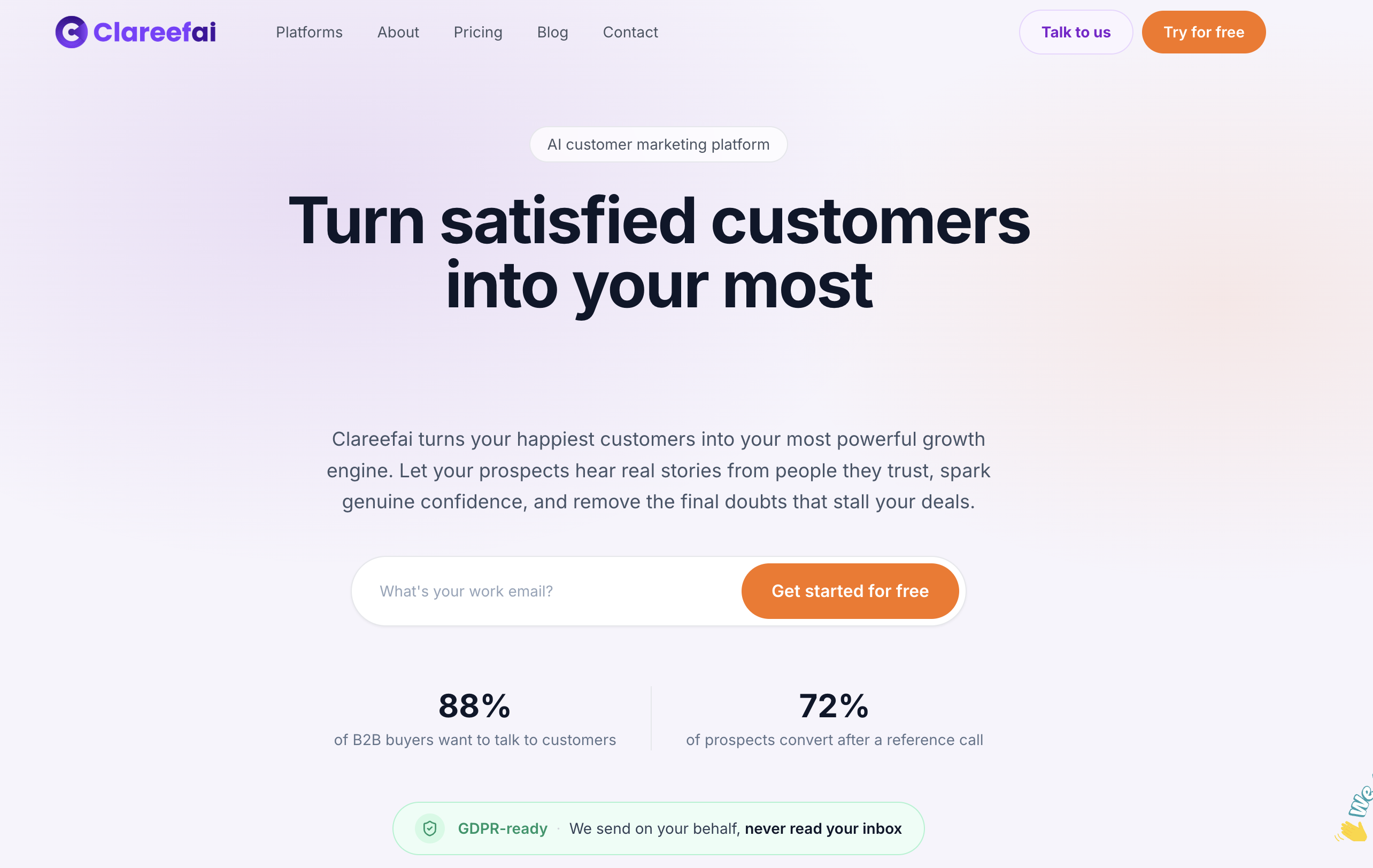
Clareefai gives marketing and communication professionals a centralized platform to collect, verify, and deploy customer testimonials and success stories at every stage of the sales funnel. Every review is tied to a verified customer identity, which eliminates the credibility gap that anonymous feedback creates. The platform’s AI-driven analysis surfaces your most impactful advocates automatically, so your team can focus on activating them rather than finding them.
If you want to see how verified customer reviews and stories work in practice, the Clareefai platform shows exactly how real brands are building trust with prospects through authenticated social proof. For marketing teams ready to turn reputation into a measurable growth asset, Clareefai for marketers is built for that outcome.
FAQ
What are the most effective examples of reputation management?
The most effective examples include proactive monitoring across all platforms, responding to negative reviews within 24 hours, publishing authoritative content to outrank negative results, and running structured customer advocacy programs. Each tactic works best when combined into a continuous system rather than used in isolation.
How quickly should brands respond to negative reviews?
Brands should respond to negative reviews within 24 hours. Faster responses reduce reputational damage and demonstrate customer care to prospects who read those exchanges.
How does SEO connect to online reputation management?
Branded search results directly reflect your reputation and now influence what AI-powered search tools tell prospects about your brand. Publishing authoritative content, case studies, and press coverage pushes negative results down and shapes favorable AI summaries.
What makes verified reviews more valuable than anonymous ones?
Verified reviews are tied to real customer identities and specific contexts, which makes them far more persuasive to prospects. Anonymous reviews create doubt about authenticity, while verified feedback builds the kind of trust that moves prospects through a sales funnel.
How do you manage reputation on platforms like Reddit?
Effective Reddit reputation management requires authentic participation in relevant communities, reporting policy-violating negative content through official channels, and encouraging satisfied customers to share genuine experiences. Promotional tactics backfire on Reddit; credibility is earned through consistent, useful engagement over time.
Recommended
Share Article
Stay Updated
Get the latest insights on customer advocacy and SaaS growth delivered to your inbox.