What Is Reputation Marketing and Why It Matters
TL;DR:
- Reputation marketing turns positive customer feedback into a powerful sales tool that influences buyer decisions. It is a proactive approach that amplifies authentic proof, leading to increased revenue and improved trust signals online.
Reputation marketing is defined as the practice of turning your brand’s positive customer feedback and online presence into a direct marketing asset that builds trust and drives sales. Unlike traditional advertising, it relies on what real customers say about you, not what you say about yourself. 94% of consumers report that online ratings and reviews influence their purchasing decisions more than product price or free shipping. That single statistic reframes the entire conversation: your reputation is not a soft metric. It is one of your most powerful sales tools.
What is reputation marketing and how does it drive revenue?
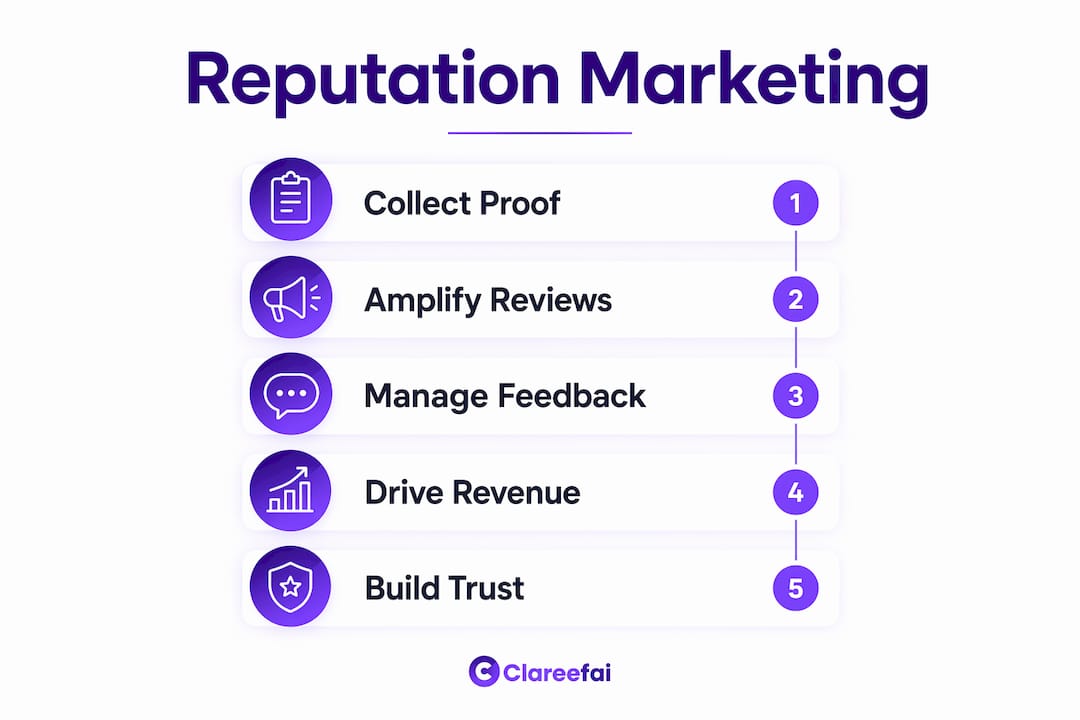
Reputation marketing is the discipline of actively collecting, amplifying, and managing authentic customer proof to influence buyer decisions and grow revenue. The industry term you will encounter alongside it is brand reputation management, but reputation marketing specifically focuses on using positive signals offensively, as a growth engine, rather than defensively to contain damage.

The financial case is direct. A one-star increase in Yelp ratings correlates with a 5%–9% revenue increase for many independent businesses. That means a business sitting at 3.5 stars is leaving measurable money on the table compared to one at 4.5 stars, even with identical products and pricing.
The metrics that reflect this impact are concrete. Net Promoter Score, repeat-purchase rate, and churn rate all shift in direct response to how well a brand manages its reputation. A higher NPS signals that customers trust you enough to recommend you. Lower churn signals that trust is sustaining relationships over time.
Pro Tip: Collect reviews immediately after a service success or product delivery. Emotional recall is sharpest at that moment, and the feedback you receive will be more specific, credible, and conversion-ready.
The importance of reputation marketing also shows up in search. A strong volume of positive reviews suppresses negative content on the first page of search results, functioning as an SEO shield that protects your brand’s first impression. Buyers who search your company name before a purchase decision see trust signals first, not risk signals.
What are the core strategies behind successful reputation marketing?
Effective reputation marketing runs on a four-element control system: monitoring and intelligence, visibility control, response and remediation, and trust building and governance. This framework enables brands to shape what appears in search results proactively, rather than reacting to crises after they surface.
Here is what each element does in practice:
- Monitoring and intelligence: Track brand mentions, review platforms, and social channels in real time. You cannot manage what you cannot see.
- Visibility control: Publish and promote positive content, verified testimonials, and case studies so they rank above neutral or negative content.
- Response and remediation: Reply to reviews promptly and professionally. A thoughtful response to a negative review often converts skeptical prospects better than a perfect five-star rating with no engagement.
- Trust building and governance: Establish internal workflows that make reputation marketing a repeatable process, not a one-time campaign.
The distinction between reputation marketing and reputation management matters here. Reputation management is reactive. It addresses negative content, manages crises, and protects visibility. Reputation marketing is proactive. It takes the positive proof you already have and amplifies authentic customer feedback as a sales asset across every channel where buyers look.
Pro Tip: Avoid reputation stagnation by automating your review request workflow. A manual, sporadic approach loses momentum fast. Set triggers based on customer milestones, such as project completion or first successful use, so requests go out consistently without relying on memory.
One of the most overlooked reputation marketing strategies is deploying user-generated content across multiple channels simultaneously. A verified testimonial that lives only on your website is working at a fraction of its potential. The same testimonial embedded in a LinkedIn post, a sales deck, and an email sequence reaches buyers at different stages of the decision process.
How does reputation marketing differ from brand marketing and reputation management?
These three disciplines are related but serve distinct purposes. Confusing them leads to gaps in your go-to-market approach.
Brand marketing promotes your company’s values, identity, and promise using content your team creates. Think brand videos, taglines, and campaign messaging. It tells buyers who you are.
Reputation management addresses risk. It monitors for negative content, responds to complaints, and works to suppress damaging search results. It protects what you have built.
Reputation marketing does something different from both. It makes existing customer truth visible rather than manufacturing messaging or spinning bad press. It takes what satisfied customers already believe about you and puts that proof in front of prospects who have not yet decided.
The practical difference shows up in your sales cycle. Brand marketing creates awareness. Reputation management prevents damage. Reputation marketing accelerates trust during the consideration phase, which is exactly when B2B buyers are most skeptical and most likely to stall. Building an authentic online brand is what makes reputation marketing sustainable over time.
Used together, all three disciplines reinforce each other. Brand marketing sets the expectation. Reputation marketing validates it with real customer proof. Reputation management protects the credibility both have built.
How can marketing teams and B2B sales teams build reputation marketing into their workflow?
Reputation marketing works best when it is systematic, not spontaneous. Here are the steps that move the needle for marketing professionals and B2B sales teams:
-
Identify your micro-win moments. A micro-win is any point in the customer relationship where the client has just experienced clear value: a successful onboarding, a project milestone, a measurable result. The most effective time to request a review is immediately after one of these moments, while the emotional impact is fresh.
-
Collect context-rich testimonials, not generic praise. “Great service” does not convert. “We closed three deals in 30 days after using their process” does. Highest-converting reputation assets are context-rich testimonials and case studies that name the problem, the solution, and the outcome.
-
Integrate reputation data into sales collateral. Most B2B teams collect testimonials and leave them on a website page that prospects rarely visit. Companies that miss integrating reputation data into proposals, pitch decks, and follow-up emails lose trust-building opportunities at the exact moment buyers are evaluating alternatives.
-
Verify and display reviews with identity context. Anonymous reviews carry less weight than verified ones. When a prospect sees a testimonial from a named person with a real job title at a real company, the trust signal is exponentially stronger. Platforms like Clareefai verify customer identities and contextualize feedback so that informal praise becomes a credible sales asset.
-
Automate the workflow. Operationalizing reputation marketing through automated workflows for timely review collection is the difference between a program that sustains momentum and one that stalls after the first month. Set triggers, assign ownership, and track completion rates.
Pro Tip: Use LinkedIn recommendations as part of your B2B reputation marketing strategy. A recommendation from a VP at a recognizable company, embedded in your sales outreach, carries more weight than a five-star rating on a review platform most of your prospects never visit.
Understanding why consistent sales growth depends on reputation is what separates teams that treat reputation as a byproduct from those that treat it as a growth driver. The latter build it deliberately, measure it regularly, and use it at every stage of the funnel.
Key Takeaways
Reputation marketing is a long-term growth asset built by making authentic, visible customer proof central to every stage of your sales and marketing process.
| Point | Details |
|---|---|
| Reputation drives revenue directly | A one-star rating increase correlates with a 5%–9% revenue gain for many businesses. |
| Timing of review requests matters | Request reviews immediately after a micro-win event to capture the strongest, most specific feedback. |
| Context-rich testimonials convert best | Testimonials that name the problem, solution, and outcome outperform generic praise in sales collateral. |
| Automate to sustain momentum | Manual review collection stalls. Automated workflows tied to customer milestones keep the program running. |
| Integrate proof into the sales cycle | Embedding verified testimonials in proposals and pitch decks accelerates trust during buyer consideration. |
Why reputation marketing is the most underused growth lever in B2B
Most B2B marketing teams I work with treat reputation as a byproduct of good service. They wait for reviews to arrive, post them on a testimonials page, and move on. That approach leaves the most persuasive content you own sitting idle while your sales team works harder to close deals without it.
What I have observed consistently is that the brands winning on reputation are not the ones with the most reviews. They are the ones with the most visible, verified, and contextually placed proof. A single detailed case study from a named client, embedded at the right moment in a sales sequence, can do more work than 50 anonymous five-star ratings.
The other mistake I see regularly is treating reputation marketing as a campaign. It is not. Reputation is a long-term asset built gradually by consistent, visible proof of trustworthiness. The brands that invest in it systematically compound their advantage over time. Those that treat it as a one-quarter initiative reset to zero every time they stop.
One more thing worth saying plainly: AI-powered search tools like Perplexity and ChatGPT are increasingly pulling brand reputation signals into their answers. When a prospect asks an AI assistant about your category, the brands with the richest, most verified, most widely distributed proof show up. Reputation marketing is not just a trust play. It is becoming an AI visibility play. The teams that recognize this now will have a structural advantage within two years.
— ClareefAi
How Clareefai helps you put reputation marketing to work
Reputation marketing only delivers results when your proof is organized, verified, and placed where buyers actually look. Clareefai is built to do exactly that.
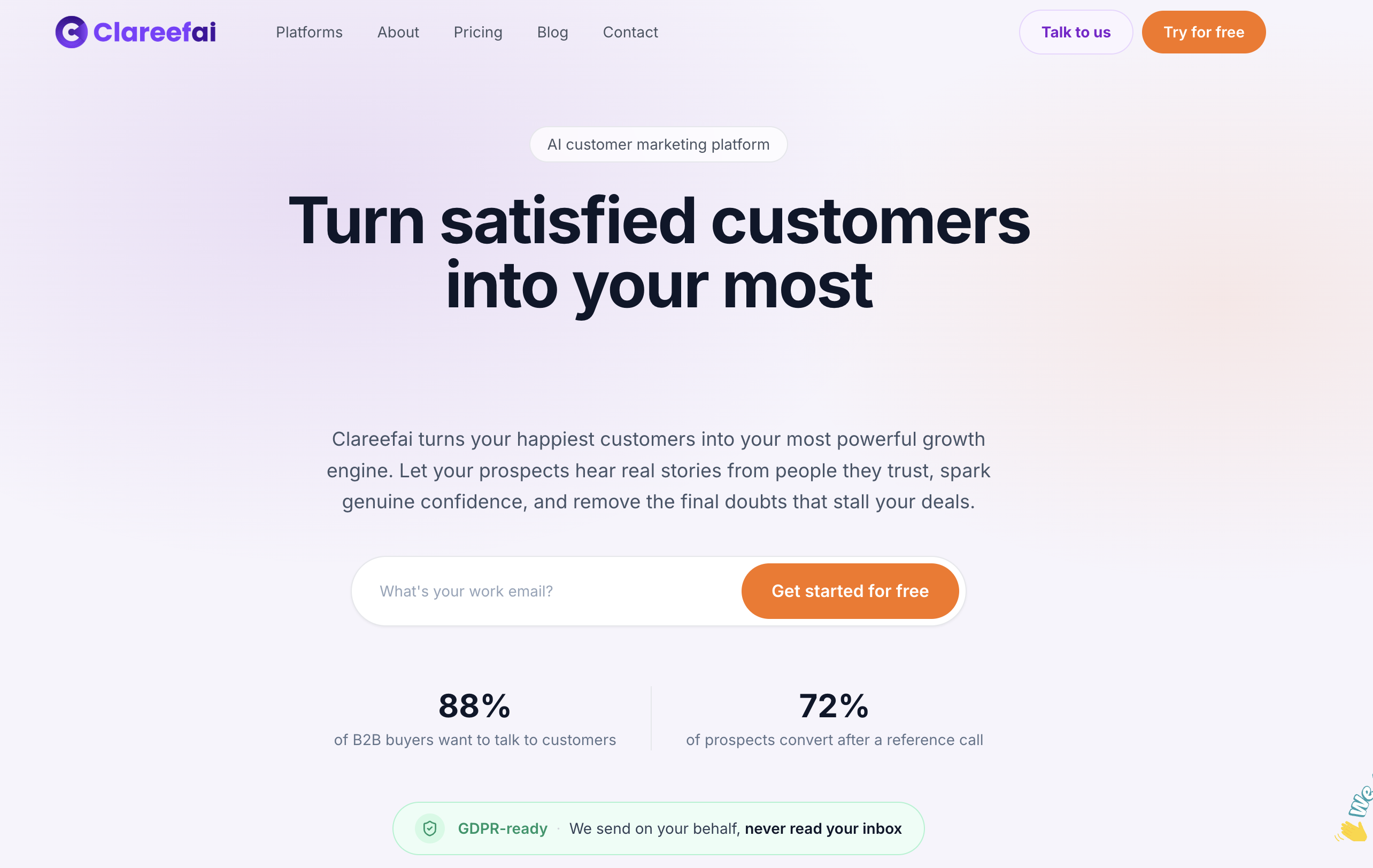
The platform collects testimonials across customer touchpoints, verifies reviewer identities, and automatically distributes the strongest proof to the channels where your prospects evaluate you. Every testimonial is contextualized with real names, job titles, and outcomes, so it functions as a credible sales asset rather than a generic quote. You can see how this works in practice through real customer results from teams using unified testimonial management to close more deals. If you are ready to turn your satisfied customers into your most effective sales tool, visit Clareefai to see the full platform.
FAQ
What is reputation marketing in simple terms?
Reputation marketing is the practice of using positive customer reviews, testimonials, and ratings as active marketing assets to build trust and drive sales. It turns what your customers say about you into a tool that attracts new buyers.
How does reputation marketing differ from reputation management?
Reputation management is reactive, focused on addressing negative content and protecting visibility. Reputation marketing is proactive, amplifying positive customer proof to influence buyer decisions and grow revenue.
Why do online reviews have such a strong impact on sales?
94% of consumers say online reviews influence their purchasing decisions more than price or free shipping. That level of influence makes review volume and quality a direct revenue factor.
What metrics show whether reputation marketing is working?
Net Promoter Score, repeat-purchase rate, and churn rate are the clearest indicators. Improvements in all three reflect that trust built through reputation marketing is translating into measurable business performance.
How do you start building a reputation marketing program?
Start by identifying your micro-win moments, then automate review requests at those points. Collect context-rich testimonials, verify reviewer identities, and integrate that proof into your sales collateral and digital channels.
Recommended
- How Customer Testimonials Build Trust and Differentiate Your SaaS Brand | ClareefAI Blog
- What Is Testimonial Curation? A Guide for Marketers | Clareefai Blog
- Why You Should Be Proactive with Customer Reference Calls - ClareefAI Blog
- How (and When) to Use Social Proof to Accelerate the Sales Cycle - ClareefAI Blog
Share Article
Stay Updated
Get the latest insights on customer advocacy and SaaS growth delivered to your inbox.