Feedback Contextualization for B2B Sales Teams
Feedback contextualization is the practice of verifying and enriching B2B testimonials and reviews with situational metadata — role, company, use case, outcomes, timestamps, and verification signals — so those assets become high-confidence social proof for buying committees. A quote from “a satisfied customer” moves no enterprise deal. That moves the needle.
Every contextualized testimonial needs a minimum metadata set to be usable:
- Attribution: Full name, job title, company name, ARR band or team size, industry
- Situation: Primary problem, feature or integration used, project timeframe
- Outcome: A specific metric (revenue, time saved, percentage lift) with a before/after frame
- Timestamp: Submission date and the quarter the result was achieved
- Media: Text, video file, or transcript; source platform (G2, direct intake, reference call)
- Verification signals: Work email or LinkedIn confirmation, purchase proof or contract quarter, account manager sign-off
Key Takeaways
Feedback contextualization — verifying testimonials with role, company, outcome metrics, and consent records — is the operational foundation that turns customer praise into B2B sales assets your entire team can deploy with confidence.
| Point | Details |
|---|---|
| Core definition | Contextualized feedback pairs a testimonial with role, company, use case, outcome metric, and verification signals. |
| Conversion impact | Aligned social proof can lift conversion rates roughly 10–270% in practitioner examples when matched to audience and platform. |
| Minimum metadata | Capture name, title, ARR band, primary problem, metric (before/after), timestamp, and consent record on every asset. |
| Verification workflow | Confirm work email or LinkedIn, cross-reference CRM, get AM sign-off, and log consent at submission. |
| Clareefai | Automates intake, identity verification, AI promoter scoring, and role-based asset delivery for B2B sales and marketing teams. |
Table of Contents
- Why contextualized feedback moves B2B buying committees
- What metadata to capture with every testimonial
- How to verify and enrich feedback before publishing
- Where to place contextualized proof across the buyer journey
- KPIs that prove the impact of contextualized feedback
- A practical rollout roadmap for your team
- Common pitfalls and US privacy considerations
- Clareefai’s perspective on verified, contextualized feedback
- Clareefai puts feedback contextualization to work for your team
- Sources
Why contextualized feedback moves B2B buying committees
Generic praise creates doubt. Specific, verified proof reduces perceived risk — and that distinction drives real conversion behavior. Practitioner data shows that tactics like role-stamped testimonials, ROI metrics, and case studies can lift conversion rates roughly 10–270% when assets are matched to the right audience and platform.

The mechanics are straightforward. A buying committee member — say, a CFO evaluating your pricing page — trusts a video from a peer CFO at a similarly sized company far more than an anonymous five-star rating. Role, company size, and a concrete metric each reduce a different layer of skepticism. Role says “this person had my job.” Company size says “their constraints matched mine.” The metric says “here is what actually happened.”
Contextualized proof also maps cleanly to funnel stages. Logo walls build awareness-level credibility. Attributed testimonials with metrics convert mid-funnel consideration. Full HTML case studies with Problem → Solution → Metric structure close enterprise deals. Practitioner estimates suggest that systematic feedback programs can drive top-line improvements in the 20–40% range when feedback is captured, verified, and applied consistently.
Case studies with named executive quotes produced up to ~73% more credibility and increased prospect dwell time by about 4.2 minutes compared to anonymous testimonials in practitioner testing.
Pro Tip: Prioritize your three highest-ARR, most-recognizable customer wins first. Those names carry the most credibility with enterprise buyers and give your sales team immediate, high-value assets to deploy.
What metadata to capture with every testimonial
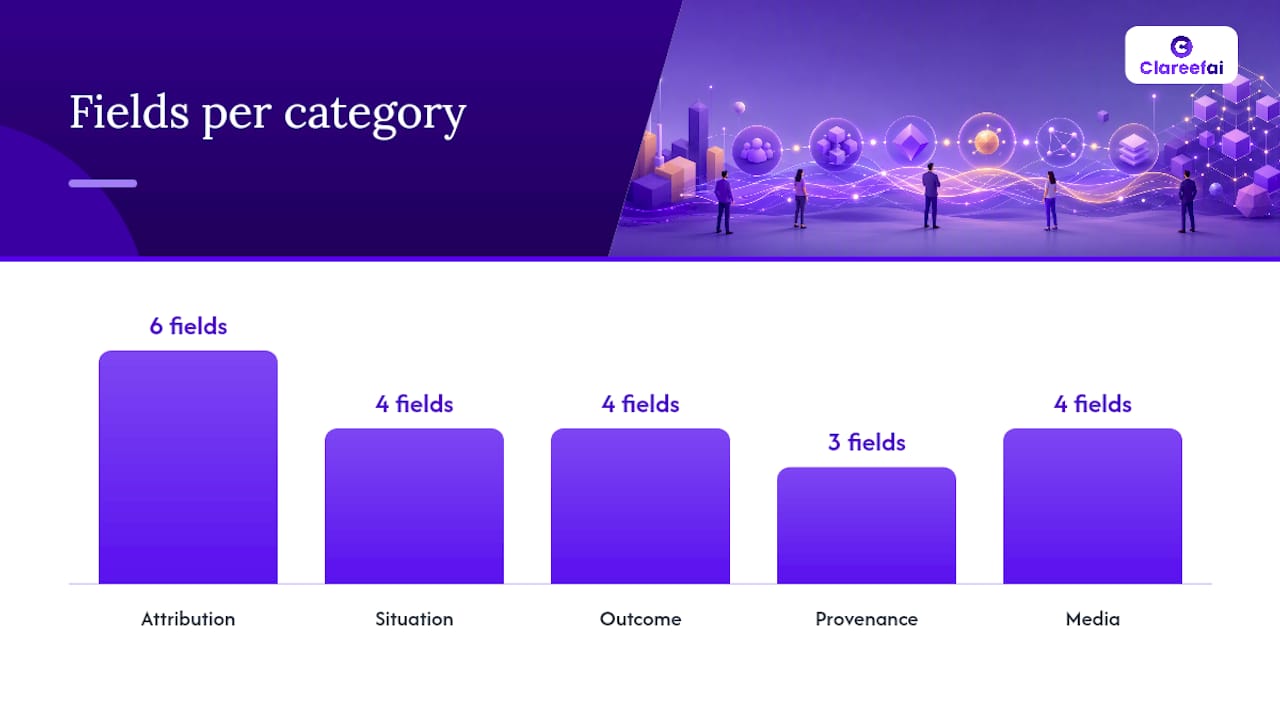
The goal is a schema your CRM, sales team, and AI tools can all read. Collect these fields on every asset:
| Field Category | Fields to Capture |
|---|---|
| Attribution | Full name, title, company, ARR band, industry, team size |
| Situation | Primary pain point, feature used, integration, project timeframe |
| Outcome | Metric type, before value, after value, time-to-value |
| Provenance | Source platform, submission timestamp, consent record |
| Media | Video file, transcript, screenshot, review URL |
For outcome metrics, phrase them in verifiable terms: “reduced onboarding time from 14 days to 6 days in Q3 2025” rather than “significantly faster onboarding.” Practitioner playbooks recommend stamping every quote with role, company, ARR band, and team size so assets are reusable across sales conversations and filterable by ICP.
Context in reviews is what separates a quote a rep pastes into a deck from one that closes a deal. Structured, machine-readable social proof — using semantic HTML and JSON-LD schema — also improves the likelihood that AI answer engines extract and cite your customer outcomes, serving both human buyers and AI-driven research tools simultaneously.
How to verify and enrich feedback before publishing
Verification is what separates a testimonial from a claim. Run this workflow on every submission:
- Email or LinkedIn check: Confirm the submitter’s work email domain matches the company name, or verify their LinkedIn title and employer.
- Purchase confirmation: Cross-reference against your CRM or billing system. If full purchase proof isn’t available, log the contract quarter and ARR band as proxy signals.
- Account manager sign-off: Your CS or account team confirms the outcome metric is plausible given the customer’s actual usage.
- Timestamped screenshot: Capture the original submission or review page with a date stamp for your records.
- Consent and release: Collect explicit written consent covering name, title, company, and the specific content being published. Log the consent record with the asset.
The production discipline — structured interview frameworks and quantification during customer interviews — is the key difference between a generic testimonial and a sales-grade case study.
— SalesRelief
For enrichment, convert video submissions to transcripts and extract metric triples (before, after, timeframe). Tag each asset by ICP segment and buyer persona so your sales team can filter by role or industry in seconds. Automating intake, verification, and syndication with CRM-connected tooling cuts the manual work significantly and increases asset reuse across sales and marketing.
Pro Tip: Use an interviewer-led script that asks “What would you tell a peer at a similar company?” — this framing naturally produces specific, role-relevant language that resonates with buying committees.
Where to place contextualized proof across the buyer journey
Match the proof format to the buyer’s stage and the channel they’re in:
- Awareness (cold outreach, ads, social): Logo cohort walls, short role-stamped one-line quotes, award badges. Keep it scannable.
- Mid-funnel (product pages, pricing pages, email sequences): Attributed testimonials with a metric, headshot, title, and company. Role-stamped video testimonials on pricing and demo pages are particularly effective for buying-committee members doing independent research.
- Bottom-funnel (proposals, reference calls, sales decks): Full HTML case studies using Problem → Solution → Metric structure. CFO-facing video testimonials on pricing pages. Syndication to G2 and TrustRadius so buyers find the same story in multiple places.
- Sales enablement: Tagged quote cards filterable by role, industry, and company size. Slide-ready excerpts. A role-filterable testimonial library your reps can search in under 30 seconds.
Structured social proof with semantic markup — Problem→Solution→Metric triples, JSON-LD schema — also raises the probability that AI answer engines surface your case studies when prospects research your category. That’s a distribution channel most teams haven’t optimized yet.
KPIs that prove the impact of contextualized feedback
| KPI | Definition | Measurement Method |
|---|---|---|
| Conversion lift | % increase in demo or trial sign-ups on pages with contextualized proof | A/B test: page with vs. without attributed testimonials |
| Win rate | % of qualified deals closed, segmented by proof asset used | CRM cohort analysis by asset tag |
| Demo-to-trial conversion | % of demos that convert to paid trial | Funnel tracking, segmented by testimonial exposure |
| Time-to-close | Average days from first touch to signed contract | CRM deal-stage timestamps |
| Asset engagement | Dwell time, click-throughs, share rate on testimonial pages | Analytics dashboard (page-level and asset-level) |
| Reference request rate | % of late-stage deals requesting a customer reference call | Sales activity log |
Track engagement metrics at the asset level, not just the page level. A case study that gets shared internally by a prospect’s champion is a stronger signal than raw page views.
A practical rollout roadmap for your team
Phase 1: Pilot (Days 1–30)
- Select three high-ARR, high-visibility customer wins as your pilot subjects.
- CS conducts structured interviews using a quantification-first script.
- Marketing produces one video testimonial, one written case study, and one quote card per customer.
- Legal reviews consent forms and approves the metadata schema.
Phase 2: Verification and enrichment (Days 31–60)
- Run the full verification workflow (email, CRM cross-reference, AM sign-off) on all three assets.
- Tag assets by ICP, buyer persona, and funnel stage in your testimonial library.
- Publish HTML case studies with JSON-LD schema; syndicate to G2 or TrustRadius.
Phase 3: Scale and measure (Days 61–90)
- Sales team deploys assets in active deals; analytics owner tracks win rate and time-to-close by cohort.
- Expand intake to 10–15 additional customers using the validated workflow.
- Review asset engagement data and refine tagging taxonomy.
Roles: Sales owns intake identification. CS conducts interviews. Marketing produces and publishes. Legal reviews consent. Analytics owns KPI reporting. A centralized feedback system keeps all roles working from the same asset library.
Common pitfalls and US privacy considerations
The most frequent mistakes teams make:
- Vague metrics: “Improved efficiency” is unpublishable. Require a before/after number at intake.
- Missing provenance: No timestamp or source platform means the asset can’t be verified later.
- Stale proof: A case study from 2021 citing a product version you’ve since replaced undermines credibility. Version and date every asset.
- Inconsistent metadata: If half your testimonials have ARR band and half don’t, your sales team can’t filter by ICP.
- Over-claiming outcomes: Attribute results only to what your product demonstrably contributed.
On the compliance side, US companies publishing customer testimonials must capture explicit written consent before using a customer’s name, title, or likeness. Under the California Consumer Privacy Act (CCPA), customers have the right to request deletion of their personal data — including testimonial content — so store consent records with a clear opt-out path. If your customers are based in the EU, GDPR obligations apply to their data regardless of where you’re headquartered. Anonymize any testimonial where full attribution isn’t consented to, rather than publishing partial attribution.
Pro Tip: Include a one-sentence metric-use clause in your consent form: “I confirm this result is accurate and consent to its use in [Company]'s marketing materials.” That single line covers attribution, accuracy, and publication rights in one step.
The testimonial collection checklist from Clareefai covers consent capture and intake templates in detail.
Clareefai’s perspective on verified, contextualized feedback
At Clareefai, we’ve built our platform around one conviction: a testimonial without context is just noise. The B2B buying process has grown more committee-driven and more skeptical, and generic reviews no longer move deals. What does move deals is verified, role-stamped, metric-backed proof that a peer at a comparable company achieved a real outcome with your product.
Our verification workflows confirm customer identities through work email and LinkedIn checks, cross-reference purchase records, and log consent at the point of submission. Role-based dashboards give sales, marketing, and CS each a filtered view of the assets most relevant to their work. Our AI-driven promoter scoring surfaces the customers most likely to give high-quality, reusable testimonials — so your team spends time on the right conversations, not chasing cold requests. GDPR controls and consent records are built into every asset, not bolted on afterward. The result is a testimonial library that’s filterable, compliant, and ready to deploy across every stage of your funnel.
Clareefai puts feedback contextualization to work for your team
Collecting, verifying, and publishing contextualized testimonials manually is slow and inconsistent. Clareefai automates the entire workflow: structured intake forms capture the metadata schema described above, identity verification runs at submission, and AI scoring identifies your highest-impact promoters before you even reach out.
Role dashboards give your sales reps a filterable library of quote cards and case studies sorted by ICP, industry, and buyer persona. Analytics track asset engagement, reference request rates, and conversion lift in real time. Every asset ships with consent records and GDPR controls already in place.
If you’re ready to turn your best customer wins into a repeatable sales asset, see how Clareefai increases win rates through testimonial management — and explore the marketing solutions built for teams at your scale.
Sources
- Social proof for B2B SaaS ads (SaaSHero)
- Case Study Mastery: How Top B2B Marketers Generate $22M+ in Validated Revenue | SalesRelief
- b2b-saas-ugc-playbook (Idukki)
- Structuring Social Proof: How to | SteakHouse Blog
- Customer feedback drives 20-40% revenue growth in 2026
- Transforming Client Feedback Loops: How GrowthPlugins Can Enhance Your Review Process - GrowthPlugins
Recommended
Share Article
Stay Updated
Get the latest insights on customer advocacy and SaaS growth delivered to your inbox.