What Is a Sales Funnel? B2B Guide to Close Deals Faster
TL;DR:
- A sales funnel visually represents how B2B prospects move from awareness to purchase, guiding targeted messaging at each stage. Verified testimonials and customer advocates are crucial tools that help reduce leakage and accelerate deal closing throughout the funnel. Modern approaches integrate advocacy and post-purchase proof into a flywheel, continuously fueling new leads and lowering customer acquisition costs.
A sales funnel is a buyer-centered visual map showing how B2B prospects move from first awareness of your solution all the way through to purchase. Think of it as the buyer’s internal decision process made visible, so your sales and marketing teams can deliver the right message, content, and social proof at exactly the right moment.
TL;DR:
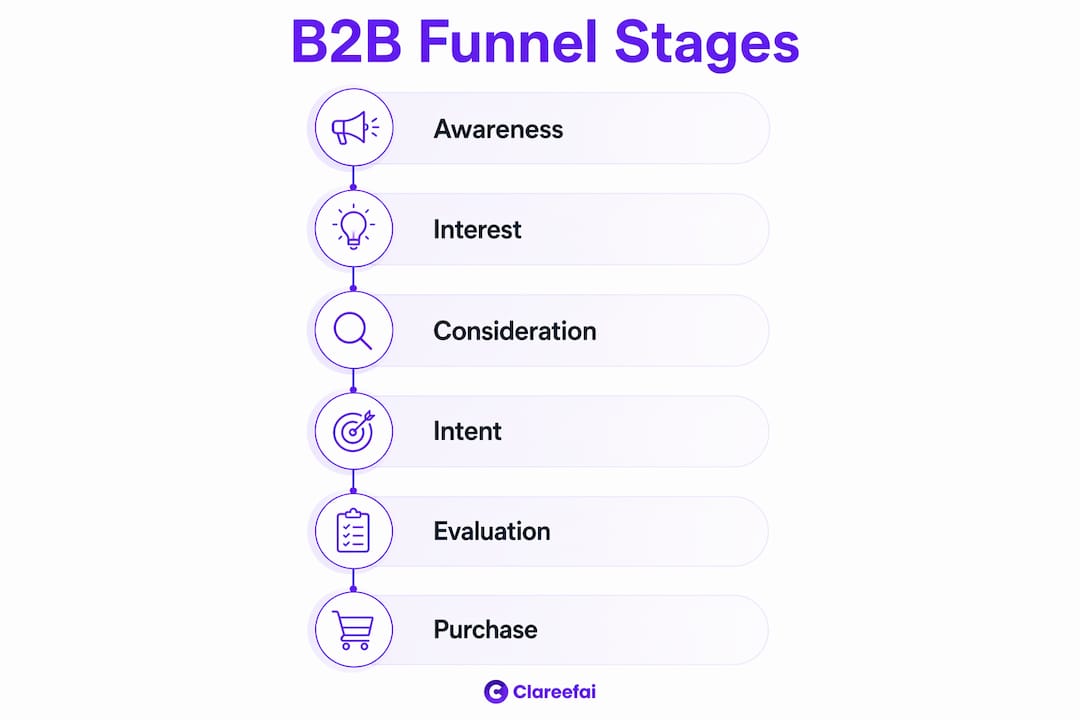
- B2B funnels typically run six stages: Awareness, Interest, Consideration, Intent, Evaluation, and Purchase.
- Verified testimonials and customer advocates are among the most effective tools for moving prospects through the middle and bottom of the funnel.
- A sales funnel tracks the buyer’s perspective; a sales pipeline tracks the seller’s workflow. They are related but not the same.
Table of Contents
- What is a sales funnel, and why does it matter for B2B teams?
- The six canonical B2B funnel stages you need to know
- How a sales funnel differs from a sales pipeline
- What prospects need at each stage: content, messages, and testimonial types
- Practical tactics: use verified testimonials to move deals faster
- Key metrics and KPIs to track at each funnel stage
- How the funnel is evolving: flywheel, advocacy loops, and post-purchase proof
- How to audit your current testimonial assets against the funnel
- How Clareefai operationalizes a testimonial-driven funnel
- Key Takeaways
- Why verified social proof is the missing layer in most B2B funnels
- Useful sources and further reading
What is a sales funnel, and why does it matter for B2B teams?
A sales funnel is a structured framework that maps how a large pool of potential leads narrows to a smaller group of paying customers as they progress through buying stages. The term “funnel” is literal: wide at the top where awareness begins, narrow at the bottom where deals close.
For B2B SaaS teams, the funnel is more than a tracking tool. It is a communications framework. Each stage represents a different set of buyer questions, and your job is to answer those questions with the right content, proof, and people before a competitor does.
The original AIDA model (Awareness, Interest, Desire, Action) gave marketers a useful starting point, but modern B2B buying is more complex. Multiple stakeholders, longer cycles, and higher scrutiny demand a more granular model with explicit handoffs between sales, marketing, and customer success.

The six canonical B2B funnel stages you need to know
Salesforce’s canonical model breaks the B2B funnel into six stages, each defined by a meaningful shift in buyer commitment:
- Awareness/Discovery: The buyer recognizes a problem and starts searching for solutions. Your goal is to be findable and credible.
- Interest: The prospect engages with your content and begins researching your category. They ask: “Is this worth my time?”
- Consideration: They dig into features, pricing, and implementation. They ask: “Does this fit our specific situation?”
- Intent: The prospect signals purchase intent, perhaps by requesting a demo or starting a trial. They ask: “Can I see this working for us?”
- Evaluation: They compare your solution head-to-head against alternatives, often involving multiple stakeholders. They ask: “Is this the right choice?”
- Purchase: The transaction closes. The prospect becomes a customer.
Stage names can vary by company or industry, but the underlying progression of buyer commitment is what matters. Skipping a stage in your content plan means leaving buyers without the answers they need to move forward.
How a sales funnel differs from a sales pipeline
The distinction is worth getting right. A sales funnel reflects the buyer’s perspective: it maps the questions prospects ask and the mental states they move through. A sales pipeline maps the seller’s operational workflow, including tasks, stages, and forecasted revenue.
Different owners, different metrics, different assets. Your pipeline tells your VP of Sales how many deals are at proposal stage. Your funnel tells your marketing team which case study to send a prospect who just requested a demo.
Confusing the two leads to a common failure: reps push administrative milestones (moving a deal to “Proposal Sent”) while the buyer is still stuck at Consideration, waiting for proof that your solution works in their industry.
Pro Tip: Map every seller action to a specific buyer question. Before you move a deal forward in your CRM, ask: “What question does the buyer have right now, and have we answered it?” That single habit reduces leakage at every stage.
What prospects need at each stage: content, messages, and testimonial types
Buyers ask different questions at each stage, and the social proof that works at Awareness rarely works at Evaluation. Here is a practical map:
| Funnel Stage | Buyer’s Primary Question | Best Content/Testimonial Format | Owner |
|---|---|---|---|
| Awareness | “Does this problem have a solution?” | Blog posts, short customer quotes, social proof snippets | Marketing |
| Interest | “Is this vendor worth my attention?” | Verified review summaries, explainer videos | Marketing |
| Consideration | “Does this fit our needs?” | Case studies, feature-specific testimonials | Marketing + Sales |
| Intent | “Can I see this in action?” | On-demand demo videos, customer video clips | Sales |
| Evaluation | “What do peers say about this?” | Reference calls, detailed ROI case studies, video testimonials | Sales + Customer Success |
| Purchase | “Are we making the right call?” | Executive sponsor references, contract-stage proof | Sales |
Verified testimonials and case studies answer the specific questions buyers ask at each stage. The most common mistake is using the same generic quote everywhere. A two-sentence micro-quote from a peer company works well at Interest. A 10-minute reference call with a named customer is what closes deals at Evaluation.
The consideration-to-intent transition is where most funnel leakage occurs. Peer-verified experiences bridge trust gaps that marketing claims simply cannot.
Practical tactics: use verified testimonials to move deals faster
Here is a repeatable sequence your team can start using this week:
- Tag your testimonial library by stage. Label each asset (quote, video, case study, reference) with the funnel stage it best addresses.
- Set CRM triggers. When a deal moves to “Demo Scheduled,” automatically surface two or three relevant customer video clips or case studies for the rep to share.
- Send a pre-demo proof email. One day before a demo, send a short email with a verified customer outcome relevant to the prospect’s industry.
- Use a reference invite at Intent. When a prospect signals intent, offer a 15-minute call with a verified customer advocate in a similar role.
- Follow up with ROI evidence. After the demo, send a one-page case study showing measurable outcomes. Keep it specific to their use case.
For multi-channel distribution, repurpose each asset across email, your website, LinkedIn, and in-app notifications. The same case study can become a 60-second video clip, a pull quote for a sales deck, and a landing page hero testimonial.
Key metrics and KPIs to track at each funnel stage
Measuring the funnel without tying metrics to testimonial exposure leaves you guessing about what actually moves the needle. Track these six metrics:
- MQL-to-SQL conversion rate (Awareness → Interest): Are your top-of-funnel assets attracting the right buyers?
- Content engagement rate (Interest → Consideration): Are prospects consuming case studies and testimonials, or bouncing?
- Demo request rate (Consideration → Intent): A rising rate often signals that your proof assets are building enough confidence to act.
- Reference request rate (Intent → Evaluation): Track how often prospects ask to speak with a customer. A low rate may mean you are not offering it proactively.
- Time-in-stage (Evaluation): Long dwell time here usually signals missing or weak proof. Adding a targeted reference call or ROI case study often shortens it.
- Win rate (Purchase): The ultimate measure. Tag deals where testimonial assets were shared and compare win rates against deals where they were not.
Social proof strategies consistently show measurable engagement lifts when testimonials are contextually matched to buyer stage. For measurement, tag every testimonial asset in your CRM with a unique identifier, then report on deal outcomes by asset type and stage exposure.
How the funnel is evolving: flywheel, advocacy loops, and post-purchase proof
The linear funnel has a blind spot: it stops at Purchase. Modern B2B teams know that post-purchase advocacy feeds new top-of-funnel momentum, creating a flywheel effect where satisfied customers become your most credible acquisition channel.
| Traditional Funnel | Flywheel/Advocacy Model |
|---|---|
| Ends at Purchase | Continues through Retention and Advocacy |
| Testimonials collected ad hoc | Testimonials systematically collected and refreshed |
| Proof assets are static | Proof assets are repurposed across channels continuously |
| Advocacy is passive | Advocates are identified, activated, and matched to prospects |
To build the loop: collect testimonials immediately after successful onboarding, convert case studies into short video clips, build a named promoter list segmented by industry and use case, and measure how many new top-of-funnel leads cite a customer reference as their first touchpoint. Customer advocacy programs that feed this loop consistently reduce customer acquisition cost over time.
How to audit your current testimonial assets against the funnel
Run this 30-minute review with your sales and marketing leads:
Audit steps:
- Inventory every testimonial asset you currently have (quotes, videos, case studies, reference contacts).
- Tag each one with the funnel stage it best addresses.
- Identify gaps: most teams find they are rich at Awareness and thin at Evaluation.
- Flag the consideration-to-intent transition specifically. Do you have verified peer references available on demand?
Priority actions (ranked by impact):
- Close the Evaluation gap first. If you have fewer than five named reference contacts available for sales, build that list this week. Owner: Customer Success. Time: 2–3 hours.
- Create stage-tagged asset folders in your CRM. Sales reps should be able to find the right proof in under 60 seconds. Owner: Sales Ops. Time: 1–2 hours.
- Set up one CRM trigger. Automate a testimonial push when a deal hits “Demo Scheduled.” Owner: Marketing + Sales Ops. Time: 1 hour.
- Refresh stale assets. Any testimonial older than 18 months should be reviewed for relevance. Owner: Marketing. Time: ongoing.
The step-by-step social proof workflow at Clareefai’s blog walks through this audit in detail if you want a templated version.
How Clareefai operationalizes a testimonial-driven funnel
Clareefai is built specifically for B2B teams that want to turn customer advocacy into a repeatable sales asset, not a one-off marketing project. Here is how the platform maps to the funnel:
- Verification: Every testimonial is identity-verified, so prospects know the proof is real, not curated marketing copy.
- AI-powered promoter identification: Clareefai’s AI surfaces your most impactful advocates and matches them to prospects by industry, company size, and use case.
- Cross-channel publishing: Testimonials sync automatically to your CRM, website, and review platforms, so the right proof appears at the right stage without manual effort.
- Role-specific dashboards: Sales, marketing, and customer success each see the metrics that matter to them, from reference request rates to win rate by asset type.
A typical workflow looks like this: a prospect books a demo → Clareefai triggers an automated request to a relevant customer for a short video clip → the clip is CRM-synced and surfaced in the rep’s pre-demo email → at Intent stage, the rep sends a reference invite matched by Clareefai to a peer advocate. The result is faster evaluation, higher reference pickup, and measurable uplift in win rate.
See how Clareefai drives win rates with unified testimonial management, or explore the full platform to see how it fits your team’s workflow.
Key Takeaways
A sales funnel is the buyer’s decision map, and verified testimonials matched to each stage are the single most effective tool for shortening B2B sales cycles.
| Point | Details |
|---|---|
| Six canonical stages | B2B funnels run Awareness through Purchase; each stage requires different proof formats. |
| Funnel vs. pipeline | The funnel tracks buyer questions; the pipeline tracks seller tasks. Confusing them causes leakage. |
| Biggest leakage point | The consideration-to-intent transition is where most deals stall; peer-verified testimonials close that gap. |
| Measure what matters | Track reference request rate and time-in-stage at Evaluation to gauge testimonial program impact. |
| Flywheel effect | Post-purchase advocates feed new top-of-funnel leads, reducing acquisition cost over time. |
Why verified social proof is the missing layer in most B2B funnels
Most B2B teams understand the funnel conceptually. Where they fall short is execution: they collect testimonials inconsistently, store them in scattered folders, and surface them too late or too generically to move a deal.
The teams that consistently outperform do one thing differently. They treat testimonials as a structured asset class, not a marketing afterthought. They know which proof works at which stage, they have it ready before the buyer asks, and they can measure its impact on win rate.
At Clareefai, we built the platform around that exact belief. Verified, contextualized, and systematically deployed social proof is not a nice addition to your sales process. It is the mechanism that makes the funnel work in practice, not just on a whiteboard. If you want to see how that looks in your specific funnel, explore Clareefai’s solutions or request a demo to run the one-page audit with your team.
All testimonials collected and displayed through Clareefai are subject to GDPR-compliant verification and data handling. This article provides general guidance; confirm your specific legal and compliance requirements with a qualified professional.
Useful sources and further reading
Canonical definitions and models:
- What is a Sales Funnel? | IBM
- What is a Sales Funnel? Complete Guide + Examples | Salesforce
- What is a Sales Funnel? | TechTarget
- What is a Sales Funnel? | Mailchimp
Tactics and best practices:
- Sales Funnel Best Practices | Pipedrive
- Sales Funnel Overview and Evolution | HubSpot
- Sales Funnel Tactics | Shopify
Clareefai resources:
- How to Use Social Proof to Accelerate the Sales Cycle
- B2B Social Proof Workflow: Build Trust and Convert
- For Sales Teams: Win More Deals with Customer Proof
- For Marketers: Turn Customer Advocacy into Content
Recommended
Share Article
Stay Updated
Get the latest insights on customer advocacy and SaaS growth delivered to your inbox.