Cut Deal Time: B2B Customer Reference Program in 30–90 Days
A customer reference program is a structured system for identifying satisfied customers and turning their experiences into reference calls, testimonials, case studies, and referrals that support sales and marketing. The primary outcome is faster deal cycles and higher buyer trust, because prospects believe a peer more than they believe your pitch. It works best when one owner, usually in customer marketing or advocacy, runs it as a repeatable process rather than a favor sales asks for on an as-needed basis.
TL;DR:
- A customer reference program is essential for speeding up deal closures and increasing trust by providing peer validation, especially for large or trust-dependent deals.
- Launching a small pilot focused on one segment and activity, with clear measurable goals, leads to more effective scaling than trying to build a comprehensive program from the start.
- Proper process management—such as a tracking system, consent records, and structured intake—prevents chaos and ensures advocates feel valued and protected over time.
- Activity metrics like reference volume are important but must be complemented by outcome metrics such as win rate improvements and referral conversion rates to prove actual program success.
- Using AI-driven tools like Clareefai can verify advocate identities, surface top promoters, and automate the publishing of testimonials, reducing manual effort and increasing trustworthiness.
Table of Contents
- Why Customer Reference Programs Matter for Revenue Teams
- Which Advocacy Activities Should You Offer Customers?
- How Do You Launch a Customer Reference Program From Scratch?
- How Do You Keep a Reference Program From Becoming Chaotic?
- What KPIs Prove a Reference Program Is Working?
- What Tools Do You Actually Need to Run This?
- How Clareefai Fits Into a Reference Program
- How Do You Motivate Customers to Participate?
- How Do You Protect Customer Privacy in a Reference Program?
- How Do You Keep Advocates Engaged for the Long Term?
- What Should You Never Skip When Running This Program?
- Get Your Reference Program Running Without the Manual Chase
- Sources
- FAQ
Why Customer Reference Programs Matter for Revenue Teams
A reference program is not a nice-to-have side project. It is one of the few sales assets that shortens deal cycles without adding headcount to your sales team. When a prospect hears directly from a peer who solved the same problem, objections tend to dissolve faster than any deck can manage.
The mechanics are straightforward. Deals with a live reference call attached typically move through legal and procurement review with less friction, because the buyer’s internal champion now has ammunition to sell the deal internally. Marketing teams get equal value: named customer outcomes posted on LinkedIn or a case study page generate inbound leads that close at a higher rate than cold outbound, since the buyer arrives already convinced by a peer rather than a rep.
Pro Tip: Track which deals stalled before a reference call and which moved after one. That single before/after comparison is often the fastest way to get budget approved for the program itself.
Not every business challenge calls for the same advocacy tool. Use this quick decision guide:
- Reference calls when a large deal is stuck on trust or technical validation and the buyer wants to hear unscripted answers.
- Testimonials when marketing needs quick, low-effort proof for a landing page or sales deck.
- Case studies when you need a detailed, quantified story for a specific vertical or use case.
- Referrals when you want new pipeline, not just proof for existing pipeline.
- Reviews on third-party sites when you need volume and search visibility more than depth.
A well-run customer advocacy program replaces the scramble of hunting for a “reference-able” account the night before a big call with a ready bench of advocates. That difference alone justifies building the function before you need it urgently.
Which Advocacy Activities Should You Offer Customers?
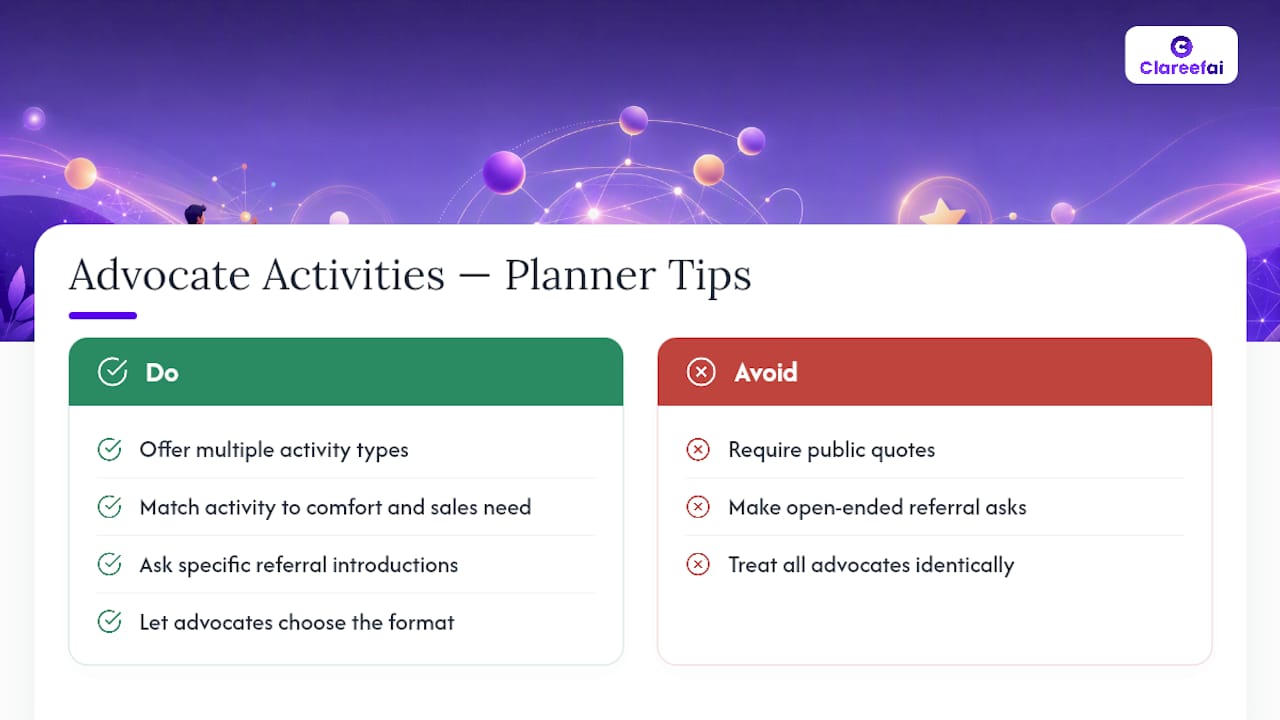
Not every advocate wants to do the same thing, and not every deal needs the same asset. Matching the activity to both the customer’s comfort level and the sales team’s need is what separates a functioning program from a pile of unused testimonial requests.
Reference calls are live conversations between a prospect and an existing customer, usually arranged by sales or customer success. They typically run 30 to 45 minutes and carry the highest impact of any single activity because the prospect can ask unscripted questions. They also cost the advocate the most time, so capacity planning matters. Sales benefits most directly here, since a well-placed call can unstick a deal in late-stage evaluation.
Written testimonials take a customer five to ten minutes to review and approve, especially if you draft a version based on a support ticket, a QBR note, or an NPS comment and simply ask them to confirm it. Marketing leans on these constantly for web pages, ads, and sales one pagers. The Small Business Administration’s guidance on testimonials is blunt about what makes them work: specificity. A testimonial naming the customer’s role, company, and a measurable before and after outcome converts far better than generic praise like “great product, great team.”
Case studies demand more, often a 30 minute interview plus a review cycle, but they pay off across the funnel. Sales uses them in later-stage decks, marketing uses them for SEO and content, and product teams often mine them for roadmap validation they would not otherwise get.
Referrals ask an advocate to open a door to a new prospect rather than validate an existing one. This is the activity most tied to new pipeline instead of deal acceleration, and it works best when you make the ask specific (“Do you know anyone at a similar company who’s evaluating tools like this?”) rather than open ended.
Speaker appearances, webinars, and panel spots ask more of the advocate’s time and public profile, but they build long-term brand equity and often deepen the relationship more than a single transactional ask ever could.
Whatever you offer, always let the advocate choose the format. Some customers will do a call happily but hate being quoted publicly. Others love a quote but have no time for a call. Ask both, and respect the answer.
How Do You Launch a Customer Reference Program From Scratch?
Most programs fail not because the idea is wrong, but because teams try to build the full operation before proving the small version works. Start narrow. A pilot focused on one segment and one primary activity teaches you more in 60 days than a sprawling multi-channel launch teaches you in six months.
Here is the sequence that works:
-
Set one measurable business goal. Pick a single number, such as reducing average sales cycle length for enterprise deals by a set number of days, or increasing inbound demo requests by a target percentage. A vague goal like “build advocacy” gives you nothing to measure against later.
-
Choose one or two advocacy activities for the pilot. If your goal is deal velocity, start with reference calls. If your goal is inbound lead volume, start with testimonials and public reviews. Resist the urge to launch five activities at once; you cannot yet tell which one is doing the work.
-
Identify advocates using real signals, not guesses. Pull your Net Promoter Score responses above a strong threshold, cross reference with accounts that have expanded usage or renewed early, and loop in customer success managers for a gut check on who actually enjoys talking to peers. A customer who scored high on NPS but is silent in check ins is a weaker bet than a mid-scoring customer who talks your CSM’s ear off every quarter.
-
Design the value exchange and timing. Advocacy requests land best at moments of value, right after a renewal, right after a positive QBR, right after a support win, or right after a measurable result like a usage milestone. Asking during a support escalation or right before a contract negotiation is the fastest way to burn goodwill. Decide upfront what advocates get in return, whether that is early feature access, a gift card, public recognition, or simply a genuine thank you from leadership.
-
Run the pilot for 30 to 90 days and measure two things. Track activity level metrics (how many references you delivered, how many testimonials you collected) and outcome metrics (did the deals attached to a reference close faster or at a higher rate). This dual tracking, recommended by advocacy program frameworks, keeps you honest about whether volume is translating into results.
-
Iterate before you scale. If reference calls converted deals but testimonials sat unused on a landing page nobody visited, cut the underperforming activity and double down on what worked. Only expand to new segments, new activities, or new regions once the first loop is proven.
Pro Tip: Give your pilot a hard end date before you start. A pilot with no deadline quietly turns into a permanent side project that never gets properly measured or properly funded.
How Do You Keep a Reference Program From Becoming Chaotic?
The single biggest killer of reference programs is not lack of enthusiasm. It is the absence of a repeatable process, which turns every request into an ad hoc scramble through Slack messages and forgotten spreadsheet rows.
A reliable operating model needs only four components to function for the first six to twelve months, before you need anything more sophisticated:
- A single intake form where any sales rep or marketer submits a request, specifying the use case, industry, deal stage, and urgency, with a clear service level agreement (typically 48 to 72 hours for a matched advocate).
- A shared tracker, whether that is CRM custom fields, an Airtable base, or a Notion database, that logs every advocate’s participation history and remaining capacity.
- A matching rubric based on role, industry, company size, and outcome achieved, so a rep asking for a healthcare reference doesn’t get matched with a retail customer.
- A briefing template sent to both the advocate and the prospect before any call, outlining talking points, deal context, and a polite reminder of what not to discuss (like pricing specifics you haven’t cleared).
Consent and follow-up round out the system. Record written permission before you publish any name, quote, or logo, and store it alongside the asset itself, not in a separate email thread nobody can find six months later. After every reference activity, send a thank you and log it against the advocate’s participation count, since nobody wants to be the customer asked for a fifth call in a year while a colleague has never been asked once.
| Governance Element | What It Prevents |
|---|---|
| Single intake form | Duplicate or conflicting requests for the same advocate |
| Capacity tracking | Advocate burnout from overuse |
| Matching rubric | Poor-fit reference calls that waste both parties’ time |
| Consent records | Compliance risk from using a quote without permission |
| Follow-up workflow | Advocates who feel used once and never asked again |
A reference database that’s actually searchable turns this from a manual chase into a two-minute lookup, which matters most the moment your pilot succeeds and requests multiply.
What KPIs Prove a Reference Program Is Working?
Two categories of metrics matter, and conflating them is the most common measurement mistake. Activity metrics tell you the program is running. Outcome metrics tell you it is working.
On the activity side, track references delivered per month, testimonial volume collected, and average advocate response time to requests. These numbers are easy to gather and useful for spotting bottlenecks, but they say nothing about revenue impact on their own.
Outcome metrics require more discipline but are what actually justify the program’s existence. Track reference-influenced win rate by comparing close rates on deals that included a reference activity against deals that did not. Track referral conversion rate, meaning the percentage of referred leads that become customers, which usually outperforms your standard lead conversion rate significantly. Track incremental revenue by tagging deals in your CRM at the moment a reference activity occurs, so finance can eventually pull a clean before/after comparison.
| Metric | What It Measures | Typical Reporting Cadence |
|---|---|---|
| References delivered | Program activity volume | Monthly |
| Reference-influenced win rate | Sales impact of reference calls | Quarterly |
| Referral conversion rate | New pipeline quality from advocates | Quarterly |
| Testimonial-to-publish time | Operational efficiency | Monthly |
| Advocate participation rate | Program health and advocate fatigue risk | Quarterly |
A 30 to 90 day review cadence during the pilot is tight enough to catch problems early without drowning your team in reporting overhead. Once the program matures past the pilot stage, quarterly business reviews with sales leadership become the natural rhythm, since that’s when deal data has had time to accumulate meaningfully.
What Tools Do You Actually Need to Run This?
Skip the platform shopping until your process is proven. A minimum viable stack for the first six to twelve months usually includes CRM custom fields to flag reference-eligible accounts, a shared tracker in Airtable or Notion for advocate capacity and history, and a scheduling tool like Calendly for booking reference calls without an email back and forth.
Three signals tell you it’s time to invest in something more specialized:
- Request volume exceeds what a spreadsheet can track without errors or duplicate asks to the same advocate.
- Multiple teams (sales, marketing, customer success) need visibility into the same advocate pool and keep stepping on each other.
- You’re spending more hours on manual matching and follow-up than on actually running reference conversations.
At that point, a dedicated reference management platform becomes worth the cost. Look for four capabilities specifically: automated matching based on firmographic and outcome data, built-in consent and preference tracking, cross-channel publishing so one testimonial can populate a website, a sales deck, and a review site without manual copy-pasting, and analytics that tie advocacy activity back to pipeline stages. Tooling advice from advocacy program frameworks is consistent on this point: buy the platform to scale a working process, not to create one.
How Clareefai Fits Into a Reference Program
Clareefai handles the parts of this process that get harder as volume grows: verifying that a testimonial actually came from the named customer, using AI to flag your strongest promoters based on activity and sentiment signals, and publishing approved assets across your website, sales decks, and review channels automatically.
- Verification removes the credibility problem: anonymous or unverifiable quotes convert worse than named, attributed ones.
- AI promoter identification surfaces advocates you might otherwise miss in a spreadsheet of hundreds of accounts.
- Cross-channel publishing keeps one approved testimonial working across every channel at once instead of sitting in a single deck.
A manufacturing client’s win-rate case study shows this approach applied to a real pilot, using unified testimonial management to move stalled deals forward.
How Do You Motivate Customers to Participate?
Most advocates aren’t motivated by cash. They’re motivated by recognition, access, and the sense that helping you actually benefits them too. Design your incentive structure around that reality rather than defaulting to gift cards as the only lever.
Recognition costs nothing and works surprisingly well: a public shoutout on your customer page, a mention in your product newsletter, or a personal note from your CEO thanking them by name. Many advocates, especially at the executive level, value visibility for their own personal brand more than any material reward.
Access is the next tier: early access to new features, a seat on a customer advisory board, or a direct line to your product roadmap discussions. This works particularly well with power users who already care about influencing where your product goes.
Material rewards still have a place, but calibrate them to the ask. A five-minute testimonial might warrant a small gift card. A 45-minute reference call for a six-figure deal deserves something more meaningful, whether that’s a charitable donation in their name, a premium gift, or a discount on their renewal.
Tiered participation matters as your advocate pool grows. A scalable advocacy program balances structure with genuine appreciation, recognizing your most active advocates differently than someone who’s done one testimonial. A simple tier system, occasional advocate, regular contributor, and top-tier ambassador, lets you match the reward to the relationship instead of treating every request the same.
Whatever you choose, ask advocates directly what they’d value. Assumptions about what motivates customers are wrong often enough that a quick survey saves you from designing an incentive program nobody wants.
How Do You Protect Customer Privacy in a Reference Program?
Every reference program collects sensitive information by design: names, titles, company details, usage data, and sometimes financial outcomes a customer would never want a competitor to see. Treating that data casually is the fastest way to lose an advocate’s trust permanently.
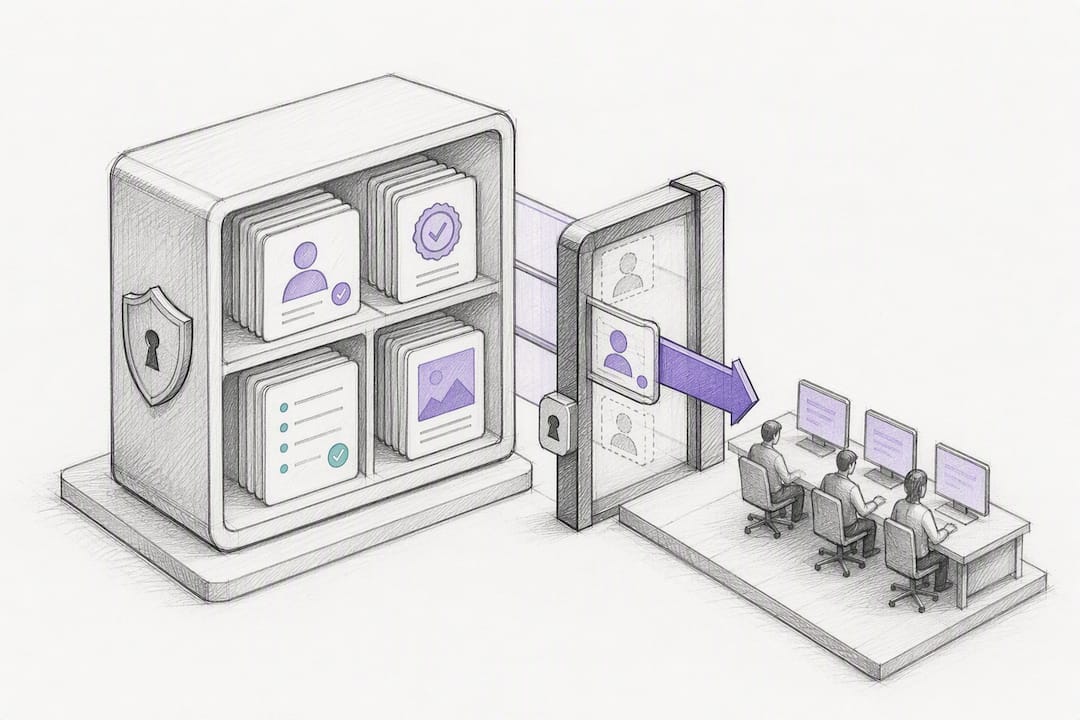
Start with data minimization. Store only what you need to run the program (contact details, consent records, participation history, and the approved asset itself) rather than pulling in unrelated CRM data just because it’s accessible. The more you store, the more you’re responsible for protecting.
Access controls matter as much as storage. Not every sales rep needs visibility into every advocate’s contact information or internal notes about their usage patterns; limit access to the people actually managing the relationship. A centralized, permission-based system prevents the common failure mode where a departing employee’s spreadsheet becomes the only record of consent anyone can find.
GDPR and similar regulations apply whenever you’re handling personal data from customers in the European Union, even if your company is based elsewhere. That means honoring deletion requests, documenting the legal basis for storing contact information, and being able to show exactly what data you hold on any individual advocate if asked.
Encryption and secure storage for any recorded reference calls or written consent forms should be non-negotiable, particularly since these records often include sensitive business outcome data a customer shared in confidence. A breach involving advocate data doesn’t just create legal exposure; it destroys the very trust your entire program depends on.
How Do You Keep Advocates Engaged for the Long Term?
Advocates who feel used once and forgotten rarely say yes twice. The programs that sustain themselves for years treat advocate relationships as ongoing, not transactional.
Rotate your ask frequency deliberately. An advocate who did a reference call in January shouldn’t be the first name pulled again in March; spread requests across your full advocate pool so no single customer feels like your only reliable option. Your capacity tracker should make this visible at a glance.
Close the loop on outcomes. Tell advocates when their reference call helped close a deal, when their testimonial drove a specific campaign’s results, or when their case study got picked up in a major publication. Most programs skip this step entirely, and it’s the single easiest way to make an advocate feel genuinely valued rather than used.
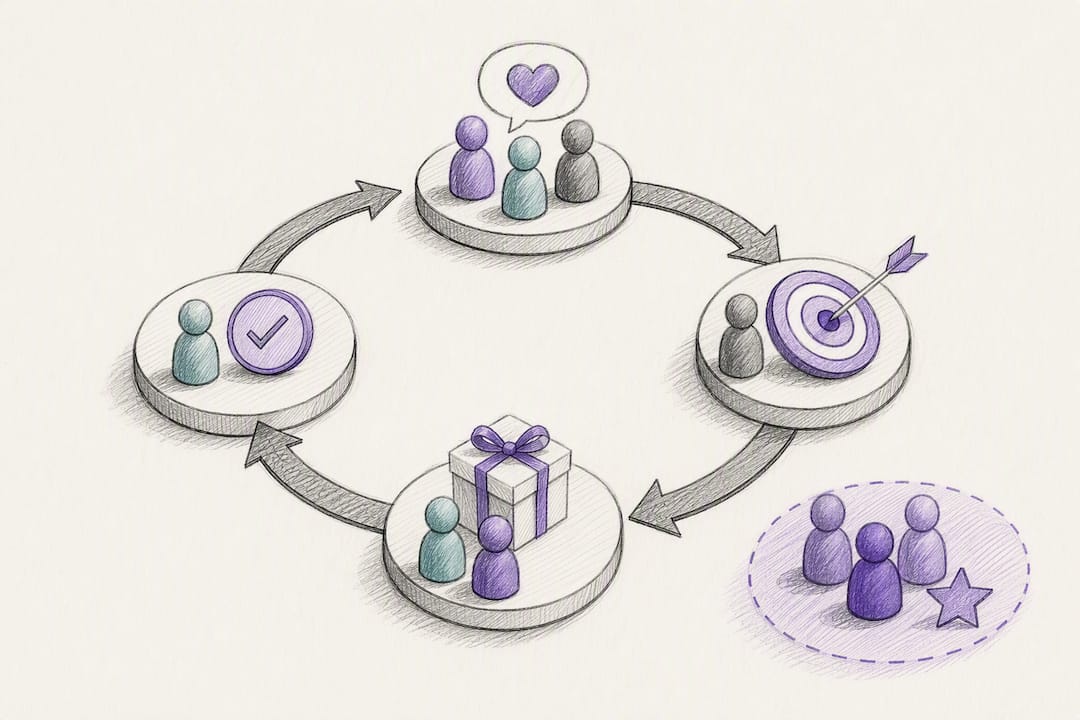
Build a rhythm of low-effort touchpoints between asks: a quarterly check-in that isn’t a request, an invite to an exclusive webinar, or early notice about a feature they specifically asked for. These moments keep the relationship warm without extracting anything, which makes the eventual ask feel far less transactional.
Finally, treat your top advocates as a distinct group worth investing in specifically, whether that’s an informal advisory council or simply direct access to your product and leadership teams. The customers who show up for you repeatedly over multiple years are rare, and a program that doesn’t recognize that difference will eventually lose them to indifference.
What Should You Never Skip When Running This Program?
A few things separate programs that last from programs that quietly die after one enthusiastic launch. Assign one owner. Get written consent before every ask. Track outcome metrics, not just activity counts. Rotate your advocate pool instead of leaning on the same three names repeatedly. And always let the advocate choose the format instead of assuming.
The pitfalls worth naming directly: treating advocacy as a one-time favor instead of an ongoing relationship, skipping consent documentation because “they already said yes verbally,” and measuring volume of testimonials collected while ignoring whether any of them actually influenced a closed deal.
None of this works if you lose sight of the person on the other end of the ask. An advocate is doing you a favor, not fulfilling an obligation. Programs that remember that distinction, and that build real reciprocity into every request, are the ones that still have willing advocates five years in.
— ClareefAi
Get Your Reference Program Running Without the Manual Chase
Clareefai replaces the spreadsheet-and-Slack-thread version of advocacy work with one system that verifies who your customers actually are, uses AI to surface the promoters most likely to say yes, and publishes approved testimonials across your website, sales decks, and review channels the moment they’re captured.
If you’ve read this far, you already know the operational gaps that kill most reference programs: no consent trail, no capacity tracking, no clean line from a testimonial to a closed deal. Clareefai’s dashboards for marketers and advocacy analytics close those gaps without requiring you to build custom CRM fields and matching rubrics from scratch. GDPR-compliant data handling and real-time sync mean the consent and privacy work covered above isn’t a manual burden on top of your day job.
Start with the Basic plan at $250 per month if you’re piloting your first program, or explore the Free plan to test the workflow before committing budget. Either way, the next step is the same: pick your pilot segment, set your one measurable goal, and let the platform handle verification and publishing while you focus on the advocate conversations that actually move deals.
Sources
Using a customer’s name, quote, or logo without explicit permission is a liability, not just a courtesy issue. Written consent should be the baseline requirement before any testimonial, case study, or logo appears publicly, and that consent needs to specify exactly what’s being approved: the quote text, the channels it will appear on, and whether the customer’s title and company name can be included.
Advertising regulators in the United States require that testimonials reflect the genuine, typical experience of the customer, not a cherry-picked outlier result presented as standard. If a case study highlights an exceptional outcome, such as a 300% pipeline increase, disclose that this represents a best-case result rather than what every customer should expect. Overstating typical results is the fastest way to turn a marketing asset into a regulatory problem.
Contractual review matters too. Many enterprise agreements include confidentiality clauses that restrict what can be shared publicly, even after a customer verbally agrees to a testimonial. Loop in legal before publishing anything from a regulated industry customer, a public company, or an account with an unusually restrictive master service agreement.
Revocation rights deserve a clear policy. Customers should be able to ask you to remove a testimonial or case study, and you need a process for pulling it down promptly across every channel it was published on, not just the original source page. Build this into your consent form upfront so it isn’t a scramble later.
Finally, keep records. If a dispute ever arises about whether a customer approved a specific quote or figure, a dated, signed consent record is the only thing that protects you.
- How to build a customer advocacy programme that drives referrals, reviews and growth
- Advocacy program design: building scalable customer advocacy programs - 2026
- Customer reference management software | Capterra
- Customer testimonials: maximize their marketing impact
FAQ
What Is a Customer Reference Program?
A customer reference program is a structured system for identifying willing customers and turning their positive experiences into sales and marketing assets, including reference calls, testimonials, and case studies. It differs from a one-off request for a quote because it runs on a repeatable process with an owner, an intake system, and measurement attached.
What Is a Customer Referral Program?
A customer referral program specifically asks existing customers to introduce new prospects, usually in exchange for an incentive like a discount or credit. It’s one activity within a broader reference program rather than a replacement for it; referrals build new pipeline while other reference activities, like calls and testimonials, accelerate deals already in motion.
What Is a Customer Reference, Exactly?
A customer reference is an existing customer who agrees to vouch for your product, whether through a live call with a prospect, a written testimonial, or a documented case study. The defining feature is named attribution: a real person, role, and company backing a specific claim, which carries far more weight with buyers than anonymous praise.
What Does a Customer-Centric Organization Actually Look Like?
A customer-centric organization treats customer feedback and outcomes as a continuous input into product, marketing, and sales decisions rather than a once-a-year survey exercise. In practice, that shows up as customer success teams flagging advocacy-ready accounts proactively, product teams reviewing case study interviews for roadmap signals, and leadership publicly recognizing the customers who help shape the business.
How Much Does Clareefai Cost?
Clareefai offers a Basic plan at 250 $ per month, a Professional plan at 624 $ per month, and an Enterprise plan at 1250 $ per month, each covering different levels of features and usage. A Free plan is also available for teams that want to test the workflow before upgrading.
Recommended
Share Article
Stay Updated
Get the latest insights on customer advocacy and SaaS growth delivered to your inbox.