
Put each testimonial beside the specific claim it proves, at the moment a buyer is deciding whether to believe that claim. Then make sure the quote is named, specific to the buyer’s situation, and compliant with FTC rules. A testimonial parked in a footer or on a page nobody reaches does very little. The same quote next to your pricing claim, your call to action or your security statement does real work. Clareefai is built to verify, organize and publish testimonials so the right proof can show up at each of these points.
TL;DR
- Place proof beside the claim it supports: a named result next to the outcome it describes, a security proof next to the data-safety line, a testimonial next to the CTA.
- Match proof to the buyer’s doubt by stage: logos and authority early, problem-specific testimonials during consideration, detailed ROI evidence at decision.
- Make each testimonial specific: full name, role, company type and the situation it solved, leading with the outcome.
- Stay inside FTC rules: disclose material connections next to the quote, never fake or gate reviews, and qualify unrepresentative results.
- Test placement one page and one position at a time, then scale what moves conversions.
Table of Contents
- Why placement matters as much as the testimonial itself
- The core rule: proof beside the claim
- Where to place testimonials, page by page
- Match testimonials to the buyer’s stage and doubt
- What makes the testimonial itself work
- Placement mistakes that quietly cost you conversions
- Stay inside FTC rules when you place testimonials
- Test placement instead of guessing
- Put proof where it counts with Clareefai
- Our perspective
- FAQ
- Sources
Why placement matters as much as the testimonial itself
B2B buyers do most of their homework before they talk to you. A Reddit and SurveyMonkey study, as reported by Abmatic in 2026, found that 83% of B2B decision-makers finish their own research before speaking with sales, and that peer recommendations were the most trusted source at 73%, ahead of vendor websites at 55%. Your website is often the first place a buyer meets a peer voice, so where it sits decides whether it is read at all.
One way to think about it comes from Ink & Signal’s guide to proof on sales pages. A page asks readers to hold a promise in mind while deciding whether to believe it. If the proof is three sections away, the reader has to carry the claim down the scroll and match it to the evidence. That effort is where visitors drop off.
The A/B figures vary by site, so treat them as direction, not a forecast. Mantas Auk’s placement analysis reports about a 3% lift from a random mid-page block, against 15 to 30% when the proof is aligned to the decision point. It is one company’s tests, which is exactly why you should run your own (more on that below).

The core rule: proof beside the claim
If you remember one thing, make it this working rule from Ink & Signal: use proof beside the claim it supports. In practice:
- A named testimonial sits next to the result it describes.
- A customer count sits next to the adoption claim.
- A security badge or compliance statement sits next to the data-safety line.
The same guide notes that three well-placed proofs usually beat twenty testimonials collected at the bottom of a page. That is good news for lean teams: you do not need a wall of quotes. You need a short list of strong ones and a map of where each belongs. Our own guide on how many testimonials you need at key doubt moments walks through that sizing.
Where to place testimonials, page by page
Homepage
The highest-impact spot on a homepage is usually a social proof bar just below the hero section. HubSpot’s guide describes this bar as a short testimonial quote, star ratings or customer logos, and notes that B2B SaaS companies often show ratings from review sites. Keep the quote short and outcome-focused here. The homepage reader is deciding whether to keep scrolling, not reading a case study.
Landing pages
Landing pages are where placement pays off fastest, because there is one decision and one button. Kippler’s B2B landing page guide maps each proof type to the doubt it answers:
| Proof type | Where it goes | What it needs |
|---|---|---|
| Customer logos | Under the headline | 4 to 6 logos from the visitor’s segment, with permission |
| Quantified outcomes | Next to the claim they prove | Number, timeframe and baseline |
| Testimonials | Beside the form or CTA | Full name, role, company type, specific situation |
| Review ratings | Near the CTA | Platform named, rating, count, date, link out |
| Case studies | Below the fold, linked | A clear path to the full story |
For more on structuring the rest of the page around conversion, this walkthrough of optimizing landing pages pairs well with the proof map above.
Product and solution pages
Product pages answer “will this work for people like us?” Put the testimonial from the same industry or role right next to the feature or outcome it speaks to. A quote about faster onboarding belongs beside the onboarding section, not in a generic carousel at the bottom. Our post on website testimonial placement covers this in more detail.
Pricing and demo request pages
The pricing page is where risk feels highest, because the buyer is about to commit budget or time. Place a testimonial that speaks to return on investment or ease of rollout close to the plan table and the demo form. Keep the quote tied to a result, and keep it close to the button the reader is about to click.
A dedicated testimonial page
A dedicated page is still worth having. HubSpot’s guide describes it as the home for all formats, serving research-phase prospects who want to dig in. Treat it as a library that your other pages link into, not as the only place proof lives. Most visitors will never open it.
Match testimonials to the buyer’s stage and doubt
A testimonial that works at the top of the funnel can fall flat near the bottom. A 2025 B2B SaaS guide from 1capture maps proof to the journey: authority proof and awards at awareness (“is this credible?”), peer testimonials and industry stories at consideration (“do people like me use this?”), outcome-focused case studies at trial, and risk-reduction proof at decision (“can I trust this investment?”).
That lines up with the advice in DesignRush’s 2026 B2B trust article. Its expert advises putting proof where buyers are already looking for an answer, not on a page they may never reach, and notes that the strongest proof is specific to the problem the buyer is solving, with enough detail to judge whether the experience applies.
Here is a simple way to build your own map:
- List the doubts buyers raise on each page (price, integration effort, security, time to value, vendor stability).
- Assign one testimonial per doubt, chosen for the buyer’s role and industry.
- Place it adjacent to the claim that triggers the doubt.
- Tag each testimonial by industry, role, company size and use case so you can reuse it in the right places.
The tagging step is where many teams stall, because their quotes live in slide decks, email threads and CRM notes. Our guide on using social proof to accelerate the sales cycle shows how stage-matched proof also supports live deals, not just web pages.
Buying committees need more than one voice
B2B purchases are rarely made by one person. Different stakeholders ask different questions: finance wants return, IT wants security, the end user wants ease of use. That is a strong reason to place several short, role-specific proofs across a page instead of one hero quote. Each stakeholder then finds a peer who sounds like them at the spot where their question comes up.

What makes the testimonial itself work
Placement gets the quote seen. Content gets it believed. Use this checklist:
- Full name, role and company type. Anonymous quotes read as invented. Kippler’s guidance asks for full name, role, company type and the specific situation.
- Lead with the outcome. Komet Media’s 2026 guide reports that testimonials opening with credentials see 34% higher early abandonment, so start with the result and keep the title for the byline.
- Be specific. A number, a timeframe and a baseline beat “great product, great team.”
- Use video where you can. The same guide reports that 53% of B2B buyers prefer video case studies over written testimonials, and that same-industry videos improved lead quality by 42%. These are the publisher’s figures, so use them as a reason to test video on your highest-intent pages.
- Keep it scannable. Pull a one-sentence quote for the page and link to the full story.
Verification matters as much as polish. When every testimonial is tied to a real, confirmed customer, you can use it with confidence on high-stakes pages. Our post on how customer testimonials build trust explains why that context is what separates sales proof from generic praise.
Placement mistakes that quietly cost you conversions
- Proof only in the footer. Kippler warns that most paid visitors never see it.
- Proof three scrolls from the claim. A big claim needs its proof in the same section.
- Mismatched logos. Logos from the wrong segment can signal “not for you.”
- One carousel for everyone. Rotating quotes that ignore page intent give each reader a roughly random message.
- Unqualified results. A dramatic number with no context invites doubt, and in the U.S. it can raise a legal issue (see below).
- Sentiment-filtered collection. Only asking happy customers, or hiding the rest, runs into FTC rules and makes the page less believable.
Stay inside FTC rules when you place testimonials
In the U.S., placement is also a compliance question, because a disclosure in the wrong place can fail even when the words are right. This section is a summary, not legal advice. Your legal counsel should review your program before launch.
Two FTC rules matter most:
- The revised Endorsement Guides, 16 CFR Part 255, effective July 26, 2023. They require clear and conspicuous disclosure of material connections, such as payment or free product. If a testimonial about a central product attribute implies typical results and you cannot substantiate that, you must clearly disclose the generally expected performance.
- The Consumer Reviews and Testimonials rule, announced August 14, 2024 and effective October 21, 2024. Per Wilson Sonsini’s analysis, it bans fake or AI-generated reviews, sentiment-conditioned incentives, undisclosed insider reviews and suppression of negative reviews. Civil penalties can reach nearly $52,000 per violation, adjusted annually for inflation.
What this means for placement:
- Put any material-connection disclosure in the same view as the quote, where it is easy to notice. Not below the fold, and not buried.
- Put a qualifier about unrepresentative results directly beside the result it qualifies, including inside carousels.
- Collect reviews only from real customers, with neutral request language.
- Keep negative and neutral feedback from being suppressed.
We cover the details in our six-step verification workflow for FTC testimonial guidelines, our review gating audit and our guide to handling negative testimonials.
Test placement instead of guessing
Benchmarks tell you where to start. Your traffic tells you what is true. A simple testing routine:
- Pick one high-intent page, such as pricing or your main demo landing page.
- Change one variable: the position, the testimonial, or the format (text versus video).
- Define the metric before you start: demo requests, form completions or click-through to pricing.
- Run it long enough to reach a meaningful sample, then keep the winner and test the next page.
- Record the result by segment, since a quote that wins for IT buyers may lose with finance.
Our testimonial placement testing playbook lays out this routine for B2B teams. For pages that adapt proof to the visitor, see our guide to dynamic social proof.
Put proof where it counts with Clareefai
Good placement depends on having the right proof ready: verified, tagged and easy to publish. Clareefai is a platform for B2B sales and marketing teams to collect, verify, categorize and showcase customer testimonials, reviews, case studies and reference calls. It uses AI to identify your most impactful advocates, and it publishes testimonials across channels through CRM and review integrations. Dashboards and analytics show which advocacy efforts matter, and the platform includes GDPR security.
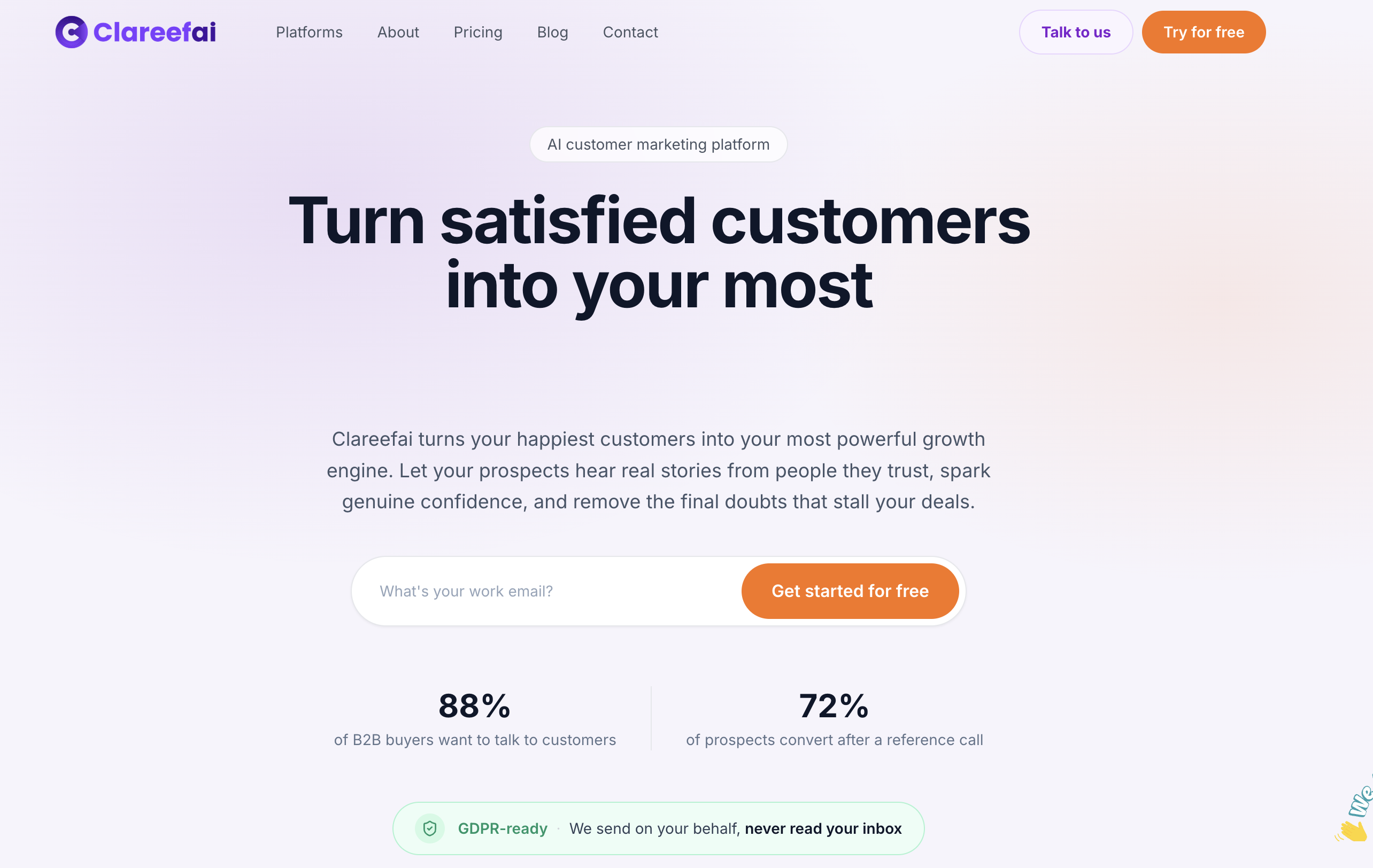
Plans are published at Clareefai pricing: Basic is $250 per month, Professional is $624 per month and Enterprise is $1250 per month. A free plan is also available, and you can see how teams use unified testimonial management in the platform overview.
Our perspective
Most teams we talk with about testimonial placement do not have a design problem. They have an organization problem. The best quote is in a call recording, the permission is in an email, and the page that needs it is built by someone who never saw either.
We built Clareefai around a simple belief: a testimonial is only a sales asset when a prospect can trust it and find it at the right moment. That is why the platform verifies customer identities and adds context to feedback, so a quote is not just praise but proof tied to a real person and a real situation.
Placement then becomes a repeatable routine. Identify the advocates with the most relevant stories, match them to the doubts on each page, and publish through the integrations you already use. Analytics close the loop, so you can see which proof supports your funnel and expand it.
The goal is to turn satisfied customers into active ambassadors, and to let every page of your site speak with their voice.
ClareefAi
FAQ
Where is the best place to put testimonials on a website?
Beside the claim they support and near the decision point. On a homepage that is usually a proof bar just below the hero. On a landing page it is next to the form or CTA. On a pricing page it is close to the plan table and the demo button.
How many testimonials should a page have?
Fewer than most teams think. A handful of specific, well-placed proofs usually does more than a long wall of quotes. Choose one per major doubt on the page, and link out to a library for readers who want more.
What are the key elements of a good testimonial?
A real, named person with a role and company type, a specific situation, and a measurable outcome that leads the quote. Add video where possible, and keep a short version for the page with a link to the full story.
Do FTC rules affect where I put a testimonial?
Yes. Disclosures of material connections must be clear and conspicuous, so they belong in the same view as the quote. A qualifier on an unrepresentative result belongs beside that result. Review your program with legal counsel.
Sources
- Abmatic: How B2B Buyers Actually Use Reddit to Research Vendors
- Ink & Signal: Where To Put Social Proof on a Sales Page
- Mantas Auk: Where to Position Social Proof
- HubSpot: Why customer reviews and testimonials convert
- Kippler: Social proof on landing pages
- 1capture: B2B Social Proof for SaaS Trials
- DesignRush: 85% Say Trust Gives B2B Companies an Edge
- Komet Media: Customer Testimonial Videos for B2B
- eCFR: 16 CFR Part 255
- Federal Register, July 26, 2023: Endorsement Guides final rule
- Wilson Sonsini: FTC Issues Final Rule Banning Fake and Misleading Consumer Reviews