Six Step Verification Workflow to Meet U.S. FTC Testimonial Guidelines
Six Step Verification Workflow to Meet U.S. FTC Testimonial Guidelines
The FTC bans fake and false consumer reviews and testimonials outright, and requires clear disclosure of any material connection between a business and an endorser. Two rules govern this: the Consumer Reviews and Testimonials Rule (16 CFR Part 465), effective October 21, 2024, and the Endorsement Guides (16 CFR Part 255). If you publish testimonials today, pause anything you can’t verify, add disclosures where a relationship exists, and start an audit trail this week.
TL;DR:
- Verifying that testimonials come from real customers who used the product and obtained documented consent is essential to comply with the new rules.
- Disclosing material connections clearly and visibly, such as payments or gifts, is required whenever a relationship exists with the endorser.
- Businesses must avoid gating reviews and ensure they do not condition incentives on positive feedback to prevent misleading impressions.
- Hosting reviews is different from disseminating testimonials; once a testimonial becomes part of marketing, its truthfulness is the business’s responsibility.
- Implementing a structured verification process, including recordkeeping and regular audits, reduces legal risk and improves testimonial credibility.
Table of Contents
- Quick Compliance Checklist for Marketers and Owners
- What the Consumer Reviews and Testimonials Rule Actually Covers
- The Endorsement Guides: Disclosure, Substantiation, and “Clear and Conspicuous”
- Prohibited and High-Risk Practices You Should Flag Immediately
- Who Is Liable, and What Penalties Actually Look Like
- A Practical Verification Workflow You Can Run This Month
- Examples: What Compliant Testimonials Actually Look Like
- Authoritative Resources and Official Texts
- Why Verified Testimonials Are a Trust Problem, Not Just a Legal One
- How Clareefai Keeps Your Testimonial Program Compliant and Sales-Ready
- Sources
Quick Compliance Checklist for Marketers and Owners
You don’t need a law degree to get most of this right. You need a system, and you need to run it before you publish, not after a complaint lands. Here’s the order that actually protects you.
- Verify the reviewer is real and actually used the product. A testimonial from someone who never touched your service is a false review under the Consumer Reviews and Testimonials Rule, full stop, no matter how flattering it sounds.
- Disclose material connections clearly and prominently. If you paid, gifted, employed, or otherwise compensated the person giving the testimonial, say so in a way an average reader will actually notice, not bury in a footnote.
- Stop gating reviews. Routing only happy customers to a public review form while diverting complaints to a private inbox creates a skewed, misleading picture, and regulators treat it as a form of suppression.
- Never condition incentives on a positive outcome. You can offer a gift card for leaving a review. You cannot offer one for leaving a good review, and the line between those two is where a lot of well-meaning marketers get into trouble.
- Document your substantiation and keep an audit trail. Screenshots of original submissions, dated consent records, and a written verification policy are the difference between “we made a mistake” and “we knowingly violated the rule.”
- Train the people who touch this content. Sales reps collecting testimonials at a trade show and social media managers reposting influencer content both need to know what “clear and conspicuous” actually means before they hit publish.
Build this into your workflow once, and it stops being a compliance chore. A testimonial collection checklist that captures identity and consent at intake saves you from reconstructing that information later, under pressure, when a regulator or a reporter is asking.
What the Consumer Reviews and Testimonials Rule Actually Covers
The Rule took effect on October 21, 2024, and it gives the FTC authority to seek civil penalties against businesses that knowingly violate it, according to the agency’s own Q&A on the Rule. That “knowing” standard matters. It doesn’t automatically punish an honest mistake, but it does mean ignorance stops being a defense the moment you’ve been told, or should reasonably have known, that a testimonial was fake.
The Rule targets specific conduct, not testimonials in general:
- Creating or selling fake reviews. Writing testimonials that don’t reflect a real customer’s real experience, or paying a third party to generate them, is squarely prohibited.
- Buying or soliciting fake reviews from insiders. This includes employees, executives, and their immediate family members posting reviews of their own company without disclosing the relationship.
- Disseminating reviews you know are fake. Publishing a testimonial on your website when you have reason to doubt its authenticity carries liability even if you didn’t create it.
- Suppressing honest negative reviews. Threatening a customer with legal action for leaving a bad review, or systematically hiding negative feedback from public view, falls under review suppression.
- Buying fake social media indicators. Purchasing followers, likes, or views to fabricate the appearance of popularity or engagement is explicitly covered.
One distinction trips up a lot of businesses: hosting reviews is different from disseminating testimonials. A retailer that hosts a third-party review widget on its product page has a lighter duty than a business that hand-picks specific testimonials and features them in an ad campaign. The FTC’s guidance makes clear that once you select and publish a testimonial as marketing material, you become responsible for its truthfulness, and you can’t simply point to the customer who wrote it as the sole source of accountability.
The Endorsement Guides: Disclosure, Substantiation, and “Clear and Conspicuous”
The Endorsement Guides, codified at 16 CFR Part 255, define an endorsement broadly: any advertising message that consumers reasonably believe reflects the genuine opinion of someone other than the advertiser. That covers written testimonials, video reviews, social media posts, and even a simple product tag from an influencer if it implies approval. Tagging a brand in an Instagram photo without context can count as an endorsement if it looks like a genuine recommendation rather than a paid placement.
The disclosure trigger is the “material connection,” and the FTC’s test for whether one needs disclosing is whether a significant minority of the audience would be surprised to learn about it, according to the FTC’s own Q&A on the Endorsement Guides. Free products, payment, affiliate commissions, employment, and even family relationships between the endorser and the business can all qualify.
Statistic Callout: The FTC doesn’t require a majority of viewers to be misled before a disclosure becomes mandatory. The bar is a significant minority, a deliberately low threshold that pushes advertisers toward disclosing early and often rather than guessing.
“Clear and conspicuous” has specific, medium-dependent requirements:
- Text content: the disclosure needs to be in a font size and location a reader won’t skip, not tucked below a “read more” link or buried in a hashtag string.
- Video content: the disclosure must appear in both the visual and audible portions when practical, and it needs to stay onscreen long enough to actually be read.
- Interactive and social media: a hidden link, a hover state, or a disclosure that requires extra clicks to find does not meet the standard, since the Endorsement Guides require disclosures that are unavoidable, not merely available.
Substantiation matters too. If a testimonial claims a specific result (“I lost 20 pounds,” “we cut costs by half”), the advertiser needs evidence that result is typical, or must clearly disclose what the typical result actually looks like. A single glowing outlier presented without context can mislead just as effectively as an outright fabrication.
Prohibited and High-Risk Practices You Should Flag Immediately
Some conduct sits so clearly in the FTC’s crosshairs that it barely needs interpretation. Other practices look innocent on the surface but carry real enforcement risk once you understand what regulators are watching for.
- Buying or selling positive reviews outright, including through third-party marketplaces that broker fake review services for a fee.
- Bot-driven engagement schemes, where a business purchases followers, likes, or fake account activity to manufacture the appearance of popularity, a practice the Rule names directly.
- Review gating, where only satisfied customers are funneled toward a public review request while dissatisfied ones are quietly redirected elsewhere. A detailed audit of review gating walks through how this practice gets flagged and what a defensible collection process looks like instead.
- Manipulated voting or ranking signals, such as coordinated upvoting campaigns on review platforms designed to push favorable content to the top.
- Undisclosed insider testimonials, where an employee, founder, or their family member posts a glowing review without noting the relationship.
- Scripted or ghostwritten endorsements dressed up as organic opinion, where marketing staff draft the language and simply attach a customer’s name and photo.
The FTC’s guidance on endorsements and influencer content treats each of these as variations on the same underlying problem: manufacturing trust signals that consumers can’t independently verify. That’s the thread connecting all of it, whether the tactic involves a bot farm or a well-meaning employee who genuinely loves the product but forgot to mention where their paycheck comes from.
Who Is Liable, and What Penalties Actually Look Like
Advertisers carry liability even when the endorser themselves did nothing wrong. If your marketing team publishes a testimonial without verifying it, you’re on the hook regardless of whether the customer who wrote it acted in good faith or was compensated by a third party you never dealt with directly.
Knowing violations of the Consumer Reviews and Testimonials Rule can bring civil penalties, and the FTC has stated plainly that businesses disseminating testimonials, not just the platforms hosting them, bear responsibility for the truthfulness of what they publish, according to the agency’s own press release announcing the final rule.
Enforcement typically unfolds through a few consistent tools:
- Consent orders and settlements, requiring a business to stop the conduct and often submit to compliance monitoring.
- Civil penalties, reserved for cases where the FTC can show the business knew, or should have known, the reviews were fake or the disclosures were missing.
- Injunctive relief, barring specific practices going forward and sometimes requiring corrective disclosures.
What reduces your exposure isn’t perfection. It’s documentation. A written verification policy, dated consent records, and a clear escalation process when something looks suspicious all signal a good-faith compliance effort, and that record is exactly what regulators look for when deciding how aggressively to pursue a case.
A Practical Verification Workflow You Can Run This Month
Most testimonial programs fail not because marketers don’t care about compliance, but because nobody built a repeatable process. Here’s a six-step workflow that closes most of the gaps.
- Capture intake details at the source. When a customer submits a testimonial, record their name, contact information, relationship to your business, and whether they received any compensation, free product, or discount in exchange for it.
- Verify identity. Confirm the person exists and is who they claim to be, using account records, order history, or a direct follow-up email. Identity verification practices built for B2B testimonial programs matter even more here, since a fabricated B2B case study can carry more commercial weight than a single consumer review.
- Confirm bona fide product use. Cross-check the testimonial against actual purchase or usage records before you publish anything tied to specific results or claims.
- Capture consent and disclosure information explicitly. Get written confirmation that the person agrees to have their testimonial published, and note any material connection that needs disclosing alongside it.
- Review the content itself. Check for exaggerated claims, results that aren’t typical, or language that reads like it was written by your own marketing team rather than the customer.
- Archive everything. Store screenshots of the original submission, consent records, and verification notes in a system you can retrieve quickly if a regulator or a customer ever asks questions.
Pro Tip: Set a recurring quarterly review of your testimonial archive, not just a one-time audit. Reviews decay: a testimonial that was accurate two years ago might reference a product feature you discontinued, or a price that no longer exists, which can turn an honest testimonial into a misleading one without anyone noticing.
Watch for red flags that should trigger a manual investigation before publishing: near-identical wording across multiple reviews, a sudden cluster of five-star ratings from accounts with no prior activity, submissions that arrive suspiciously close to a requested benefit like a discount or renewal, and language that mirrors your own marketing copy a little too closely. These patterns are exactly what the FTC’s Q&A points to as evidence of fabrication. A step-by-step verification process that treats these triggers as automatic escalation points, rather than edge cases someone might notice eventually, is what separates a defensible program from a liability waiting to surface.
Recordkeeping isn’t glamorous, but it’s the single cheapest form of legal protection available to you. A dated, written policy combined with copies of consents and original submissions is persuasive evidence of good faith if your practices are ever questioned, far more persuasive than a verbal assurance that “we always check these things.”
Examples: What Compliant Testimonials Actually Look Like
Noncompliant web testimonial: “This product changed my life! Best purchase I’ve ever made.” No name, no verification, no context about whether the reviewer received anything in exchange for the words. If your team wrote that copy and attached a stock photo, you’ve created a fake testimonial under the Rule, not curated a real one.
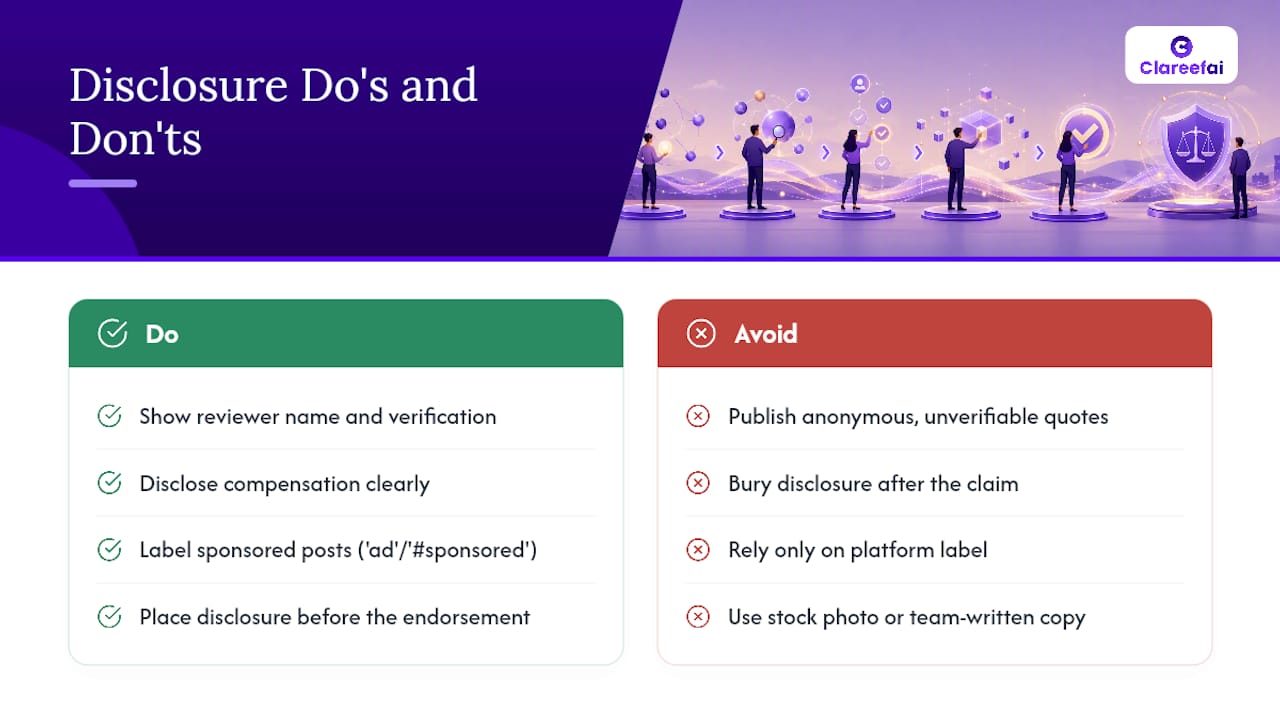
Compliant version: “Sarah T., verified customer since March 2025: ‘The onboarding process saved my team about six hours a week.’ Sarah received a $50 credit for sharing her experience.” The name, the verification note, and the compensation disclosure all do real work here.
Influencer post example: A sponsored video review needs the word “ad” or “#sponsored” placed in the caption text itself, not buried after ten hashtags, and ideally spoken aloud in the first few seconds of the video for audiovisual content.
A short, plain disclosure like “I was given this product for free in exchange for an honest review” does more compliance work in twelve words than a legal disclaimer buried three paragraphs into a blog post ever will.
Placement rules that hold up across formats: put the disclosure before the endorsement claim, not after it; keep it in the same visual field the viewer is already looking at; and never rely on a platform’s automatic “paid partnership” label as your only disclosure if your own caption doesn’t reinforce it. Building a stronger digital reputation starts with disclosures readers actually notice, not ones that technically exist but practically hide.
Authoritative Resources and Official Texts
Bookmark these before you need them in a hurry:
- The Consumer Reviews and Testimonials Rule: Questions and Answers, the FTC’s own plain-language explanation of Part 465, with the clearest breakdown of prohibited conduct available anywhere.
- FTC’s Endorsement Guides: What People Are Asking, covering disclosure standards, the significant-minority test, and common scenario questions.
- Federal Register notice on the revised Endorsement Guides, the official rulemaking record with the regulatory reasoning behind each definition.
- 16 CFR Part 255, the full legal text of the Endorsement Guides, useful when you need the precise regulatory language rather than a summary.
Consult the Q&A pages first for day-to-day decisions, and reserve the CFR text for situations where your legal team needs the exact statutory wording.
Why Verified Testimonials Are a Trust Problem, Not Just a Legal One
Compliance and conversion aren’t competing priorities here, they’re the same problem viewed from two angles. A testimonial that can’t survive a verification check is also a testimonial that a skeptical prospect won’t trust, and B2B buyers in particular have gotten sharper about spotting generic, unverifiable praise. The businesses treating FTC compliance as a box to check are missing that the underlying discipline, knowing who said what, confirming they meant it, and showing your work, is exactly what makes a testimonial persuasive in the first place.
If your testimonial program can’t tell you, right now, who verified a given quote and when, that’s worth fixing before a regulator asks the same question. Audit what you’re currently publishing, and build the habit of verification into collection instead of bolting it on after the fact.
— ClareefAi
How Clareefai Keeps Your Testimonial Program Compliant and Sales-Ready
A centralized system that verifies who a customer is, captures their consent at the moment they submit a testimonial, and keeps a permanent audit trail tied to every quote you publish can help manage testimonial compliance more effectively. Instead of chasing down proof after a complaint lands, you have it already, timestamped and searchable.

The platform’s identity verification confirms testimonials come from real, bona fide customers before they ever reach your marketing channels, directly addressing the fake-review risk the Consumer Reviews and Testimonials Rule targets. Role-based dashboards can let compliance, sales, and marketing teams each see the disclosure status and verification history for every testimonial in the system, helping ensure published content has been checked. Real-time syncing allows published testimonials to update promptly when a customer’s status or consent changes.
See how a structured testimonial program plays out in practice on Clareefai’s customer stories page, and start a trial to run your first verified testimonial through the system this week.
Sources
- The Consumer Reviews and Testimonials Rule: Questions and Answers | Federal Trade Commission
- FTC’s Endorsement Guides: What People Are Asking | Federal Trade Commission
- Federal Register: Guides Concerning the Use of Endorsements and Testimonials in Advertising
- 16 CFR Part 255 — Guides Concerning the Use of Endorsements and Testimonials in Advertising (CFR)
Recommended
Share Article
Stay Updated
Get the latest insights on customer advocacy and SaaS growth delivered to your inbox.