Avoid FTC Fines: 2024–2026 Review Gating Audit for Marketers & Ops
Review gating is illegal under federal law, full stop. The Federal Trade Commission’s Consumer Reviews and Testimonials Rule, combined with Section 5 of the FTC Act, gives regulators civil-penalty authority against businesses that filter customers by predicted sentiment before asking for a review. Google and Yelp separately ban the practice under their own platform policies. If your review request flow sends unhappy customers to a private form and happy ones to a public link, stop that flow today and switch to routing everyone to the same public request.
TL;DR:
- Routing all customers to a public review request regardless of their feedback response is the only compliant practice; gating based on sentiment is illegal.
- The new FTC rule imposes civil penalties for review suppression and manipulation, with violations potentially costing tens of thousands of dollars per instance.
- Google and Yelp enforce their own review policies by removing or demoting reviews and suspending profiles for gating or soliciting selectively.
- Businesses are responsible for review tools that filter or gate reviews, and should audit their processes to ensure all customers see the same public review link.
- Verified testimonials and audit trails provide compliant alternatives that build trust without risking legal or platform penalties.
Table of Contents
- What Counts as Review Gating vs. Legitimate Review Requests
- The Federal Rules That Make Gating a Legal Risk
- How Google and Yelp Enforce Their Own Review Rules
- What Enforcement Actually Costs: Fines, Settlements, and Fallout
- Auditing Your Review Tools for Hidden Gating
- Building a Review Program That Stays Legal and Still Grows
- Verified Testimonials Take the Pressure off Public Review Sampling
- A Compliant Way to Turn Happy Customers Into Sales Assets
- Sources
What Counts as Review Gating vs. Legitimate Review Requests
Review gating means sorting customers by predicted sentiment before deciding who gets asked to post a public review. The classic version: a post-purchase survey asks “How was your experience?” and only customers who click “Great” get routed to Google or Yelp, while anyone who clicks “Not great” gets funneled into a private feedback form that never reaches a public platform. That selective routing is what the FTC’s business guidance treats as misleading, because it manufactures a review sample that no longer reflects your actual customer base.
Compliant review generation looks different. It sends the same public review link to every customer who completed a purchase or service, regardless of how they answered any prior question.
Allowed operations include:
- Running internal satisfaction surveys that never gate access to a public review link
- Asking all customers the identical public review request, win or lose
- Offering a private feedback channel as an additional option, not a replacement for the public one
- Following up publicly and quickly when a negative review lands
The dividing line is simple: if sentiment determines who sees the public link, you are gating.
The Federal Rules That Make Gating a Legal Risk
The FTC finalized its Consumer Reviews and Testimonials Rule in August 2024, codified at 16 CFR Part 465. The rule directly addresses fake reviews, review suppression, and incentives conditioned on sentiment, and it hands the agency civil penalty authority it did not clearly have before.
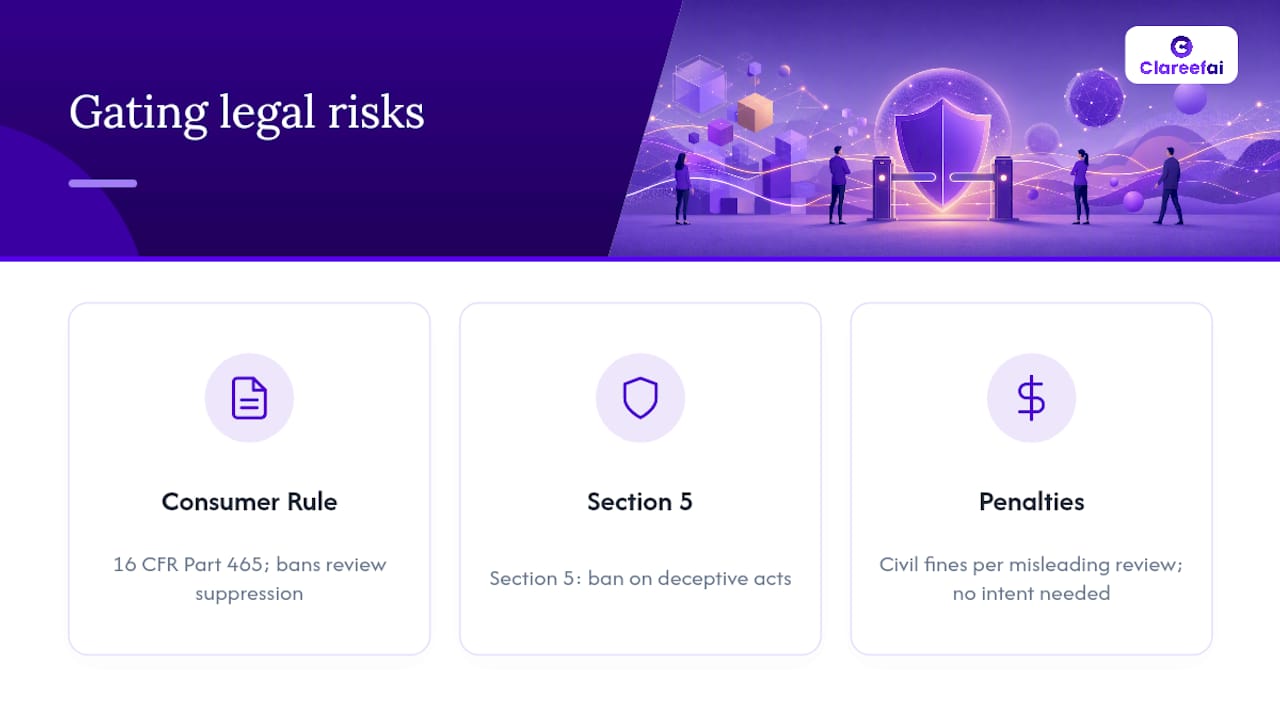
Review suppression is now an explicit violation. The Federal Register text prohibits misrepresenting that displayed reviews represent most or all submitted reviews when suppression has skewed the sample. Gating produces exactly that misrepresentation: a storefront of five-star reviews that quietly excludes everyone who had a bad experience.
Section 5 of the FTC Act does the heavier lifting for anything the new rule doesn’t name explicitly. Section 5 bans “unfair or deceptive acts or practices” broadly, so even a gating scheme built around a workaround not spelled out in the rule can still trigger enforcement under this older, more general statute.
Penalty mechanics that matter: Civil penalties under the rule can run into the tens of thousands of dollars per violation, adjusted periodically for inflation, and each misleading review request can count as a separate violation. Enforcement doesn’t require proof you intended to deceive. A “should have known” standard applies, so ignorance of how your review software actually routes customers is not a defense, according to legal analysis of the rule.
The rule didn’t invent a new legal theory so much as formalize enforcement the FTC was already pursuing, which is exactly why exposure now feels more automatic than it did a few years ago.
How Google and Yelp Enforce Their Own Review Rules
Platform policy violations run on a separate track from federal law, and they move faster. Google’s guidelines prohibit selectively soliciting reviews from customers you expect to respond positively, and they specifically bar discouraging or blocking negative reviews. The distinction Google draws is the same one the FTC draws: routing is fine, gating is not, according to an analysis of Google’s review policy.
Yelp applies even stricter content rules and layers algorithmic filtering on top of manual enforcement. Yelp’s system is known for flagging suspicious review patterns and can apply a public “consumer alert” to a business page, which tanks discoverability well beyond just hiding a few reviews.
Typical platform consequences include:
- Removal of individual reviews flagged as solicited unfairly
- A hidden or asterisked star rating pending investigation
- Full profile suspension for repeated or severe violations
- Reduced ranking in local search results, independent of any federal penalty
None of this requires a lawsuit or a regulator. A platform algorithm can impose real financial damage in the time it takes to detect a pattern.
What Enforcement Actually Costs: Fines, Settlements, and Fallout
Civil penalties under the FTC’s rule scale per violation, and per-violation math adds up fast when a business has been running an automated gating flow for months across thousands of customers.
Enforcement history gives a sense of scale. The FTC’s refund process tied to Fashion Nova’s deceptive review practices came after the agency found the retailer had suppressed negative reviews for years, and it became a template case referenced throughout later FTC guidance on suppression. Legal analysis of the current rule notes that civil penalties for review-manipulation violations can reach into the tens of thousands of dollars per instance, and that platform suspensions frequently arrive faster than any federal action.
The costs that don’t show up on a settlement notice tend to hurt longer:
- Reinstatement after a platform suspension can take weeks, during which local search visibility stays suppressed
- A public consumer alert on a Yelp or Google profile often outlasts the violation that triggered it
- Prospects doing due diligence during that window see a flagged profile, not your product
Financial penalties get the headlines. Lost visibility during a slow reinstatement is usually the bigger operational hit.
Auditing Your Review Tools for Hidden Gating
You’re liable for what your review software does, even when a vendor or agency built it. The FTC has stated plainly that businesses can be held responsible for third-party conduct done on their behalf, including software a vendor configured without your explicit sign-off on the sentiment logic.
Run these three checks on any review tool you currently use:
- Does the flow condition the public review link on how a customer answers an earlier question? If yes, that’s gating regardless of who built the tool.
- Is the same public review option shown to every customer, positive and negative alike? If only some customers see it, you have a routing problem.
- Is a private feedback channel offered as a genuine choice, or does it quietly replace the public option for anyone flagged as unhappy? Replacement is the violation; choice is not.
Pro Tip: Keep dated screenshots of the exact request flow shown to customers, plus a change log from your vendor whenever they update the survey logic. That documentation is your best evidence if a regulator or platform ever asks what customers actually saw.
Building a Review Program That Stays Legal and Still Grows
Routing beats gating on both compliance and results. A compliant routing flow gives every customer who completed a purchase one-tap access to a public review platform, and it presents any private feedback option as an addition, never a substitute.
The FTC’s guidance for marketers is specific about incentives: you can offer a small reward for leaving a review, but you can never condition that reward on the review being positive, and any compensation has to be disclosed clearly near the review itself.
An operational playbook that holds up under scrutiny includes:
- Automatic review requests sent to every completed-service customer, not a filtered subset
- A fast public-response process for negative reviews, since responding well often does more for trust than hiding the review ever could
- An audit log showing what each customer was shown and when
- A written service agreement with any review-management vendor that bans sentiment-based routing outright
Businesses that switch from gating to routing typically see review volume climb, not fall, because the flow reaches every customer instead of a filtered slice, and public responses to criticism tend to read as more credible to prospects than a suspiciously spotless five-star page.
Pro Tip: Review your step-by-step review collection process against your last 90 days of customer records. If the ratio of requests sent to five-star responses looks too clean, your flow is probably filtering somewhere upstream.
For teams building this out from scratch, a structured review management playbook and a partner resource on managing online reputation both walk through the routing model in more operational detail.
Verified Testimonials Take the Pressure off Public Review Sampling
The reason gating tempts marketing teams in the first place is fear of an unfiltered public review page. Verified, contextualized testimonials solve that fear without touching the sample. When you can show a prospect a named customer, their role, and the specific result they got, you’re no longer depending on the average of every public star rating to make the sale.
Marketing teams should prioritize tools that build audit trails and verification into the collection process itself, not bolted on after the fact. A workflow that verifies identity, timestamps consent, and logs where a testimonial was published gives you both a sales asset and a compliance record in the same system. That combination is what actually reduces the incentive to manipulate a public sample: you stop needing every review to be five stars because your best proof points are living somewhere else entirely.
— ClareefAi
A Compliant Way to Turn Happy Customers Into Sales Assets
Review gating tempts businesses because a flawless public star rating feels like the only lever available. It isn’t. The platform offers verified, contextualized testimonials and video reviews collected through a documented, audit-friendly process, so you’re not depending on a filtered public sample to close deals.
It can verify customer identity before a testimonial goes live, keep a record of consent and publishing history, and sync across CRM and public channels in real time, giving a compliance trail if a vendor’s review flow is ever questioned. Dashboards can surface advocacy data relevant to different roles, so a testimonial collected once can support a sales deck, a landing page, and a case study without re-requesting the customer. If your current review software can’t show you exactly what each customer saw and when, that is an important capability to consider addressing. Visit the Clareefai platform overview to see how verification and audit logging work together, or explore solutions for sales, marketing, and management to find the setup that fits your team.
Sources
- Featuring online customer reviews: A guide for businesses
- Federal Register: Trade Regulation Rule on the Use of Consumer Reviews and Testimonials (final rule text)
- Is Review Gating Illegal Under Consumer Protection Laws? - LegalClarity
Recommended
Share Article
Stay Updated
Get the latest insights on customer advocacy and SaaS growth delivered to your inbox.