GDPR for B2B: A Practical Compliance Guide for 2026
TL;DR:
- GDPR applies to all personal data processing of EU individuals, including in B2B contexts.
- Legal compliance requires documentation, prompt handling of opt-outs, signed data agreements, and transparent notices.
GDPR is defined as a regulation that governs all personal data processing of EU individuals, including data collected in business-to-business contexts. Explaining GDPR for B2B means accepting one core truth: the regulation makes no distinction between consumer and commercial relationships. If you process the personal data of an EU-based individual, whether they are a private customer or a corporate buyer, GDPR applies. For compliance officers, legal advisors, and marketing teams, this means every cold email, CRM record, and published testimonial falls under the same legal framework. Getting this right protects your organization and builds the kind of trust that moves deals forward.
What counts as personal data in B2B and when does GDPR apply?
Personal data in B2B is broader than most teams expect. Under GDPR, any information that identifies or can identify a living individual qualifies as personal data. That definition covers far more than home addresses and phone numbers.
In a B2B context, the following data types are all protected:
- Professional email addresses (e.g., john.smith@company.com) that identify a specific person
- LinkedIn profiles and other professional networking data linked to an individual
- Business phone numbers that route directly to a named employee
- Job titles combined with company names when they identify a specific person
- Customer testimonials that include a person’s name, photo, or role
- CRM records containing contact history, notes, or behavioral data tied to an individual
GDPR fully applies to B2B prospecting, and any EU individual’s business email or LinkedIn profile qualifies as personal data. This matters because many B2B teams assume that targeting a company, rather than a consumer, removes them from GDPR’s scope. That assumption is wrong.
The regulation applies whenever you process the personal data of an EU-based individual, regardless of whether the transaction is commercial. Selling to a company does not exempt you from GDPR. The individual behind the business email address retains full data subject rights, including the right to access, correct, and erase their data.

Pro Tip: Review your CRM field structure. If any field stores data that could identify a specific person at a company, that field is subject to GDPR, even if the record is labeled as a company account.
What are the legal bases for processing B2B personal data?
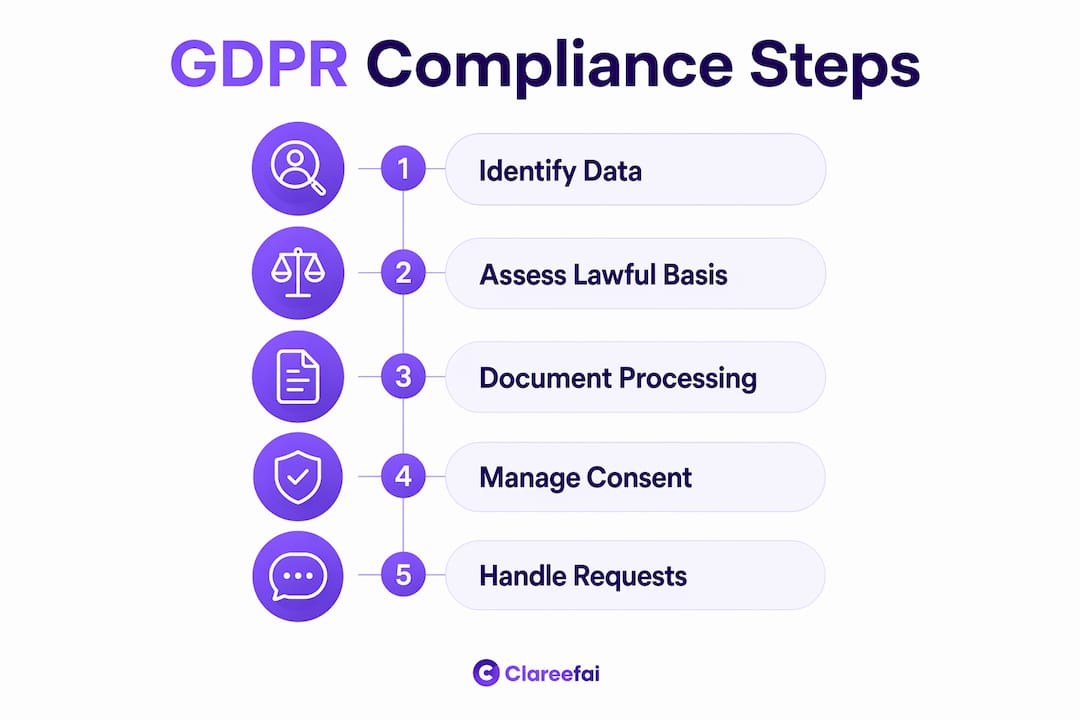
Article 6 of GDPR defines six lawful bases for processing personal data. In B2B, two bases dominate: legitimate interest and consent.
Legitimate interest for B2B outreach
Legitimate interest under Article 6(1)(f) is the most commonly used basis for B2B prospecting and cold outreach. To rely on it legally, three conditions must be met:
- Relevance: Your message must be genuinely relevant to the recipient’s professional role or business needs.
- Transparency: You must inform the contact that you hold their data and explain how you use it.
- Opt-out respect: You must honor opt-out requests promptly and permanently.
Cold outreach is legal under Article 6(1)(f) when message relevance, transparency, and opt-out compliance are all maintained. Legitimate interest is not a blanket permission. Each campaign requires its own documented assessment.
Legitimate Interest Assessments
A Legitimate Interest Assessment (LIA) is the written record that justifies your use of legitimate interest for a specific processing activity. LIA documentation is the legal insurance policy for B2B outreach. Without it, your defense in a regulatory audit is weak or absent. The LIA must weigh your business interest against the individual’s rights and confirm that the processing does not override those rights.
Consent in B2B
Consent applies primarily to inbound marketing and ongoing communications where the contact has actively opted in. For newsletter subscriptions, gated content downloads, and remarketing campaigns, consent is the cleaner legal basis. Consent must be freely given, specific, informed, and unambiguous. Pre-ticked boxes and bundled agreements do not meet the standard.
Pro Tip: Do not rely on a single LIA for an entire year of outreach. Document a fresh assessment for each new campaign or audience segment. Regulators look for campaign-level documentation, not blanket annual approvals.
Key GDPR obligations and best practices for B2B data handling
Compliance is not a one-time project. It requires ongoing operational discipline across your sales, marketing, and legal functions. The following obligations are non-negotiable.
Opt-out and erasure requests
Opt-out and erasure requests must be processed within 30 days under GDPR, but best practice in B2B is to act within 48 hours. Faster processing reduces the risk of regulatory complaints and demonstrates good faith. Once a contact opts out, they must be added to a suppression list immediately. Maintaining suppression lists prevents opted-out contacts from being re-added to campaigns, which is one of the most common causes of formal complaints.
Data retention limits
- Maximum retention: 3 years from the last meaningful interaction with a B2B contact
- Quarterly reviews: Audit your CRM every quarter to identify and remove stale records
- Cold prospects: Contacts who have never engaged should be removed within 12–24 months
- Documented policy: Your retention schedule must be written down and applied consistently
CRM data retention for B2B contacts should not exceed 3 years from the last interaction. Holding data longer than necessary is a direct GDPR violation, even if the contact never complained.
Data Processing Agreements
Every third-party vendor that processes personal data on your behalf requires a signed Data Processing Agreement (DPA). This includes your CRM provider, email marketing platform, data enrichment tools, and any analytics vendor. Failure to have DPAs in place with CRM and data providers creates significant liability under Article 28. The DPA must define the roles of controller and processor and specify the scope of processing.
Privacy notices for business contacts
Privacy policies must inform business contacts specifically about how their data is used and what rights they hold. A generic consumer-facing privacy policy does not satisfy this requirement. Your B2B privacy notice should explain the lawful basis for processing, the categories of data held, retention periods, and how contacts can exercise their rights.
Pro Tip: Add a short, plain-language data notice to your cold outreach emails. One sentence explaining why you have their data and how to opt out satisfies the transparency requirement and reduces complaint risk.
Common misconceptions and compliance pitfalls in B2B GDPR
Several persistent myths cause B2B teams to underestimate their GDPR exposure.
“GDPR is a consumer regulation. We only sell to businesses, so it doesn’t apply to us.” This belief is the single most dangerous misconception in B2B compliance. GDPR protects individuals, not entities. The moment you store or use data that identifies a person at a company, you are processing personal data under GDPR.
The most common pitfalls include:
- Assuming business emails are exempt. A professional email address that identifies a specific person is personal data. There is no B2B exemption.
- Ignoring opt-out requests. Ignoring opt-out requests within 48 hours is a primary driver of regulatory complaints. Suppression list management is not optional.
- Failing to notify contacts about CRM use. Many B2B companies collect contact data from LinkedIn or trade events without ever informing those individuals. That omission violates GDPR’s transparency requirements.
- Skipping LIA documentation. Running outreach campaigns without a documented LIA leaves you legally exposed. Regulators expect written evidence, not verbal justifications.
- Overlooking testimonials. Publishing client testimonials with names or job titles is personal data processing and requires a lawful basis or explicit consent. This is one of the most overlooked compliance gaps in B2B marketing.
How does GDPR affect B2B marketing, sales outreach, and testimonial management?
GDPR reshapes how B2B teams approach lead generation, outreach, and social proof. The regulation does not ban these activities. It sets the conditions under which they are lawful.
| Activity | GDPR Requirement | Recommended Approach |
|---|---|---|
| Cold email outreach | Lawful basis (legitimate interest) + transparency + opt-out | Document LIA per campaign; include data notice in email |
| CRM data storage | Retention limits + DPA with CRM vendor | Quarterly audits; signed DPA in place |
| Customer testimonials | Lawful basis or explicit consent for personal data in testimonials | Obtain written consent before publishing names or photos |
| Marketing automation | Article 28 compliance for data processors | Signed DPA with every automation vendor |
| Lead list purchases | Vendor must confirm GDPR-compliant sourcing | Request documentation of lawful basis from data provider |
GDPR-compliant outreach is still effective outreach. Relevance and transparency, the two pillars of legitimate interest, are also the two qualities that make cold emails worth reading. Teams that build GDPR-compliant lead generation practices tend to see higher engagement because their messages are targeted and their contacts feel respected.
For testimonial management, the compliance requirement is clear. Every publicly displayed testimonial with personally identifying information counts as personal data processing under GDPR. You need either explicit consent from the individual or a documented lawful basis. Collecting that consent at the point of testimonial submission is the cleanest approach. Platforms that automate consent collection and record-keeping make this process far less burdensome for marketing teams. Clareefai, for example, builds GDPR security and consent documentation directly into its testimonial collection workflow, so compliance does not become a blocker for social proof programs.
For marketing automation and data vendors, Article 28 requires that every processor handling personal data on your behalf operates under a signed DPA. Data Processing Agreements are a critical legal safeguard when working with vendors. Review your vendor contracts annually and request updated DPAs whenever a vendor changes its data processing practices.
Key Takeaways
GDPR applies to all B2B personal data processing of EU individuals, requiring a documented lawful basis, timely opt-out handling, and signed Data Processing Agreements with every vendor.
| Point | Details |
|---|---|
| B2B is not exempt from GDPR | Business emails and professional profiles are personal data; no commercial exemption exists. |
| Legitimate interest requires documentation | Complete a written LIA for every campaign before outreach begins. |
| Opt-outs demand fast action | Process erasure and opt-out requests within 48 hours and maintain suppression lists. |
| Testimonials need a lawful basis | Obtain explicit consent before publishing any testimonial with a name, photo, or job title. |
| Vendor DPAs are mandatory | Every CRM, data, and automation vendor must have a signed Data Processing Agreement under Article 28. |
GDPR compliance is a competitive advantage, not just a legal obligation
Most B2B teams treat GDPR as a constraint. I see it differently. The companies that get compliance right tend to have cleaner data, sharper targeting, and stronger relationships with their customers. That is not a coincidence.
The transparency requirement, which many teams view as a burden, is actually an opportunity. When you tell a prospect why you have their data and how you use it, you demonstrate respect. That respect builds the kind of trust that shortens sales cycles. The teams I have seen struggle most with GDPR are the ones treating it as a checkbox exercise. They document an LIA once, apply it to every campaign for a year, and hope no one notices. Regulators notice.
The practical reality is that GDPR compliance in B2B is not complicated. It requires discipline, not genius. Document your LIAs per campaign. Process opt-outs within 48 hours. Audit your CRM quarterly. Get your DPAs signed. Inform your contacts. These are operational habits, not legal mysteries.
The area I find most underestimated is testimonial management. Teams invest heavily in collecting customer success stories and then publish them without a second thought about consent. Every name, every job title, every photo is personal data. Building a consent workflow into your testimonial collection process protects you and signals to your customers that you take their data seriously. That signal matters in B2B, where trust is the currency that closes deals. You can read more about how proactive communication around customer reference calls builds that trust while keeping your process compliant.
— ClareefAi
Clareefai and GDPR-compliant testimonial management
B2B teams that rely on customer testimonials and social proof face a specific compliance challenge: collecting, storing, and displaying personal data from real customers requires a clear lawful basis and documented consent.
Clareefai is built to handle exactly that. The platform verifies customer identities, records consent at the point of testimonial submission, and stores that documentation securely. Your marketing team gets the social proof it needs. Your compliance team gets the paper trail. Clareefai’s GDPR security features and real-time data synchronization mean your testimonial program stays compliant as regulations evolve. See how unified testimonial management can improve both your win rates and your compliance posture, or visit Clareefai to learn more about the platform.
FAQ
Does GDPR apply to B2B companies that only target businesses?
Yes. GDPR protects individuals, not companies. Any personal data belonging to an EU-based individual, including their business email or job title, falls under GDPR regardless of the commercial context.
What is the best lawful basis for B2B cold outreach?
Legitimate interest under Article 6(1)(f) is the standard lawful basis for B2B prospecting. It requires that your outreach is relevant, transparent, and that you honor opt-out requests promptly.
How long can you keep B2B contact data in your CRM?
The recommended maximum retention period is 3 years from the last meaningful interaction. Cold prospects who have never engaged should be removed within 12–24 months, with quarterly CRM audits to enforce the policy.
Do customer testimonials require GDPR consent?
Yes. Publishing a testimonial that includes a person’s name, photo, or job title is personal data processing under GDPR. You need either explicit consent from the individual or a documented lawful basis before publishing.
What is a Legitimate Interest Assessment and why does it matter?
A Legitimate Interest Assessment (LIA) is a written document that justifies your use of legitimate interest as a lawful basis for a specific processing activity. Without a documented LIA, your legal defense in a regulatory audit is absent.
Recommended
Share Article
Stay Updated
Get the latest insights on customer advocacy and SaaS growth delivered to your inbox.