Building Trust with Reviews: A Practical Guide for Marketing and CX Teams
Publish verified, contextual reviews and commit to public responses within 48 hours. That combination does more for buyer confidence than any ad campaign you can run. Verified-purchaser signals tell prospects that real people with real experience are vouching for you, while public responses show that your team is accountable and engaged.
Your three-item quick-start checklist:
- Verify the source. Confirm every review ties to a real transaction before displaying it. The FTC requires clear disclosure of any incentive offered for reviews, so build that into your collection flow from day one.
- Respond publicly. Post a human, solution-oriented reply to every review under four stars within 48 hours. Treat each response as owned marketing content, not a support ticket.
- Close the loop. After resolving an issue, notify the original reviewer directly and, where appropriate, update the public response to show the outcome.
Two quick owner-level tasks: marketing owns page placement and CTA copy for review collection; CX owns response templates and escalation routing. Clareefai’s testimonial-management platform handles the verification and syndication layer that connects both teams.
Table of Contents
- Why do customer reviews move purchase decisions?
- How do reviews actually build trust? The mechanisms you can design for
- How to encourage, collect, and verify useful reviews
- How to respond to negative reviews and turn them into trust signals
- Which review formats actually increase credibility?
- How do you measure whether reviews are actually building trust?
- How to operationalize review verification at scale
- Key Takeaways
- What good looks like in 60–90 days
- Clareefai helps you scale verified testimonials without the manual overhead
- Authoritative sources for further reading
Why do customer reviews move purchase decisions?
Reviews are the single most influential trust signal in digital purchase journeys, and the data backs that up clearly. Research compiled by Capital One Shopping found that 88% of consumers consider written reviews more trustworthy than a star rating alone. A score tells shoppers how good something is; a written review tells them why and who said so.
The dynamic plays out differently depending on the buying context.
- B2C purchases: Recency and volume drive confidence. A product page with dozens of recent, detailed reviews converts better than one with a perfect but thin rating.
- B2B sales cycles: Reference-driven proof matters more. A procurement team evaluating a six-figure SaaS contract wants named case studies, verified promoter calls, and peer reviews on platforms like G2, not just aggregate scores.
Social proof strategies that surface verified reviews at the right moment in the buyer journey consistently lift engagement. The mechanism is straightforward: reviews reduce perceived risk. When a prospect sees that someone with a similar role and use case had a positive outcome, the decision feels less like a gamble. That’s why 88% of consumers find written reviews more trustworthy than a star rating alone, and why verification amplifies that effect further.
How do reviews actually build trust? The mechanisms you can design for
Trust comes from proof of experience, transparent moderation, and visible, timely responses. Each of those is a design lever you can control.

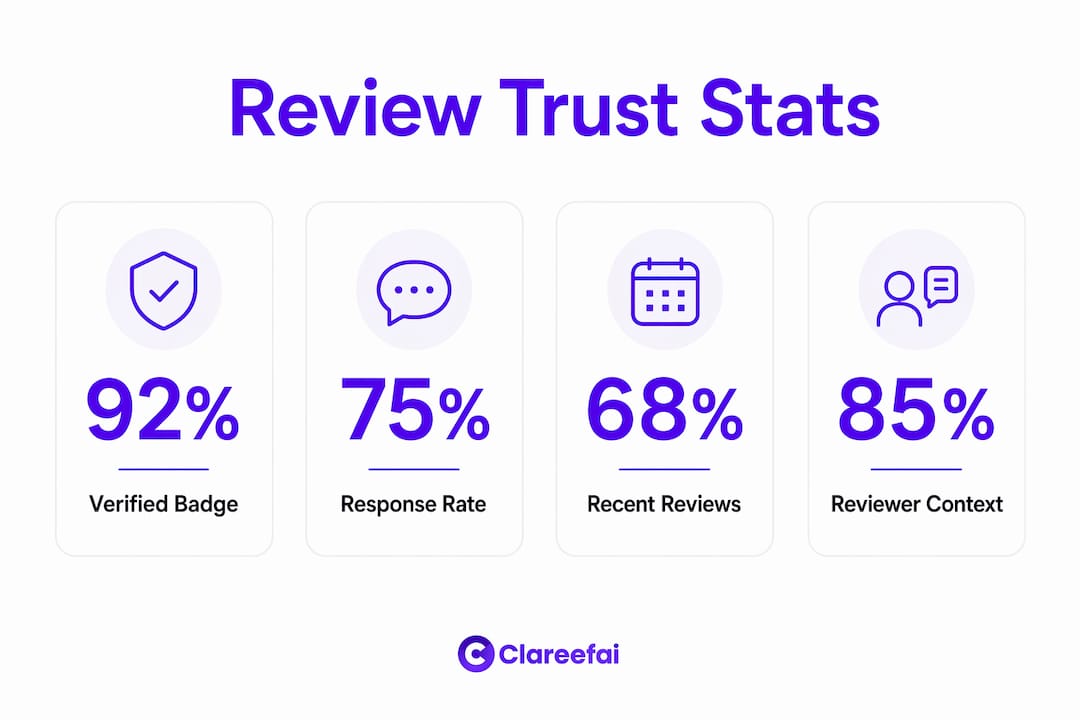
Verified-purchaser badges are the most direct signal. Data from the Spiegel Research Center, summarized in a recent verified-review analysis, shows that displaying a verified-buyer badge raised purchase likelihood. The badge works before the reader processes a single word of the review text.
Reviewer context adds the second layer. A review that names the reviewer’s role, company size, and use case is far more persuasive than an anonymous paragraph. On a B2B product page, “Head of Operations at a 300-person logistics firm” anchors the feedback in a recognizable situation.
Recency and rating distribution signal authenticity together. A perfect 5.0 average can look suspicious to sophisticated buyers. A verified 4.6 with a visible spread of ratings, including a few critical ones, reads as honest. Showing that distribution, alongside constructive responses to lower-rated reviews, increases confidence more than a flawless score.
Public responses with timestamps are the most underused mechanism. A minority of brands respond to reviews at all, according to Yext’s research on review strategy. That gap is your opportunity.
Placement by channel:
- Product detail pages: verified badge + reviewer role + rating distribution
- PPC landing pages: short quote + verified badge + response status
- Sales enablement decks: named case study + outcome metric
- Ad creative: aggregate rating + review count (volume as social proof)
How to encourage, collect, and verify useful reviews
A segmented, timed ask plus transaction verification produces the highest-quality, trust-building reviews. The sequence matters as much as the ask itself.
- Segment by value and moment. Identify customers who have reached a success milestone: first meaningful outcome, renewal, or expansion. These are your highest-signal reviewers.
- Choose the right channel. Post-delivery email works for transactional B2C. In-product prompts work for SaaS at the moment a user completes a key workflow. CS touchpoints work for enterprise accounts after a QBR.
- Send a short, specific request. Generic asks produce generic reviews. Ask about a specific outcome.
- Verify the transaction. Cross-reference the reviewer against your CRM or order system before publishing. Tag the review with product, segment, and date for later filtering.
- Disclose any incentive. If you offer a gift card or discount for a review, the FTC requires clear disclosure. Build that language into your email template.
Example email template (post-delivery, B2B SaaS):
Example in-app prompt (moment of success):
Pro Tip: Ask at the moment of success, not at renewal. Renewal timing feels transactional; a success milestone feels like a natural conversation. Reviews collected at peak satisfaction are longer, more specific, and more credible.
Consumer trust in online reviews has declined as concern about fake reviews has grown, per Shopify’s review research. Verification is your countermeasure. Transaction checks, CRM cross-references, and verified-purchaser badges are the gold standard for proving authenticity.

How to respond to negative reviews and turn them into trust signals
Prompt, human, and solution-oriented public responses increase credibility more than a perfect rating. Buyers read your response to a bad review as carefully as they read the review itself.
Three adaptable response templates:
- Apology + remediation: “Thank you for sharing this, [Name]. What you experienced doesn’t reflect our standard, and we’ve already [specific action taken]. Please reach out to [contact] so we can make this right.”
- Clarification + next steps: “We appreciate the feedback. To clarify: [brief factual context]. We’d like to walk you through [solution]. Please reply here or contact [channel] and we’ll prioritize your case.”
- Acknowledgment + invite offline: “We hear you, [Name], and we want to understand this better. Could you reach out to [contact] directly? We’ll follow up within [timeframe] and share what we’ve done.”
Escalation flow:
- Respond publicly within 48 hours using one of the templates above.
- Triage internally: route to CX for service issues, ops for fulfillment issues, legal/privacy for potential fake or defamatory content.
- Resolve offline when the situation requires personal detail or negotiation.
- Publish an outcome update on the original review thread to close the loop publicly.
Red-flag checklist for suspicious reviews: look for no purchase history in your CRM, generic language with no product-specific detail, multiple reviews from the same IP or account, and reviewer profiles with no prior activity. When a review appears defamatory or violates platform terms, escalate to legal before responding publicly.
Treat every public response as reputation management content that future prospects will read. A well-handled negative review often converts more skeptical buyers than a string of five-star scores.
Which review formats actually increase credibility?
Format and context determine whether a review signals trust, not just the rating. The same customer sentiment lands differently depending on how you present it.
| Format | Best use case | Key trust element |
|---|---|---|
| Short quote (1–2 sentences) | PPC landing pages, ad creative | Verified badge + reviewer name/role |
| Long-form case study | Case study library, sales decks | Named outcome metric + company context |
| Video testimonial | Product pages, email nurture | Face + voice = highest authenticity |
| Aggregated review feed | Homepage, category pages | Volume + recency + response rate |
Recommended metadata to display with every review:
- Verified-purchaser badge
- Reviewer’s role and company size (with permission)
- Purchase or review date (recency signal)
- Product or use-case context
- Response status (responded / resolved)
UX dos and don’ts:
- Do place your highest-credibility testimonials above the fold on high-intent pages.
- Do show the rating distribution, not just the average.
- Don’t hide critical reviews. A transparent moderation approach reduces skepticism more than curating only five-star content.
- Don’t use tiny fonts or bury reviews below the page fold on mobile. Most B2B buyers research on mobile before switching to desktop for the final decision.
Customer testimonials in SaaS perform best when they include a named outcome, a recognizable company type, and a visible verification signal. All three together remove the doubt that stalls a purchase.
How do you measure whether reviews are actually building trust?
Measure reviews with both exposure metrics and outcome metrics. Impressions and click-through tell you reach; conversion lift and time-to-purchase tell you impact.
Dashboard KPIs to track:
- Verified review volume: total reviews with confirmed transaction links, tracked monthly
- Recency: percentage of reviews posted within the last 90 days
- Response rate and speed: share of reviews with a public response, and median time to first response
- Conversion lift: conversion rate on pages displaying testimonials vs. pages without (run as an A/B test)
- Reference-influenced win rate: for enterprise deals, track how often a verified promoter call or case study appears in the closed-won record
Simple A/B test to run this month: show a verified-buyer badge on your highest-traffic landing page for four weeks against a control version without the badge. Measure conversion rate and time-on-page. The Spiegel Research Center data cited earlier suggests a 15% lift in purchase likelihood from the badge alone, giving you a concrete benchmark to beat or validate.
A closed customer feedback loop — collect, analyze, act, close — is what turns review data into retention improvements. Closing the loop by notifying customers of changes made in response to their feedback is the highest-leverage step most teams skip.
How to operationalize review verification at scale
An operational verification workflow with named owners prevents the “feedback graveyard” and converts reviews into sales assets. Without ownership and cadence, feedback collects and sits unused.
Process flow with owners:
- Collect (Marketing): trigger review requests at defined success moments via email or in-product prompt.
- Verify (Ops/CX): cross-reference reviewer against CRM order data; reject unverifiable submissions before publishing.
- Tag (Marketing): label each verified review by product, segment, use case, and sentiment for easy retrieval.
- Publish (Marketing): syndicate to product pages, sales decks, and third-party platforms (Google Reviews, G2, industry-specific sites).
- Respond (CX): post a public response within 48 hours; route escalations per the flow above.
- Measure (Marketing/Management): pull dashboard KPIs monthly; report reference-influenced win rate to sales leadership quarterly.
Verification elements that matter most:
- Transaction confirmation (CRM order link or purchase record)
- Verified-purchaser badge displayed publicly
- LinkedIn profile linkage for B2B reviewers (adds professional context)
- Promoter identification: AI-assisted flagging of high-satisfaction customers who are likely to participate in reference calls
For B2B sales teams, this workflow shortens enterprise sales cycles. A prospect who can speak directly with a verified promoter in a similar role moves through evaluation faster than one who reads a generic case study. Clareefai automates the collect-verify-tag-publish-measure cycle, with GDPR-compliant storage, role-specific dashboards, and AI-driven promoter identification built in.
Pro Tip: Sync verified review tags into your CRM so sales reps can surface the most relevant testimonial for each prospect’s industry and use case during active deals. That one integration turns your review library into a live sales asset.
Conversational feedback collection and AI-assisted synthesis are replacing static surveys as the higher-value input for this workflow, capturing the “why” behind ratings at a scale that manual analysis cannot match.
Key Takeaways
Building trust with reviews requires verified signals, public accountability, and a closed-loop process that connects feedback to measurable outcomes.
| Point | Details |
|---|---|
| Verified badges drive conversion | A verified-buyer badge raises purchase likelihood by 15%, per Spiegel Research Center data. |
| Written reviews outperform star ratings | 88% of consumers find written reviews more trustworthy than a star rating alone. |
| Public responses are owned content | Treat every reply to a review as a marketing asset that future prospects will read and evaluate. |
| Close the loop to retain customers | Notifying customers of changes made from their feedback is the highest-leverage retention step. |
| Clareefai automates the full cycle | Clareefai’s platform handles verification, promoter identification, cross-channel publishing, and analytics for B2B teams. |
What good looks like in 60–90 days
The teams that move the needle fastest on trust don’t start with a platform overhaul. They pick one high-traffic page, add verified badges and a response commitment, and measure for six weeks. That’s it.
In 60–90 days, the concrete signals of success are specific: reference requests from prospects increase, landing-page conversion on testimonial-bearing pages improves, and sales reps start citing customer proof in deal notes rather than asking marketing to produce it on demand. Those three signals together mean your review program has crossed from a collection exercise into a genuine sales asset.
The pilot challenge: this month, either publish verified badges on your top landing page or respond publicly to your ten most recent negative reviews. Both take under a week to execute. Both generate data you can act on. Pick one, assign an owner, and measure it.
Clareefai helps you scale verified testimonials without the manual overhead
If your team is managing review collection, verification, and response across multiple channels in spreadsheets or disconnected tools, the process breaks down at volume. Clareefai organizes, verifies, and syndicates testimonials to your sales and marketing channels from a single platform, so the workflow described in this guide runs with defined owners and real accountability.
Key capabilities that support the tactics in this guide:
- Verification: transaction-linked review confirmation with verified-purchaser badges
- Promoter identification: AI-driven flagging of high-satisfaction customers ready for reference calls
- Cross-channel publishing: automatic syndication to product pages, CRM records, and third-party review platforms
- Role-specific dashboards: separate views for marketing, CX, and management with the KPIs each team tracks
- Analytics: conversion lift tracking, response rate monitoring, and reference-influenced win-rate reporting
A practical starting point: run a six-week verified-testimonial pilot for one product line or one sales team. Measure verified review volume, response rate, and conversion lift on the pilot page. That’s a lightweight proof-of-value that any marketing or CX leader can present to leadership.
See how Clareefai supports sales teams or explore the full platform to request a demo and scope a pilot for your organization.
Authoritative sources for further reading
- How reviews shape customer trust and brand loyalty — Yext: Research-backed overview of how review signals influence buyer decisions; useful for building the business case internally.
- Why verified reviews build more trust than star ratings alone — TrustSync: Detailed breakdown of the Spiegel Research Center data on verified badges and conversion lift; reference when designing your badge display.
- Building trust with user-generated reviews: The transparency playbook — DiarySphere: Practical guidance on moderation transparency and anti-fraud signals; consult when writing your review policy.
- Customer feedback loop guide — Koji: Step-by-step explanation of the collect-analyze-act-close model; use this to design your closed-loop process and assign owners.
- FTC guidance on endorsements and testimonials: The primary US regulatory reference for incentive disclosure requirements; review before launching any incentivized review campaign.
- What online review statistics reveal about consumer trust — Inc.: Consumer sentiment data on response behavior and rating distribution; useful for the response-rate and rating-mix arguments.
Recommended
- How Customer Testimonials Build Trust and Differentiate Your SaaS Brand | ClareefAI Blog
- How to Verify Reviews: A Practical 2026 Guide | Clareefai Blog
- Improving B2B Trust Process: A 2026 Guide for Sales Teams | Clareefai Blog
- ClareefAI - Drive Sales Growth Using Customer Testimonials and Word-of-Mouth Marketing
Share Article
Stay Updated
Get the latest insights on customer advocacy and SaaS growth delivered to your inbox.