The Role of Identity Verification in B2B Testimonial Programs
TL;DR:
- Identity verification validates that testimonials are from real, confirmed customers, increasing trust and reducing fraud. It enhances sales by building credibility during procurement, leading to faster deal closures and more reliable reference pools. Verified advocacy ensures compliance, auditability, and measurable improvements in conversion rates.
Identity verification converts raw testimonials and reference activity into verified, auditable sales assets that buyers can trust. When a prospect is evaluating your product during procurement, an anonymous five-star review does almost nothing. A verified testimonial from a named, confirmed customer at a real company? That moves deals forward.
Here’s what verification delivers for your advocacy program:
- Trust signal to prospects: Verified identities tell buyers that your social proof is real, not manufactured.
- Measurable conversion lift: Verified testimonials placed at key funnel stages improve demo-to-trial and trial-to-close rates.
- Compliance and auditability: Attestation records protect you during RFPs, procurement reviews, and regulatory audits.
Table of Contents
- What is the role of identity verification in testimonial programs?
- Why identity verification matters for B2B sales and marketing teams
- How identity verification works for advocates, references, and video testimonials
- Where to insert verification into your testimonial pipeline
- Timelines, cost drivers, and how to measure ROI
- What to require from identity verification vendors
- Limits, legal risks, and defenses against evolving fraud
- How Clareefai applies identity verification to make testimonials sales-ready
- Key Takeaways
- Verification as a growth engine, not a compliance checkbox
- Clareefai helps you verify, publish, and win with testimonials
- Selected sources and references
What is the role of identity verification in testimonial programs?
NIST SP 800-63A defines identity proofing as a three-step process: resolution, validation, and verification.
- Identity resolution confirms that the claimed identity corresponds to a single, unique real person.
- Identity validation confirms that the submitted evidence is genuine, accurate, and unexpired.
- Identity verification links that validated evidence to the live person presenting it, typically through biometric or physical comparison.
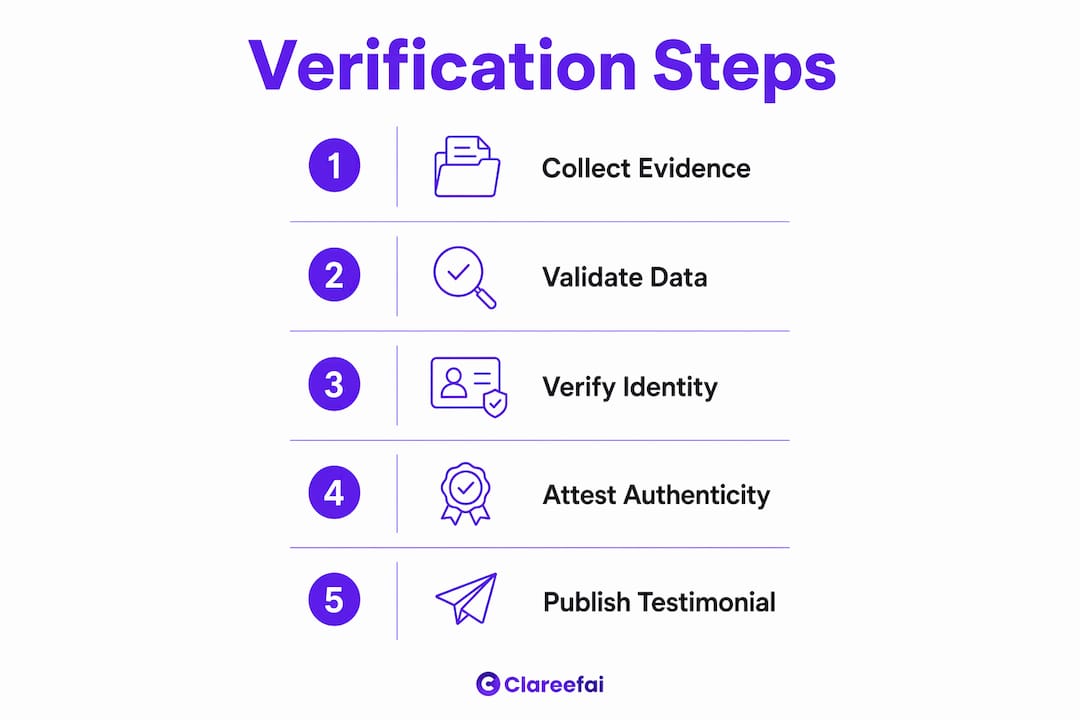
For testimonial programs, this flow looks like: collect advocate evidence → validate that evidence against authoritative sources → confirm the live person matches the evidence. The result is a defensible record that a real customer said what you’re publishing.
Why identity verification matters for B2B sales and marketing teams
Verified advocacy solves the anonymity problem that plagues most testimonial programs. When advocates are confirmed real people at real companies, your social proof builds trust with prospects in a way that generic reviews never can.
Direct benefits for your testimonial and reference pipeline:
- Credible social proof: Named, verified advocates carry far more weight with procurement teams than anonymous submissions.
- Fewer fraudulent or invalid submissions: Verification filters out fake accounts, duplicate entries, and incentivized reviews that violate FTC guidelines.
- Stronger reference-call outcomes: Confirmed advocates show up, speak credibly, and reflect well on your brand.
- Shorter procurement cycles: Buyers who can validate the source of a testimonial spend less time in due diligence.
Metrics worth tracking: conversion lift after placing verified testimonials at key funnel touchpoints, reduction in flagged or invalid submissions, and reference-to-deal win rate before and after verification rollout. Identity verification reduces false positives during onboarding and advocacy collection, which directly improves the signal quality of your reference pool.
Pro Tip: When you publish a verified testimonial, include a brief attestation badge (e.g., “Identity verified via document + biometric check on [date]”) visible to prospects. You don’t need to expose any personal data. The badge alone signals rigor and increases buyer confidence during procurement due diligence.
How identity verification works for advocates, references, and video testimonials
Modern verification combines multiple layers. Multi-layered approaches reduce fraud while keeping the advocate experience smooth.

| Method | Best Use Case | Assurance Level |
|---|---|---|
| Document verification (OCR + authenticity check) | Text testimonials, written references | Moderate |
| Biometric matching + liveness detection | Video testimonials, high-value references | High |
| Device intelligence | All digital submissions | Low-to-moderate (layered) |
| Behavioral analytics | Ongoing advocate monitoring | Moderate (continuous) |
| Database / attribute checks | Quick identity resolution | Low-to-moderate |
Liveness detection is the critical differentiator against deepfakes and generative AI fraud. FinCEN has flagged that AI-generated content and synthetic identities are active threats to digital identity programs. A liveness check confirms that the person submitting a video testimonial is physically present, not a pre-recorded or AI-generated face.
A practical flow for a verified video testimonial:
Capture (advocate records video) → Auto-verify (document scan + liveness + biometric match runs in background) → Attestation generated (time-stamped record of method used and evidence retained) → Publish (testimonial goes live with verification badge attached).
Audit logs and attestation records are non-negotiable for enterprise sales. During RFPs and procurement reviews, buyers increasingly ask for provenance on the testimonials you share. A time-stamped attestation that records the verification method, the date, and the evidence type gives your sales team a defensible answer.
Where to insert verification into your testimonial pipeline
Identity verification should match the risk level of the use case. A lightweight check at collection is appropriate for most text testimonials; a full biometric + liveness flow is warranted for video testimonials used in enterprise deals. Here’s a practical implementation sequence:
- Capture: Collect the testimonial (text, video, or audio) via your platform or form.
- Obtain consent: Present a clear, plain-language consent statement explaining what data you collect, how it’s used, and how long it’s retained.
- Run lightweight verification: At minimum, validate email domain + company attribute against a business database. For video, add liveness + biometric matching.
- Enrich and tag: Attach company size, role, industry, and use-case tags to the verified record.
- Generate attestation: Create a time-stamped record of the verification method and evidence type.
- Publish with badge: Display the testimonial with a visible verification indicator.
- Sync to CRM: Push the verified advocate record and attestation to your CRM or reference management system.
- Re-verify periodically: Run risk-based re-checks on established advocates to detect account takeover or role changes.
Collect only the minimum data necessary. Tell advocates upfront what you’re collecting and why. Transparency at this step increases participation rates and reduces drop-off.
Timelines, cost drivers, and how to measure ROI
| Cost Driver | Typical Range | Notes |
|---|---|---|
| Per-check pricing | Varies by vendor and method | Document + biometric checks cost more than database-only |
| Subscription / seat model | Monthly or annual tiers | Better for high-volume programs |
| Real-time vs. async processing | Real-time: seconds–minutes; async: hours–days | Async lowers cost; real-time improves UX |
| Integration and customization | One-time or ongoing | API setup, CRM webhooks, white-label |
| Geographic coverage | Varies | International advocates may require additional document types |
A simple ROI formula: (Expected additional deals closed from verified-reference lift × average deal size) − annual verification cost = net verification ROI. Track reference-to-win rate, reduction in invalid submissions, and time-to-close for deals that used verified testimonials vs. those that didn’t. Automation reduces manual review load and lowers per-check cost significantly over time.
What to require from identity verification vendors
Vendor checklist:
- Accuracy and assurance levels documented (IAL1 or IAL2 per NIST SP 800-63A)
- Liveness detection with anti-deepfake capability
- CCPA-compliant data handling; GDPR controls for international advocates
- CRM, CMS, and video platform integrations via API/webhooks
- Audit logs and exportable attestation records
- Clear SLA for real-time and async processing
- Evidence retention and deletion policies in writing
Questions to ask during a demo:
- How do you handle video liveness for remote testimonial capture?
- What are your false-positive rates for biometric matching?
- What is your evidence retention policy, and how do you handle deletion requests?
- Do you support asynchronous verification for advocates in different time zones?
- What CRM and marketing platform integrations do you offer out of the box?
Red flags to walk away from: vendors that require excessive PII beyond what the use case justifies, no auditable attestation output, no clear data retention or deletion policy, and poor or manual-only CRM export.
Limits, legal risks, and defenses against evolving fraud
Verification reduces risk but doesn’t eliminate it. Residual threats include synthetic identities (fabricated personas that pass document checks), stolen credentials, and collusion between a real advocate and a bad actor. Behavioral analytics and device intelligence add continuous monitoring that catches anomalies static checks miss.
Practical mitigations: layer document, biometric, and behavioral checks rather than relying on any single method; set risk-based re-challenge triggers for advocates whose behavior changes; build an escalation workflow for disputes so your team can investigate without removing a testimonial prematurely.
U.S. compliance note: Under CCPA, California residents have the right to know what personal data you collect, request deletion, and opt out of sale. For international advocates, GDPR applies. Collect only what’s necessary, document your retention periods, and build a data subject request (DSR) process before you scale your verification program. For GDPR-specific guidance on cross-border testimonial publishing, review your obligations before onboarding European advocates.
This article provides general information, not legal advice. Confirm your specific compliance obligations with qualified legal counsel.
How Clareefai applies identity verification to make testimonials sales-ready
Clareefai’s platform handles the full testimonial lifecycle: collection, verification, attestation, and publishing. When an advocate submits a video or text testimonial, Clareefai runs automated checks (document validation, biometric matching, or lightweight identity resolution depending on the assurance level required), then attaches a time-stamped attestation to the record. That attestation travels with the testimonial through every channel it’s published on.
The workflow in practice: an advocate records a video → Clareefai runs liveness and biometric checks in the background → an attestation badge is generated and stored → the verified testimonial syncs to your CRM reference queue and publishes to your chosen channels with a visible verification indicator.
Teams using this workflow report fewer anonymous or unverifiable submissions in their reference pools, higher reference-call success rates, and improved confidence during enterprise procurement reviews. Clareefai’s unified testimonial management approach maps directly to the implementation steps in this guide, including CRM sync, audit logs, and GDPR-compliant data controls.
Key Takeaways
Identity verification turns testimonials from unverifiable claims into auditable sales assets that shorten procurement cycles and increase buyer confidence.
| Point | Details |
|---|---|
| NIST three-step process | Resolution, validation, and verification are the standard framework for defensible identity proofing. |
| Liveness is non-optional | Liveness detection protects against deepfakes and AI-generated submissions in video testimonial programs. |
| Match assurance to risk | Use lightweight checks for text testimonials; full biometric + liveness for video and enterprise references. |
| Audit logs drive RFP wins | Time-stamped attestation records give sales teams a defensible answer when buyers ask for testimonial provenance. |
| Clareefai automates the pipeline | Clareefai collects, verifies, attests, and publishes testimonials with CRM sync and GDPR controls built in. |
Verification as a growth engine, not a compliance checkbox
The conventional wisdom treats identity verification as a defensive cost. That framing is wrong, and it leads teams to under-invest in the one process that actually makes their social proof credible.
Think about what a verified testimonial does that an anonymous one can’t: it gives a skeptical procurement team a real person to call, a real company to research, and a real use case to validate. That’s not a compliance feature. That’s a sales asset.
The objection we hear most often from sales leaders is that verification adds friction and will reduce advocate participation. In practice, the opposite tends to be true. Advocates who know their identity is protected and their contribution is handled professionally are more willing to participate, not less. The friction argument usually reflects a poorly designed consent flow, not a fundamental problem with verification itself.
Start with a low-friction pilot: pick your top 20 advocates, run a lightweight verification flow, measure the impact on reference-call success and deal velocity, and present those numbers to your legal and marketing stakeholders. The data makes the case better than any internal memo.
Clareefai helps you verify, publish, and win with testimonials
Verified testimonials don’t happen by accident. They require a pipeline that collects advocate evidence, runs the right checks, stores attestations, and publishes proof across every channel your buyers use. That’s exactly what Clareefai is built to do.
Clareefai maps directly to the implementation checklist in this guide: automated verification (document, biometric, or lightweight depending on your assurance needs), time-stamped attestation records, CRM sync, and GDPR-compliant data controls. Enterprise teams get white-label options, custom integrations, and full audit log exports for procurement reviews. See how verified customer advocacy drives pipeline and bring your current testimonial workflow to a demo. The team will show you exactly where verification fits and what KPIs to track from day one. Start with the platform overview or explore customer stories to see verified testimonials in action.
Selected sources and references
- NIST SP 800-63A: Identity Proofing and Enrollment — the authoritative standard for identity resolution, validation, and verification assurance levels.
- NIST SP 800-63A Implementation Resources: Identity Verification — practical guidance on biometric matching, liveness detection, and verification strength levels.
- FinCEN: Fraud trends and AI-era threats — regulatory perspective on generative AI, deepfakes, and evolving identity fraud.
- Plaid: The ultimate guide to identity verification — industry overview of verification use cases and business outcomes.
- TransUnion: The role of identity verification — business case for verification as a trust and compliance enabler.
- TransUnion: Benefits of identity verification — efficiency and ROI framing for automated verification programs.
- Experian: Identity verification guide — multi-layer method overview including device intelligence and behavioral analytics.
- Ondato: What is identity verification? — risk-based approach and friction/conversion trade-offs.
- Clareefai: Secure testimonial management — operational guidance on collecting and verifying testimonials securely.
- Clareefai: Why use secure reputation platforms — compliance and auditability rationale for verified testimonial platforms.
- Building trust online: proven strategies — partner resource on trust signals and how verification complements brand authenticity.
Recommended
Share Article
Stay Updated
Get the latest insights on customer advocacy and SaaS growth delivered to your inbox.