Evidence Backed: 3–5 Testimonials Marketers Need at Key Doubt Moments

Aim for 3 to 5 targeted testimonials placed at your highest-doubt moments, like a pricing page or a bottom-of-funnel CTA, and keep a rotating bank of 10 to 15 vetted stories for your broader site. Low-cost items often convert with a few reviews, while high-consideration or high-price offerings tend to benefit from more. Quality, relevance, and verification matter more than the raw count, and the evidence below shows exactly why.
TL;DR:
- Display three to five targeted and verified testimonials near key decision points like pricing pages or CTAs to maximize influence.
- Focus on quality and relevance over quantity, ensuring testimonials explicitly address the specific objections or concerns of the buyer stage.
- Verify the authenticity of testimonials and disclose incentives to maintain compliance and build trust with prospects.
- Use a structured process to collect, tag, and rotate testimonials regularly, with a focus on freshness and alignment with real customer experiences.
- Automate testimonial collection and management with AI-driven platforms to maintain a diverse, verified, and well-organized proof bank at scale.
Table of Contents
- 1. Recommended testimonial counts by page and context
- 2. What the research says about testimonial counts and diminishing returns
- 3. Mapping testimonials to objections, services, and buyer stages
- 4. Where and how to display testimonials for maximum impact
- 5. Keeping your testimonial program authentic and compliant
- 6. A repeatable workflow for collecting, verifying, and rotating testimonials
- How to think about count versus credibility as a marketer
- An automated alternative for scaling your testimonial program
- FAQ
- Sources
1. Recommended testimonial counts by page and context
The right number of testimonials depends entirely on where a visitor is standing in their decision. A first-time visitor on your homepage needs a quick trust signal, not a wall of quotes. A prospect staring at your pricing page needs something closer to proof of ROI. Matching the count and content to the page’s job is what separates a testimonial section that converts from one that just takes up space.
Here is how we recommend splitting your testimonial counts across the pages that matter most:
- Homepage or hero section: 1 to 3 short, representative quotes that rotate, giving new visitors an instant credibility signal without slowing the page down.
- Landing pages and CTAs: 3 to 5 targeted testimonials that speak directly to the primary objection a visitor has at that stage of the funnel.
- Pricing or purchase pages: 3 to 5 testimonials focused on ROI, implementation ease, or measurable value, placed near the decision point itself.
- Service or product pages: 1 to 3 testimonials per major feature or service, mapped to the specific objection that feature tends to raise.
- Dedicated testimonials or case study pages: a bank of 10 to 15 vetted long-form stories or videos that you can draw from for sales calls, proposals, or deeper research.
Notice the pattern: the closer a visitor gets to a purchase decision, the more targeted and specific the testimonial needs to be. A homepage visitor just needs reassurance that real people use your product. A visitor on a pricing page, especially for a B2B tool with a four-figure monthly cost, needs to see a story that mirrors their own situation closely enough to reduce the risk they feel.
This also means you do not need hundreds of testimonials scattered everywhere. You need the right handful in the right slots, backed by a deeper bank you can pull from when a prospect asks for proof that matches their specific use case. A sales team fielding a reference request during a late-stage deal does not want to scroll through fifty generic quotes. They want one or two stories that map precisely to the buyer’s industry, company size, or objection.
Dedicated case study pages deserve their own strategy because they serve a different purpose than conversion pages. Instead of optimizing for a quick trust signal, they function as a searchable library. A bank of 10 to 15 strong stories, each covering a different use case or objection, gives your sales and marketing teams enough variety to match almost any prospect’s situation without diluting the page with filler quotes that say nothing specific.

2. What the research says about testimonial counts and diminishing returns
The counts above are not arbitrary. Research from the Spiegel Research Center at Northwestern University found that a product displaying five reviews sees purchase likelihood rise by about 270% compared to a product with none. That lift is not spread evenly across every review added. Most of the gain happens within the first five, and the curve flattens out by around the tenth review, meaning each additional testimonial after that point contributes far less to a visitor’s confidence.
A product with five reviews shows roughly a 270% increase in purchase likelihood compared to one with zero, and that single data point explains why the 3 to 5 baseline shows up across so many high-converting pages: it sits right at the steepest part of the trust curve.
Price and consideration level change how far along that curve you need to go. Low-cost impulse purchases rarely need many reviews before a buyer feels comfortable, since the financial risk is low and the decision is fast. Higher-priced, higher-consideration purchases involve more stakeholders, longer sales cycles, and more scrutiny, so buyers tend to need more reviews, often supplemented by a detailed case study or reference call, before reaching the same comfort level.
The same Spiegel research points to another factor that matters as much as count: verification. Verified-buyer indicators measurably increase purchase likelihood because they tell a skeptical visitor that the praise they are reading came from someone who actually bought and used the product. A handful of verified testimonials will outperform a long list of anonymous ones every time, which is exactly why verification should sit at the center of any testimonial strategy rather than being treated as an afterthought.
One more nuance worth internalizing: a perfect 5.0 average often reads as suspicious to modern buyers, while a mix of ratings in the mid-4-point range tends to feel more authentic and convert better. Perfection raises doubt. A credible spread of experiences, including the occasional minor criticism, builds more trust than a flawless record ever could.

3. Mapping testimonials to objections, services, and buyer stages
Once you know roughly how many testimonials a page needs, the harder question becomes which ones. Coverage, not volume, is the goal here. Coverage means every major objection a prospect might raise has at least one testimonial directly addressing it, rather than having twenty quotes that all say some version of “great product, highly recommend.”
Start by listing your top three buyer objections. These might be price, implementation time, or whether the product works for a specific industry. For each objection, your job is to find 1 to 3 testimonials that speak to it directly, ideally from a customer who had that exact doubt before becoming a buyer. A testimonial that says “I was worried about the learning curve, but my team was fully onboarded in a week” does more work than ten quotes calling the product “amazing.”
Here is a simple process for building that coverage:
- List your top three objections that come up most often in sales calls, support tickets, or pre-purchase chat conversations.
- Search your existing customer base for stories or quotes that already address each objection, even informally.
- Request new testimonials specifically when a gap exists, asking the customer a pointed question rather than a generic one.
- Tag each testimonial by the objection, service, or buyer stage it addresses so your team can find it quickly later.
- Pair quotes with one detailed case study per major offering to give prospects a deeper proof point when they want it.
Authenticity details matter as much as the content of the quote itself. A testimonial with a full name, job title, and photo carries far more weight than an anonymous one, and specific outcomes beat vague praise every time. “This saved our team hours every week” is forgettable. “Our sales team cut reference-call scheduling from three days to same-day” sticks, because it is concrete and verifiable.
Pro Tip: When requesting a testimonial, ask the customer what almost stopped them from buying, then ask how that concern played out. The answer usually becomes your most persuasive quote.
4. Where and how to display testimonials for maximum impact
The format and placement of a testimonial often matter as much as its content. A powerful quote buried in a slow-loading carousel does less work than a mediocre one placed exactly where a visitor is hesitating.
Different slots call for different formats:
- Hero sections work best with a short, punchy quote paired with a photo and name, something a visitor can absorb in two seconds without slowing their scroll.
- Pricing pages perform better with a quantified or result-driven quote that speaks directly to value or ROI, since that is the exact question a visitor is asking at that moment.
- Case study pages are the right place for a full narrative or a 60 to 90 second video, since visitors here have already opted into a deeper level of research.
- Sliders and carousels should show no more than 3 visible testimonials at once, and auto-advance settings should be avoided when they hide social proof before a visitor has time to read it.
- Mobile experiences benefit from progressive disclosure, showing a short quote first and letting visitors tap to expand into the full story if they want it.
Video testimonials deserve particular attention in B2B contexts, where a 30 to 90 second clip mapped to a specific deal stage tends to land harder than a wall of text, since it lets a prospect hear the tone and conviction behind the words. If you use video, make sure it is lazy-loaded so it does not slow the page for visitors who never click play, and always include a transcript both for accessibility and for visitors who prefer to skim.
Readability matters more than most teams realize. A testimonial block with low contrast text, cramped spacing, or a font size that strains on mobile will get skipped regardless of how good the quote is. Treat the testimonial section with the same design care you give your primary CTA, because for a hesitant visitor, it often functions as one.
5. Keeping your testimonial program authentic and compliant
A testimonial program only works if people trust it, and that trust depends on following a few clear rules. The FTC’s endorsement guidance is built around one core idea: an endorsement has to reflect the honest experience of the person giving it. If a reviewer received a free product, a discount, or any other incentive in exchange for their testimonial, that incentive needs to be disclosed clearly enough that a reader would not miss it.
Cherry-picking is another area regulators have made clear is risky. The Federal Register’s Consumer Reviews and Testimonials rule outlines how selectively posting only the most glowing feedback, while suppressing typical or negative results, can cross into deceptive territory if it misleads buyers about what they should realistically expect.
A few operational habits keep a program on the right side of these rules without adding much overhead:
- Keep documentation of consent for every testimonial you publish, including whether any incentive was involved.
- Apply the same moderation standard to every testimonial, rather than holding negative ones to stricter scrutiny than positive ones.
- Watch for suspicious patterns, like a sudden spike in reviews or several testimonials using oddly similar phrasing.
- Add a disclosure whenever a product was gifted, a testimonial was paid for, or an affiliate relationship exists between you and the reviewer.
None of this needs to slow down a healthy testimonial program. It just needs to be built in as a habit from the start rather than bolted on after a problem surfaces.
6. A repeatable workflow for collecting, verifying, and rotating testimonials
The counts and placements above only hold up if you have a process behind them, because testimonials go stale fast without a plan to keep refreshing the pool. A one-time collection push gives you a short-term boost and then nothing new for months.
A workflow that holds up over time looks like this:
- Audit your current gaps by checking which objections, services, or buyer stages have no testimonial coverage at all.
- Ask for targeted stories, not generic praise, by prompting customers with a specific question tied to the gap you found.
- Verify identity and context before publishing, confirming the person is a real customer and the story is accurate.
- Tag each testimonial by objection, service, and deal stage so it is easy to pull the right one for the right page or sales conversation.
- Publish in targeted slots rather than dumping every testimonial into one long page.
- Measure and rotate, tracking which testimonials are actually influencing conversions and swapping out ones that have gone stale.
Not every customer is a fit for every format. Customers with a detailed, specific story and measurable results are the best candidates for a long-form case study, while customers with a strong one-line reaction are better suited to a short quote or a brief video clip. A reasonable cadence is refreshing hero quotes quarterly and rotating landing-page testimonials every four to eight weeks, while keeping your dedicated testimonials bank more stable and curated so it functions as a reliable archive rather than a constantly shifting target.
Pro Tip: Track conversion rate by testimonial slot, not just by page. A quote near your CTA might be doing far more work than the three sitting above the fold.
Watching the right metrics matters here too. Conversion rate by page section, time spent near the testimonial block, and click-through rate on any “read the full story” link all give you a clearer signal than vanity metrics like total testimonial count ever will. This kind of workflow, where identity verification, tagging, and rotation happen as routine steps rather than occasional cleanup projects, tends to produce a healthier testimonial program over time than an ad-hoc approach where quotes get added once and forgotten.
How to think about count versus credibility as a marketer
If you remember one heuristic, make it this: prioritize 3 to 5 sharply targeted testimonials at the moments where a buyer’s doubt peaks, and keep a vetted pool of 10 to 15 in reserve for rotation and deeper proof. Expand that pool when you launch a new product or enter a new market where existing testimonials no longer match the buyer’s situation. Prune it when quotes go stale, start repeating the same phrasing, or no longer reflect your current offering.
A simple way to validate your own setup is an A/B test: run your current testimonial count and placement against a version with fewer, more targeted quotes mapped directly to your top objection, then compare conversion rate on that specific page over a few weeks.
— ClareefAi
An automated alternative for scaling your testimonial program
Running this entire workflow by hand gets harder as your customer base grows, especially once you are juggling dozens of sales conversations, multiple product lines, and a sales team that wants a fresh reference story for every call. That is the exact gap we built our platform to close.
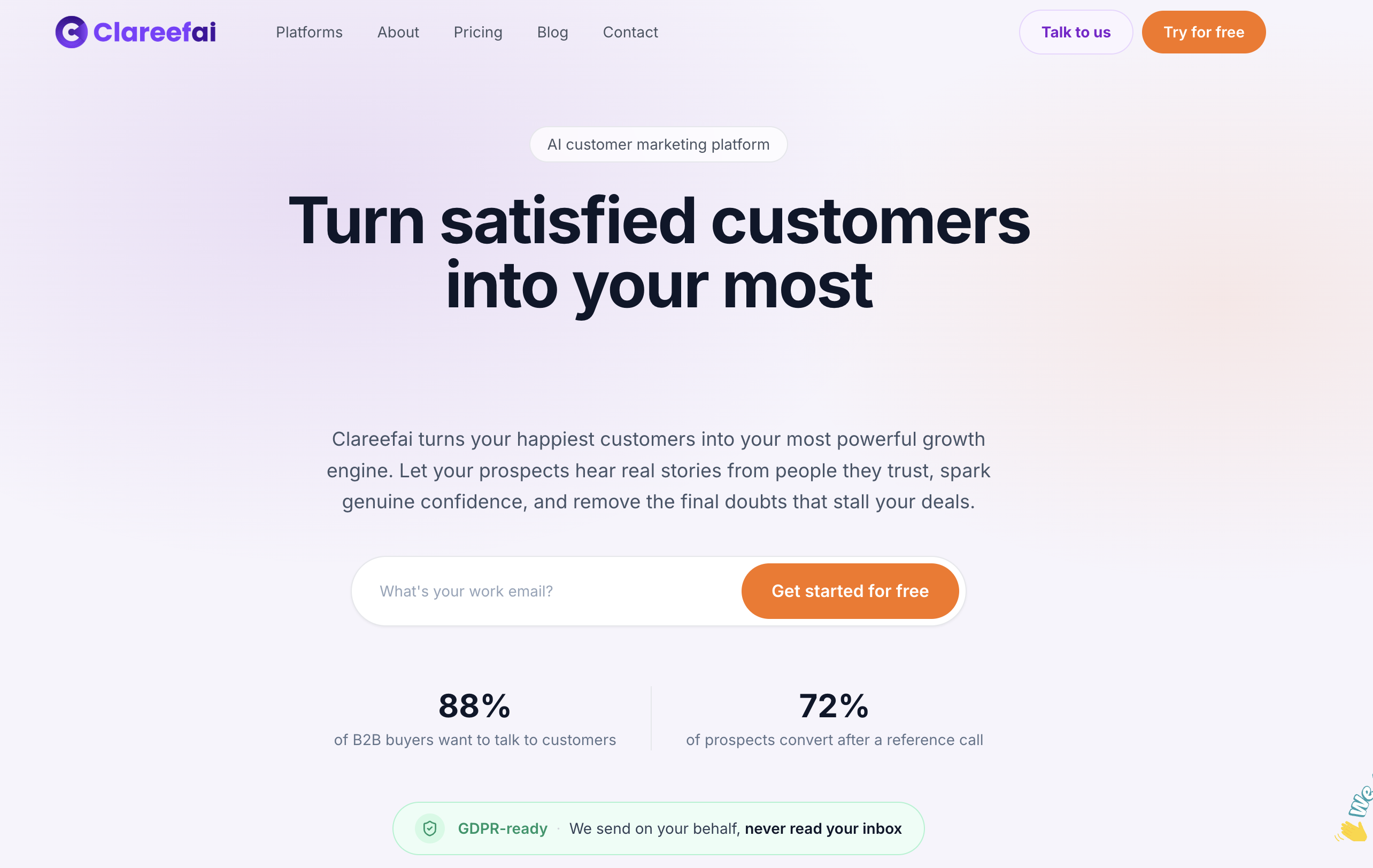
We designed our platform around the same principles covered above: verification, tagging, and targeted placement, but automated. Our platform uses AI-driven analysis to identify your strongest promoters, a verification system to confirm identity before publication, and a tagging structure to organize testimonials by objection, service, or deal stage so your sales team can quickly find the right story. Dashboards provide visibility into performance, GDPR-compliant handling protects customer data, and real-time synchronization keeps your testimonial bank up to date.
If your team is still collecting testimonials through spreadsheets and manual follow-up emails, our pricing plans give you a faster path to the same targeted, verified coverage this article recommends, with Basic, Professional, and Enterprise tiers built around how much of that workflow you want automated.
FAQ
What is an example of a testimonial?
A strong testimonial names the customer, their role, and a specific outcome, such as a sales leader explaining that reference calls now take same-day scheduling instead of three days. The more specific and verifiable the detail, the more persuasive the testimonial becomes compared to generic praise.
What are the FTC guidelines for testimonials?
The FTC requires that endorsements reflect the honest experience of the person giving them, with clear disclosure whenever an incentive like a free product or payment was involved. Selectively showcasing only glowing feedback while hiding typical results can also cross into deceptive territory under related consumer protection rules.
How many reviews do I need to get 5 stars?
A perfect 5.0 rating is not actually the goal, since buyers tend to trust a realistic mix of ratings more than a flawless record. What matters more is volume at the start: purchase likelihood rises sharply through the first five reviews and levels off after about ten, so a credible mid-4-point average with verified reviews often converts better than a suspiciously perfect score.
What is a testimonial?
A testimonial is a customer’s firsthand account of their experience with a product or service, typically used to build trust with prospective buyers. It differs from a star rating or review score because it carries context, detail, and a personal voice that a numeric score alone cannot convey.
Sources
- How Online Reviews Influence Sales (Spiegel Research Center, Northwestern University)
- FTC’s Endorsement Guides: What People Are Asking | Federal Trade Commission
- Federal Register: Consumer Reviews and Testimonials rule (excerpt)
Recommended
Share Article
Stay Updated
Get the latest insights on customer advocacy and SaaS growth delivered to your inbox.