Dynamic Social Proof for B2B and Ecommerce: Verified, FTC Safe Workflow

Dynamic social proof shows real people taking real action right now, like recent purchases, live visitor counts, or fresh reviews, instead of a static quote frozen in time. The payoff is straightforward: it builds trust exactly when buyers feel unsure, and that trust tends to lift conversions. Here’s how to pick the right signals, place them well, and keep them honest.
TL;DR:
- Dynamic social proof is most effective on pricing, checkout, and trial pages where buyer hesitation is highest, especially when showing recent activity or current reviews.
- The best signals include live visitor counts, recent purchase notifications, low stock alerts, and current user reviews, with selection tailored to your buyer’s decision process.
- Proper placement involves displaying proof near decision points, such as CTAs and product pages, and rotating signals based on visitor persona and funnel stage for maximum impact.
- Collect, verify, and disclose customer praise from emails, social comments, and review platforms, ensuring compliance with FTC rules and retaining records for defense.
- Continuously test and refresh proof elements’ placement, type, recency, and source to prevent stale or fake appearances, and use verified, contextual testimonials to accelerate B2B sales cycles.
Table of Contents
- What dynamic social proof is and why it works
- High-impact dynamic proof types and examples
- Placement strategy: where to show proof and when
- How to collect, verify, and comply with the rules
- Measure and A/B test dynamic social proof
- Common mistakes and a quick troubleshooting checklist
- Verified, contextual testimonials accelerate B2B deals
- Clareefai: a concise option for verified testimonial management
- Sources
- FAQ
What dynamic social proof is and why it works
Static social proof is a testimonial on your homepage that never changes. Dynamic social proof updates in real time: a counter showing how many people bought in the last hour, a notification that someone in Chicago just signed up, a review timestamped yesterday instead of two years ago. Both have a place, but dynamic signals carry more weight at moments when a buyer is actively deciding.

The psychology is simple. People look to others’ behavior when they’re uncertain, and momentum (lots of recent activity) reads as a safer bet than a single old endorsement. Conversion specialists note that social proof works best at moments of uncertainty, which is exactly why dynamic signals outperform static ones on high-stakes pages.
Dynamic proof moves the needle most on:
- Checkout and pricing pages, where buyers are weighing the final decision
- Trial signup flows, where hesitation is highest
- Any CTA tied to a cost or commitment, where recent activity reassures a skeptical visitor
High-impact dynamic proof types and examples
You don’t need every signal type. Pick the ones that match how your buyers actually decide.
- Live visitor counts and recent view notifications work well on ecommerce product pages, signaling that a listing is currently in demand.
- Recent purchase notifications and rolling purchase counters show “12 people bought this today,” which reinforces that others have already taken the risk.
- Low-stock or limited-quantity alerts add urgency without faking scarcity, as long as the stock number is real.
- Real-time review recency counters highlight that feedback is current, not three years stale.
- User-generated content feeds pull in recent photos, comments, or video reviews, giving prospects unscripted evidence.
Ecommerce teams tend to lean on visitor counts, purchase counters, and stock alerts because buying decisions happen fast and often alone. B2B buying motions are slower and involve more than one decision-maker, so outcome-specific testimonials, named customer stories, and reference-call availability tend to carry more weight than a raw counter.
Placement strategy: where to show proof and when
Where you place a signal matters as much as which signal you choose, as explained in this practical overview of social proof types and tactics. Put proof near the decision, not just near the brand.
- Hero sections and primary CTAs benefit from broad “crowd” proof, like total customers served or recent signups.
- Product and collection pages should carry ratings, recent reviews, and photos, since Shopify recommends testing review placement and star-rating visibility on exactly these pages.
- Pricing pages work best with outcome-specific proof, like a named customer describing a measurable result.
- Demo and signup flows should answer the specific objection a visitor is likely holding, whether that’s cost, complexity, or risk.
Match the proof to the funnel stage: crowd proof early builds general confidence, outcome proof later closes the gap, and objection-specific proof at the final CTA removes the last hesitation. Where you have the data, rotate proof by visitor persona, industry, or company size so a healthcare buyer sees a healthcare customer story rather than a generic one.
Pro Tip: If you only have budget to fix one page, fix the pricing page. That’s where uncertainty peaks and the right proof does the most work.
How to collect, verify, and comply with the rules
Good dynamic proof starts with mining the praise you already have, then verifying it before it ever goes live.
- Inventory your sources. Customer emails, direct messages, social comments, and review platforms all contain usable praise that most teams never surface. Salesforce points out that marketers often overlook high-value testimonial candidates sitting inside routine customer communications.
- Triage by relevance. Match each piece of feedback to an audience, use case, funnel stage, and recency before deciding where it belongs.
- Verify identity and consent. Confirm the person is real, get explicit permission to publish, and disclose any incentive offered in exchange for the review or testimonial.
- Timestamp and retain records. Keep a dated record of consent and provenance so you can defend the claim if it’s ever challenged.
The FTC’s endorsement and testimonial guides require clear and conspicuous disclosure of any material connection between a brand and the person giving the endorsement, and treat fake reviews or paid false endorsements as unlawful.
One statistic worth building a process around: the FTC’s Consumer Reviews and Testimonials Rule took effect on October 21, 2024, and it carries real penalties for suppressing negative feedback or publishing reviews without verified provenance. If your dynamic proof system can’t show who said what, when, and under what terms, it’s exposed.
Measure and A/B test dynamic social proof
Treat every proof element as a hypothesis, not a given.
- Track CTA conversion rate, add-to-cart lift, time-to-purchase, and direct engagement with the proof element itself (hovers, clicks, expansions).
- Test presence versus absence first: does removing the signal change conversion at all?
- Test recency thresholds: does “bought in the last hour” outperform “bought this week”?
- Test placement variants: near the CTA, on the product image, or in a sticky bar.
CXL recommends continuous testing of social proof types and placement rather than assuming one format persuades every visitor, since a signal that lifts conversion on one page can do nothing on another. Run tests long enough to clear normal traffic noise before calling a small lift a win.
Common mistakes and a quick troubleshooting checklist
Dynamic proof backfires fast when it looks fake or feels stale.
- Never buy or fabricate a visitor count, purchase notification, or review. Use only verifiable, sourced data.
- Refresh proof regularly. A review feed stuck on the same five testimonials from last year reads as abandoned, not trusted.
- Show a mix of ratings, not only five-star quotes. All-positive feeds read as curated rather than honest.
- Rotate signals instead of stacking every one on a single page. Three well-placed signals beat ten competing for attention.
Verified, contextual testimonials accelerate B2B deals
Clareefai’s approach starts with discovery: mining the praise already sitting in emails, calls, and review platforms, then verifying who said it before it ever reaches a buyer. Teams that surface contextual testimonials, ones naming a real customer, role, and outcome, tend to see faster movement through late-stage deals than teams relying on generic quotes. If you’re starting from scratch, audit your top three conversion points this month and run a two-week pilot on just one. You’ll know quickly whether the signal is worth scaling.
— ClareefAi
Clareefai: a concise option for verified testimonial management
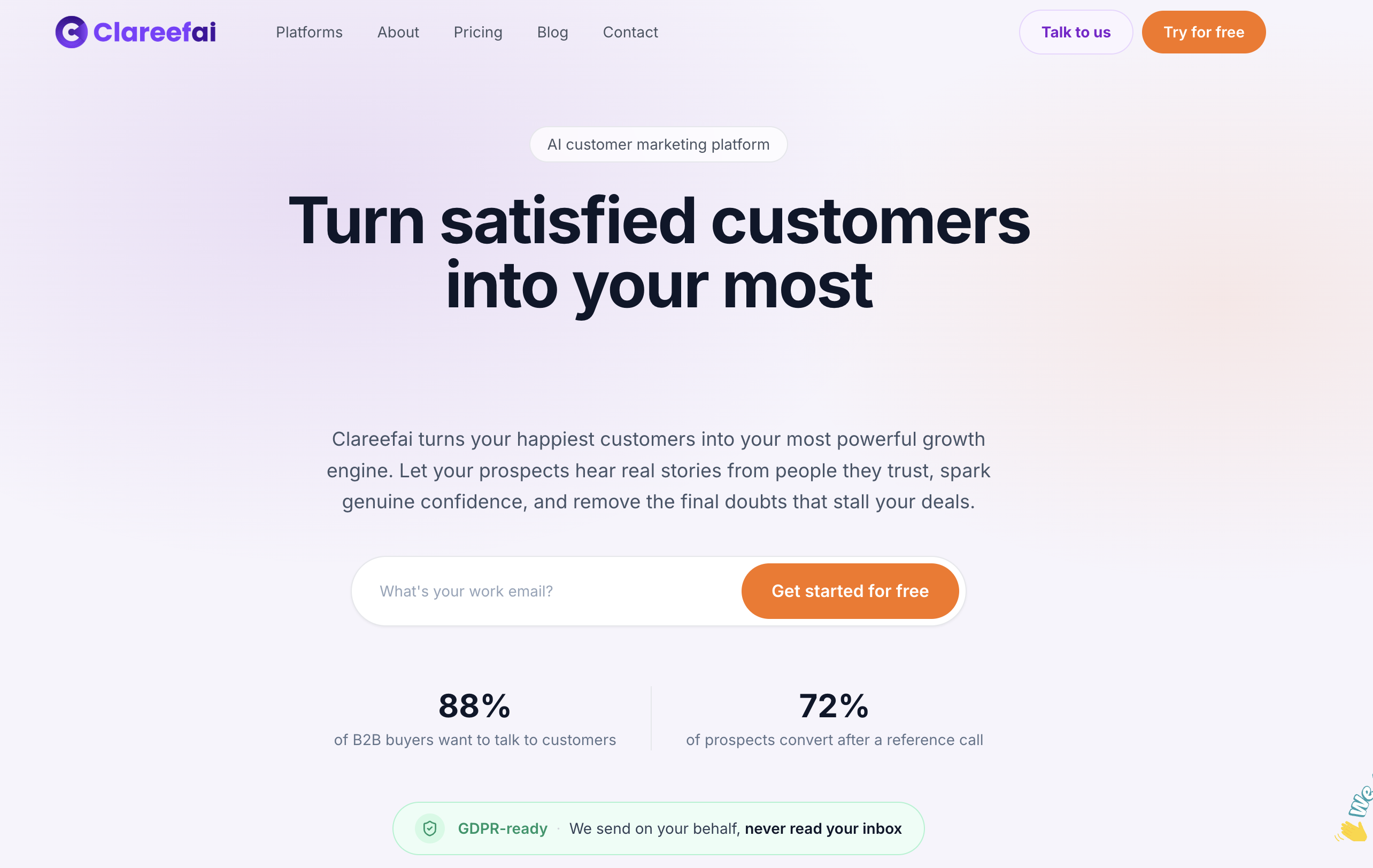
If the workflow above sounds right but your team doesn’t have time to build it by hand, Clareefai exists to run it for you. It’s a platform built specifically for B2B sales and marketing teams who need to collect, verify, and publish customer testimonials, reviews, and video stories without chasing permissions in spreadsheets.
The parts that matter most for dynamic proof: identity verification on every testimonial, AI-driven identification of your strongest advocates, cross-channel publishing so the same verified story shows up on your site, CRM, and sales decks, and analytics that tie specific testimonials back to deal movement. Clareefai also handles GDPR-compliant data management, so the compliance piece from the collection workflow above is built in rather than bolted on.

Plans run from a Basic tier to Professional and Enterprise tiers, with a free plan available for teams that want to start small. Pricing details are available on the pricing page. Compare them on the pricing page when you’re ready to evaluate.
Sources
- What is Social Proof? Everything You Need to Know
- Guides Concerning the Use of Endorsements and Testimonials in Advertising
- Defining social proof: 5 strategies retailers can use to bolster sales
- Is social proof really that important?
- How to use social proof (Sprout Social)
FAQ
What is an example of dynamic social proof?
A rolling counter showing recent purchase activity or a notification reading “Someone in Austin just signed up” are both examples. Unlike a fixed testimonial, these update automatically as new activity happens.
How do you collect social proof from existing customers?
Start by mining emails, direct messages, and social comments where customers have already praised you informally, then verify identity and get explicit permission before publishing. Sprout Social recommends organizing these mentions into an asset library and using listening tools to spot natural advocates worth amplifying.
What is the concept behind social proof?
Social proof is the idea that people look to others’ behavior to guide their own decisions, especially when they’re uncertain. Dynamic social proof applies that same principle in real time, showing current activity instead of a single fixed endorsement.
What is another term for social proof?
It’s sometimes called social validation or consensus-based influence, though “social proof” remains the standard term across marketing and conversion research. All three describe the same underlying behavior: people trusting a choice more because others are visibly making it too.
How does Clareefai help with dynamic social proof specifically?
Clareefai verifies customer identity and consent before any testimonial goes live, then uses AI to identify which advocates are most relevant to a given prospect’s industry or role. That verified, contextual story can then be published across your site, CRM, and sales materials automatically.
Recommended
Share Article
Stay Updated
Get the latest insights on customer advocacy and SaaS growth delivered to your inbox.