Spot Fake Reviews: 6 Step Verification for B2B Revenue Teams
When a testimonial lands on your desk, the first move is not to publish it. Pause it, verify the person’s identity and get written permission, then assign it a confidence score before it ever touches a sales deck or landing page. That process ends one of two ways: you get a verified asset you can use with confidence, or you get a rejection that just saved your brand from an FTC complaint. Centralizing that process through a dedicated platform is what turns this from a judgment call into a repeatable system.
TL;DR:
- Verifying testimonials requires checking for clear attribution, contactability, and avoiding signs of stock images, recycled language, or incentivized phrasing.
- High-visibility testimonials citing specific ROI or metrics demand full manual verification, while internal quotes can rely on automated checks.
- Automated signals like email domain matching, LinkedIn profiles, and cross-source consistency are critical to scalable verification; confidence scores inform publishing decisions.
- Re-verification every 90 days is recommended for high-risk testimonials to account for leadership or relationship changes that may invalidate previous claims.
- Clareefai’s platform helps organizations automate ingestion, verification, enrichment, and audit trails, streamlining testimonial management at scale.
Table of Contents
- Red Flags That Signal a Fake or Unverifiable Testimonial
- Building a Tiered Verification Workflow That Scales
- What Technical Signals Actually Separate Real From Fake
- Turning Verified Testimonials Into Sales Ammunition
- FTC Compliance Checklist for Testimonials and Endorsements
- The Sophisticated Fake Review Tactics B2B Teams Miss
- What Detection and Resolution Actually Look Like in Practice
- Who Owns Verification Inside Your Organization
- Training Teams to Catch Fake Testimonials Before They Spread
- Why Verification Is a Revenue Lever, Not Just Compliance
- How Clareefai Operationalizes Verification at Scale
- Sources
- FAQ
Red Flags That Signal a Fake or Unverifiable Testimonial
Most fake B2B testimonials share a genetic fingerprint. Once you know what to look for, spotting them takes seconds, not hours.
The biggest tell is attribution. A quote from “a VP at a leading enterprise company” with no name, no title, and no LinkedIn profile is not a testimonial. It is marketing copy wearing a costume. Legitimate case studies come with a name, a role, a company, and a way to verify all three. When that’s missing, common red flags include anonymous clients and refusal to provide contactable references, and that pattern shows up constantly in fabricated proof.
Watch for these signs of fake reviews when you’re triaging incoming testimonials:
- Anonymous or vague attribution. No full name, no title, no company, or a company with no public footprint.
- Suspiciously perfect metrics. An impressive increase in pipeline claim without raw dashboard, timeframe, or baseline information.
- Duplicate or recycled language. The same phrasing appears across multiple “different” customers, or an identical quote surfaces on a competitor’s site.
- Stock photography or mismatched branding. The headshot looks like a stock photo, or the company logo doesn’t match public brand assets.
- Thin reviewer profiles. A generic email domain (Gmail instead of a corporate address), a brand new account, or zero prior activity.
- Incentivized or coached language. Phrasing that reads like a script rather than a genuine reaction, often paired with an undisclosed discount or gift.
Any one of these alone might be innocent. Two or three together should stop publication cold.
Building a Tiered Verification Workflow That Scales
Not every testimonial carries the same risk, so not every testimonial needs the same scrutiny. The most efficient B2B teams run a tiered verification model that matches effort to exposure.
Tier A covers high-visibility placements, like homepage testimonials, paid ads, or anything naming specific ROI figures. These require full manual verification. Tier B covers mid-funnel assets, like case study excerpts in a proposal, and gets automated checks plus a spot confirmation. Tier C covers low-risk internal use, like an anonymized quote in a sales training deck, and needs only basic identity confirmation.
Here’s the six-step pipeline that keeps this manageable:
-
Ingest. Pull the testimonial from every source, forms, review sites, calls, into one system with canonical fields (name, title, company, date, channel).
-
Normalize. Standardize formatting so a quote from a survey and a quote from a sales call look identical in your database.
-
Verify. Run automated checks, email domain matching, LinkedIn lookup, cross-source ID matching, then escalate Tier A items to a manual step: a verification email or a direct LinkedIn confirmation.
-
Enrich. Add firmographics, persona tags, sentiment scoring, and industry vertical so sales can find the right proof fast.
-
Store. Log the written permission, the verification method used, and a timestamp in an auditable record.
-
Deliver. Push the verified asset to the CRM, website, or outreach sequence with its confidence score attached.
Pro Tip: Set an automatic 90-day re-verification trigger on Tier A testimonials tied to specific metrics. Companies get acquired, leadership changes, and a stat that was true in January can be false by October.
For teams building this internally, Clareefai’s step-by-step verification guide breaks down escalation triggers in more detail.
What Technical Signals Actually Separate Real From Fake
Manual review does not scale past a few dozen testimonials a month. Automation does, but only if you’re checking the right signals.
The strongest technical indicators are the ones that are hard to fake at scale: a corporate email domain that matches the claimed company, a LinkedIn profile that confirms the name and title, and cross-source ID matching that flags when the same “customer” shows up under different names on different channels. Automated checks like email domain matching, LinkedIn lookups, and activity heuristics form the backbone of any scalable pipeline.
Composite confidence scoring is what makes this actionable rather than academic:
- Identity match weight. Corporate email plus LinkedIn confirmation scores higher than either alone.
- Cross-source consistency. A quote confirmed across two independent channels outweighs a single unverified submission.
- Content quality checks. Specific, idiosyncratic detail scores higher than generic praise; near-identical phrasing across “different” reviewers drags the score down.
- Technical metadata. EXIF data on submitted screenshots or video files can confirm or contradict a claimed date and device.
Architecturally, this usually means a vector database for semantic similarity detection (catching reworded duplicates), synced to your CRM so sales sees the confidence score right next to the testimonial. Watch platform terms of service and privacy law closely here. Third-party enrichers can pull firmographic data, but sensitive personal information has no business in a testimonial record. Store consent, not surveillance.
Turning Verified Testimonials Into Sales Ammunition
A verified testimonial that never reaches a rep’s outreach template is a wasted asset. The goal is matching the right proof to the right buyer at the right moment.
A testimonial from a 200-person manufacturing company means more to a prospect in that same industry and size band than a glowing quote from an enterprise retailer, even if the retailer’s logo is more recognizable. Verified, enriched reviews with firmographic and persona tags let salespeople find role-specific proof quickly, which is exactly why enrichment tagging matters more than logo prestige.
Before any testimonial goes into outbound material:
- Confirm written permission specific to the channel you’re using, a permission for a website quote doesn’t automatically cover a cold email campaign.
- Verify the outcome is stated accurately, not rounded up or stripped of its original context.
- Add a typicality disclosure if the result is above average for your customer base.
- Include full attribution, name, title, company, since effective outbound use requires written permission, accurate outcomes, and proper attribution.
Format matters as much as content. Use a tight one-line quote for cold outreach, a fuller case excerpt for proposals, and a live promoter introduction for late-stage deals where the prospect wants to talk to someone real.
Pro Tip: Skip the recognizable logo if the company behind it isn’t a peer to your prospect. A mid-market buyer trusts a mid-market customer story more than a Fortune 500 name that has nothing to do with their reality.
FTC Compliance Checklist for Testimonials and Endorsements
The FTC’s final rule, approved in August 2024, requires real attribution, accurate outcomes, and disclosure of any material relationship between your company and the reviewer. Violations carry civil penalties, not just reputational risk.
Build these into your standard operating checklist:
- Get written permission before publishing or distributing any testimonial, in any channel.
- Disclose incentives. If a customer got a discount, gift card, or free upgrade for their review, that relationship needs disclosure.
- Add typicality language when a featured result is above what most customers experience.
- Never gate reviews by only soliciting them from customers you expect to say something positive.
- Keep an auditable record of permission, verification method, and date for every published testimonial.
Escalate to legal counsel when a testimonial references specific pricing, contract terms, or claims about enterprise integrations. Those categories carry higher liability if the details turn out to be wrong or outdated.
The Sophisticated Fake Review Tactics B2B Teams Miss
Consumer-market fake reviews tend to be crude: bot farms and bought five-star ratings. B2B fakes are subtler because the stakes and the sophistication of the actors are both higher.
Competitor sabotage is real and specific to this space. A rival can post a coordinated negative review campaign against you on G2 or Capterra, or worse, submit a glowing fake testimonial for themselves timed right before your prospect’s renewal decision. The tell is usually timing: a burst of similar-sounding reviews within days of each other, often from accounts with thin posting history.
Paid influencer testimonials present a quieter risk. A LinkedIn “thought leader” with a large following gets compensated to praise a product without disclosing the arrangement. This violates the same FTC disclosure requirements as a traditional customer testimonial, but it’s harder to catch because the person is a real, verifiable individual, just one with an undisclosed financial relationship to the vendor.
Another pattern worth watching: reviews written by agencies on behalf of clients who never saw the final copy. The attribution is technically real, the words are not. Practical guides to identifying fake reviews flag repetitive phrasing and suspicious posting patterns as the clearest signal here, since agency-written reviews often share syntax across supposedly unrelated customers.
Cross-referencing reviewer LinkedIn activity against the platform’s posting timestamp catches most of these tactics without needing legal intervention.
What Detection and Resolution Actually Look Like in Practice
The pattern that keeps showing up in resolved fake testimonial cases is simple: someone on the marketing or CS team noticed something small didn’t add up, and pulled the thread instead of ignoring it.
Pulling the original submission reveals the “quote” came from a marketing agency’s suggested draft that the customer approved with a quick reply, not language the customer actually wrote. The fix wasn’t to delete the case study. It was to go back to the customer, confirm the real number, get a corrected quote in their own words, and republish with accurate attribution.
Another recurring pattern: a testimonial with a company name that doesn’t match any record in the CRM. Cross-source ID matching, checking the claimed company against your own customer database, catches this before it ever reaches a webpage. In several documented cases, the “company” turned out to be a real business that had never purchased anything, meaning the testimonial was either submitted in error or fabricated entirely.
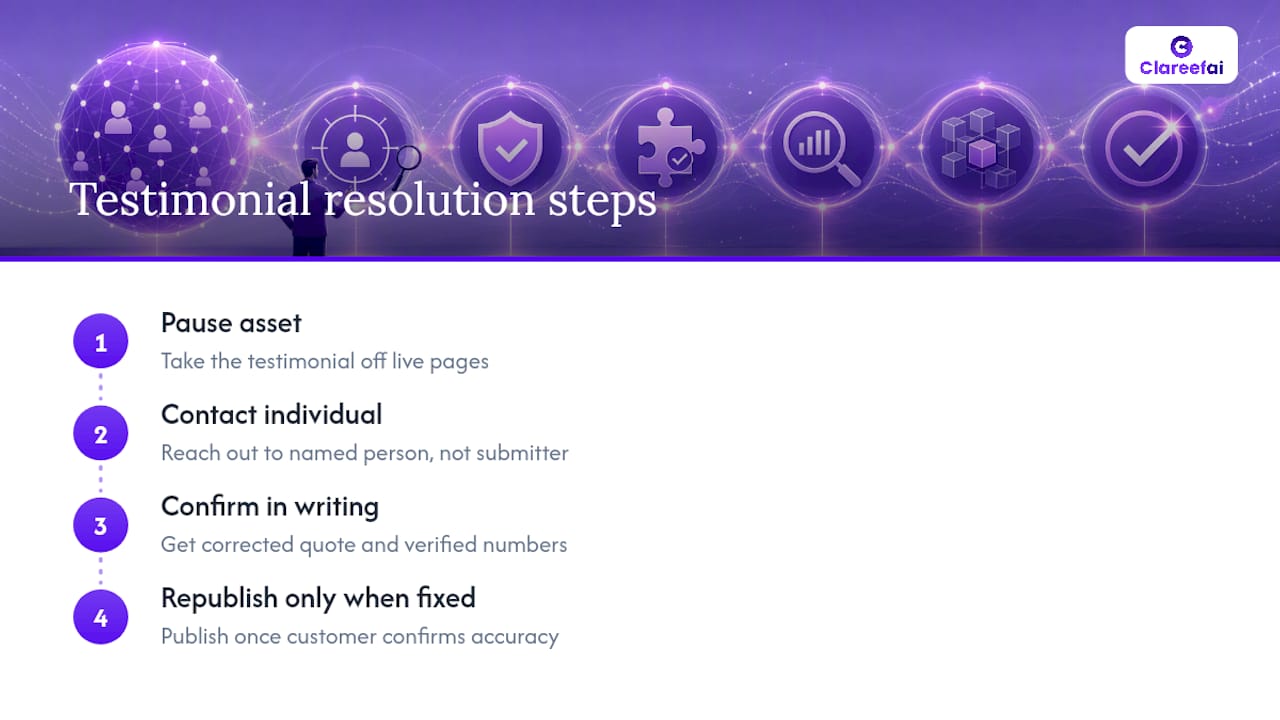
The resolution playbook is consistent: pause the asset, contact the named individual directly (not through whoever submitted it), confirm details in writing, and only republish once the discrepancy is resolved. Teams that skip the “contact the individual directly” step are the ones who get burned twice.
Who Owns Verification Inside Your Organization
Verification fails when it’s everyone’s job and no one’s responsibility. The teams that handle this well assign clear ownership at each stage.
Customer success typically owns the initial relationship, they know which accounts are genuinely happy and can flag when a testimonial request feels off before it even gets submitted. Marketing owns the verification workflow itself: running the checks, assigning confidence scores, and maintaining the audit trail. Sales leadership owns usage discipline, making sure reps only pull from verified, permission-cleared assets rather than screenshotting a Slack compliment and dropping it into a deck.
Legal or compliance should have a defined escalation path, not a rubber stamp on everything, but a required review for Tier A testimonials that reference pricing, ROI percentages, or contractual terms. Without this handoff point, the riskiest claims are often the ones that slip through fastest, because everyone assumes someone else checked them.
A single owner for the verification system itself, whether that’s a marketing operations lead or a dedicated advocacy manager, prevents the common failure mode where three different teams each think verification already happened.
Training Teams to Catch Fake Testimonials Before They Spread
The best verification system in the world fails if the people submitting and requesting testimonials don’t know what to look for. Training has to reach three groups differently.
Sales reps need a five-minute version: if a testimonial doesn’t have a name, title, and verifiable company, don’t use it in outreach, full stop. Give them a simple escalation path, forward anything questionable to marketing ops rather than deciding themselves.
Marketing and content teams need the deeper version: how to run the verification checks, how to read a confidence score, and how to recognize the subtler red flags like duplicate phrasing or coached language. This is also where FTC disclosure rules need to be taught explicitly, most marketers have never read the actual rule and are working from assumptions.
Customer success managers need training on the collection side: how to ask for a testimonial in a way that doesn’t feel like coaching the answer, and how to get written permission at the moment of collection instead of chasing it down later. Clareefai’s testimonial collection checklist gives CS teams a script for this handoff.
Run a quarterly refresher, not a one-time onboarding session. Fake review tactics evolve, and so should your team’s radar for them.
Why Verification Is a Revenue Lever, Not Just Compliance
Sales teams treat testimonial verification like a legal chore. That’s backwards. A verified testimonial with a real name, a confirmed title, and a documented outcome closes deals faster because it eliminates the reference call a skeptical buyer would otherwise demand. Every unverified claim in a deck is a question mark a prospect has to resolve somewhere, usually by asking your rep for three more references, which slows the deal down.
The gap most companies underestimate isn’t fraud risk. It’s the cost of unusable proof. Testimonials collected but never verified well enough to trust in outbound create a backlog of unusable social proof that is often bigger than the fake-review problem itself.
— ClareefAi
How Clareefai Operationalizes Verification at Scale
Everything covered above, tiered verification, confidence scoring, audit trails, permission tracking, is exactly what Clareefai was built to run without pulling your team into spreadsheet triage every week.
The platform ingests testimonials, reviews, and video proof from multiple channels, runs them through identity and cross-source verification, enriches them with firmographic and persona tags, and syncs the verified results to CRMs. Every step leaves an audit trail, so when legal or compliance asks who verified a claim and when, the answer is already logged.
What that looks like in practice:
- Verification badges and confidence scores attached to every testimonial before it’s approved for use.
- Verified promoter introductions that connect prospects directly with real customers who agreed in writing to be referenced.
- Advocacy analytics dashboards showing which verified assets are actually driving pipeline movement.
- GDPR-compliant storage with retention and deletion controls built in, not bolted on.
If your team is still verifying testimonials manually in a shared drive, that’s the exact gap Clareefai’s platform closes. See how it applies to your team’s advocacy program by exploring Clareefai’s sales and marketing solutions or reviewing a documented use case on unified testimonial management to see the workflow in action.
Sources
- Federal Trade Commission announces final rule banning fake reviews, testimonials
- Verify & Enrich B2B SaaS Reviews — Automation 2026 | B2B Stack Weekly
- How to Integrate Customer Testimonials in Cold Outreach | Apollo
- Fake Digital Agency Case Studies: How to Spot & Verify Authentic Proof
FAQ
What is the fastest way to spot fake reviews in B2B testimonials?
Check for a verifiable name, title, and company first. If any of those three are missing or unconfirmable, treat the testimonial as unusable until you verify it.
Do B2B companies have to follow the same FTC rules as consumer brands?
Yes. The FTC’s final rule applies to testimonials and endorsements regardless of industry, requiring accurate attribution and disclosure of material relationships.
How often should verified testimonials be reassessed?
Re-verify Tier A testimonials, the ones citing specific metrics or used in high-visibility placements, every 90 days, since leadership changes and outdated stats can turn a true claim false.
Can automation fully replace manual review of testimonials?
No. Automation handles email domain checks, LinkedIn matching, and duplicate detection well, but high-risk Tier A claims still need manual confirmation before publication.
How does Clareefai help teams verify testimonials at scale?
Clareefai centralizes ingestion, identity verification, confidence scoring, and audit trails in one platform, so teams aren’t manually chasing verification across spreadsheets and email threads.
Recommended
Share Article
Stay Updated
Get the latest insights on customer advocacy and SaaS growth delivered to your inbox.