Proof positioning means backing the position you claim in the market with specific, verifiable evidence that matters to the buyer making the comparison. Positioning says who you serve, which problem you solve and how you differ. Proof gives the buyer a reason to believe it. The strongest proof is a named customer, in a segment your prospect recognizes, saying what changed and by how much. That is the kind of evidence Clareefai is built to collect, verify and show where buyers evaluate you.
This guide is for sales leaders, product and customer marketers, customer success managers and founders who already have a positioning statement and need buyers to accept it.
TL;DR
- Proof positioning pairs each positioning claim with evidence a buyer can check: customer outcomes in the target segment, third-party validation and win/loss findings.
- Prove three to five claims, not a dozen. Pick the ones that are relevant to buyers, true, and distinctive.
- Peer recommendations and third-party reviews carry the most trust with B2B SaaS leaders, so build proof from real customer voices rather than company-authored copy alone.
- Verify every quote and number, give it context (segment, baseline, time period) and get the customer’s approval before you publish.
- Measure by comparing deals, not by counting asset views: usage is not attribution.
Table of Contents
- What proof positioning actually means
- Why customer evidence carries the weight
- Step 1: Decide which claims need proof
- Step 2: Match each claim to the right kind of proof
- Step 3: Verify and contextualize every proof point
- Step 4: Put proof where the doubt lives
- Step 5: Measure whether the proof is working
- A worked example
- Where Clareefai fits
- Our perspective
- FAQ
- Sources
What proof positioning actually means
A positioning statement is a hypothesis. It says, for example, that you are the fastest-to-deploy option for mid-market finance teams. Buyers do not accept that sentence because you wrote it. They accept it when something outside your marketing team supports it.
The Product Marketing Alliance describes the practice as supporting differentiated positioning with specific evidence, such as relevant customer outcomes, analyst recognition and win/loss findings, instead of leaning on assertions or general revenue growth. For a deeper look at how evidence strengthens differentiated positioning, the underlying idea is simple: the claim tells buyers where you stand, the evidence tells them they can trust it.
Two features separate proof from decoration:
- It is tied to a claim. Gartner’s research on customer-featured content says the proof needed depends on the message being validated, and recommends connecting each piece clearly to the claim it supports. A glowing quote about friendly support does nothing for a claim about security.
- It is relevant to the comparison. A buyer weighing you against two named alternatives wants evidence from companies like theirs, about the criteria they are scoring.
Why customer evidence carries the weight
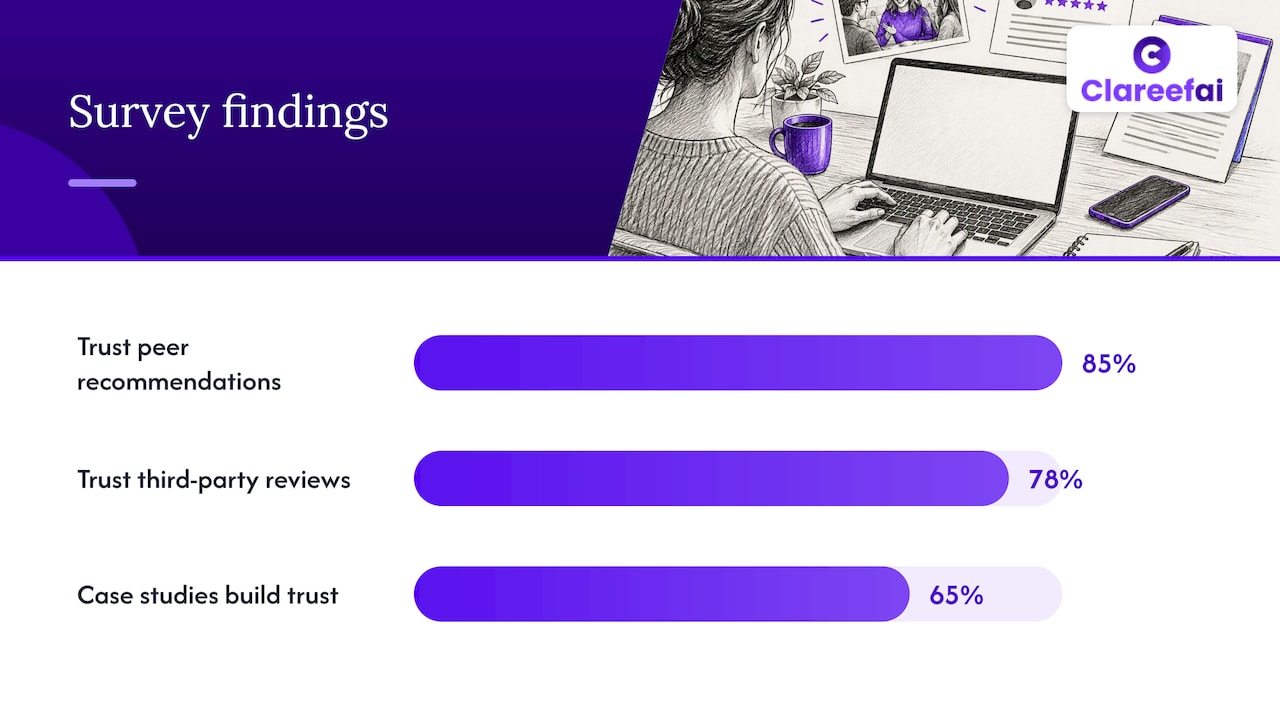
Buyers discount what vendors say about themselves. The 2025 Omniscient Digital and Wynter survey of 100 B2B SaaS leaders found that respondents trusted peer recommendations (85%) and third-party reviews (78%) most, and 65% said case studies build brand trust.
The implication is worth sitting with. The sources buyers trust most are the ones you control least. You cannot write a peer recommendation. What you can do is make it easy for real customers to speak, make sure what they say is attributable to a real person at a real company, and put it in front of prospects at the moment of doubt.
That is the gap between a testimonial and a proof point. A testimonial is anonymous praise. A proof point is a verified voice, a specific outcome and enough context for the prospect to judge whether it applies to them.
Step 1: Decide which claims need proof
Not every sentence in your messaging needs evidence. Start by listing the claims in your positioning, then filter them with three tests:
- Relevant: do buyers care enough that it affects how they evaluate, buy or expand?
- True: can your product and your customer record support it today?
- Distinctive: do competitors fail to make the same promise with equal credibility?
A claim that passes all three earns a place in your positioning. A claim that is true but shared by every shortlisted vendor, such as uptime or “easy to use”, is table stakes. Proving it will not move a decision.
Keep the list short. Three to five claims is a workable ceiling. Each should be written as a plain sentence, with the reason a competitor cannot easily copy it and the proof that it holds. If you cannot name the proof, the claim is not ready to be positioned on yet.
Where to find the evidence for the test
Use your own buyer data before you use opinion:
- Win/loss interviews. Ask buyers why they chose or rejected you, in their words.
- Review sites and sales call notes. See whether buyers describe you the way your positioning does. If they use different language, the mismatch itself is a finding.
- Segments you already win. Look at deal size, industry, company size and buyer role. Proof is strongest where you have a record.
Be careful with CRM lost-reason fields as the only source. They are often incomplete or filled in by the rep rather than the buyer, so treat them as a starting point and confirm with buyer conversations.
Step 2: Match each claim to the right kind of proof
Different claims call for different evidence. Here is a practical mapping.
| Positioning claim | Proof that fits | What to include |
|---|---|---|
| “We cut time to value” | Named customer outcome, video testimonial | Baseline, time period, segment |
| “Built for enterprise security teams” | Reference call with a peer in the same industry | Role, company size, what they evaluated |
| “Our customers expand with us” | Customer quote plus expansion data approved by the customer | Scope of expansion, timeframe |
| “We win against the legacy option” | Win/loss quote from a buyer who compared both | What they compared and why they switched |
| “Trusted in your category” | Third-party reviews, analyst recognition | Date and source of each |
Gartner’s abstract notes that 71% of marketers use customer success stories, while it recommends a broader range of customer-featured content than case studies alone. If you are weighing formats, strategies for using social proof beyond a single format are a good place to compare how short quotes, video and comments each do different jobs.
For concrete formats, our guides on proof point examples you can paste into your content and on short testimonial designs mapped to deal stage show how a claim becomes a usable asset.
Step 3: Verify and contextualize every proof point
Proof that a prospect cannot trust is worse than none. Before anything goes public, run each item through five questions.
- Is the speaker real and attributable? Name, title and company. Anonymous praise reads as marketing.
- Is the number defensible? State the baseline, the measurement period and what is included. One customer’s result does not establish an average effect, so write it as that customer’s result.
- Is the context shown? Segment, use case and company size let a prospect judge fit.
- Did the customer approve it? Confirm exact wording and permission. Never edit a quote beyond its meaning.
- Is it current? Give each proof point an owner and a review date so stale results do not linger.
IndustryWeek lists the pitfalls that make customer proof backfire: comparing against the wrong alternative, relying on one anecdotal case, using friendly customers who are not representative, skipping the customer’s finance review of ROI figures, publishing implausible numbers, and not explaining the assumptions. A figure such as a 93% increase in average selling price, the article notes, loses credibility with a CFO. Those errors share one root: nobody checked the evidence before it was published.
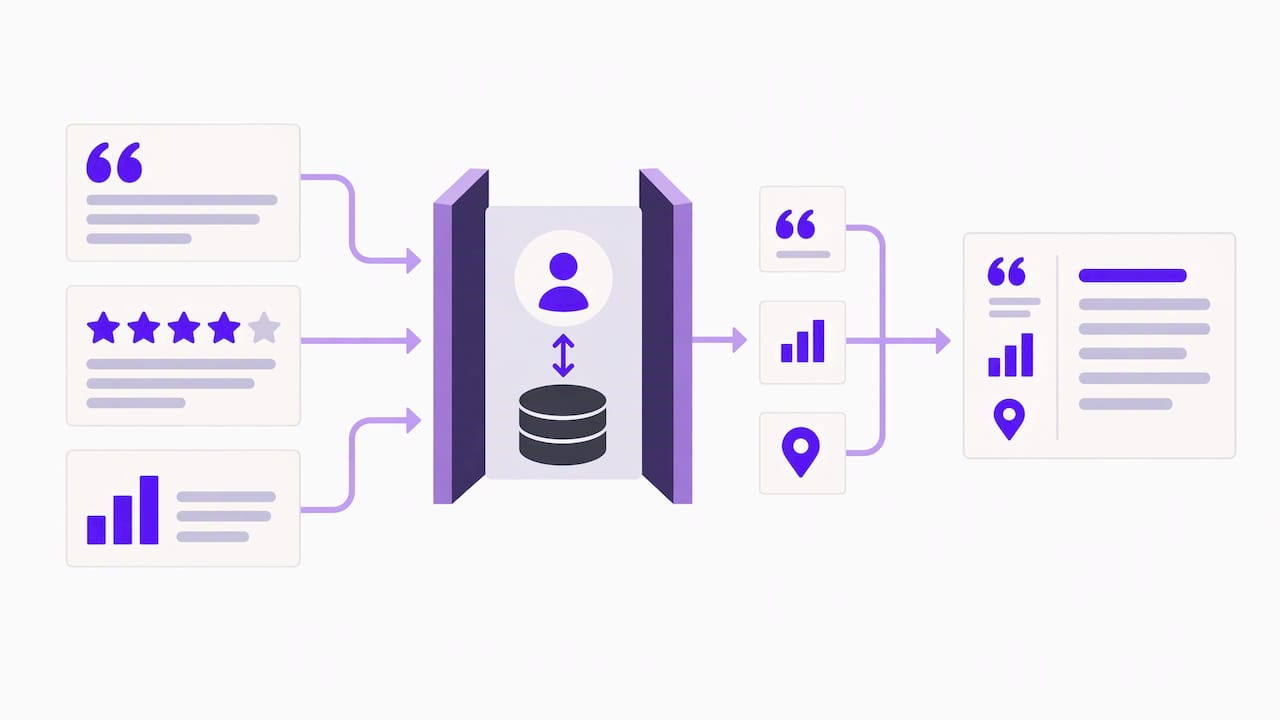
This is the part of the process that is slow when it lives in spreadsheets, inboxes and scattered slide decks. Clareefai centralizes testimonials, reviews and success stories, verifies customer identities and contextualizes feedback, so informal praise becomes an asset a prospect can believe. If you are starting from scratch, our seven-day customer proof library playbook shows how to inventory what you already have.
Step 4: Put proof where the doubt lives
Proof positioning only works when buyers meet the evidence at the point they are questioning the claim. That means spreading it across the journey rather than parking it on one page of customer logos.
The usual touchpoints include your website, campaigns, sales decks, demos, talk tracks, battlecards and customer success conversations. A few principles hold across them:
- Match the persona. A CFO wants a different voice than a head of operations. Our piece on persona-matched testimonials in account mapping covers how to pair them.
- Match the stage. Early evaluation needs credibility signals, late stage needs risk-removal. See how to verify claims at each pipeline stage.
- Place it near the claim. A quote about onboarding belongs next to your onboarding promise. Our testimonial placement best practices explain where on a B2B site this tends to matter.
- Use the right volume. More is not always better; three to five well-chosen testimonials at key doubt moments can do the job, as we lay out in how many testimonials you need.
- Make it live. When the highest-impact voices update automatically across channels, your claim and its proof never drift apart. See testimonial display automation.
Reference calls are the strongest late-stage proof because the buyer controls the questions. Having verified advocates ready to take those calls, matched to the prospect’s industry and role, removes a common bottleneck for sales teams.
Step 5: Measure whether the proof is working
Be disciplined here, because the temptation is to credit proof for every win.
Start with a baseline before you change anything. Then track measures such as competitive win rates, whether reps are using the assets, and whether buyers cite your positioning as a deciding factor, reviewing them monthly.
The Product Marketing Alliance cautions that adoption is not attribution, and revenue is not proof unless you can isolate a signal that links the positioning change to the result. Practical ways to build that signal:
- Compare win rates on deals where a proof asset was used against comparable deals where it was not, and describe the result as correlation unless you can run a controlled test.
- Layer your measures: asset usage first, then rep confidence, then deal outcomes. Usage alone does not show that performance improved.
- Test one change at a time, such as a new testimonial placement, so you know what moved the number. Our testimonial placement testing playbook walks through the approach.
- Map proof touchpoints into your CRM so deals can be tied to the evidence buyers saw. Our guide to proving social proof ROI with tests and CRM mapping covers the setup and the compliance questions that come with testimonials.
Review your claims and proof on a schedule. Markets shift, competitors start making your claim, and a result from three years ago ages badly.
A worked example
Suppose you sell workflow software to mid-size logistics companies. Your positioning claim: “The fastest rollout for multi-site operations.”
- Relevance test: win/loss interviews show buyers repeatedly name rollout across sites as their biggest fear. Relevant.
- Truth test: your implementation records show multi-site customers live in a consistent window. True.
- Distinctive test: competitors talk about features, not rollout. Distinctive.
Now assemble proof. A named operations director at a 12-site distributor records a 60-second video describing how long rollout took and what they expected. Their quote is tied to a segment, a baseline and a time period, and they approve the final wording. A second customer, from a similar company, agrees to a reference call. The claim on your pricing page sits right beside the video, and the same quote appears in the sales deck and battlecard for competitive deals.
That single claim now has a source buyers trust, context they can compare with their own situation and a placement at the moment of doubt. Repeat for each of your three to five claims.
Where Clareefai fits
Clareefai is a subscription platform that helps B2B sales and marketing teams collect, verify, categorize and show customer testimonials, reviews, video, reference calls and success stories. AI identifies the most impactful promoters, and the platform publishes testimonials across channels through CRM and review integrations, with analytics that show the impact of advocacy. It includes GDPR-compliant data management and role-based dashboards.
Plans are billed monthly or annually, with no long-term contracts and a free trial. The published prices are $250 per month for Basic, $624 per month for Professional and $1,250 per month for Enterprise, which adds multi-team accounts, white-label options and custom integrations. See the plans and pricing, or explore the solutions for sales, marketing and management. If you need to show leadership what advocacy is worth, the management view for measuring advocacy ROI is built for that conversation.
Teams that want to see unified testimonial management applied to win rates can read our use case on boosting win rates.
Our perspective
Most positioning fails at the same point: the claim is sharp, but the evidence is a folder of anonymous quotes and a few logos. A logo says you have customers. It does not say what changed for them.
We built Clareefai on the belief that the best proof is a real, verified customer voice with context around it. When a prospect can see who is speaking, what their situation was and what they achieved, a positioning claim stops being a promise and becomes a fact they can weigh. That is why we verify identities and contextualize feedback instead of simply collecting praise.
We also believe proof has to travel. A great testimonial that lives in one slide deck helps one rep. When AI identifies your most impactful advocates, and their words reach your website, your CRM workflows and your reference-call process, the whole funnel speaks with one credible voice.
Finally, we think advocacy should be measured like any other revenue lever. Dashboards, analytics and CRM synchronization let your team see which proof supports which claim, and where buyers respond. Your customers are already your best argument. Our job is to make sure buyers hear it.
ClareefAi
FAQ
What is the difference between positioning and proof positioning?
Positioning defines the buyer, the problem and how you differ. Proof positioning adds the evidence that makes the difference believable, such as customer outcomes in your target segment, third-party validation and win/loss findings. Without it, a position is a statement the buyer has to take on faith.
How many claims should I try to prove?
Three to five is a practical range. Each claim should be relevant to buyers, true and distinctive, and each should have named evidence behind it. If a claim cannot pass those tests, remove it rather than stretching the proof.
Are case studies enough?
Case studies help, and 65% of respondents in the Omniscient Digital and Wynter survey said they build brand trust. Peer recommendations and third-party reviews scored higher in the same survey, so pair case studies with short testimonials, video and reference calls that give buyers more than one way to confirm a claim.
How do I make sure a customer number is credible?
State the baseline, the measurement period, the segment and what is included, and have the customer approve the wording. IndustryWeek recommends having the customer’s finance team vet ROI figures and explaining the assumptions behind them.
How do I know proof positioning is paying off?
Set a baseline, then compare competitive win rates, asset usage and deal-level feedback monthly. Treat the comparison as correlation unless you can isolate the effect of a single change, and review claims and evidence on a regular schedule.
Sources
- How to prove your positioning’s commercial impact, Product Marketing Alliance
- Omniscient Digital and Wynter 2025 research
- Beyond Case Studies: Content That Builds Trust, Gartner
- Winning with Customer Case Studies: 4 Tips, 6 Pitfalls, IndustryWeek