9 Pasteable Proof Point Examples for B2B Marketers
Proof points are verifiable evidence, quantified customer outcomes, specific case studies, or verified testimonials, that turn a marketing claim into a fact that a buyer can check. The three types worth building first are a quantified outcome (a real number tied to a real customer), a short case study that a rep can drop into a deck, and a verified testimonial with a name attached. This article gives you the templates, formats, and a simple system for organizing all three so your team never scrambles for proof mid-pitch again.
TL;DR:
- Verifiable proof points must include a specific actor, defined situation, measured outcome, and timeframe to be credible and useful.
- Building a proof points bank with structured data, verification status, and permissions ensures proof remains accurate, current, and legally compliant.
- Quantified outcomes, short case studies, and verified testimonials are most effective for B2B buyers at all funnel stages, especially when combined.
- Use the proof sentence template to create clear, checkable claims that include the source, measurement method, and date for easy verification.
- Obtain explicit written permission and confirm the data’s accuracy before publishing any proof point to maintain credibility and legal compliance.
Table of Contents
- What Proof Points Are and Why They Matter
- 9 Types of Proof Points Worth Stealing
- [The Proof Sentence Method: How to Write Verifiable Claims](#the-proof-sentence-method-how-to-write-verifiable-claimshttpsbabylovegrowthaiblogdeveloping-persuasive-copy-2026-guide-marketers)
- Proof-Point Formats You Can Paste Into Anything
- Building a Proof-Points Bank That Doesn’t Go Stale
- Legal and Ethical Rules for Using Customer Proof
- A Sales Meeting Where One Number Changed Everything
- How Clareefai Turns Scattered Praise Into a Verified Proof Bank
- Where to Learn More
- Sources
What Proof Points Are and Why They Matter
A proof point earns its name only when it hits four marks: a specific actor (a named company or role, not “a customer”), a defined situation (the problem before you stepped in), a measured outcome (a number, not an adjective), and a timeframe (30 days, two quarters, a full year). Miss any one of those four and you have a slogan wearing a proof point’s clothes.
That distinction matters because slogans ask for trust while proof points ask for verification, and buyers increasingly demand the latter. Verifiable, data-driven evidence is becoming the deciding factor over brand promises alone, according to recent marketing analysis. The SBA’s own guidance on messaging pushes in the same direction: test your claims, refine them, and make sure they hold up under scrutiny before you put them in front of a prospect.
Proof points earn their keep at every funnel stage, not just the bottom:
- Top of funnel: a stat in an ad or LinkedIn post that stops the scroll
- Middle of funnel: a case study that answers “does this work for someone like me?”
- Bottom of funnel: a reference call or testimonial that neutralizes the last objection before signature
9 Types of Proof Points Worth Stealing
Not every proof type carries equal weight, and not every claim needs the heaviest one. Here’s how to match the evidence to the moment.
- Quantified customer outcomes. “Reduced onboarding time from 14 days to 3” beats “faster onboarding” every time. Pair the number with a timeframe and you have something a skeptical CFO can’t wave away.
- Mini case studies. A tight, three-paragraph story (problem, solution, result) works well in a blog post or a mid-deck slide where you have thirty seconds of attention, not three minutes.
- Full case studies. Reserve these for your website’s resource library or a sales leave-behind. They carry more detail: methodology, timeline, multiple metrics, and often a quote.
- Verified testimonials and reference calls. A named quote from someone who’ll actually answer the phone outweighs ten anonymous five-star ratings. Prospects call bluffs on anonymous praise instantly.
- Independent research or analyst reports. Third-party validation from an outside body carries weight your own marketing never will, similar to how organic certification reassures buyers a claim was checked by someone with no stake in the sale.
- Charts and graphs from real data. A trend line showing churn dropping quarter over quarter does more persuasive work than a paragraph describing the same trend.
- Live demos and trials. Letting a prospect touch the product is proof by experience rather than proof by claim, and it short-circuits a lot of the skepticism the other formats have to work to overcome.
- Awards and certifications. These matter most when they come from a recognized standards body; a badge from an obscure site convinces no one. Formal standards frameworks like those published by ISO exist precisely because third-party rigor changes how a claim gets received.
- User-generated content. Screenshots of unsolicited praise on social media, forwarded emails, even a Slack message a customer didn’t know you’d screenshot, these read as more honest because nobody staged them.
Quick gut check: B2B buyers respond most consistently to a mix of quantified outcomes, narrative case studies, and testimonial quotes, according to customer-proof frameworks built for B2B SaaS messaging. If you build only one type this quarter, build a bank of quantified outcomes first. They’re reusable across every format below.
The Proof Sentence Method: How to Write Verifiable Claims
Most marketing claims fail the checkability test because they’re missing pieces, not because they’re dishonest. The fix is a single template: [Actor] achieved [measured outcome] in [timeframe] under [situation]. This is the Proof Sentence technique, and it forces you to fill in every gap a skeptical reader would otherwise flag.
Three worked examples for B2B messaging:
- “A 400-person logistics firm cut invoice processing time by 62% in the first quarter after switching from manual entry to automated matching.”
- “A regional SaaS company increased trial-to-paid conversion from 11% to 19% within two months of adding in-app onboarding checklists.”
- “An enterprise HR team reduced time-to-hire by 18 days over one hiring cycle after consolidating three vendor tools into one platform.”
Before you publish any Proof Sentence, run it through a short verification pass:
- Where did this number come from, and can you point to the raw data?
- Do you have written permission to use the customer’s name or company?
- How was the outcome measured, and by whom?
- What’s the date range, and is the data still current?
Pro Tip: Keep a spreadsheet column labeled “measurement method” next to every stat you collect. Six months from now, when a prospect asks “how exactly did you calculate that?”, you’ll have the answer in seconds instead of chasing down a customer success manager who’s since changed roles.
Proof-Point Formats You Can Paste Into Anything
The format should match where the claim is going, not the other way around.
- The one-liner. A single Proof Sentence, ready for a sales email, an objection-handling script, or a slide footer. No context needed beyond the sentence itself.
- The three-paragraph mini case study. Paragraph one states the problem, paragraph two describes what changed, paragraph three gives the measured result. This fits neatly into a B2B case study format built around five essential fields: customer, challenge, solution, metric, and quote.
- The full case study. Built for a resource page, this needs a title, customer background, the challenge in the customer’s own words, your solution, quantified results, and a named, quotable testimonial. Anonymize only when permission is genuinely unavailable, and say so rather than inventing a placeholder name that reads as fake.
Building a Proof-Points Bank That Doesn’t Go Stale
A centralized proof-points bank keeps evidence from scattering across a dozen Slack threads and forgotten Google Docs. Structure it with these columns:
- Claim (the statement you want to support)
- Proof (the actual evidence, in Proof Sentence form)
- Source type (testimonial, case study, analyst report, internal data)
- Verification status (confirmed, pending, expired)
- Date and Permission (signed off, verbal, none yet)
- Use cases (which deck, page, or objection this proof answers)
Review the bank every 30 to 90 days, plus an annual deep clean, and assign one owner (usually marketing ops or customer marketing) so proof doesn’t rot from neglect. Prioritize new entries by buyer stage: early-funnel proof needs breadth, late-funnel proof needs precision against a specific objection. Teams that tag proof by use case and objection see faster adoption of these assets across sales, because reps stop hunting and start deploying.
Legal and Ethical Rules for Using Customer Proof
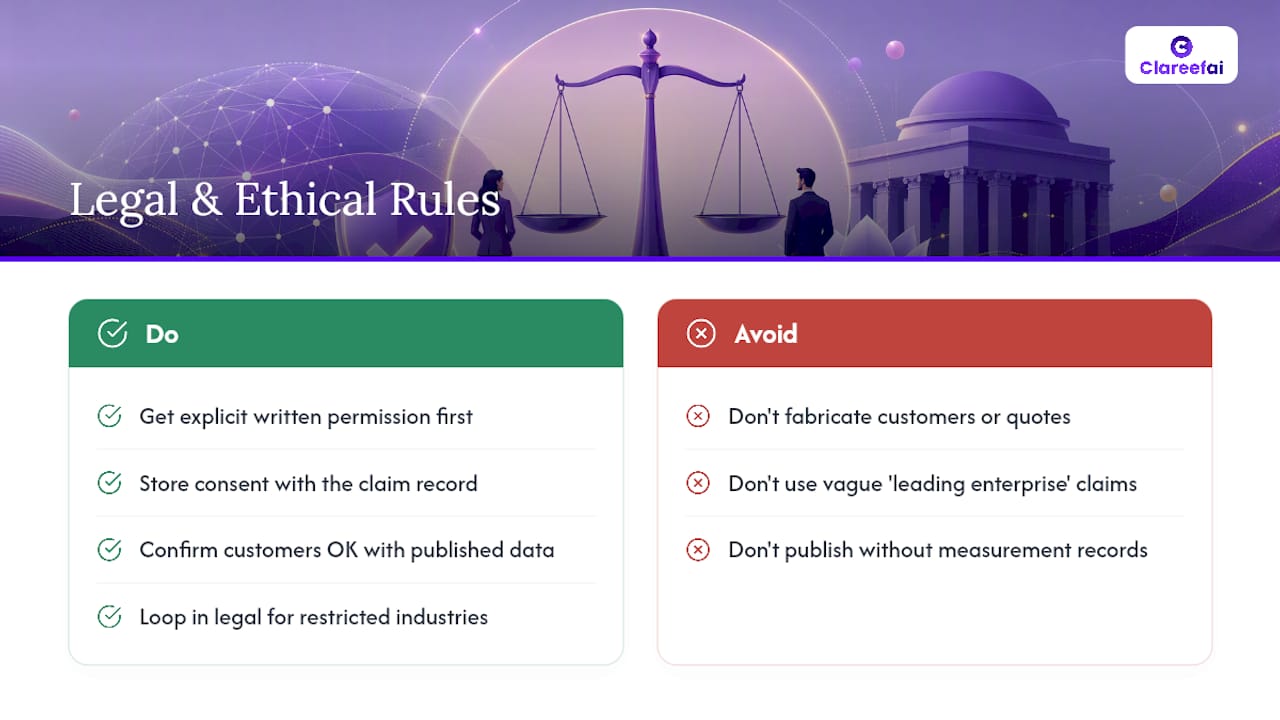
Every testimonial, case study, or quoted metric involves someone else’s name, data, or likeness, and that carries real obligations. Get explicit written permission before publishing a customer’s name, title, company, or photo anywhere public. A verbal “sure, go ahead” in a meeting isn’t enough if that customer later changes jobs or has a falling out with your account team; get it in an email or a signed release, and keep that record in your proof-points bank next to the claim itself.
Data privacy matters just as much as attribution. If a proof point includes usage statistics, revenue figures, or operational metrics from a customer’s business, confirm they’re comfortable with those numbers becoming public, even in aggregate or anonymized form. Some industries (healthcare, finance, government contracting) carry additional restrictions on what can be disclosed at all, so when in doubt, loop in legal before a case study goes live rather than after.
Anonymizing a testimonial is acceptable when a customer wants credit for the outcome but not the spotlight. What’s not acceptable is inventing a customer, fabricating a quote, or attributing a real number to a vague “leading enterprise” that doesn’t exist. That’s not a gray area. It’s the fastest way to lose the exact credibility a proof point is supposed to build, and it tends to surface at the worst possible moment, usually during due diligence or a reference call a prospect requests on their own.
Finally, keep a record of how each number was measured and by whom. If a prospect or their legal team ever asks you to substantiate a claim, “we can’t remember” is a worse answer than any number you might have reported.
A Sales Meeting Where One Number Changed Everything
The friction usually isn’t finding a good customer story. It’s getting permission fast enough to use it before the deal closes. The fix: ask for a quotable line and a name the moment a customer reports a win, not months later during a quarterly review. Capture one proof point this week, while the outcome is still fresh in your customer’s mind.
— ClareefAi
How Clareefai Turns Scattered Praise Into a Verified Proof Bank
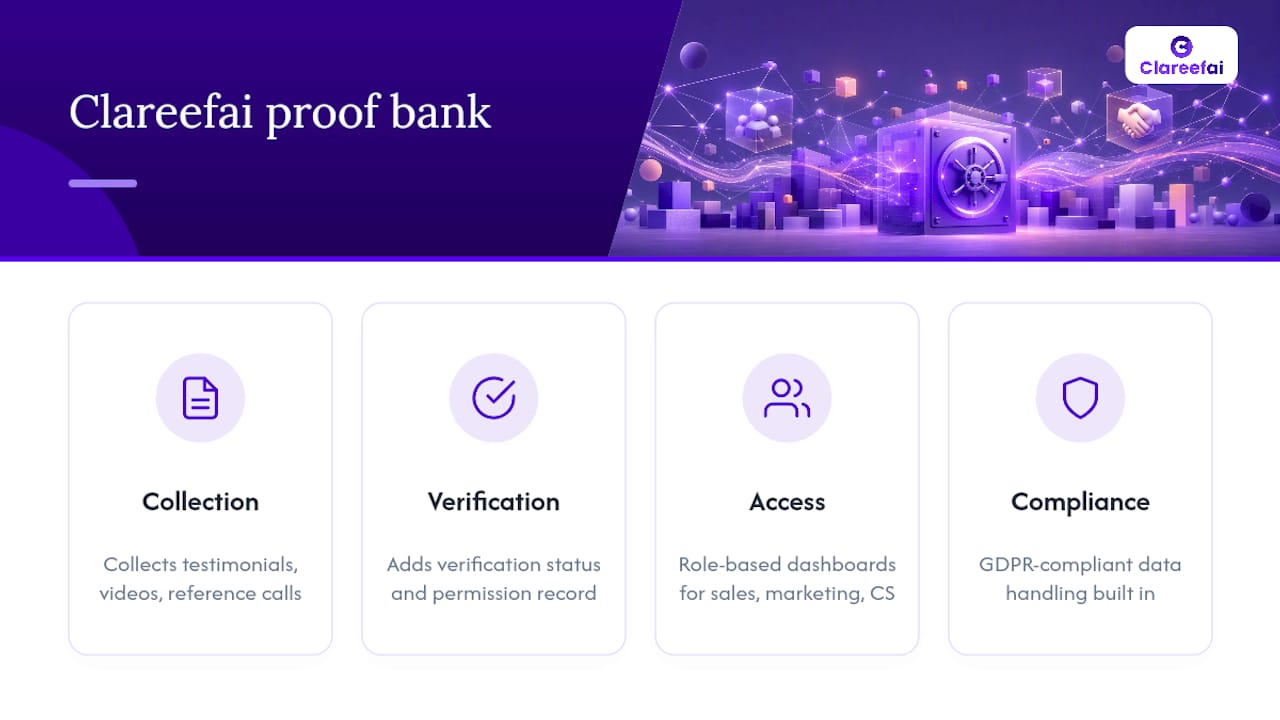
A practical alternative to chasing testimonials through email threads and hoping a customer success manager remembers to ask permission exists. The platform collects, verifies, and organizes customer testimonials, video reviews, and reference calls in one place, then uses AI-driven analysis to flag your strongest advocates before a competitor’s rep even asks for a reference.
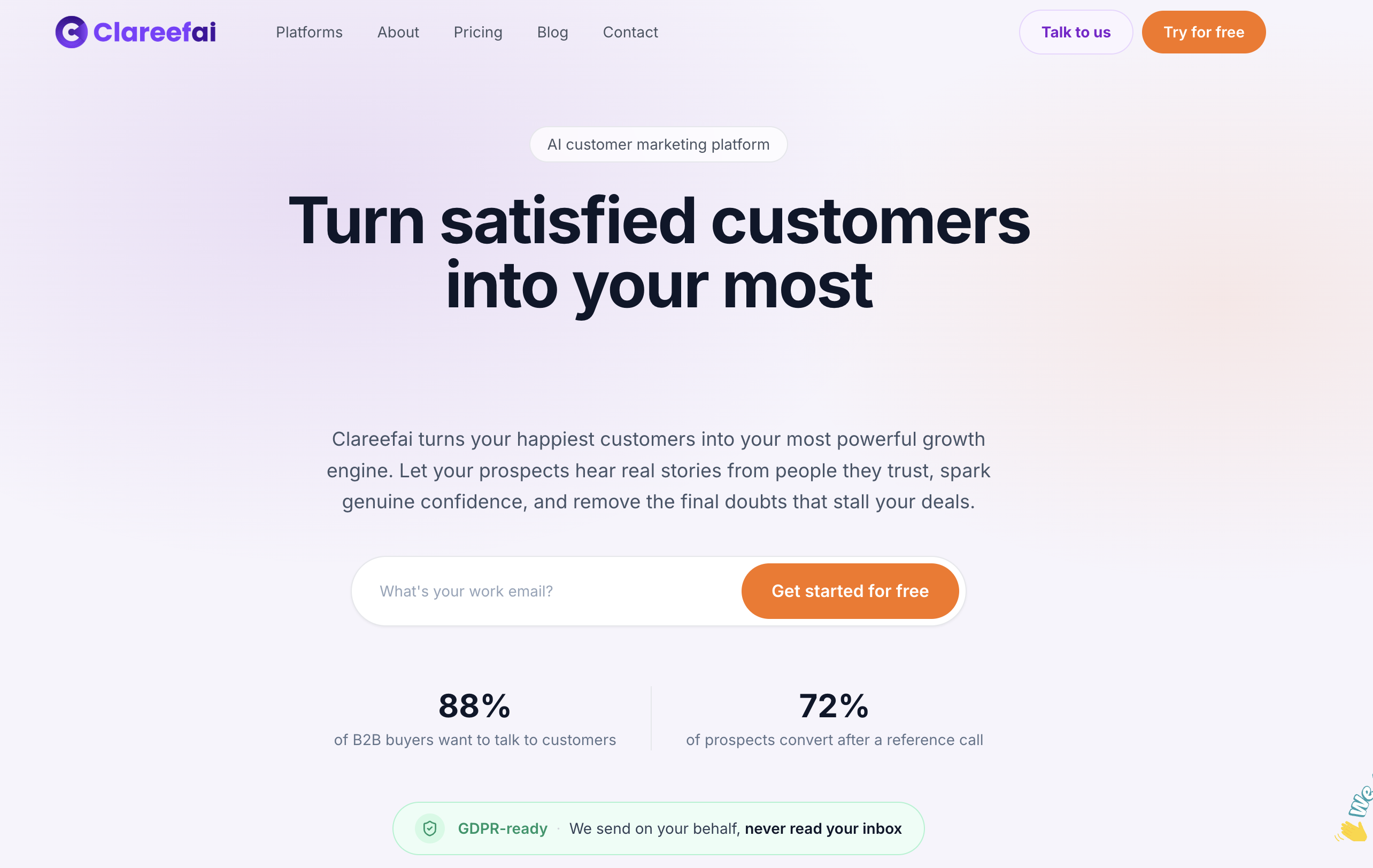
Every proof point in your bank needs a verification status and a permission record, and Clareefai builds both into the collection process instead of leaving them as a spreadsheet afterthought. Role-based dashboards let sales, marketing, and customer success pull the right proof for the right moment, whether that’s a one-line Proof Sentence for a cold email or a full case study for a board deck. GDPR-compliant data handling means the permission and privacy questions covered above are built into the system, not bolted on after a legal review flags a gap.
If your team is still hunting for that one great testimonial the night before a big pitch, take a look at how Clareefai’s platform handles collection and verification, or explore a real customer testimonial use case to see the workflow in action, then request a demo to see it running against your own customer base.
Where to Learn More
For definitions and standards behind this article: Merriam-Webster on the meaning of proof, the SBA’s messaging guide, and Comms With AI’s proof-points bank template for a ready-made structure.
Sources
Recommended
Share Article
Stay Updated
Get the latest insights on customer advocacy and SaaS growth delivered to your inbox.