Social Proof: Verify Claims at Each B2B Pipeline Stage

For awareness-stage prospects, short peer testimonials and trust badges build fast credibility because strangers trust people who look like them more than they trust a brand. For consideration-stage buyers, role-specific case studies and short videos work best because they prove the solution fits a situation like theirs. For decision-stage buyers, quantified ROI case studies and live reference calls close the gap because they remove the last doubts a committee has. Homophily research and B2B buyer behavior findings both back this up, and verification makes every one of these assets usable.
TL;DR:
- At awareness, use a brief testimonial from a buyer’s industry or a trust badge; similarity matters more than a famous company name.
- Start in consideration, where buyers rely on case studies and peer insights, then tailor one core case study to finance, IT, and executive concerns.
- Use concise case studies for internal sharing, lightly edited 30 to 90 second videos during evaluation, and prepared reference calls near a purchase decision.
- Verify each advocate’s identity, role, and company, check claimed results against CRM or usage data, and retain dated verification and consent records.
- Track asset assists, reference call influence, and win rates by CRM stage; test new case studies against a comparable group and report results monthly.
Table of Contents
- How to map proof formats to each pipeline stage
- Forms of social proof and where each one fits
- Collecting, verifying, and tagging proof at scale
- Measuring the impact of proof on your pipeline
- Rollout checklist and ready-to-use templates
- Why relatable proof beats polished proof
- How Clareefai systemizes verified proof across your pipeline
- FAQ
- Sources
How to map proof formats to each pipeline stage
Buyers ask different questions at different points in the pipeline, and the proof you show them should answer the question they’re actually asking, not the one you wish they were asking.
At the awareness stage, prospects want a quick signal that other people like them trust you. They haven’t invested time yet, so they respond to short, relatable cues: a one-line testimonial from someone in their industry, a trust badge, a citation from a report they recognize. The mechanism at work is homophily. Research on testimonial persuasion found that similarity, not authority, mediates how much a testimonial shifts attitudes and intentions. A prospect doesn’t need a Fortune 500 logo at this stage. They need someone who sounds like them.
At the consideration stage, buyers are comparing options and building internal consensus, which is why this phase deserves the most proof investment. B2B buyer research found this is the point where buyers lean hardest on case studies, peer insights, and original research to build a case they can defend internally.
At the decision stage, the proof has to survive scrutiny from specific stakeholders:
- Finance wants verified cost savings, payback periods, and contract terms that match their own budget cycle.
- IT wants proof of security, integration effort, and uptime from a technical peer, not a marketing claim.
- Executives want a short, outcome-focused story that ties the purchase to a business result they can repeat in a board meeting.
Pro Tip: Build one core case study, then cut three role-specific versions from it, each leading with the metric that stakeholder cares about.
Forms of social proof and where each one fits
Different formats carry different weight depending on how much time a buyer has and how skeptical they are. Here’s how to match format to moment.
- Micro-testimonials for awareness. A single sentence, name, title, and company is enough. Structure it as situation, result, in under 20 words so it reads in three seconds on a landing page or ad.
- Mini case studies for consideration. Use a problem, solution, numbers template: one paragraph on the challenge, one on what changed, one with a measurable result. Keep it concise so a buyer can forward it internally without editing.
- Video testimonials for consideration through decision. Aim for 30 to 90 seconds, built around three questions: what problem were you solving, what made you choose us, what changed afterward. Light editing only, since overly polished video can feel staged.
- Reference calls for decision. Prep the reference with the three questions the prospect is likely to ask and confirm availability before you promise the call.
Third-party benchmarks and analyst mentions work well as supporting proof when you have permission to cite them, placed next to a testimonial rather than standing alone. Industry-specific testimonial templates and 30 to 90 second design examples mapped to deal stage give you starting structures instead of a blank page.
User-generated content plays a similar role earlier in the pipeline: unprompted praise on review sites or social posts carries the same peer credibility as a solicited testimonial, sometimes more, because the buyer assumes it’s unfiltered. A partner resource on user-generated content breaks down why this unsolicited format builds trust faster than polished brand content.
Collecting, verifying, and tagging proof at scale
A good testimonial is only useful if your team can find it, trust it, and reuse it without starting over every time. That takes a repeatable process, not a folder of screenshots.
Start with advocate identification. Customer success scores, renewal timing, and product usage spikes are reliable signals that a customer is ready to talk. Reach out soon after a strong result, while the win is still fresh.
Use a structured collection template with consent language built in up front, so the customer knows exactly how their words or video will be used. FTC-safe prompts ask for honest feedback, not a scripted compliment, which matters for both trust and legal exposure.
Once you have the raw material, verify it:
- Confirm the person’s name, role, and company independently, not just through self-report.
- Capture the metric they cite and check it against your own CRM or usage data.
- Record the date and who verified it.
- Store the original consent alongside the published asset.
Tag every asset by pipeline stage, buyer role, vertical, and use case so sales and marketing can pull the right one in seconds. A practical guide to building trust with reviews covers how to extend this same structure across review platforms.
Pro Tip: Store metadata as structured fields, not free text, so your CRM or sales enablement tool can surface the right testimonial automatically when a deal hits a given stage.
Automate the parts that don’t need judgment, like follow-up reminders and tagging suggestions, but keep a human approval step before anything goes public.
Measuring the impact of proof on your pipeline
Proof only earns its budget when you can tie it to pipeline movement, not just a feeling that it helped.
Map each asset to the CRM stage it’s meant to support, then track when reps actually attach it in sequences or share it in deal rooms. Without that link, you’re measuring content production, not sales impact.
Useful KPIs include:
- Asset assists: how often a specific testimonial or case study was attached to a deal that later advanced.
- Reference call influence: win rate on deals that included a reference call versus deals that didn’t.
- Win-rate delta: the gap in close rate between deals that used verified proof at the decision stage and deals that didn’t.
A literature review of social proof mechanisms suggests layering peer and expert cues could amplify persuasion, though the review itself notes this combined effect still needs direct testing rather than being an established fact.
Run simple lift tests: give one group of reps a new case study to use and hold a comparable group back, then compare win rates. Report results monthly to revenue leadership, since a quarterly cadence is too slow to catch what’s actually working. A playbook for proving social proof ROI walks through test design and CRM mapping in more detail.

Rollout checklist and ready-to-use templates
Start in the middle of the funnel, since that’s where buyers report relying most heavily on case studies and peer insights to build internal consensus.
- Pick three recent customer wins with a clear, verifiable metric.
- Build one mini case study and one 30 to 90 second video from each.
- Tag every asset by stage, role, and vertical before publishing.
- Load assets into your CRM or enablement tool so reps can find them by deal stage.
- Set a 30-day check-in to review which assets reps actually used.
For discoverability, use consistent naming: company, industry, metric, stage. A clearly named file that includes the company, industry, metric, and stage tells a rep what it contains before opening it.
Keep a short interview script ready:
- What problem were you trying to solve before working with us?
- What result can you point to today?
- What would you tell a peer who’s on the fence?
A simple outreach line works better than a long request: “Your result stood out to us. Would you be open to a 10-minute call to share it in your own words?”
Why relatable proof beats polished proof
Verification and relatability work together, not separately. A testimonial from someone who looks like your buyer builds trust fast, but only if that person is real and checkable. Strip out verification and the same testimonial becomes a liability the moment a skeptical buyer starts asking questions.
Avoid the perfection trap. A wall of flawless five-star reviews reads as curated, and research on testimonial effectiveness found that a few authentic, imperfect comments actually improve conversion by signaling the feedback wasn’t filtered. Pilot one stage, measure what moves, then scale what works.
— ClareefAi
How Clareefai systemizes verified proof across your pipeline
Everything in this playbook, advocate identification, structured collection, verification, tagging, and reporting, is easier with a system built for it instead of a shared drive and good intentions. We built Clareefai to organize, verify, and surface customer testimonials, video reviews, and case studies so your team can match the right proof to the right buyer without rebuilding the process every quarter.
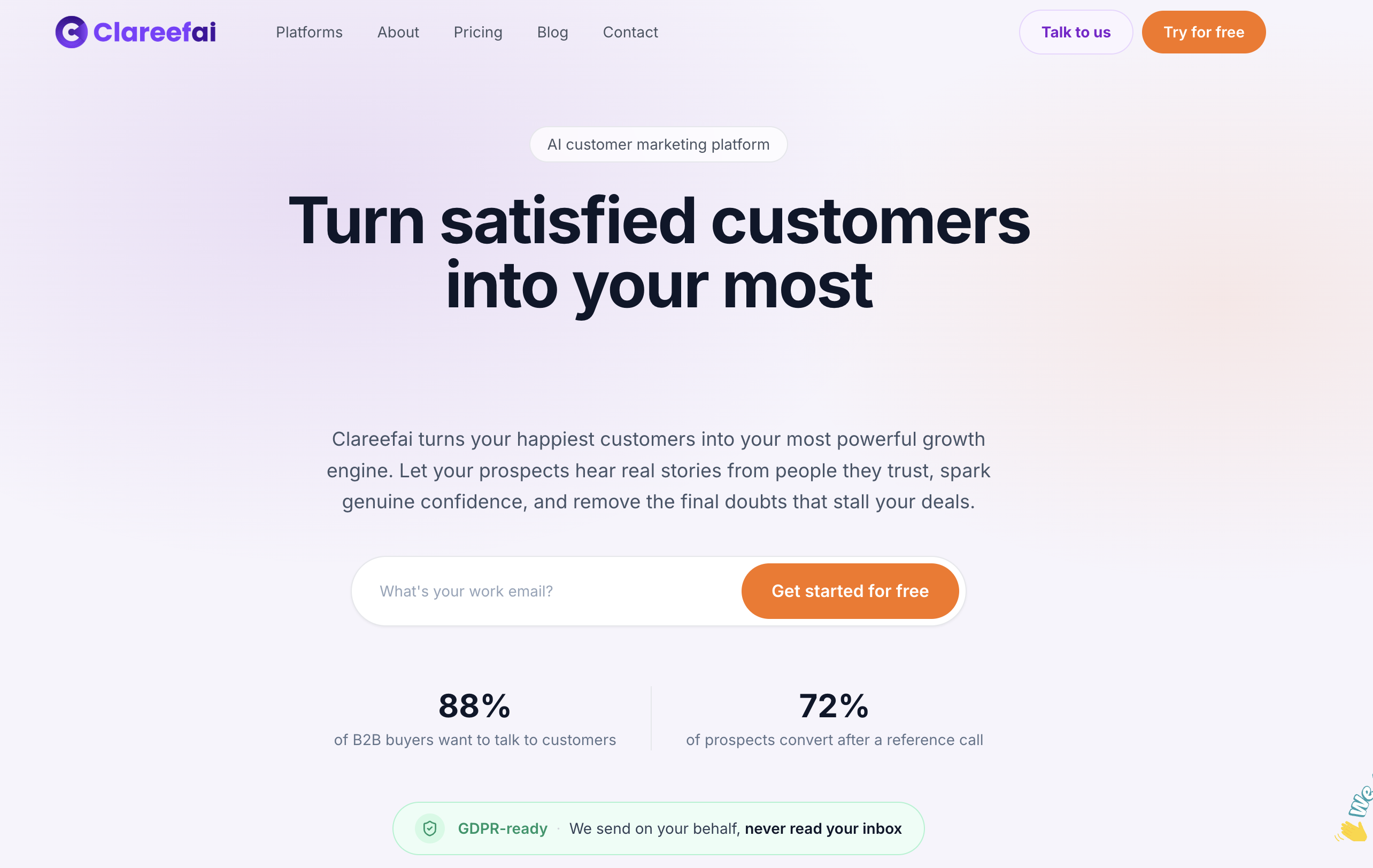
Our platform connects verified promoters to prospects through testimonials and reference calls, tags every asset by stage and role, and syncs with your CRM so reps see the right proof at the right moment. Teams use it to boost win rates with unified testimonial management and to give marketing teams and revenue leadership a shared view of what’s actually working.
Explore our plans and pricing, starting with a Basic plan at $250 per month, or try our free plan to see how verified proof fits into your own pipeline.
FAQ
What are some examples of social proof?
Common examples include customer testimonials, case studies, verified reviews, trust badges, reference calls, video endorsements, and third-party benchmarks. Each format carries different weight depending on the buyer’s stage: short testimonials and badges work early, while detailed case studies and reference calls carry more weight close to a decision.
What are the 7 stages of marketing?
Definitions vary across sources, but a common version covers awareness, consideration, decision, retention, advocacy, with some models splitting these further into research, evaluation, and purchase substeps. For B2B pipelines specifically, most teams simplify this to awareness, consideration, and decision, which is the framework this article uses.
How do I get social proof?
Identify recent customer wins using renewal timing, usage data, or customer success scores, then reach out with a short, specific request within a couple of weeks of the result. Use a structured interview script and clear consent language so the testimonial is both authentic and usable without legal risk.
What does social proof mean?
Social proof is the tendency for people to trust a decision more when they see evidence that others, especially people similar to them, made the same choice. In B2B sales, this shows up as testimonials, case studies, and reference calls that reduce a buyer’s perceived risk at each stage of the pipeline.
Sources
- Frontiers | Investigating the Persuasive Effects of Testimonials on the Acceptance of Digital Stress Management Trainings Among University Students and Underlying Mechanisms: A Randomized Controlled Trial
- Content That Converts: 2025 B2B Buyer Insights - Redpoint Insights
- Marketingexperiments
Recommended
Share Article
Stay Updated
Get the latest insights on customer advocacy and SaaS growth delivered to your inbox.