B2B Marketers: FTC safe templates for industry specific testimonials

Industry-specific testimonials convert better than generic praise because they speak directly to a buyer’s own context, role, and risk. The first move is simple: pick one high-fit customer story, verify it, and publish it in a targeted format within 48 hours. The rest of this guide walks through examples by sector, a compliance-first collection process, formats, and templates you can use today.
TL;DR:
- Industry-specific testimonials that include real metrics, dates, and detailed context significantly increase trust and credibility over vague praise.
- Collecting verified testimonials requires a documented process, including direct customer requests, cause-and-effect questions, and explicit consent for publication.
- Using the right format, such as short quotes, videos, or detailed case studies, should match the buyer’s journey stage and channel to maximize impact.
- Measurable lift in conversions can be assessed through simple A/B testing, cohort comparison, and tracking click-through and engagement metrics linked to testimonial assets.
- Future regulatory pressures and buyer skepticism make verified, detailed, and role-specific testimonials more valuable, requiring investment in proper documentation and analytics.
- ✓Verified customer testimonials
- ✓Reviews and success stories
- ✓AI-identified customer advocates
- ✓Detailed testimonial analytics
Table of Contents
- 1. Why industry-specific testimonials matter
- 2. Industry-specific testimonial examples you can adapt
- 3. How to collect and verify testimonials the right way
- 4. Choosing formats: quotes, video, case studies, and templates
- 5. Where to put testimonials across the buyer’s journey
- 6. Measuring testimonial impact without overcomplicating it
- 7. Templates, scripts, and a quick checklist
- 8. What a verification-first approach looks like in practice
- The future of testimonials is stricter and more specific
- How Clareefai supports verified, industry-specific testimonials
- FAQ
- Sources
1. Why industry-specific testimonials matter
Trust decides more purchase decisions than price or features, especially in B2B sales where the buyer is putting their own reputation on the line. Research on testimonial authenticity finds that about half of senior decision-makers cite trust as the top factor in vendor selection, and more than a quarter struggle to trust vendors during early research. That gap is exactly where a well-placed, industry-matched testimonial does its job.
A generic quote like “Great product, highly recommend” tells a prospect nothing about their own situation. A testimonial from someone in their industry, with their title, facing their problem, does the opposite: it lets the reader see themselves in the story. The same research notes that transparency, not just positive sentiment, builds credibility. Publishing the problem context, the date, and the metric alongside the quote matters more than the star rating attached to it.
A few principles carry this idea into practice:
- Match the role and industry of the testimonial giver to the reader’s own job and sector whenever possible.
- Lead with specifics, not adjectives: a number, a timeframe, or a named outcome beats “amazing” every time.
- Resist the urge to chase star counts. A five-star average with thin, vague quotes persuades less than a four-star page full of detailed, contextual stories.
- Treat the testimonial as evidence, not decoration. It should answer a question the reader was already asking.
Depth is what separates a testimonial that gets skimmed from one that gets remembered. Specificity is what makes depth possible.
2. Industry-specific testimonial examples you can adapt
Different sectors need different proof; for managing local reputation and reviews effectively, consider trusted tools like Google Business Profile Management. A SaaS buyer wants a metric. A healthcare buyer wants to know the patient’s privacy was respected. Below are working examples you can use as templates, organized by sector.
- SaaS: Pair a metric-led quote (“We cut onboarding time from three weeks to four days”) with a 30-second video clip for the pricing page, and reserve a full one-page case study for sales enablement during procurement. The short clip builds trust fast; the case study answers the detailed questions a buying committee will ask later.
- E-commerce: Show a real product photo alongside a specific usage detail, such as sizing, fit, or a before-and-after result. “Ordered a size up and it fit perfectly after the first wash” does more work than “love this product,” because it answers the exact hesitation a shopper has before checkout.
- Healthcare: Center the patient outcome, but pair it with explicit consent language and a privacy note that confirms what was and was not shared. A testimonial here needs to read as carefully handled, not just persuasive, or it undermines the trust it is meant to build.
- Real estate: Use a short narrative arc with a concrete before-and-after metric, like days on market or price uplift from listing to sale. “The agent repositioned our listing and we had an offer in nine days instead of the forty we expected” gives a prospective seller something to measure their own expectations against.
- Professional services: Tie the testimonial to a specific role and problem, then close with an ROI statement. A CFO’s quote about a consulting engagement that reduced close time by a defined number of days speaks louder than a vague endorsement of “great service.”
- Agencies: Anchor the quote in a campaign KPI, state the scope of the engagement, and include an attribution note so the reader understands what the agency controlled versus what the client’s team handled. Clarity about scope protects credibility when results vary by client.
- Financial and B2B technical services: Combine a named metric with a short explanation of the buyer’s prior alternative, so the reader understands the before-state as clearly as the after-state.
- Nonprofit and membership organizations: Use a member or donor’s own words about measurable community impact, paired with a date and program name, since vague impact language is the most common credibility gap in this category.
The common thread across every example: a reader should be able to picture the exact situation, not just the sentiment.
3. How to collect and verify testimonials the right way
A testimonial is only as valuable as the trust it carries, and that trust depends on how it was collected. The FTC’s Consumer Reviews and Testimonials Rule prohibits buying or fabricating reviews and requires disclosure of material connections between a business and the reviewer. Civil penalties for violations can be substantial, which makes a documented process worth the extra half hour it takes.
A workable collection flow looks like this:
- Request: Ask a satisfied customer directly, ideally right after a win or milestone.
- Interview: Ask cause-and-effect questions, such as why they chose you and how they measured the result.
- Record: Capture the exact role, company, metric, and date, whether on video or in writing.
- Verify: Confirm the person and the claim before anything goes live.
- Get written consent: Document permission to publish, including any media used.
- Publish: Match the format to the channel, and keep a record of the approval.
Authenticity checks matter here too. Reviewers who use specific cause words, numbers, and personalized details are judged as more credible, while fabricated or incentivized reviews tend to read as more generic and more uniformly positive. Our six-step verification workflow built around FTC guidelines walks through the documentation each step requires, from email confirmation to a signed release.
Pro Tip: Keep a simple folder per testimonial with the consent form, a screenshot of any shared metric, and the interview notes. It turns a five-minute compliance question into a thirty-second lookup.

4. Choosing formats: quotes, video, case studies, and templates
Format should follow purpose, not habit. A quote card works for a fast scan on a pricing page. A 30 to 90 second video clip builds trust before a sales call ever happens, particularly in complex B2B sales where the buyer wants to see a real person before they see a rep. A long-form case study earns its place in procurement packets and sales decks, where a buying committee wants depth, not brevity.
A simple video script structure keeps clips tight and useful: state the problem the customer faced, describe the solution they adopted, name the metric that changed, and close with their own quote in their own words. Our breakdown of video testimonial advantages for B2B marketers covers why this structure consistently outperforms open-ended customer interviews.
A few practical design notes:
- Place the call to action near the quote, not buried below it, so interest converts immediately.
- Pull the single strongest sentence into a bold, larger treatment above or beside the full quote.
- Use a still frame that shows the speaker’s face as the video thumbnail, since a recognizable person outperforms a logo or product shot.
- Confirm consent covers the specific media format you plan to publish, not just the quote itself.
Pro Tip: If you only have time to produce one asset this month, make it a 60-second video. It works across social, the pricing page, and a sales deck without modification.
5. Where to put testimonials across the buyer’s journey
The same testimonial can work at several stages if you resize and recontextualize it rather than publishing it once and forgetting it.
- Pricing and product pages: Place a short, metric-led quote near the decision point, where hesitation is highest.
- Demo request flow: Add a testimonial from a similar company right before the form, to reduce last-second drop-off.
- Sales decks and reference calls: Use the full case study version, and keep a short list of customers willing to take a reference call for serious prospects.
- Top-of-funnel content: Repurpose a video microclip for social and a two to three paragraph excerpt for email, where attention spans differ sharply from a product page visit.
Mapping format to channel matters as much as the testimonial content itself: a thirty-second clip suits a social feed, while a longer excerpt suits an email that a reader has already opened with intent. Our guide to multi-channel social proof for B2B trust goes deeper on sequencing these placements by funnel stage.
6. Measuring testimonial impact without overcomplicating it
You do not need a full attribution model to know whether a testimonial is working. Track conversion lift on the page where it appears, the demo-to-win rate for leads who viewed a testimonial-heavy page, and the reference-to-close rate for prospects who took a reference call.
A simple way to start:
- Run an A/B test on one high-traffic page with and without a specific industry testimonial.
- Tag testimonial-linked campaigns with UTM parameters to see which asset drove the click.
- Compare cohorts who saw a testimonial against those who did not, rather than building a full multi-touch model on day one.
One of the clearest signals in testimonial research is specificity itself: fake or manipulated reviews tend to be more superficial and less context-rich than authentic ones, which means a detailed, verified testimonial is doing double duty: it converts better and it reads as more trustworthy at a glance. A one-page dashboard tracking these few metrics is usually enough to show leadership the program is working.
7. Templates, scripts, and a quick checklist
Speed matters here, since a testimonial collected a week after a customer’s win is harder to get than one collected the same day.
- Short email request: “You mentioned [result] last week. Would you be open to a two-minute quote we can share with similar companies?”
- Five-question interview script: What problem were you solving? Why did you choose us? What changed, specifically? How did you measure it? What would you tell someone in your position considering this?
- Consent line: “I agree to let [company] publish my name, title, company, and the above quote or recording across its marketing materials.”
- Publishing checklist: Confirm attribution, add alt text and metadata for the image or video, check the metric against the original source, and optimize file size before upload.
Our testimonial collection checklist for marketers in 2026 expands each of these into a reusable internal document your team can run without rebuilding the process every quarter.
8. What a verification-first approach looks like in practice
A verification-first workflow means every testimonial is tied to a real, confirmed customer before it goes live, with the context and metric intact rather than trimmed down to a vague compliment. That approach centers on matching the right advocate to the right prospect’s industry and problem, then publishing the resulting testimonial, reference, or case study across the channels where a buyer will actually see it.
Teams that unified their testimonial collection and publishing process reported faster sales cycles and higher win rates once verified, industry-matched stories replaced scattered or unverified quotes.
One use case focused on unified testimonial management shows this in practice: centralizing verification and distribution turned informal praise into a structured asset sales teams could rely on. For execution detail, our posts on testimonial design examples mapped to deal stage and the step-by-step testimonial workflow cover the operational side in more depth.
The future of testimonials is stricter and more specific
Regulation is tightening, not loosening. The FTC’s rule explicitly targets fabricated reviews, undisclosed incentives, and review suppression, and that pressure will keep pushing marketers toward documented consent and verified identity rather than quietly collected quotes. At the same time, buyers are getting better at spotting generic praise, which makes verified video and detailed, role-specific stories more valuable each year, not less.
The practical move is to invest in verification and basic analytics now, before the next rule update or the next round of buyer skepticism forces a scramble. A testimonial program built on documentation rather than hope ages well. One built on casual screenshots does not.
— ClareefAi
How Clareefai supports verified, industry-specific testimonials
We built Clareefai around the exact problem this guide addresses: turning scattered, hard-to-verify praise into sales assets a team can actually trust and reuse. Our platform automates the collection, verification, and cross-channel publishing of testimonials, references, and case studies, with AI-driven matching that surfaces the right advocate for a given prospect’s industry or role.
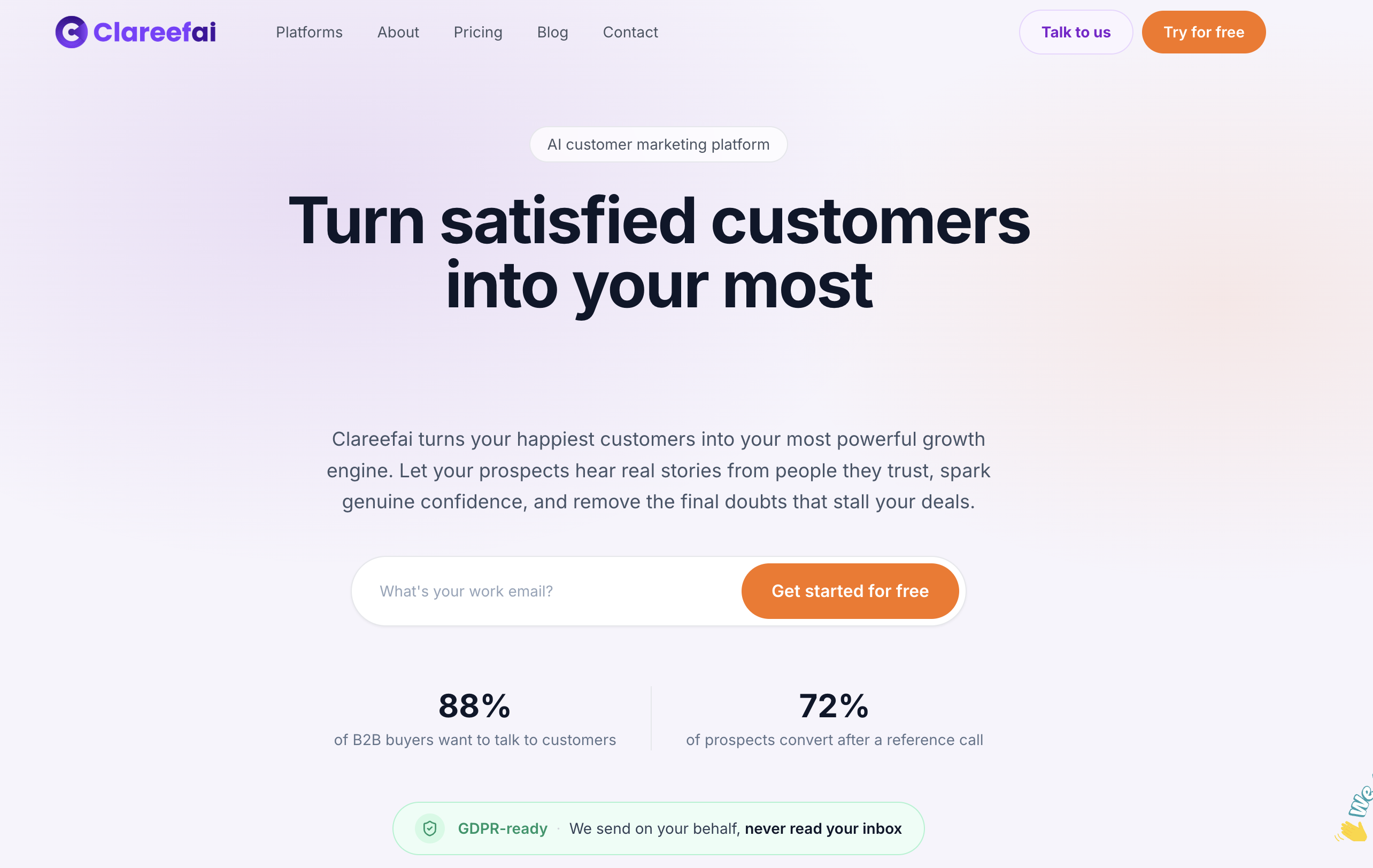
We handle GDPR-compliant data management and give marketing, sales, and leadership separate dashboards so each team sees the metrics that matter to them. If you want to see how the workflow fits your own pipeline, our platform overview walks through the core features, and our pricing page lists current prices. Prefer to test the waters first: our free plan is the lowest-friction way to start collecting and verifying industry-specific testimonials.
- Verification-first collection that ties every quote to a confirmed customer.
- AI-driven promoter matching to find the advocate whose story fits a given prospect.
- Cross-channel publishing so one verified testimonial reaches the pricing page, sales deck, and email at once.
- Advocacy analytics that show leadership what the program is actually producing.
FAQ
What is an example of a good testimonial?
A good testimonial names a specific problem, states what changed in measurable terms, and includes the person’s real name, title, and company. “We cut response time from five days to one” works because it gives a reader something concrete to compare against their own situation.
What is a testimonial example?
A testimonial is a customer’s own statement about their experience with a product or service, typically including their name, role, and a specific result. The strongest examples pair a direct quote with a metric, a date, or a before-and-after detail rather than general praise alone.
Are fake testimonials illegal?
Yes, under the FTC’s Consumer Reviews and Testimonials Rule, buying, fabricating, or incentivizing fake reviews without disclosure is prohibited, and civil penalties can reach up to $43,792 per infraction. The rule also bars suppressing genuine negative reviews and requires disclosure of any material connection between a business and a reviewer.
What are 5-star positive reviews examples?
A strong five-star review goes beyond the rating itself and explains exactly what worked, such as a specific feature, a measurable result, or a detail about how the product was used. Reviews that stop at “five stars, great service” carry less persuasive weight than ones that explain why the rating was earned.
Sources
- Consumer reviews and testimonials rule: questions and answers | Federal Trade Commission
- Par
- Investigating reviewers’ intentions to post fake vs. authentic reviews (Reading/ScienceDirect extract)
Recommended
Share Article
Stay Updated
Get the latest insights on customer advocacy and SaaS growth delivered to your inbox.