Persona-Based Testimonials: Start With 3–5 High-Impact Pairs

Persona-based testimonials, short proof points matched to a specific buyer’s role and objection, drive higher trust and conversion than generic praise. The quickest way to start is to sort your top five testimonial assets by the exact objection each one answers, not by how polished they sound. That one sort reveals which personas you’re already covering well and which ones you’re leaving unanswered.
TL;DR:
- Start with three to five persona and testimonial pairs, chosen by buyer role, job to be done, primary objection, and deal complexity; expand after testing.
- Match proof to buyer needs: evaluators need detailed case studies, champions need forwardable quotes, and skeptics respond to stories that acknowledge doubt.
- Ask advocates to explain their experience to a colleague in the same role; eight studies found this prompt improved narrative quality and persuasiveness.
- Compare matched and generic testimonials on the same traffic segment, tracking conversion lift, time from demo to close, and win rate; test placement too.
- Disclose incentives clearly, show video disclosures onscreen, retain identity, date, and consent records, and name sales and marketing owners before expanding collection.
Table of Contents
- Why persona-based testimonials outperform generic social proof
- How to map testimonials to buyer personas and funnel stages
- Step-by-step process to collect, edit, and publish persona-based testimonials
- Formats, channels, and scripts that convert by persona
- How to measure and optimize persona-targeted testimonials
- Legal, disclosure, and ethics checklist for FTC-safe testimonials
- Clareefai in practice: proof points behind a verified testimonial platform
- Priorities and trade-offs when building a persona-based testimonial program
- Try Clareefai to scale verified, persona-matched testimonials
- FAQ
- Sources
Why persona-based testimonials outperform generic social proof
A testimonial that says “great product, highly recommend” tells a prospect nothing about their own situation. A testimonial that says “I was worried about migration downtime, and we had zero” tells a specific buyer exactly what they needed to hear. That specificity is not a stylistic preference, it’s a behavioral one.
Research into marketing psychology shows that surprise and emotional intensity amplify engagement, which means an unpredictable, personalized detail in a testimonial sticks in a reader’s memory far longer than a bland compliment does. When a testimonial surprises a reader with a specific number, a candid admission, or an unexpected outcome, it registers as more credible precisely because it doesn’t sound rehearsed.
The structure matters as much as the content. Testimonials that follow a problem, skepticism, solution arc tend to land harder with skeptical buyers than testimonials that open with unconditional praise. A line like “we were skeptical at first, honestly” does more persuasive work than five adjectives stacked in a row, because it mirrors the doubt the prospect is already feeling. Buyers, especially younger B2B decision-makers who’ve grown up surrounded by marketing noise, read unqualified enthusiasm as a red flag rather than reassurance.
Verification closes the loop. A testimonial attached to a real name, title, and company reduces the instinctive suspicion that the quote was invented or cherry-picked. Context does the same job: a testimonial that names the specific feature, timeline, or result a buyer cared about reads as evidence rather than decoration. Strip away the vague adjectives and what’s left, a named person, a specific outcome, an honest admission of doubt, is what actually moves a skeptical reader toward yes.

How to map testimonials to buyer personas and funnel stages
Not every persona needs the same proof. A technical evaluator wants implementation detail. A budget-holder wants ROI. A skeptical end user wants to know the product won’t make their job harder. Before you write a single interview question, decide which personas actually deserve a dedicated testimonial library.
Four criteria help narrow the list:
- Job-to-be-done: what outcome is this person actually trying to achieve, separate from their job title.
- Role in the buying committee: are they the researcher, the final approver, the internal champion, or the skeptic who can kill the deal.
- Primary objection: what specific doubt or fear stops this person from saying yes.
- Deal size and complexity: a $250-per-month self-serve buyer needs lighter proof than a six-figure enterprise buyer running a formal evaluation.
Once you’ve got your personas, build a simple mapping: persona, objection, and testimonial type, side by side. A Researcher persona early in the funnel might need a short quote confirming the product does what it claims. An Evaluator comparing vendors needs a detailed case study with implementation specifics and measurable outcomes. A Champion trying to sell the purchase internally needs a testimonial they can forward to their own boss, something that reads as a ready-made internal pitch. A Skeptic, often the hardest to move, responds best to the problem-skepticism-solution arc, because it acknowledges the exact hesitation they’re feeling instead of talking past it.
The SBA’s guidance on testimonial marketing makes a related point worth keeping in mind: build around the buyer’s actual job-to-be-done and the objection stopping the purchase, not around an imagined “average” customer. There is no average customer, there’s only the specific person reading your landing page right now, and the testimonial they need depends entirely on what’s making them hesitate.

Step-by-step process to collect, edit, and publish persona-based testimonials
Collecting a testimonial that actually fits a persona takes more than sending a generic review request. It takes a repeatable process your sales and marketing teams can run without reinventing it every quarter.
- Identify the right advocates. Pull customers who match your target personas and who recently hit a measurable win, renewed early, expanded usage, or resolved the exact objection you’re trying to counter.
- Reach out with a specific ask. Tell them which persona or use case you’re highlighting so their answer stays focused instead of generic.
- Use prompts that increase narrativity. Rather than asking customers to “write a review,” ask them to imagine explaining the experience to a close colleague who’s considering the same purchase. AMA research across eight studies found that this small framing shift measurably improves narrative quality and persuasiveness compared with simply instructing reviewers to “tell a story.”
- Ask targeted follow-up questions. “What almost stopped you from buying?” and “What surprised you after you started using it?” pull out the skepticism and the specific detail a persona-matched testimonial needs.
- Edit for persona relevance, not polish. Trim tangents, but keep the customer’s own phrasing and the specific numbers or doubts they mentioned. Over-polishing erases the authenticity that made the quote work in the first place.
- Verify identity and capture provenance. Record the customer’s name, title, company, and date of the testimonial, along with documented consent to use it.
- Tag for reuse. Label each testimonial by persona, objection, funnel stage, and outcome metric so sales and marketing can pull the right asset in seconds.
- Route to the right channel. Push the testimonial into the sales deck, landing page, or nurture sequence where that persona is most likely to see it.
Pro Tip: Ask advocates “what would you tell a colleague in your exact role who’s still on the fence?” instead of “what do you like about us?” The answer almost always surfaces the objection a matched testimonial needs to address.
This workflow mirrors what we’ve documented in our B2B social proof workflow, where the recruiting and tagging steps determine how fast a testimonial actually gets used once it’s collected.
Formats, channels, and scripts that convert by persona
The right testimonial in the wrong format still underperforms. A rushed text quote won’t carry the weight a technical Evaluator needs, and a ten-minute video case study is overkill for a quick nurture email aimed at a budget-conscious Researcher.
Match format to persona habit:
- Video case studies work best for Evaluators and Champions who need depth and are willing to spend three to five minutes building confidence before a final decision.
- Short text quotes fit fast-scanning Researchers on landing pages, where a single sharp sentence does more work than a paragraph.
- LinkedIn recommendations carry extra weight with Champions, since a public, professional-context endorsement feels harder to fake.
- Proposal references matter most for Skeptics and procurement-heavy enterprise buyers who want a name they can call directly.
Channel placement follows the same logic: put Evaluator-focused case studies on comparison or pricing pages, put Champion-ready quotes in sales decks they can forward internally, and put Skeptic-focused problem-skepticism-solution stories in retargeting ads and late-stage nurture emails. Our guide on video testimonial advantages for B2B marketers breaks down which channels get the most mileage from video specifically.
For interview prompts, nine questions tend to produce the most usable, persona-relevant answers: What problem were you trying to solve? What almost stopped you from buying? What surprised you after onboarding? What result can you point to today? What would you tell a peer in your exact role? What nearly made you walk away? How did this change your day-to-day work? What did you expect versus what actually happened? Would you make the same decision again, and why? Six shorter prompts work for quick quotes: name one result, name one doubt you had, name one feature you didn’t expect to use, describe the moment it clicked, compare it to what you used before, and sum up the experience in one sentence.
How to measure and optimize persona-targeted testimonials
Testimonials are a conversion asset, which means they deserve the same measurement discipline as any other piece of sales or marketing content. Track three primary signals:
- Conversion lift on landing pages where a persona-matched testimonial replaces a generic one, measured against the same traffic segment.
- Demo-to-close time, since a well-matched testimonial can shorten the gap between an initial call and a signed deal by pre-answering the objection that usually stalls it.
- Win rate uplift when sales reps actively use matched testimonials during the evaluation stage versus deals where they don’t.
Run simple A/B tests before scaling anything: persona-matched testimonial against generic testimonial on the same page, then testimonial placement above the fold against placement near the pricing table. Feed the results back through your CRM, and pay attention to which testimonials reps actually request from marketing, since that demand signal usually predicts which persona-objection pairs are costing you the most deals. Our playbook on boosting sales credibility walks through how reps can fold these matched assets into outreach without slowing down their pipeline.
Legal, disclosure, and ethics checklist for FTC-safe testimonials
Persona-based testimonials only work if prospects trust they’re real, and trust depends on staying inside the rules that govern endorsements.
- Disclose incentives clearly. If a customer received a discount, credit, or anything else in exchange for their testimonial, that relationship needs a clear, conspicuous disclosure.
- Never fabricate or edit out of context. The FTC’s consumer reviews and testimonials rule treats fake, misleading, or undisclosed incentivized testimonials as a liability risk, not a gray area.
- Caption disclosures in video, not just text. A disclosure buried in a description nobody reads doesn’t meet the bar for “clear and conspicuous.”
- Keep provenance metadata on file. Name, title, company, date, and documented consent protect you if a testimonial’s authenticity is ever questioned.
Verified provenance measurably reduces buyer skepticism, and that same metadata doubles as the detail sales reps need to personalize outreach. Our six-step verification workflow covers how to document consent and provenance without adding friction to the collection process.
Clareefai in practice: proof points behind a verified testimonial platform
We built our platform around the workflow this guide describes: identify the right advocates, verify who they are, tag their feedback by persona and objection, and publish it where the matching buyer will actually see it. AI-driven analysis flags which customers are the strongest advocates for a given use case, and a verification layer attaches documented identity and consent that FTC-safe practices require.
Our evidence-backed guidance on testimonial volume points to three to five testimonials at each key doubt moment as a practical target for resource-constrained teams, enough to cover a persona’s main objections without drowning sales reps in options; for more inspiration on effective formats, see these social proof examples that build trust and win customers. From there, our dashboards sync verified testimonials into CRM records and sales one-pagers automatically, so the right proof shows up at the right funnel stage without manual digging.
Priorities and trade-offs when building a persona-based testimonial program
Start with three to five persona-testimonial pairs, not fifty. Prove the lift on your highest-value personas before scaling wider, because a library of a hundred unsorted quotes helps nobody.
Favor authenticity over polish in almost every case, a slightly rough, specific quote outperforms a slick one that reads like marketing copy.
Ownership is the part teams underestimate. Testimonials fail when marketing collects them and sales never uses them, or sales requests them and marketing can’t keep up. Put a clear service-level agreement in place between both teams, with named owners on each side, before you scale the program.
Try Clareefai to scale verified, persona-matched testimonials
We make the operational side of this guide faster: our platform automates advocate matching, identity verification, and persona tagging, then publishes the right testimonial to the right channel without manual handoffs between sales and marketing.
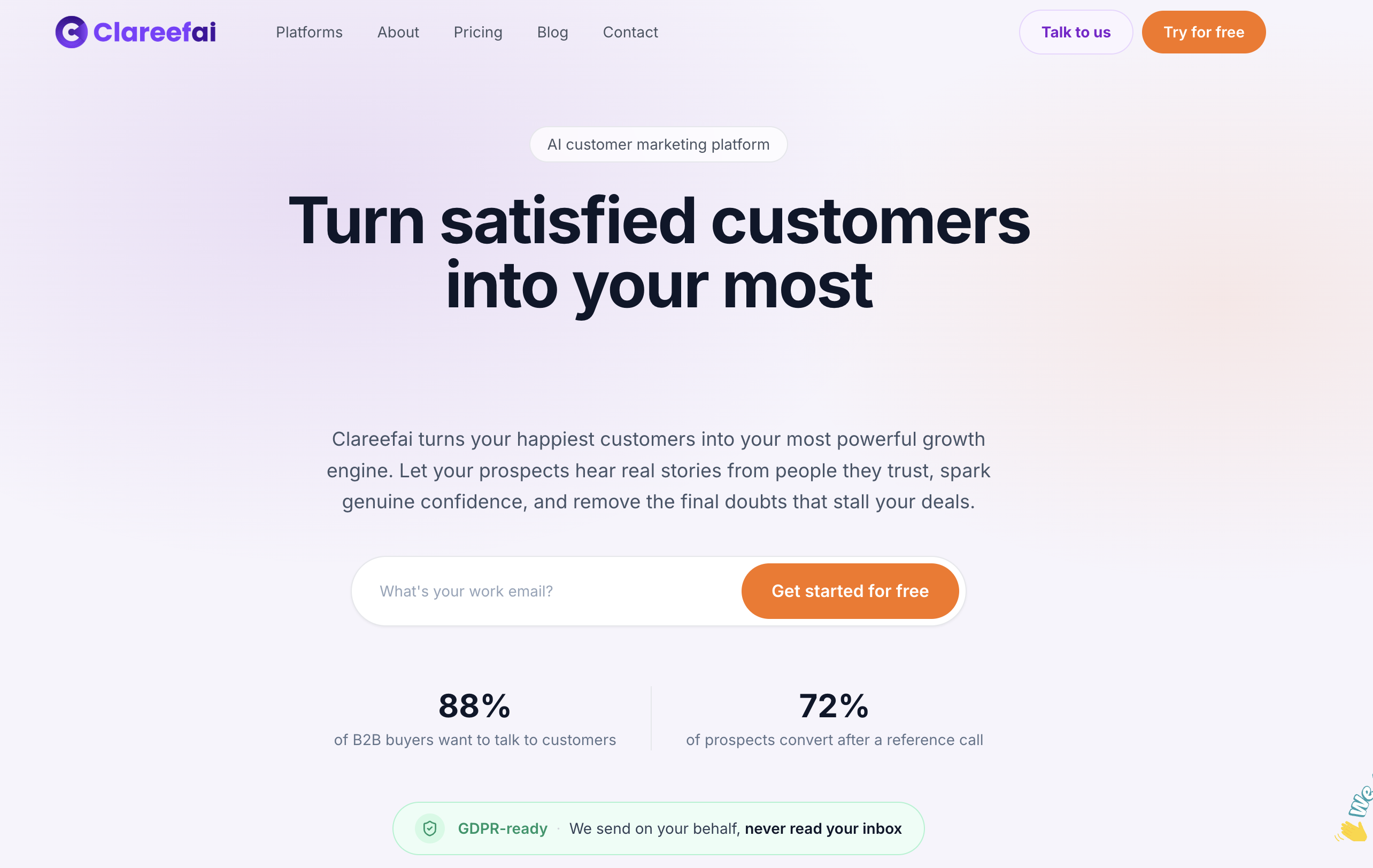
That automation keeps every asset FTC-safe by design, since verification and consent capture happen as part of collection, not as an afterthought. Start with our free plan or compare paid tiers on our pricing page.
| Plan | Price | Best fit |
|---|---|---|
| Free plan | Available on request | Teams testing persona-based testimonial workflows |
| Basic | $250 per month | Small sales and marketing teams starting their first persona library |
| Professional | $624 per month | Growing teams managing multiple personas and channels |
| Enterprise | $1,250 per month | Organizations needing custom integrations and white-label publishing |
FAQ
What does persona-based mean?
Persona-based means content, including testimonials, is built around a specific buyer profile defined by role, objection, and job-to-be-done, rather than written for a generic audience. The goal is relevance: the message matches what that particular reader actually needs to hear before they’ll act.
Can you give me some examples of personas?
Common B2B personas include the Researcher gathering early information, the Evaluator comparing vendors on technical fit, the Champion advocating internally for the purchase, and the Skeptic who needs their specific doubts addressed before signing off. Each one responds to a different type of proof and a different testimonial format.
What are the three main types of personas?
Definitions vary across marketing teams, but a common grouping splits personas into buyer personas (the people involved in a purchase decision), user personas (the people who’ll actually use the product day to day), and audience personas (broader segments used for content and advertising targeting). B2B testimonial programs usually focus on buyer personas first.
Who is the target audience for persona?
Persona development is used by marketing and sales teams who need to tailor messaging, including testimonials, landing pages, and sales outreach, to specific buyer types rather than a single generic audience. It’s most useful for teams selling complex products with multiple decision-makers involved in each deal.
Sources
- Why Surprise Is the Secret Sauce: Marketing Lessons from Nancy Harhut
- The Consumer Reviews and Testimonials Rule: Questions and Answers | Federal Trade Commission
Recommended
Share Article
Stay Updated
Get the latest insights on customer advocacy and SaaS growth delivered to your inbox.