
Case study storytelling means telling one customer’s real journey, from a problem they recognized to a change they can measure, so your next prospect sees their own situation in it. The story carries the context. The numbers carry the proof. The customer’s voice carries the trust. When all three are verified and easy for sales to reach, a case study stops being a PDF in a folder and becomes a sales asset. At Clareefai, that is the job we built our platform around: collecting, verifying and showing authentic customer voices at the moment a deal needs them.
TL;DR
- Pick one customer, one challenge and one outcome. A case study that crams in every win loses the reader.
- Build the arc: a problem the buyer recognizes, a turning point, the solution in action, and results that explain why the change mattered.
- Interview for specific past moments, not general opinions, and keep the customer’s own words.
- Give every number a baseline, a time frame and a source, and get written approval for the final text.
- In the US, a published case study counts as a testimonial, so it must reflect the customer’s honest experience.
Table of Contents
- Why a story beats a feature list
- Choose a story worth telling
- Structure the case study as a story
- Interview for the story, not the summary
- Back the story with evidence a buyer can trust
- Get approval without losing the story
- Our perspective
- Put your stories to work with Clareefai
- FAQ
- Sources
Why a story beats a feature list
B2B buyers rarely lack information. They lack context. That is the point made by B2B case study specialist Joel Klettke, who argues that customers explain that context better than vendors do, and that a story built around a real person shows doubts, tension and stakes a sales pitch cannot. The customer is vouching for you instead of you promising.
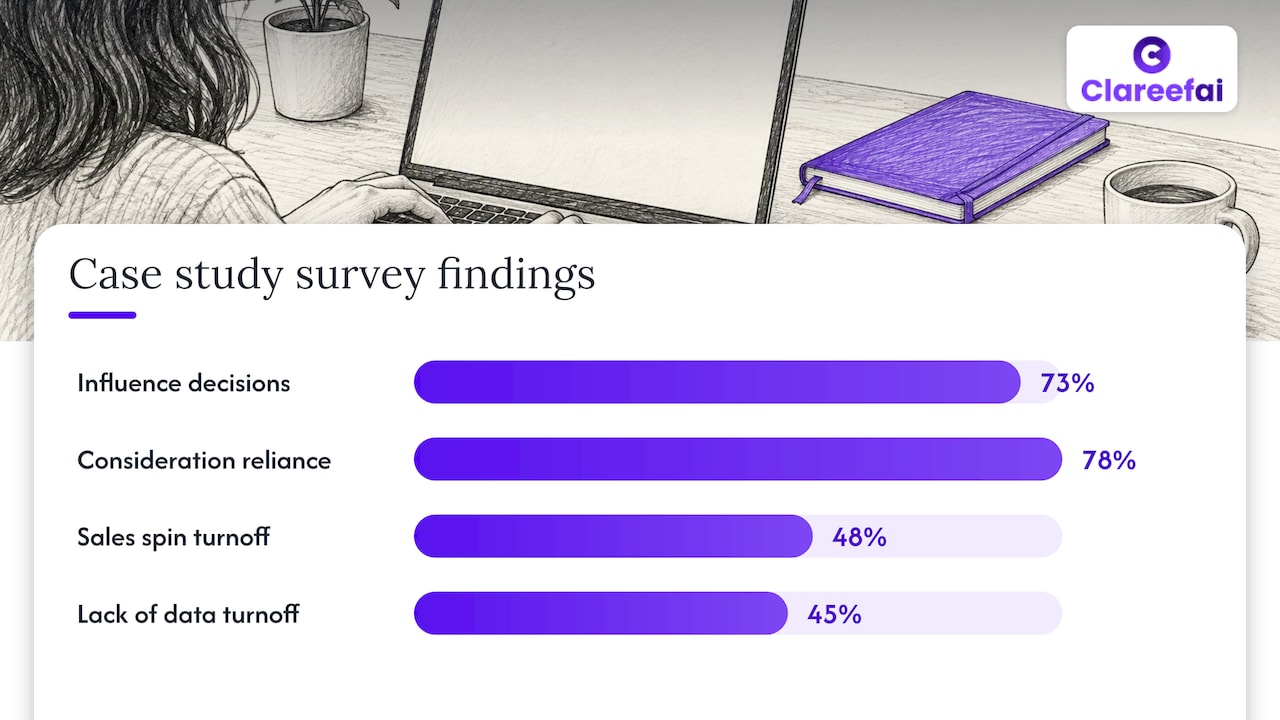
There is also a good reason to care about the format itself. A 2025 roundup of B2B surveys reports that 73% of B2B decision makers say case studies significantly influence purchasing, and 78% of buyers rely on them at the consideration stage. The same roundup cites DemandGen’s finding that the top turn-offs are too much sales spin (48%) and not enough data to support claims (45%). Read those two together and you have the brief: a case study needs a human story and hard proof, and it needs to avoid sounding like an advertisement.
The contrast with a product pitch is simple:
| Product pitch | Case study story | |
|---|---|---|
| Hero | Your product | Your customer |
| Opens with | Features | A problem the buyer recognizes |
| Tension | None | Stakes, doubt, setbacks |
| Proof | Claims | Named people, numbers, quotes |
| Reader feels | Sold to | Understood |
If you want the broader picture of why customer-led narratives build trust with buyers, this overview of content storytelling for business growth covers the fundamentals. For the sales side, our guide to why success stories matter to B2B sales teams shows where they fit in the deal.
Choose a story worth telling
Great customer stories are discovered, not invented. Before you book an interview, check the raw material with the account manager or customer success manager who knows the account. Fenwick’s guide to customer stories recommends checking plot, character and setting before you commit, and says a plot needs motivation, tension and setbacks, not merely one thing after another.
A practical filter, adapted from Mercer Mackay’s case study guide, is to look for four things:
- A challenge your target buyers recognize. If a prospect in your ideal segment would not say “that’s us,” the story will not travel.
- A transformation with tension. Stakes, complexity or risk make the change worth reading about.
- A willing, on-the-record participant. A customer who will be named, quoted and available for a call is worth more than a bigger logo who will not.
- A strong business outcome. Ideally both qualitative and quantitative.
Frame the problem around a business initiative
David Kamm of iBeam Consulting advises framing the problem around a key business initiative rather than dwelling on the customer’s pain, and giving the customer credit. It keeps your customer the hero and protects the relationship: nobody wants to be published as a company that was struggling. The same source notes that real implementation problems overcome add credibility, because a flawless implementation story reads as marketing fluff.
Word the problem so everyone in that category can relate. According to a MarketingProfs conversation with Bob Wiesner, the problem should be stated so the reader sees you understood it, and its difficulty amplified without exaggeration. Otherwise the work sounds so easy that readers wonder why they need you.
Structure the case study as a story
The standard B2B case study has four parts: the customer, the challenge, the solution and the benefits. That skeleton is sound. Storytelling is what you put on it.
Several practitioners offer richer versions. Zapier’s roundup of expert methods describes a four-step approach (business problem and metrics, turning point and tools, solution development and deployment, results) and a seven-beat approach (customer, challenge, journey, discovery, solution, implementation, results). They agree on the principle: conflict, protagonist, resolution.
Here is a working structure that blends them:
- The customer and the ordinary world. Who they are, what they do, what “normal” looked like. Two or three sentences.
- The challenge. Open in the action with the stakes. Not “Company X needed a better process,” but the moment the old way stopped working.
- The turning point. What convinced them to act. This is the beat most case studies skip, and it is the one buyers identify with most.
- The journey. Evaluation, setbacks, the implementation hurdle that got solved.
- The results. Numbers first, then why they mattered.
- The new status quo. What is different today and what the customer plans next.
Treat results as the wrap-up, not the whole story
Copyhackers’ guide to writing case studies recommends a before, during, after interview format and treating results as the end of the story: share why the outcome matters, not just the metric. Gainsight makes the same case, noting that using a case study only to deliver metrics misses a chance to connect emotionally.
What does that look like? A 30% efficiency gain is a statistic. The story is what that time bought: the renewal team that finally had room to run proactive outreach, or the sales director who stopped dreading quarter-end. Put the statistic in a callout and the human consequence in the paragraph.
For a ready-made layout your sales team can scan in seconds, see our B2B case study format with a five-field snapshot.
Interview for the story, not the summary
The interview decides whether you get a story or a press release. Three habits make the difference.
Brief the interviewee and share the questions in advance. Mercer Mackay also advises asking permission up front to use their name, title and quotes.
Ask for specific moments. Product coach Teresa Torres recommends starting with “Tell me about the last time you…” because specific past-behavior stories avoid the biases that distort answers about general habits. In a case study interview, that becomes: “Tell me about the week you decided the old process had to go.”
Talk to more than one person. HubSpot’s customer success story guide suggests interviewing the project lead and colleagues to get the whole story, not just the champion’s version.
A short question set that covers the arc:
- What was frustrating before? What did you try first?
- What was missing from your previous product or provider?
- What convinced you to act, and why then?
- What was the hardest part of getting started?
- What is different today? What can your team do now that it could not before?
- Which number would you point to if your CFO asked whether this worked?
Capture the customer’s own language. A phrase like “we stopped guessing” does more work than three paragraphs of marketing copy. Our guide to customer success stories goes further on collecting them across touchpoints.
Back the story with evidence a buyer can trust
Story earns attention; evidence earns belief. The Fourward guide to SaaS case studies gives a clean standard: name the people, give each number its unit, baseline, time frame and source, say when a result is unusual, disclose any discount or fee the customer received, and include an honest limit.
In practice:
- State the baseline. “Win rate rose 8 points” means little. “Win rate rose from 22% to 30% over two quarters” can be checked.
- Attribute carefully. FactoryMore advises against claiming results you cannot attribute to your product alone, and recommends verifying every number.
- Agree on data early. Measurable results are often the hardest part to obtain, so settle what data you can use at the proposal stage, not after the project ends.
- Put numbers in a customer’s mouth. An executive quote that contains a hard figure is more persuasive than the same figure in your voice, a point made in the iBeam guide.
- Keep every word true. The cardinal rule, as Write for Business puts it, is that no data or quote may be invented.
The quotes matter at scale, too. The statistics roundup cited above reports an Accenture finding that 62% of respondents trust case studies more when they include direct customer voices. If you want to turn results into a defensible business case, our walkthrough on result-first case study ROI shows how to build the math.
Get approval without losing the story
Approval is where good stories die, usually in legal review three weeks after the interview. Plan it from the start.
- Confirm who must approve on the customer side, and agree what is off limits.
- Interview and draft. Bebop’s template suggests aiming to send the draft within five business days, while the conversation is fresh.
- Run customer and legal review.
- Get written sign-off on the final text, quotes, logo and channels. A verbal yes from your champion is not approval from their company.
- Record who approved which version and when. One practitioner guide recommends this, along with agreeing in writing what may be named and measured, the formats and channels, the duration and the right to withdraw.
Draft in the customer’s order of events, not yours. It keeps the story honest and makes approval faster, because the customer recognizes their own experience.
The US rules for customer endorsements
In the United States, a published case study counts as a testimonial under the FTC’s Endorsement Guides, according to Bebop’s summary of the guidance. The practical consequences: the story must reflect the customer’s honest experience, edits must not distort it, and if a testimonial implies results other customers can expect, you need to be able to substantiate that or disclose what is generally expected. Disclose any material connection, such as a discount for taking part. For anything specific to your claims, ask your legal counsel before publishing.
Our perspective
We built Clareefai on a simple belief: the most persuasive voice in a B2B deal is not yours, it is your customer’s. But a story only persuades when the prospect can trust it. Anonymous, generic praise reads like marketing. A named person, in context, with a verified connection to your company reads like a reference.
That is why our platform is designed to organize, verify and contextualize testimonials, reviews, video and case study material in one place, so the story you worked hard to capture does not end up buried in a shared drive. Our AI-driven analysis helps you identify which customer advocates are likely to have the most impact, and our integrations with your CRM and review channels help the right story reach the right deal.
Storytelling is the craft. Verification, approval records and measurement are what make it scale. When you treat both as part of one advocacy program, satisfied customers become active ambassadors across every stage of your funnel.
ClareefAi
Put your stories to work with Clareefai
A well-told case study only moves deals when sales and marketing can find it, trust it and show it at the right stage. Clareefai is a subscription platform that collects, verifies and displays customer testimonials, video reviews, case studies and reference requests, with analytics on advocacy impact, GDPR-compliant data management and CRM integration. Plans are billed monthly or annually with no long-term contracts, and a free trial is available. Pricing is published: Basic is $250 per month, Professional is $624 per month and Enterprise is $1,250 per month.
See how the platform works on our solutions page, or read how one team approached boosting win rates with unified testimonial management. When you are ready to publish, our guide on how to display success stories that convert covers placement.
FAQ
What is the difference between a case study and a case narrative?
The narrative is how and why you tell the story, while the story is the journey itself. Horizon Peak Consulting describes it in three parts: a beginning with the customer’s background and problem, a middle showing how they worked with you, and an end with results and what comes next. Customer quotes run through every section.
How long should a customer case study be?
Long enough to cover the full arc, short enough to scan. Many teams publish a one-page snapshot with the headline result, then a fuller story for buyers who want detail. Make the first screen carry the customer, the challenge and the headline number.
Can AI write my case study?
AI can help with drafting and structuring, but the facts must come from the customer. Every word must be true, with no invented data or quotes, so the interview, the verified numbers and the written approval still have to be real. Use any draft as a starting point and have the customer approve the final text.
How do I make a case study sound less like an ad?
Keep the focus on the customer’s problem, decision, implementation and measurable result, and let their quotes do the praising. Include the obstacle they overcame, state baselines and time frames, and avoid overt sales language. A story where nothing went wrong reads like an advertisement.
Sources
- How to Create Case Studies That Sell for B2B
- Case study statistics 2025: How B2B customer stories drive results
- Four keys to writing captivating customer stories
- A complete guide to writing better case studies
- Producing B2B Customer Case Studies
- 4 Steps to B2B Case Studies that Convince
- B2B Case Studies: What 11 Features Make Them Effective?
- How experts write case studies that convert
- Writing case studies (Copyhackers)
- How to write a case study like a storyteller
- How to Turn a Case Study into a Customer Success Story
- Customer Interviews: How to Recruit, What to Ask, and How
- How to Write a Business Case Study: 8 Steps for SaaS
- Case Study Template: B2B Format, Questions, Sample
- How to Create Customer Case Studies
- How to Write a Customer Case Study with Permission
- The Ultimate Guide to Writing Narrative-Style Case Studies