Turn One Case Study Into 7 Sales Assets: Case Study Distribution for B2B
Turn One Case Study Into 7 Sales Assets: Case Study Distribution for B2B
Case study distribution is the active, ongoing work of pushing verified customer stories into every place a buyer forms an opinion, not publishing them once and hoping search traffic finds them. The single priority to start with is making each story findable and usable by sales: tag it with buyer-relevant metadata, cut it into ready-to-send snippets, and place those pieces on the channels your prospects actually use. Clareefai’s work with Delta Logistics NL shows what this looks like when it works.
TL;DR:
- Distributing case studies across multiple channels like LinkedIn, community forums, and short videos significantly increases exposure and engagement beyond the website.
- Creating derivatives such as snippets, one-pagers, social posts, and videos from each case story enhances sales use and helps address specific buyer objections efficiently.
- Regularly updating and owning a case study library with clear triggers and role-based ownership prevents content staleness and maximizes its impact on deals.
- Tracking deals influenced by case studies through CRM links, assisted conversions, and usage rates provides a more accurate measure of revenue impact than pageviews alone.
- Using verified, AI-identified customer advocates and consolidating assets on a single platform streamlines distribution, reduces approval delays, and boosts ROI.
Table of Contents
- What Channels Should You Prioritize for Case Study Distribution?
- How Do You Turn One Case Study Into a Full Content Set?
- Who Owns Case Study Collection and When Should It Trigger?
- Which Metrics Actually Prove Case Studies Drive Revenue?
- Why Do Most Case Studies Never Influence a Deal?
- What Verification and AI Actually Change in Distribution
- Run Your Case Study Program on One Platform
- Sources
- FAQ
What Channels Should You Prioritize for Case Study Distribution?
Your website should stay the canonical source, but treat it as a reference point, not the finish line. Keep your primary case study copy ungated for discovery. Gating a story behind a form kills the organic traffic and social shares that make it useful in the first place. A single case study parked on a low-traffic customers page barely moves the needle. Once you push that same story across LinkedIn, community forums, and short-form video, exposure multiplies and the asset starts generating actual conversations instead of sitting quietly in a folder.
Here’s how to map channels to intent:
- Website hub: the permanent, linkable record with full context, metrics, and quotes, always ungated for maximum reach.
- LinkedIn: executive posts, carousels, and quote cards that build social proof and trigger inbound comments from peers evaluating the same problem.
- Sales collateral: one-pagers, deck slides, and CRM-linked snippets built specifically to handle objections mid-deal.
- Email nurture and account-based marketing: excerpts that move a lead from “aware” to “evaluating” without asking them to leave their inbox.
- Short-form video: 30 to 60 second clips built for attention on social feeds and easy internal sharing among reps.
- Community sites: peer forums and industry groups where a story lands with more credibility because it isn’t coming from your brand account.
Reserve gated PDFs for genuinely long-form assets, like a multi-account industry report, where the reader expects to trade an email address for depth. For a standard case study, gating does more harm than good.
How Do You Turn One Case Study Into a Full Content Set?
One good customer interview should produce more than a single web page; using an AI Content Marketing Platform to scale and adapt content makes this process efficient and repeatable. Building a repeatable packaging recipe means every case study becomes a small content library instead of a one-off article, and it starts with a canonical page that carries approved metrics, direct quotes, and signed permissions.
From that canonical version, produce these derivatives:
- A sales-ready snippet: three to four sentences a rep can paste directly into an email.
- A one-pager formatted for print or PDF attachment during a deal.
- LinkedIn post copy written in the voice of the champion or executive sponsor.
- Carousel slides breaking the story into a scroll-friendly sequence.
- A quote graphic pulling the single strongest line for visual sharing.
- A short video clip, ideally under a minute, for social and internal training use.
- An email excerpt sized for a nurture sequence touchpoint.
Before production starts, confirm publishable metrics, get release approvals in writing, and settle on a file naming convention so a rep searching your CRM in month four can still find the right asset. Each derivative should answer exactly one buyer question or objection. A snippet built to counter “how fast can you actually implement this” should not also try to cover pricing.
Pro Tip: Build your repurposing schedule at the same time you approve the case study, not after it publishes. Assign a redistribution date for the LinkedIn post, the email inclusion, and the sales training mention right in your project tracker.
Who Owns Case Study Collection and When Should It Trigger?
Waiting for a great story to surface on its own is how libraries go stale. Effective programs build collection into the calendar with defined triggers: the 90 day mark after go live, a contract renewal, a KPI milestone the customer hits, or an NPS score crossing a set threshold. Each of these can be automated as a CRM alert that notifies the account owner the moment a customer becomes a strong candidate.
Assigning ownership at each step prevents the request from dying in someone’s inbox:
- Customer success nominates candidates based on health scores and milestone triggers.
- Sales confirms the account is a good story fit for target ICP segments and flags any competitive sensitivity.
- Marketing conducts the interview, drafts the narrative, and manages the approval chain.
- A designated approver, often legal or the account executive, signs off on publishable metrics before writing even begins.
Treating your program as a recurring engine rather than a one-off project means running a quarterly review of the whole library. Use that review to check which industries, roles, or use cases are underrepresented and prioritize your next round of requests to fill those gaps. Standardized interview scripts, a shared brief template, and an asset tracker spreadsheet or dashboard cut the time from trigger to published story significantly.
Which Metrics Actually Prove Case Studies Drive Revenue?
Pageviews tell you almost nothing about whether a case study closed a deal. The metrics that matter connect directly to pipeline: deals influenced where the case study was linked in the CRM record, assisted conversions, and close rate lift on opportunities where a rep actually used the asset.
Track these alongside your revenue metrics:
- Engagement signals: time on page, scroll depth, and video watch percentage, which flag which stories are actually resonating before a deal even starts.
- Distribution activity: how many redistribution events ran per quarter and how many derivative assets came out of each canonical story.
- Sales usage rate: the percentage of reps who pulled a case study snippet or link into an active deal in the last quarter.
Tag every asset with a UTM parameter and a unique case_study_id, then log usage directly in the CRM record tied to the opportunity. That single habit is what makes it possible to report deals influenced instead of guessing.
Measure influence, not just traffic. Tracking deals influenced, assisted conversions, and sales usage rate alongside engagement metrics gives you a defensible number for what your case study program is actually worth, not just how many people scrolled through it.
Review usage weekly, roll numbers into a monthly marketing report, and run a full quarterly ROI review to decide which stories earn another redistribution cycle and which get retired.
Why Do Most Case Studies Never Influence a Deal?
The gap between publishing a case study and it actually closing business almost always traces back to five fixable problems.
- Buried assets: if a rep can’t filter your library by industry, role, or use case in under 10 seconds, they’ll stop looking. Add filters immediately.
- Generic stories: a case study that doesn’t resemble the prospect’s company or problem gets skipped. Require a headline metric and clear ICP resemblance before you greenlight the write up.
- Publish once and forget: a story that runs once and never resurfaces loses all compounding value. Put it on a repurposing schedule from day one.
- No sales-ready snippets: full PDFs are too slow for a rep mid email. Produce one to three copy-pasteable excerpts per story so reps actually use them.
- Slow approvals: a request that sits in legal for six weeks kills momentum. Agree on publishable metrics and use a templated release form before the interview even happens.
Pro Tip: Ask your top five reps which objections they hear most often, then check whether you have a sales-ready snippet mapped to each one. If you don’t, that’s your next production priority.
What Verification and AI Actually Change in Distribution
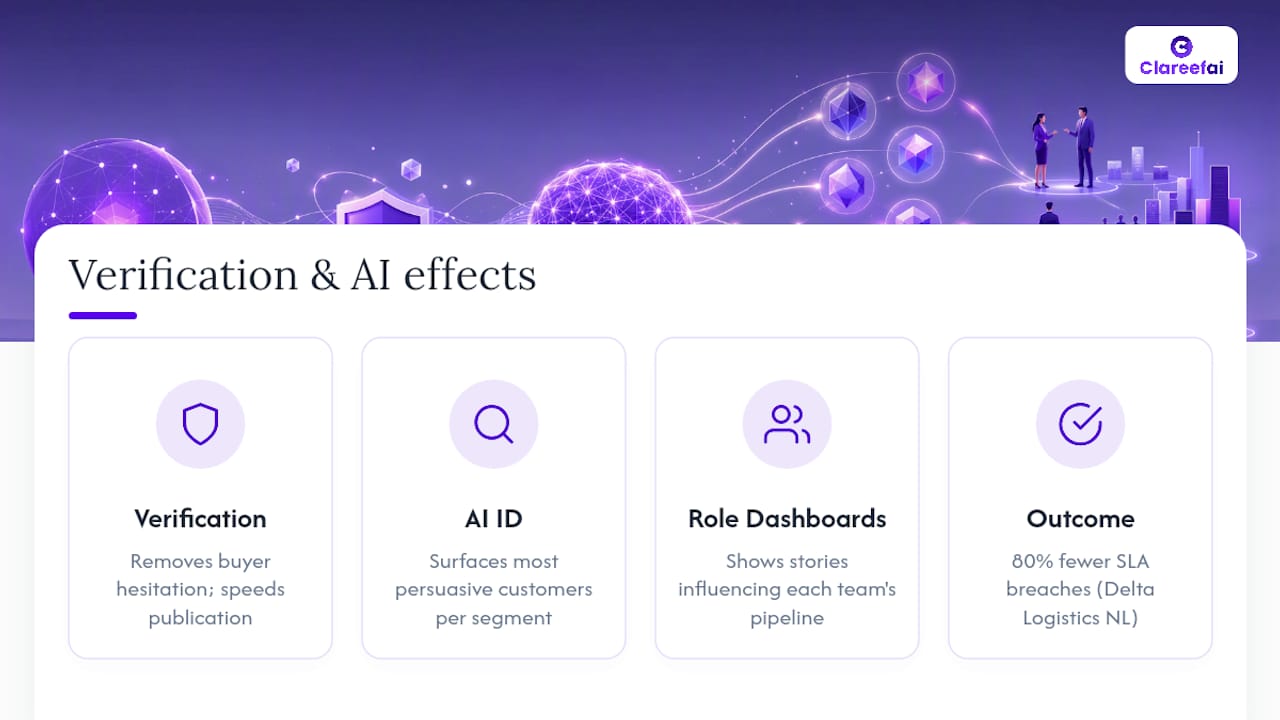
Buyers hesitate over testimonials that sound too polished to be real. Verifying a customer’s identity and role before a quote goes live removes that hesitation and gives your team the confidence to publish claims faster, not slower. That confidence is what actually shortens the gap between a great customer conversation and a published, distributed asset.
AI-driven advocate identification changes the economics of this work by surfacing which customers are the most persuasive voices for a specific segment, instead of relying on whoever happens to answer a survey. Role-based dashboards then let sales, marketing, and customer success each see which stories are actively influencing deals in their own pipeline, so effort goes toward the assets that are working rather than the ones that merely exist. Clareefai’s work with Delta Logistics NL, documented in the company’s own case example, produced an 80% reduction in SLA breaches after the team began systematically collecting and verifying customer testimonials to reinforce operational trust. That kind of result doesn’t come from a story sitting on a customers page. It comes from a verified story getting into the right hands at the right moment.
— ClareefAi
Run Your Case Study Program on One Platform
Most teams juggle a spreadsheet for tracking, a shared drive for assets, and a Slack channel for approval requests, and stories still fall through the cracks between them. Clareefai replaces that patchwork with one system: collect and verify testimonials, let AI surface your strongest advocates, and give sales, marketing, and customer success each a role-based dashboard that shows which stories are actually moving deals.
The platform connects directly to your CRM, so a rep can pull a verified snippet into an active opportunity without leaving their workflow, and the analytics tie usage back to revenue instead of guesswork. If you’re rebuilding your own program from scratch, start with the Basic plan at $250 per month and scale into Professional or Enterprise as your library and your sales team’s usage grow.
Sources
- Case study distribution strategy for B2B (Conbersa)
- Case study and customer testimonial strategy for B2B (10Louder)
FAQ
What Is Case Study Distribution?
Case study distribution is the ongoing process of adapting a verified customer story into channel-specific assets, like sales snippets, LinkedIn posts, and video clips, and placing them where buyers actually make decisions.
How Often Should You Redistribute a Case Study?
A quarterly redistribution cycle keeps a modest library generating steady visibility instead of a single publish date, according to B2B distribution research.
What Metrics Prove a Case Study Influenced a Deal?
Track deals influenced through CRM links, assisted conversions, and sales usage rate alongside engagement signals like video watch percentage and time on page.
Does Clareefai Help With Case Study Distribution?
Yes. Clareefai verifies testimonials, uses AI to identify your strongest advocates, and provides role-based dashboards with CRM integrations so sales teams can find and use the right story in an active deal.
How Much Does Clareefai Cost?
Clareefai’s Basic plan starts at $250 per month, Professional runs $624 per month, and Enterprise runs $1250 per month, with current details available on the pricing page.
Recommended
Share Article
Stay Updated
Get the latest insights on customer advocacy and SaaS growth delivered to your inbox.