What Are Sales Assets? A Guide for Sales Teams
TL;DR:
- Sales assets are targeted materials sales teams use to advance deals, address objections, and communicate value. Using authentic customer language in these assets significantly improves conversion rates and shortens sales cycles. Regular updates and organized libraries ensure sales teams deliver consistent, relevant messaging at every funnel stage.
Sales assets are defined as any content or material that sales teams use to advance deals, address buyer objections, and communicate value directly to prospects. The industry also calls these materials “sales collateral,” a term that captures their deal-specific nature. Unlike broad marketing materials designed for mass audiences, sales assets travel without the rep, carrying your value proposition into every inbox, meeting room, and decision-making conversation. Understanding what are sales assets, how to build them, and how to keep them sharp is one of the highest-return investments a sales team can make.

What are the most common types of sales assets?
Sales assets span a wide range of formats, and the best teams match each format to a specific stage of the buying process. A one-pager works at the top of the funnel to spark interest. A detailed case study or ROI calculator earns its place mid-funnel when a prospect is comparing options. A proposal or pricing guide closes the deal at the bottom.
The most frequently used sales asset examples include:
- Pitch decks — structured presentations that introduce your solution and frame the business problem
- One-pagers — concise summaries that give prospects a fast overview of your offer
- Case studies — proof-based narratives showing how a real customer solved a real problem with your product
- Battle cards — internal reference sheets that help reps handle competitor objections on the spot
- Pricing guides — transparent breakdowns that reduce friction during negotiation
- Proposals — customized documents that formalize the offer and move deals to signature
- Customer testimonials and video reviews — authentic social proof that builds trust at every funnel stage
Customer voice sales assets deserve special attention here. When you embed real customer language into case studies, testimonials, or objection cards, you give prospects something they can recognize and trust. Generic marketing copy does not do that job.
Pro Tip: Build your asset list by mapping your last 10 lost deals. The objections that killed those deals tell you exactly which assets you are missing.
How do sales assets improve sales outcomes?
Well-crafted sales assets produce measurable results. Authentic customer proof drives 2x higher lead conversion rates and up to 30% higher click-through rates on sponsored social content. That is not a marginal gain. It means the difference between a prospect who bounces and one who books a call.
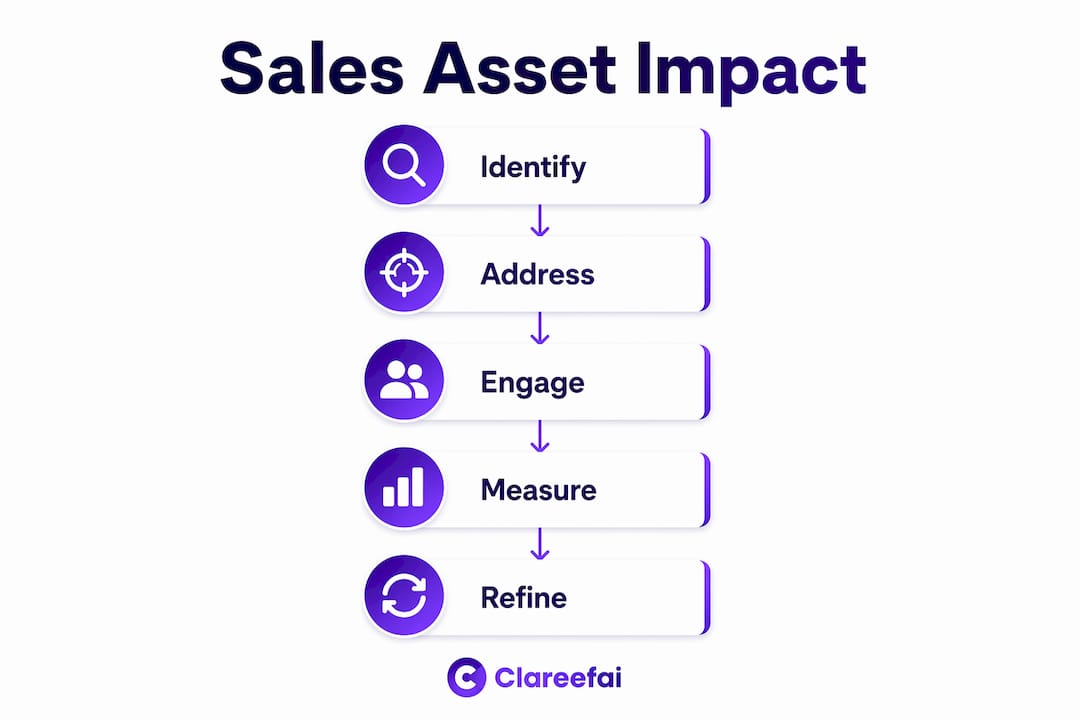
Sales cycles also shrink when assets do their job. Using verified customer proof can shorten sales cycles by up to 20% by addressing common decision-maker doubts more quickly. Buyers who see relevant proof earlier in the process need fewer follow-up calls to reach a decision.
The operational benefits are just as real:
- Consistency — every rep delivers the same core message, regardless of experience level
- Confidence — reps who have the right asset for each objection perform better on calls
- Speed — a well-organized asset library cuts the time reps spend searching for content
- Credibility — verified testimonials and case studies carry more weight than rep-generated claims
The importance of sales assets becomes clearest when you look at what happens without them. Reps improvise. Messaging drifts. Prospects receive inconsistent information. Deals stall because no one sent the right proof at the right moment. Assets solve all three problems at once.
Research on revenue growth through feedback confirms that companies integrating authentic customer proof into their sales process consistently outperform those relying on generic marketing content.
How to create and maintain effective sales assets
Building a strong asset library requires a staged approach, not a bulk migration. Starting with your top 20–30 highest-impact assets prevents the library from becoming an unusable archive that reps ignore. Prioritize the assets that address your most common deal friction points first.
Follow this sequence when building or rebuilding your asset library:
- Audit existing content. Catalog what you already have. Identify gaps by funnel stage and common objection type.
- Prioritize by deal friction. Successful sales teams focus first on assets that address the objections most likely to kill a deal.
- Organize with a 3-layer rule. Structure your library by funnel stage, content type, and a custom dimension such as buyer persona or industry vertical.
- Set a feedback cycle. Schedule bi-weekly reviews to update assets based on new customer language, objection patterns, and win/loss data.
- Test findability. Ask a new rep to locate three specific assets without help. If they struggle, your library needs better tagging or navigation.
Pro Tip: Assign one person to own the asset library. Without clear ownership, updates stop happening and the library quietly becomes outdated.
Mid-market B2B sales teams manage an average of 180 distinct sales assets, often spread across email threads, shared drives, and presentation tools. That fragmentation costs reps time and kills consistency. A centralized library with clear organization solves both problems.
The table below shows how to map asset types to funnel stages for faster rep adoption:
| Funnel Stage | Primary Asset Types | Key Purpose |
|---|---|---|
| Awareness | One-pagers, blog posts, social proof snippets | Spark interest and establish credibility |
| Consideration | Case studies, ROI calculators, comparison guides | Address objections and differentiate |
| Decision | Proposals, pricing guides, customer testimonials | Reduce friction and build final confidence |
| Post-sale | Onboarding guides, success stories | Support expansion and generate new proof |
Without a regular update cycle, your assets go stale fast. Feedback loops that include direct communication back to customer success managers are critical. Without them, customer feedback capture drops off within six weeks, and your messaging falls behind what buyers actually care about.
What role does customer voice play in sales assets?
Customer voice is the single most underused asset in most sales libraries. The difference between a polished marketing quote and raw, unedited customer language is the difference between a claim and proof. Raw, unedited customer language provides far more effective messaging than sanitized marketing quotes. It improves discovery questions, objection handling, and case study relevance in ways that internal copywriting simply cannot replicate.
The most effective teams use a structured Voice of Customer process to capture this language before sales influence shapes it. Here is what that looks like in practice:
- Win language capture — record the exact words customers use to describe the problem your product solved
- Objection patterns — log recurring objections from lost deals and use real customer phrasing to address them in battle cards
- Use-case realities — document the specific workflows and outcomes customers describe, not the idealized version your marketing team prefers
- Discovery question refinement — update your discovery questions based on the language prospects use during calls
Industry-leading revenue teams run a bi-weekly “Win-Language” update cycle that captures verbatim customer feedback and turns it into updated objection-handling cards and discovery questions within 14 days. That cadence keeps messaging current without overwhelming the team.
The impact on rep confidence is real. When a rep can say “here is what a customer in your exact situation said,” the conversation shifts. The prospect stops evaluating and starts relating.
“The most powerful sales asset you can build is one where the customer does the selling for you. When a prospect reads a case study and thinks ‘that is exactly my problem,’ you have already won half the deal. Raw customer language, captured before your marketing team polishes it away, is what creates that moment of recognition.”
Clareefai’s approach to turning customer advocacy into content is built on this principle. Verified, contextualized testimonials give sales teams proof that prospects actually believe.
Key Takeaways
Sales assets are the most direct lever sales teams have to shorten cycles, handle objections, and close more deals with consistent messaging.
| Point | Details |
|---|---|
| Define assets by deal stage | Match each asset type to a specific funnel stage to maximize relevance and rep adoption. |
| Customer voice outperforms polish | Raw, unedited customer language converts better than sanitized marketing quotes in objection handling. |
| Organize with a 3-layer rule | Structure your library by funnel stage, content type, and buyer persona to improve findability. |
| Update on a bi-weekly cycle | Refresh objection cards and discovery questions every 14 days using new customer feedback. |
| Start small, then scale | Build your library around your top 20–30 highest-impact assets before expanding the catalog. |
What I have learned about sales assets after working with hundreds of B2B teams
Most sales teams treat their asset library like a filing cabinet. They add content when someone asks for it, organize it loosely by format, and rarely delete anything. The result is a graveyard of outdated decks and case studies that reps do not trust and prospects never see.
The teams that actually close deals with their assets do something different. They treat every asset as a tactical response to a specific deal friction point. They ask: “What is the objection that kills deals at this stage?” and then they build or update the asset that addresses it. That focus changes everything.
The other mistake I see constantly is treating customer voice as a nice-to-have. Teams spend weeks crafting the perfect case study narrative, then strip out all the raw, specific language that made the customer story compelling in the first place. The polished version sounds credible to the marketing team. The unpolished version actually converts.
Feedback loops are where most programs fall apart. You need a system that pulls customer language from your customer success team into your asset updates on a regular cadence. Without that system, your assets reflect what you thought buyers cared about six months ago. The market moves faster than that.
My advice: pick your five most common deal-killing objections, build or update one asset for each, and measure the impact over 30 days. That focused approach will move the needle faster than any library reorganization project.
— ClareefAi
How Clareefai helps sales teams build proof-driven assets
Sales teams that want to close more deals need more than good content. They need verified, authentic customer proof that prospects trust on first contact.
Clareefai is built to give sales teams exactly that. The platform collects, verifies, and organizes customer testimonials, video reviews, and success stories so your reps always have the right proof for the right moment. AI-driven analysis identifies your most impactful customer advocates and surfaces their stories automatically. Every testimonial is verified and contextualized, so prospects see real names, real companies, and real outcomes. If you want to see how unified testimonial management can raise your win rates, Clareefai is the place to start. You can also visit Clareefai for sales teams to see how the platform fits directly into your sales workflow.
FAQ
What are sales assets in simple terms?
Sales assets are any content or materials that sales reps use to advance deals and handle buyer objections. Common examples include case studies, proposals, pitch decks, battle cards, and customer testimonials.
How do sales assets differ from marketing materials?
Marketing materials target broad audiences to build awareness. Sales assets are deal-specific and shared one-to-one with buyers to address their exact concerns at a specific stage of the purchase process.
What types of sales assets have the highest impact?
Case studies and verified customer testimonials consistently produce the strongest results. Authentic customer proof drives 2x higher lead conversion rates and can shorten sales cycles by up to 20%.
How often should sales assets be updated?
Top-performing teams update objection-handling cards and discovery questions on a bi-weekly cycle using fresh customer feedback. Without regular updates, messaging becomes outdated within six weeks.
How does customer voice improve sales assets?
Raw, unedited customer language makes assets more credible and specific. When prospects read or hear language that mirrors their own experience, they connect faster and object less. That is why B2B social proof workflows built on real customer voice consistently outperform generic content.
Recommended
Share Article
Stay Updated
Get the latest insights on customer advocacy and SaaS growth delivered to your inbox.