Case Study vs Testimonial: What Each One Proves to Buyers
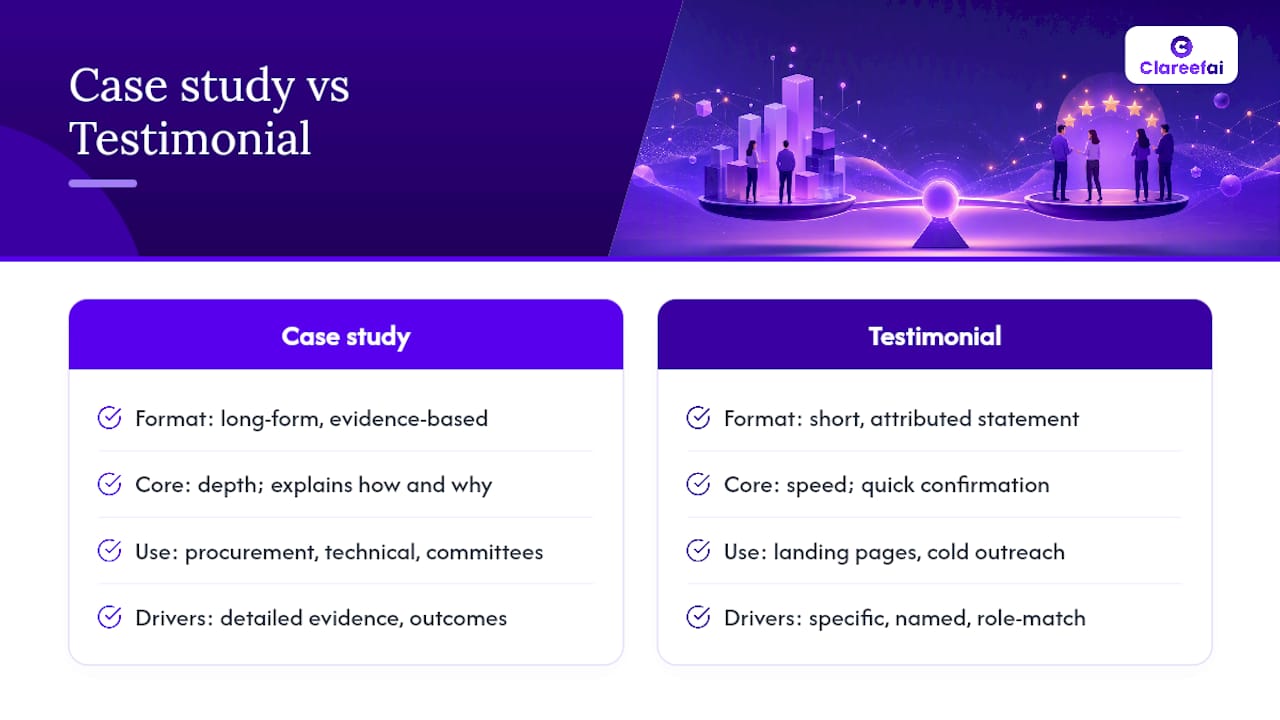
A case study proves how your solution worked, in detail, for someone like your prospect. A testimonial proves that it worked, fast, in a sentence a skimming reader can trust. That’s the whole split, and once you internalize it, every “which one do I need” question in your marketing calendar answers itself.
Here’s how to allocate your production time:
- Use a testimonial for landing pages, cold email, and social posts, anywhere a prospect needs a fast trust signal before they’ll keep reading.
- Use a case study for mid-funnel content, sales enablement, and procurement packets, anywhere someone is asking “will this work for a company like mine?”
- Pick based on budget: a testimonial can be collected in a day; a real case study takes one to three weeks of interviews, writing, and approvals.
Key Takeaways
Case studies win complex, high-stakes B2B decisions through depth and evidence, while testimonials win fast trust through brevity and specific attribution.
| Point | Details |
|---|---|
| Match asset to question | Use case studies for “how/why” questions and testimonials for quick trust signals. |
| Specificity beats volume | A named, metric-backed testimonial outperforms a wall of generic quotes. |
| Production cost differs sharply | Testimonials take a day to collect; case studies take one to three weeks. |
| Refresh case studies regularly | Retire or update case studies every 12 to 24 months as metrics and features change. |
| Pair both for buying committees | Testimonials build early trust; case studies survive procurement review. |
| Centralize with a platform | Clareefai automates collection, verification, and distribution across the funnel. |
Table of Contents
- Case Study vs Testimonial: What a Case Study Actually Is
- Case Study vs Testimonial: What a Testimonial Actually Is
- How Do Case Studies and Testimonials Compare Side by Side?
- When Should You Use a Case Study or a Testimonial?
- How Do You Create a Persuasive Case Study or Testimonial?
- Copy-Ready Templates for Case Studies and Testimonials
- What Does the Research Say About Testimonial and Case Study Effectiveness?
- What’s the Right Sequence for Producing These Assets?
- Manage Both Assets Without the Manual Chase
- Where to Go Deeper on Case Studies and Testimonials
- Frequently Asked Questions
- Sources
Case Study vs Testimonial: What a Case Study Actually Is
A case study is a documented account of how a specific customer used your product to solve a specific problem, told with enough context and data that a reader can judge whether the same approach would work for them. It’s narrative plus evidence plus setting. Strip out any one of those three and you’ve got something else: a stat with no story, or a story with no proof.
B2B teams typically produce a few variations:
- Intrinsic case studies that spotlight one customer’s unique implementation because the story itself is remarkable.
- Instrumental case studies that use one customer to illustrate a broader issue every prospect in that segment faces.
- Collective or success-story roundups that string together several shorter accounts to show pattern, not just anecdote.
- Implementation case studies focused narrowly on rollout, timeline, and technical fit.
- ROI case studies built almost entirely around a before/after number.
Researchers who study case study methodology note that intrinsic, instrumental, and collective designs serve different goals: exploring something unique, illuminating a general issue, or building generalizability across cases. That distinction matters for B2B marketers too. If you’re trying to convince every mid-market prospect that your onboarding is fast, an instrumental case works better than an intrinsic one about your weirdest, most atypical customer.
Whatever the type, a persuasive case study needs the same skeleton: the challenge the customer faced, context about their business, the solution they chose and why, how implementation actually went, the metrics that resulted, a rough timeline, direct quotes, and supporting artifacts like screenshots or dashboards. Expect 800 to 1,500 words, one or two customer interviews, a round of legal or PR approval, and design time for charts. That approval hurdle is why case studies move slower than testimonials, and why teams that skip it often end up with vague, unusable drafts.

Pro Tip: Choose the customer who is closest to your ideal next buyer, not your happiest customer. A thrilled outlier convinces no one; a representative success story convinces everyone in that segment.
Case Study vs Testimonial: What a Testimonial Actually Is
A testimonial is a short, attributed statement of satisfaction, built for speed rather than depth. Where a case study walks a reader through a process, a testimonial delivers a verdict in one or two sentences.
You’ll see testimonials in a handful of formats:
- A short text quote paired with a name, title, and company.
- A video clip, usually 15 to 60 seconds.
- A pull quote layered over a customer photo.
- Embedded social proof, like a linked review or a public post.
Their strength is production cost: a testimonial can be captured in a five-minute call, published the same week, and reused across a dozen channels. Their weakness shows up when they’re generic. “Great product, highly recommend” from “J.S.” tells a skeptical buyer nothing. Compare that with “We cut onboarding time from six weeks to nine days” attributed to a named VP of Operations at a company your prospect recognizes. Specificity and attribution are what separate a testimonial that closes deals from one that gets scrolled past. HubSpot’s research on customer reviews backs this up: generic quotes tend to underperform, while specific, persona-targeted ones integrated with other credibility markers convert better.
Pro Tip: Never publish a testimonial without a verifiable name, title, and company. Anonymous praise reads as manufactured, even when it’s real.
How Do Case Studies and Testimonials Compare Side by Side?
Once you frame both assets across the same dimensions, the decision of what to produce next gets a lot less abstract.
| Dimension | Case Study | Testimonial |
|---|---|---|
| Purpose / job to do | Prove how and why a solution worked in context | Signal quick, credible satisfaction |
| Typical length / format | 800–1,500 words, long-form written or video | One to three sentences, text or short video clip |
| Detail & evidence | Quantitative metrics plus qualitative narrative | Usually qualitative, occasionally a single metric |
| Production effort & cost | High: interviews, data collection, design, approvals | Low: a short call, quote, or review request |
| Placement in buyer journey | Consideration, procurement, ROI justification | Awareness, landing pages, email, social |
| Credibility & verification | Named source, documented metrics, artifacts | Name, title, company, ideally photo or video |
| Best-for scenarios | Complex deals, technical buyers, committee decisions | Fast trust-building, high-volume touchpoints |
A few decision rules follow directly from that table. If a prospect is asking “how does this actually work in practice,” produce a case study, not another quote. If you need something to put on a landing page this week, a testimonial gets you there faster than a case study ever will. If the deal involves a buying committee, pair both: testimonials to get past initial skepticism, a case study to survive procurement review.
Neither asset replaces the other. Practitioner guidance on proof assets consistently recommends stacking a high volume of testimonials for breadth with a smaller set of deep case studies for pairing coverage, so you’re covering both the fast-trust need and the deep-evidence need without over-investing in either.
When Should You Use a Case Study or a Testimonial?
Funnel stage answers most of this question by itself. Early in the buyer journey, prospects are scanning, not studying, so testimonials do the heavy lifting on your homepage, in cold outreach, and across social posts where attention spans are short. Once a prospect moves into evaluation, the questions get specific, and that’s where a case study earns its production cost.
Map it to actual stakeholder questions:
- “Do other companies like us trust this?” → testimonial, ideally with a recognizable logo attached.
- “Will it integrate with our stack?” → case study, focused on implementation detail.
- “What’s the real ROI?” → case study, built around a specific metric.
- “Is this safe to recommend internally?” → both, since a champion inside the buying committee often needs a quick testimonial to build initial confidence and a case study to defend the recommendation.
Role matters too. SDRs want testimonials they can drop into a cold email in seconds. Account executives want case studies they can walk a technical buyer through on a call. Product marketers need both stocked for campaign launches. Procurement teams, frequently the last gate in enterprise deals, almost always ask for a case study over a testimonial, because they’re evaluating risk, not vibes.
One maintenance note: testimonials stay fresh almost indefinitely, but case studies age. Metrics shift, product features change, and customer personnel move on. Practitioners generally recommend refreshing or retiring case studies every 12 to 24 months so you’re never pitching a prospect on numbers that no longer hold.
How Do You Create a Persuasive Case Study or Testimonial?
Production quality comes down to process, not talent. Here’s a workflow that works for both asset types:
- Select the customer. Prioritize relevance to your target segment over sheer enthusiasm.
- Prep an interview guide. Ask for the specific state before your product, the trigger that made them look for a solution, the decision process, and the measurable outcome after adoption.
- Collect the data. Request real numbers, screenshots, or dashboard exports wherever possible, not paraphrased impressions.
- Draft and route for approval. Legal or PR sign off on quotes and metrics before anything ships.
- Design and distribute. Match format to channel: PDF or web page for case studies, short clip or quote card for testimonials.
Good interview questions get specific fast: “What number changed, and by how much?” “What almost stopped you from buying?” “What would you tell a peer considering the same purchase?” Those produce the quotable soundbites that make an asset worth publishing.
Don’t skip permissions. Get written consent for usage rights, verify every claimed metric with the customer before publishing, and keep a record of that approval. Testimonial verification processes exist for exactly this reason: an unverified quote is a liability, not an asset.
Once published, tag every asset by funnel stage, persona, and product line so you can track engagement, lead attribution, and eventual influence on win rate.
Pro Tip: Ask every customer interview subject the same closing question: “If a peer of yours was skeptical, what would you tell them?” That answer is almost always your best pull-quote.
Copy-Ready Templates for Case Studies and Testimonials
Steal these starting points instead of staring at a blank page.
Testimonial templates:
- “[Product] helped us [specific outcome] in [timeframe].” — Name, Title, Company
- “Before [Product], we struggled with [problem]. Now [result].” — Name, Title, Company
- “I’d recommend [Product] to any [role/industry] dealing with [pain point].” — Name, Title, Company
Case study TL;DR (for executive decks): “[Company] faced [challenge]. After adopting [Product], they achieved [metric] in [timeframe], driven by [key feature or process change].”
15-second video soundbite: “We were losing hours every week to manual work. [Product] cut that to minutes.”
45-second video soundbite: “Before we brought in [Product], our team spent [X hours/dollars] on [problem]. Within [timeframe], we saw [specific result]. If you’re on the fence, the ROI showed up faster than we expected.”
To pull a testimonial out of an existing case study, lift the single sentence with the clearest number and the strongest emotional beat, then attribute it exactly as it appears in the source interview.
What Does the Research Say About Testimonial and Case Study Effectiveness?
The strongest evidence for testimonials comes from a randomized experiment showing that testimonials increase usage intentions and attitudes largely because perceived similarity and source credibility mediate how much a reader trusts the message. Translation: a testimonial from someone who looks and sounds like your buyer works better than one from an executive with no resemblance to the reader’s role or industry.
Case studies earn their place on a different axis. Case study research method is the preferred approach specifically for “how” and “why” questions, where context can’t be separated from the outcome, unlike broad survey data built for frequency claims.
Conversion testing backs this with a caveat: video and text testimonials placed near a prospect’s decision anxiety often lift conversions, but bolting on credibility indicators without matching page context can hurt results instead of helping.
The practical implication: don’t treat either asset as a set-and-forget tactic. Test placement, match the testimonial’s speaker to your actual buyer persona, and reserve full case studies for the “how” and “why” questions surveys and quotes can’t answer.
What’s the Right Sequence for Producing These Assets?
Start broad, then go deep. Early-stage companies and smaller deal sizes should prioritize collecting a high volume of testimonials before investing in a single polished case study. Larger deal sizes and enterprise sales cycles justify the extra production cost of full case studies much sooner.
A workable 30 to 90 day sequence:
- Days 1 to 30: Collect testimonials broadly across every recent happy customer touchpoint.
- Days 30 to 60: Identify one or two standout stories with strong metrics and greenlight full case study production.
- Days 60 to 90: Extract pull-quotes from the finished case study to feed back into testimonial channels, then distribute both across sales and marketing.
Tag every asset by segment and funnel stage from day one. It’s the only way to know later which format actually moved a deal forward.
Author perspective: what actually moves deals
In practice, the teams that win aren’t the ones agonizing over “case study or testimonial.” They’re the ones running both in parallel from day one, treating testimonial collection as a continuous habit and case studies as a quarterly investment. The lesson that keeps repeating: specificity beats volume, every time.
Manage Both Assets Without the Manual Chase
Producing testimonials and case studies is one problem. Collecting, verifying, and getting them in front of the right prospect at the right funnel stage is a different one entirely, and it’s the one most marketing teams underinvest in. A platform built for customer advocacy closes that gap: automated collection requests, identity verification so quotes hold up under scrutiny, analytics that show which asset actually influenced a closed deal, and distribution that pushes testimonials to the channel where a prospect is already looking.
This matters most in a few specific situations: enterprise sales cycles with multiple buyer personas who each need a different proof point, regulated industries where every claim needs a documented verification trail, and any team managing testimonials across more than a handful of customer touchpoints without a shared system. Clareefai handles all three by centralizing collection and matching verified promoters to the deals where their story fits. If you’re managing testimonial and case study production across a growing customer base, see how unified testimonial management improves win rates and start a pilot with your own customer list.
Where to Go Deeper on Case Studies and Testimonials
For readers who want to validate these recommendations further, these sources each cover a distinct angle:
- CASRAI’s case study research method guide for the methodological case behind “how/why” questions.
- Colorado State University’s case study guide for a deeper look at thick description and generalizability tradeoffs.
- Frontiers in Psychology’s testimonial persuasion study for the experimental data on similarity and credibility.
- HubSpot’s guide to customer reviews and testimonials for practitioner-level attribution tactics.
- For ready-to-use collection workflows and templates, the testimonial collection checklist covers the operational side this article only summarizes.
Frequently Asked Questions
What is the main difference between a case study and a testimonial? A case study is a long-form, evidence-based account of how a customer achieved a result, while a testimonial is a short, attributed statement confirming satisfaction. Depth versus speed is the core distinction.
When should I use a case study instead of a testimonial? Use a case study when a prospect is asking detailed “how” or “why” questions, typically during procurement, technical evaluation, or committee-based buying decisions. A testimonial fits earlier, faster-moving touchpoints like landing pages and cold outreach.
Are testimonials still effective in B2B marketing? Yes, particularly when they’re specific, attributed to a named person, and matched to the reader’s role or industry. Generic or anonymous testimonials carry far less persuasive weight.
How many customer case studies does a B2B company need? There’s no fixed number, but most practitioner guidance suggests one strong case study per major segment or use case, refreshed every 12 to 24 months, paired with a much larger, continuously growing pool of testimonials.
Can testimonials and case studies be used together? Yes, and they typically should be. Pull-quotes extracted from a case study make excellent standalone testimonials, and a strong case study often cites shorter testimonials within its narrative for added credibility.
Sources
- Case study research method — CASRAI
- HubSpot Blog — Customer reviews & testimonials
- Investigating the persuasive effects of testimonials — Frontiers in Psychology
- Case study guide — Colorado State University Writing Center
Recommended
Share Article
Stay Updated
Get the latest insights on customer advocacy and SaaS growth delivered to your inbox.