7 Step Workflow to Reference Call Recording Consent for B2B Teams

The short answer: get written, scoped consent before you press record, and get it again before you publish. That consent must name the recording, the intended use as a testimonial, and every channel you plan to publish it on. If the customer received anything of value for participating, disclose it clearly under FTC guidance. Your next move is simple: log an affirmative, timestamped consent for every reference call before it happens.
TL;DR:
- Obtaining written, specific, and scoped consent is essential before recording and publishing customer testimonials to ensure legal compliance and clear rights.
- Consent forms must include details such as customer identity, permitted channels, duration, revocation process, and disclosure of incentives received for participation.
- Consent should be captured before the call, with documented approval attached to the final asset, not after, to prevent scope and liability issues.
- Maintaining a centralized repository of consent records with timestamps, expiration dates, and revocation logs enables effective audit and scope management over time.
- Teams benefit from platforms that connect consent, assets, and channels, reducing legal risks and increasing the reliability of testimonial use in marketing activities.
Table of Contents
- What Does Reference Call Recording Consent Actually Cover?
- Consent Checklist and Sample Clauses You Can Copy
- The Step-by-Step Workflow From Outreach to Published Asset
- How to Document, Store, and Audit Consent Records
- What FTC Rules Expect From Testimonial Publishers
- Common Risks in Reference Call Consent (and How to Fix Them)
- ClareefAi’s View: Consent as a Governance Asset
- How Clareefai Handles Reference Call Consent for You
- Sources
- FAQ
What Does Reference Call Recording Consent Actually Cover?
Reference call recording consent is permission from a customer to record a reference call and reuse that material as a testimonial, case study, or marketing asset. It is not the same question as whether recording a phone call is legal in a given state, that’s a separate wiretapping issue your legal team handles case by case. What you’re solving here is a publishing and rights question: does the customer agree to be recorded, and do they agree to let you publish that recording, or quotes drawn from it, on the channels you name?
That distinction matters because plenty of revenue teams assume a verbal “sure, go ahead” during the call covers them. It doesn’t. Verbal recording approval might satisfy the mechanics of starting the recorder, but publishing that recording as a sales asset requires a separate, explicit release: an authorization for using the person’s name, voice, likeness, and words in marketing. Think of it as two layers stacked on top of each other. Layer one is recording consent. Layer two is a publication license. Skip either layer and you have a customer who can ask you to pull an asset down at the worst possible moment, mid-deal, in front of a prospect.

Consent Checklist and Sample Clauses You Can Copy
A usable consent form needs specific fields, not a vague consent checkbox. Here’s what belongs in every reference call recording consent request:
- Identity and role: full name, title, and company, so the release ties to a real, verifiable person.
- Recording permission: explicit language authorizing audio and/or video capture of the call.
- Publication permission: explicit language authorizing republication of the recording, transcript, or excerpted quotes.
- Permitted channels: website, sales decks, paid ads, social media, whatever you actually intend to use, named individually.
- Duration and expiration: a defined term (12 months, 24 months, indefinite until revoked) rather than a silent assumption of forever.
- Revocation process: a stated method and timeline for withdrawing consent.
- IP and likeness license: rights to name, voice, image, and company logo where applicable.
- Confidentiality carve-outs: any figures, pricing, or internal details the customer wants redacted before publication.
If the customer received anything of value for participating, that disclosure needs its own line, not a buried footnote. A short script works: “As a thank-you for your time today, we’re providing an incentive. We may quote or record this conversation for marketing use, with your approval before anything goes live.” The FTC’s endorsement guidance treats that kind of material connection as something that must be disclosed clearly and conspicuously, not tucked into fine print.
Three snippets you can adapt directly:
Phone script: “Before we start, I want to confirm we have your permission to record this call and to use portions of it, including your name and title, in marketing materials on our website and in sales presentations. Is that alright with you?”
Video release clause: “Customer grants [Company] a nonexclusive, worldwide license to use the recorded video, audio, and transcript for marketing purposes on the channels listed above, for the term specified, subject to revocation as described in Section 4.”
Written quote release: “I approve the use of the quote below, attributed to my name and title, in [Company]'s marketing materials for up to 24 months from the date of this approval.”
Pro Tip: Send the consent request in writing before the call, not during it. A customer who reads the scope in advance gives cleaner, more defensible approval than one improvising an answer while on speakerphone.
The Step-by-Step Workflow From Outreach to Published Asset
A reference call recording consent process breaks down cleanly into seven stages, and each one needs a named owner:
- Identify the candidate. Customer success usually flags happy accounts; sales confirms deal relevance.
- Send the scoped consent request. Marketing or the reference program owner sends written consent covering recording, publication, and channels, before scheduling the call.
- Record only after affirmative consent. Whoever hosts the call confirms consent verbally on the recording itself, as a backup to the written form.
- Transcribe and draft. Marketing or an ops team member produces a transcript and pulls a working draft of the testimonial or clip.
- Send the draft for approval. The customer reviews the exact wording or edited clip before anything is finalized, a quick step that prevents most disputes.
- Attach the signed release and log metadata. Ops attaches the consent record to the final asset, tagged with expiration date and permitted channels.
- Publish within permitted scope. Marketing publishes only on the channels named in the release, nothing broader.
Timing is the part teams get wrong most often. Consent has to happen before recording starts, not as a follow-up email sent after the call already exists. If a channel changes late (say, sales wants to run the clip in a paid ad that wasn’t in the original scope), that’s a new consent request, not a rubber stamp on the old one. Clareefai’s step-by-step testimonial workflow maps this same sequence with role assignments built in, which helps when reference requests span sales, customer success, and legal at once.
How to Document, Store, and Audit Consent Records
A signed release that lives in someone’s inbox is functionally useless six months later when legal asks where it is. Every consent needs a home in a centralized repository with these fields: linked asset ID, the consent text or file itself, permitted channels, expiration date, revocation status, an assigned owner, and campaign tags.
Timestamp each consent record and link it directly to the final asset, whether that’s a raw recording, an edited clip, or a transcript. Programs that keep signed releases tied to the published asset with metadata for channels and expiration catch scope violations before they happen, rather than after a customer complains.
Run a quarterly audit. Spot check a sample of published assets against their consent records, and set rotation limits so the same three enthusiastic customers aren’t fielding every reference call your sales team requests.
- Revoked consent gets documented immediately, with the reason and date logged.
- New use of that asset stops the moment revocation is recorded.
- Already-printed materials (a trade show banner, a physical case study booklet) get a revocation note in the repository, since physical reprints aren’t always instantly recoverable, but new digital placements stop right away.
What FTC Rules Expect From Testimonial Publishers
The FTC’s 2023 update to its Endorsement Guides sharpened the rules around material connections, and reference call programs sit squarely inside that scope. If a customer got paid, discounted, or given free product in exchange for the reference call, that connection needs disclosure that’s clear and conspicuous, not buried in a terms page nobody reads.
A few specific expectations matter for how you edit and publish:
- Disclose material connections. Payment, discounts, free products, or insider access all count, and the disclosure needs to sit near the testimonial itself, not three clicks away.
- Never edit quotes out of context. 16 CFR Part 255 prohibits presenting an endorsement in a way that changes its meaning from what the person actually said.
- Keep the original recording. Retain transcripts and raw recordings as evidence of what was actually said, in case a testimonial’s accuracy is ever questioned.
- Incentives are allowed, but not conditioned sentiment. You can offer a gift card for participation; you cannot require a positive review in exchange for it.
Clareefai’s breakdown of the six-step verification workflow for FTC compliance walks through how to build these disclosure checks into a standard intake process instead of treating them as a one-off legal review.
Common Risks in Reference Call Consent (and How to Fix Them)
Most consent problems trace back to four repeatable mistakes.
- Risk: perpetual, all-rights clauses. Customers resent discovering a testimonial from three years ago still running in a current campaign. Fix: use time-limited, channel-specific clauses with a clear revocation path.
- Risk: verbal-only consent. A recorded “yes” during the call is thinner protection than it sounds. Fix: capture written or recorded affirmative consent and attach it to the asset file, not just the call recording.
- Risk: selective editing. Cutting a quote to remove nuance can shift its meaning and expose you to an endorsement-guide violation. Fix: keep the original recording accessible and let the customer review the final quote before publication.
- Risk: vague incentive disclosure. A discount mentioned once, off the record, isn’t disclosure. Fix: build a standard disclosure line into both the consent form and the published asset itself.
Pro Tip: Treat every reference call recording consent record like you’d treat a contract renewal date. If nobody owns the expiration tracking, testimonials quietly become liabilities the moment they lapse.
ClareefAi’s View: Consent as a Governance Asset

Most teams treat consent as paperwork to survive, then forget about it. That’s backwards. A well-scoped, timestamped consent record is reusable infrastructure: it tells you exactly what you can publish, where, and until when, without a scramble every time legal asks a question.
Granular consent isn’t friction, it’s what lets you say yes faster to sales asking for one more clip. Programs that centralize this well end up publishing more testimonials, not fewer, because nobody’s guessing about scope. Teams scaling advocacy programs benefit from applying social proof strategies with this kind of governance underneath them, since trust compounds when the record behind each testimonial is airtight.
— ClareefAi
How Clareefai Handles Reference Call Consent for You
Clareefai gives revenue teams what a spreadsheet and a folder of signed PDFs never quite manage: one place where consent, asset, and channel scope live together and never drift apart. Every approval gets timestamped and linked directly to the recording, transcript, or clip it authorizes, so nobody on your sales team has to ask legal whether a quote is still cleared to run.
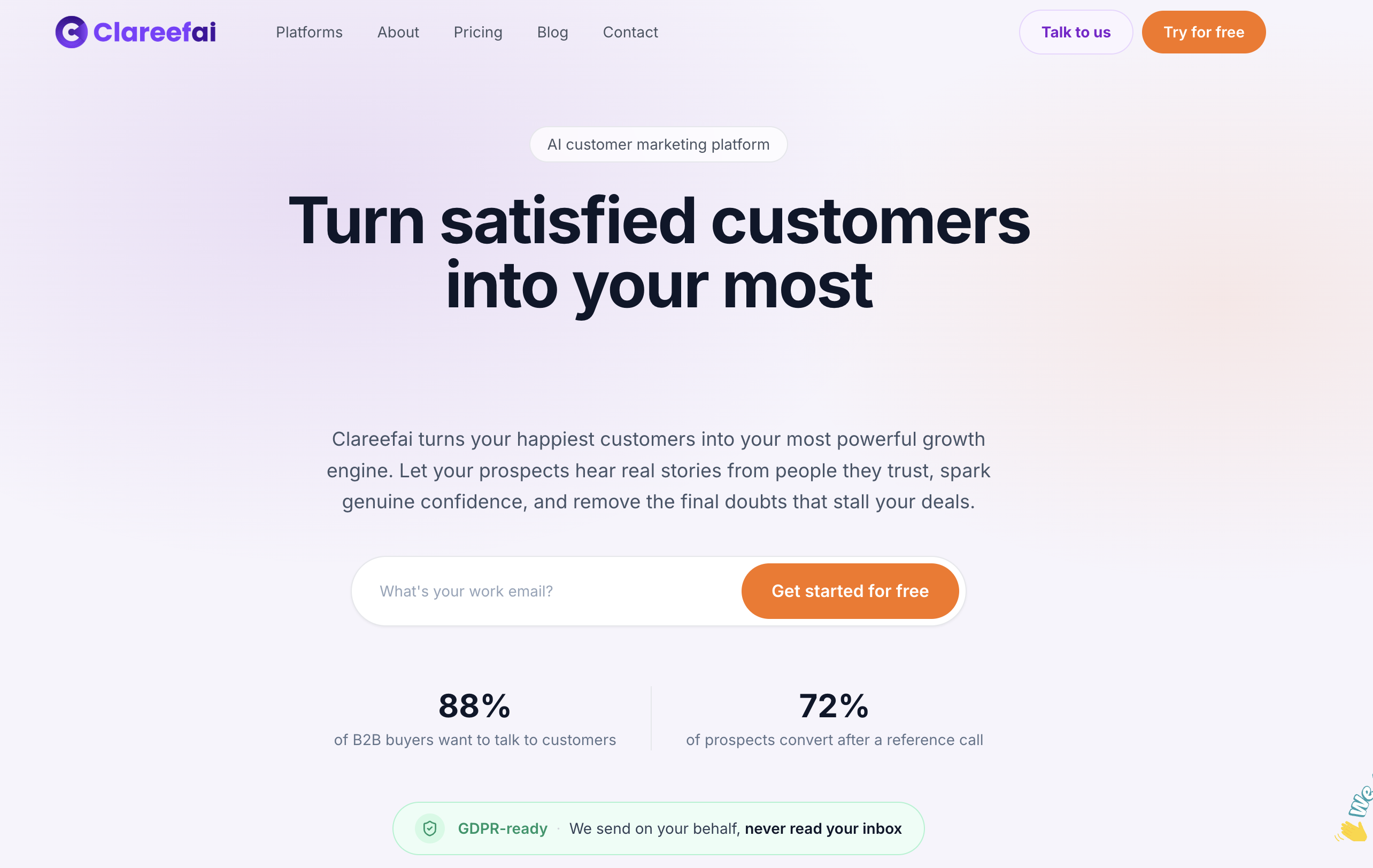
Role-based dashboards mean customer success can request a reference, marketing can review the draft, and legal can check disclosure language, all without forwarding email threads back and forth. That structure holds up whether you’re producing a sales-ready clip for one deal or repurposing a quote across a dozen ad variations, since the audit log shows exactly what was approved and when. Explore how the platform connects testimonials to your CRM, start with the free plan to see the consent workflow firsthand, or compare Basic, Professional, and Enterprise plans if your team is ready to run this at scale.
Sources
For the legal detail behind the checklist above, go straight to the primary sources rather than a secondhand summary:
- Federal Trade Commission announces updated advertising guides to combat deceptive reviews and endorsements
- eCFR :: 16 CFR Part 255 – Guides Concerning Use of Endorsements and Testimonials in Advertising
FAQ
Do I Need Separate Consent to Record and to Publish?
Yes. Recording consent covers the act of capturing audio or video; publication consent is a separate authorization to use that material, or quotes from it, as a marketing asset. Treating them as one step is the most common gap in reference call programs.
What Counts as a Material Connection Under FTC Rules?
A material connection includes payment, free products, discounts, or any special access given in exchange for participation. The FTC requires disclosure of these connections wherever the testimonial appears, not just in internal records.
How Long Should a Testimonial Consent Stay Valid?
Set a defined term, commonly 12 to 24 months, rather than leaving it open-ended. A defined expiration date forces a review point where you confirm the customer still wants the asset live.
What Happens if a Customer Revokes Consent Later?
Document the revocation immediately, disable new uses of the asset, and stop any active digital placements. Already-printed physical materials get a revocation note in your records, since instant recall isn’t always possible for those.
Does Consent Change for Minors or Vulnerable Participants?
Yes. Reference programs should avoid recording minors or individuals unable to give informed consent without a parent, guardian, or authorized representative signing on their behalf. When in doubt about someone’s capacity to consent, route the request through legal before scheduling the call.
Can Clareefai Help Manage Consent Across a Large Reference Program?
Clareefai centralizes consent capture, links approvals to specific assets, and tracks expiration and revocation status through role-based dashboards. Teams running high-volume reference programs use it to avoid the scope drift that happens when consent lives in scattered documents.
Recommended
Share Article
Stay Updated
Get the latest insights on customer advocacy and SaaS growth delivered to your inbox.