How to Humanize Brand Reputation and Build Real Trust

The most effective way to humanize brand reputation is to combine a consistent human voice, visible people, verified customer stories, and human-first customer experience — then measure all of it. That combination turns passive brand awareness into active trust. Gartner frames trust as a scarce asset in the AI era, arguing that brands which design intentional human signals into their operations will outperform those that rely on campaigns alone.
Start here — five things your team can execute this week:
- Sign every marketing email with a real person’s name and title, not “The [Brand] Team.”
- Publish one behind-the-scenes video — 30–60 seconds, shot on a phone, showing how your team solves a real customer problem.
- Post one verified customer micro-story on LinkedIn or your website: one sentence of context, one sentence of the problem, one sentence of the outcome.
- Replace the top three stock photos on your homepage with real team or customer photos.
- Set a 4-hour reply window for all public social mentions and direct messages.
Why these moves work:
- Buyers trust people before they trust logos. Named senders and real faces reduce the psychological distance between prospect and brand.
- Micro-stories carry the same credibility signal as long case studies at a fraction of the production cost.
- Fast, personal replies signal that a human is paying attention — which is increasingly rare and therefore increasingly valuable.
Key Takeaways
Humanizing brand reputation is an operations discipline, not a campaign — it requires consistent human signals across voice, people visibility, customer stories, CX recovery, and governed measurement.
| Point | Details |
|---|---|
| Voice before tactics | Define three to five voice traits with emotional anchors before writing any templates or scripts. |
| Verified stories outperform generic claims | Attributed, consent-verified customer stories with named outcomes build more trust than anonymous reviews. |
| Human visibility accelerates familiarity | Real photos, named email senders, and short employee videos reduce buyer distance faster than polished campaigns. |
| Measure what matters | Track NPS, CSAT, testimonial conversion lift, and response time together — not in separate reports. |
| Governance makes it scale | Assign voice owners, define human-in-the-loop escalation rules, and audit content monthly to keep signals authentic. |
Table of Contents
- Why humanizing your brand reputation works: the core principles
- How to craft a brand voice that actually sounds human
- How storytelling and verified customer stories build real credibility
- Practical ways to make your team and customers visible
- Designing customer experience to surface human moments
- How to engage on social channels and build a community that feels real
- How to measure humanization efforts and govern them at scale
- Scaling verified customer proof: research, operations, and governance
- Your 30/60/90-day plan to humanize your brand
- The real reason most humanization efforts stall
- Turn your best customers into your most credible proof
- Sources
Why humanizing your brand reputation works: the core principles
Humanizing your brand is not a tone-of-voice exercise. The Brand Humanizing Institute frames it as a strategic capability that pairs human talent with technology, built on four organizational capabilities: AI and automation design, creativity, applied human sciences, and emotional intelligence with ethical judgment.
Five principles underpin every tactic in this guide:
- Transparency: Share pricing ranges, common failure modes, and who your product is not for. ImpactPlus shows that this partner-first honesty helps prospects self-qualify and accelerates close rates.
- Consistency: Trust is built in repeated small interactions, not single campaigns. A brand that replies promptly every time builds more credibility than one that runs a viral campaign once a year.
- Empathy: Map the emotional state of your buyer at each stage. A prospect evaluating a $50,000 SaaS contract is anxious, not excited — your content and CX should acknowledge that.
- Aligned incentives: Brands that design business models without exploitative upsells earn more durable trust, as practitioners at The Drum note.
- Human visibility: Names, faces, and short videos accelerate familiarity. Imperfect, real footage often outperforms overproduced content as a trust signal.
The urgency is real. Gartner recommends that CMOs formally govern Human Experience (HX) as a brand system — mapping which interactions must stay human and which can be automated. In a world where AI generates most content, building trust online through genuine human signals is the differentiator that compounds over time. Survey data from Amazon Ads and Environics Research confirms that product quality, customer service, and value for money are the primary drivers of repeat purchase and advocacy — all of which depend on operational reliability, not creative campaigns.
How to craft a brand voice that actually sounds human
A believable brand voice starts with three to five adjectives that describe how you want customers to feel after every interaction — not how you want to be perceived. “Direct, warm, and candid” is a voice. “Professional and innovative” is a job posting.
Define your voice traits with emotional anchors:
- Pick three adjectives. For each one, write one sentence that would violate that trait. That violation sentence becomes your quality-check filter.
- Example: If “candid” is a trait, the violation is “We’re excited to announce our best quarter yet!” with no specifics. Candid means you share the number.
Templates your team can use today:
- Email sign-off: “Questions? Reply directly to me — [First Name], [Title], [Company].”
- Social post format: “[Customer name] had [specific problem]. Here’s what changed: [one-line outcome]. Full story: [link].”
- Support script opener: “Hi [Name], I’m [Agent First Name]. I’ve pulled up your account — let me fix this for you right now.”
Language rules that make copy feel human:
- Use contractions (“we’re,” “you’ll,” “it’s”).
- Name the person you’re writing to when you know it.
- Keep sentences under 20 words in customer-facing copy.
- Replace “utilize” with “use,” “leverage” with “apply,” and “facilitate” with “help.”
Roll-out playbook:
- Week 1: Audit five recent emails, five social posts, and three support tickets against your voice traits. Score each one.
- Week 2: Rewrite the three lowest-scoring pieces and share them as examples in a one-page voice guide.
- Week 3: Assign one person per channel as the voice owner. They approve any copy that goes out under the brand name.
- Week 4: Run a QA pass on all automated email sequences.
Pro Tip: A/B test two subject lines — one written in your new human voice, one in your old corporate style. Track open rate and reply rate for two weeks. The reply rate is the better trust signal.
How storytelling and verified customer stories build real credibility
Stories work because they give abstract claims a concrete anchor. National Geographic’s research on storytelling and cultural traditions confirms that narrative techniques — character, setting, and stakes — improve both memorability and emotional connection. For B2B brands, the practical implication is simple: a customer story with a named person, a specific problem, and a measurable outcome will outperform a generic “we help companies grow” claim every time.

The three formats that move the needle by buyer stage:
| Story Format | Buyer Stage | Distribution Channel | Outcome to Track |
|---|---|---|---|
| Micro-story (2–3 sentences) | Awareness | LinkedIn, email newsletter | Engagement rate, shares |
| One-paragraph case study | Consideration | Website, sales deck | Time on page, demo requests |
| 60–90 second video testimonial | Decision | Sales outreach, landing page | Conversion lift, close rate |
Statista’s data on brand message types suggests social proof and emotional framing resonate strongly with U.S. consumers — test those formats first before investing in rational/feature-led content.
Checklist: producing one verified customer story end-to-end
- Request: Send a short, personal email from the account manager — not a mass survey tool — asking for a 15-minute conversation.
- Record: Use a structured interview: “What was the situation before? What changed? What would you tell a peer considering this?”
- Verify: Confirm the customer’s name, title, company, and consent in writing. Note any details they want redacted.
- Approve: Send the draft back to the customer for a 48-hour review window before publishing.
- Publish: Post across the channels that match the buyer stage (see table above). Tag the customer where appropriate and permitted.
For privacy compliance, U.S. brands should follow the FTC’s endorsement guidelines — disclosing any material connection and confirming the testimonial reflects the customer’s genuine experience. Building trust with reviews requires that every published story is attributed, verified, and current.
Practical ways to make your team and customers visible
Visibility is the fastest credibility shortcut available to most brands. HubSpot recommends ditching stock photography, showing real team members, and signing emails with names as immediate ways to increase relatability.
High-impact formats, minimal production:
- Leadership micro-video: 30 seconds, phone camera, natural light. The CEO answers one customer question per week. No script needed — one talking point is enough.
- Employee spotlight: A 150-word post featuring one team member’s role, one thing they’re proud of, and one thing they wish customers knew. Rotate weekly.
- Day-in-the-life reel: 60 seconds showing how your support or implementation team actually works. Imperfect footage builds more trust than polished production.
- Customer spotlight series: One customer per month, featured on your website and social channels with their name, company, and a one-sentence quote.
30-second script template for employee videos:
Diversity and inclusion checklist:
- Rotate spotlights across departments, seniority levels, genders, and ethnicities — not just leadership.
- Avoid featuring the same demographic twice in a row.
- Ask featured employees to review their own content before publishing.
- Never use a person’s identity as the story — feature their work and perspective instead.
One legal note: always obtain written consent before publishing any employee’s or customer’s name, photo, or video. In the U.S., this means a simple release form covering the specific channels and duration of use. Redact job titles or company names when the individual requests it.
Designing customer experience to surface human moments
The moments that most damage or build trust are not your campaigns — they’re your service interactions. The Drum’s analysis of brand trust is direct: handing service entirely to AI without human escalation damages trust, and graceful recovery is one of the highest-leverage places to win loyalty.
Where human touch matters most:
- Onboarding (first 30 days of a new contract)
- Complex or emotionally charged support tickets
- Service failures and billing disputes
- Renewal conversations
Service recovery playbook:
- Acknowledge within one hour: “We know something went wrong. We’re on it.”
- Empathize with a named person: “Hi [Customer Name], I’m [Agent Name]. I understand this disrupted your [specific workflow].”
- Fix with a specific timeline: “We’ll have this resolved by [time] today. I’ll send you a direct update.”
- Follow up after resolution: “This is fixed. Here’s what caused it and what we’ve changed to prevent it.”
Apology script template:
Rules for AI in customer experience:
- Automate: FAQs, order status, password resets, scheduling.
- Escalate to a human: billing disputes, complaints with emotional language, any ticket open more than 24 hours, and all renewal conversations.
Marketing and CX should align on a single incident communication template so customers never receive conflicting messages from two channels during a service failure.
How to engage on social channels and build a community that feels real
Social engagement is where brand humanity is most visible — and most easily faked. The difference between a brand that feels human and one that performs humanity is whether the replies are specific, timely, and signed.
Rules of engagement:
- Reply to every mention within four hours during business hours.
- Sign replies with a first name when the platform allows it.
- Never copy-paste the same response to two different comments — even if the question is identical, vary the phrasing.
- Escalate any complaint that includes personal frustration to a direct message within 30 minutes.
Tactical ideas that build real community:
- UGC campaigns: Ask customers to share one outcome they achieved using your product. Repost with attribution and a specific thank-you.
- Creator partnerships: Work with niche B2B creators who already have your buyer’s trust. A 500-follower creator with your exact ICP outperforms a 50,000-follower generalist.
- Community Q&A sessions: Host a monthly 30-minute LinkedIn Live where a team member answers real customer questions. Publish the transcript as a blog post.
- Employee amplification: Give employees three pre-approved posts per month they can share with their own commentary. Their networks trust them more than they trust your brand page.
Track these metrics to measure social trust — not just reach:
- Sentiment ratio: positive vs. negative mentions over time
- Response rate: percentage of mentions that receive a reply
- Reply-to-engagement ratio: how many people engage after you reply
- Inbound DM volume: a rising trend signals that people feel safe reaching out
Multi-channel social proof distributed through employee networks consistently outperforms brand-only publishing for B2B audiences. Vanity metrics — follower count, impressions — tell you almost nothing about whether your brand feels human.
How to measure humanization efforts and govern them at scale
You can’t manage what you don’t measure. The goal is to triangulate across behavioral signals (what people do), attitudinal signals (what people say), and operational signals (how fast and consistently you deliver).
KPI framework:
| Metric | Hypothesis It Tests | Reporting Cadence |
|---|---|---|
| NPS (Net Promoter Score) | Overall trust and advocacy intent | Quarterly |
| CSAT (Customer Satisfaction) | Quality of individual human interactions | Per interaction |
| Testimonial conversion lift | Whether social proof moves prospects to act | Monthly |
| Response time (social + support) | Consistency of human presence | Weekly |
| Advocacy rate | Percentage of customers who actively refer | Quarterly |
Governance checklist:
- Assign a Voice Owner per channel (marketing owns web and email; CX owns support; sales owns outbound).
- Define a human-in-the-loop rule for every automated workflow: what triggers escalation, who receives it, and what the SLA is.
- Run a monthly content audit: pull five random customer-facing pieces per channel and score them against your voice traits.
- Review NPS and CSAT together every quarter — a rising NPS with falling CSAT usually means your marketing is ahead of your delivery.
Experiment ideas:
- Test signed vs. unsigned email campaigns and compare reply rates.
- A/B test a landing page with a real team photo vs. a stock image and track conversion rate.
- Compare testimonial conversion lift for attributed video stories vs. anonymous text reviews.
Reputation marketing works best when marketing, CX, and sales share a single dashboard — not three separate reports that never talk to each other.
Scaling verified customer proof: research, operations, and governance
Trust scarcity is the defining challenge for B2B brands right now. Gartner recommends that CMOs design intentional trust signals and govern human-in-the-loop moments as a formal brand system — because AI-generated content has made authentic, attributed proof the scarce resource buyers actually seek out.
BrandMentions advises publishing case studies, earning editorial mentions, and maintaining structured business data to shape how AI models summarize your brand. That means your testimonials, reviews, and case studies need to be public, attributed, and regularly refreshed — not locked in a CRM or buried in a PDF.
Operational workflow for verified customer proof:
- Source: Identify promoters through NPS surveys, support ticket sentiment, or renewal conversations.
- Verify: Confirm identity, consent, and accuracy of the customer’s claims before publishing.
- Attribute: Attach the customer’s name, title, and company to every published story.
- Publish: Distribute across website, sales deck, review platforms, and social channels simultaneously.
- Measure: Track which stories drive the most demo requests, time on page, and conversion lift.
Vendor evaluation checklist for testimonial platforms:
- Identity verification and consent management built in
- Role-based dashboards for marketing, sales, and CX
- GDPR and U.S. privacy compliance
- Integration with your CRM and review platforms
- Automated collection workflows that reduce manual effort
- Analytics that tie individual testimonials to pipeline outcomes
Authenticity in branding at scale requires a system, not a spreadsheet. When your testimonial library is verified, attributed, and connected to your sales workflow, it becomes a live asset — not a static page that goes stale.
Building brand credibility for B2B sales teams means every rep has access to the right proof point for the right prospect at the right stage. That’s the operational gap most brands leave open.
Your 30/60/90-day plan to humanize your brand
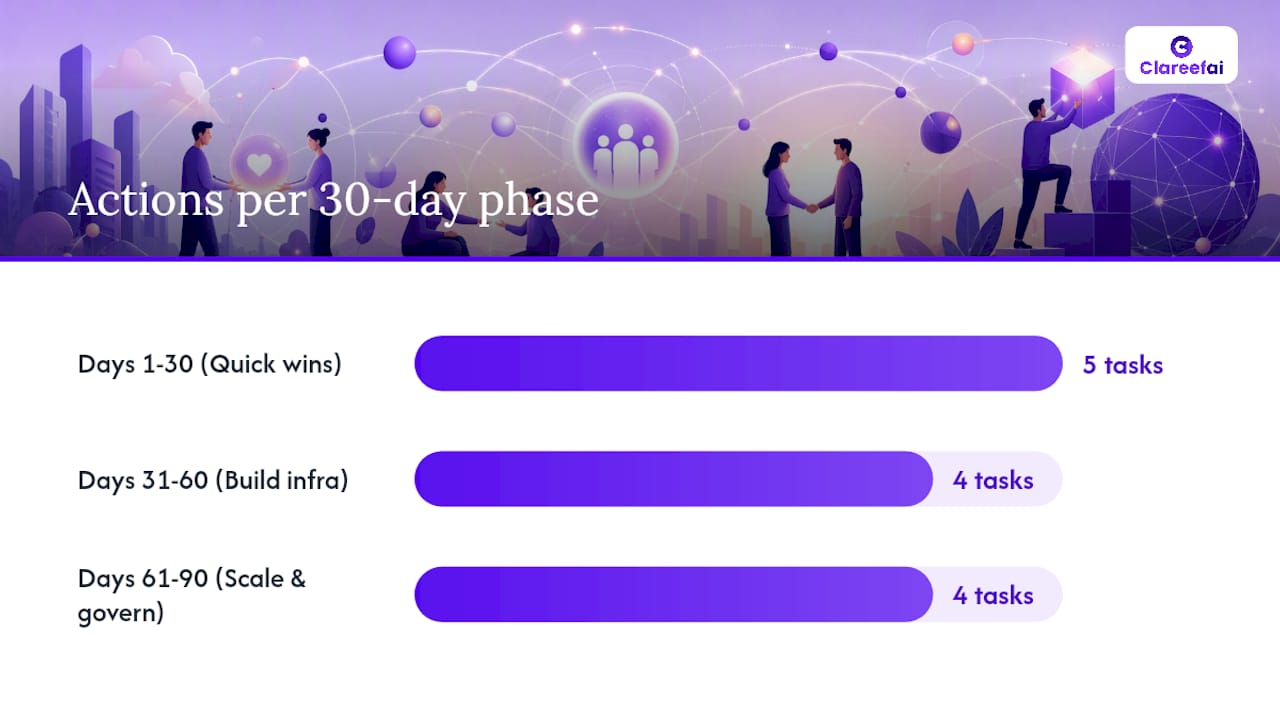
Convert this guide into a workstream with clear owners and expected outcomes.
Days 1–30: Quick wins
- Audit your voice (Owner: Marketing Lead) — Score 20 customer-facing pieces against your voice traits. Identify the three worst offenders.
- Sign all marketing emails (Owner: Email Marketing) — Replace “The Team” with a real name and title in every outgoing sequence.
- Replace stock photos (Owner: Web/Design) — Swap the top five stock images on your homepage and about page with real photos.
- Publish one micro-story (Owner: Content) — Source, verify, and post one two-sentence customer story on LinkedIn and your website.
- Set reply SLAs (Owner: Social/CX) — Document and enforce a four-hour reply window for all public mentions.
Days 31–60: Build the infrastructure
- Produce two employee spotlight posts (Owner: HR + Marketing) — Use the 30-second script template. Rotate across departments.
- Launch one UGC campaign (Owner: Social) — Ask customers to share one outcome. Repost with attribution.
- Deploy the service recovery playbook (Owner: CX Lead) — Train support staff on the four-step acknowledgment script and the apology template.
- Instrument your KPIs (Owner: Marketing Ops) — Set up tracking for NPS, CSAT, response time, and testimonial conversion lift in a shared dashboard.
Days 61–90: Scale and govern
- Assign voice owners (Owner: Marketing Director) — One person per channel owns QA and approval.
- Run your first voice audit (Owner: Voice Owners) — Score five pieces per channel and share results with leadership.
- Publish two verified video testimonials (Owner: Customer Success + Marketing) — Use the end-to-end checklist from the storytelling section.
- Review NPS and CSAT together (Owner: CMO + CX Director) — Identify the gap between marketing perception and delivery reality.
Quick wins vs. medium-term investments:
- Quick wins (Days 1–30) require no budget — just decisions and discipline.
- Medium-term investments (Days 31–90) require cross-functional coordination and a testimonial management system.
- Prioritize based on your biggest gap: if your voice is inconsistent, start there. If you have no verified customer stories, start with the micro-story checklist.
The real reason most humanization efforts stall
Most brands treat humanizing their reputation as a creative brief — a new tone guide, a brand refresh, a campaign with “authentic” in the strategy deck. That’s the wrong frame. Humanized reputation is an operations problem.
The brands that sustain trust over time are the ones where marketing, CX, and product share accountability for the same signals. When marketing promises empathy and support delivers a bot, the gap is not a messaging problem — it’s a coordination failure. The voice guide means nothing if the support team hasn’t read it. The testimonial library means nothing if sales reps don’t know it exists.
The cultural work required to sustain human signals is harder than the tactical work. It means giving CX teams permission to spend an extra five minutes on a difficult call. It means letting a product manager publish a candid post-mortem when a feature ships late. It means measuring your team on reply quality, not just reply volume.
The B2B social proof workflow that actually converts is the one built on cross-functional trust internally — because customers can feel when a brand is performing humanity vs. living it.
Turn your best customers into your most credible proof
Clareefai gives B2B marketing and sales teams a single platform to collect, verify, and publish customer testimonials, video reviews, and case studies — with AI-powered promoter identification that surfaces your best advocates automatically. Every story is attributed, consent-managed, and connected to your CRM so your reps always have the right proof point at the right moment.
See how Clareefai boosts win rates with verified testimonials or explore the full solutions suite to find the right fit for your team.
Sources
- In the AI Era, Trust Scarcity Is Rewriting the Rules of Brand Growth
- How to Humanize Your Brand (And Why It Builds Buyer Trust)
- How to Make Your Brand More Human in the Age of AI | Brand Humanizing Institute
Recommended
Share Article
Stay Updated
Get the latest insights on customer advocacy and SaaS growth delivered to your inbox.