Ways to Build Brand Credibility for B2B Sales Teams
TL;DR:
- Building verified customer advocacy with documented evidence enhances B2B brand credibility and trust. Implementing measurable, transparent activities like documented SLAs and named testimonials accelerates purchase decisions and reduces perceived risk.
The fastest way to build measurable B2B brand credibility is to operationalize verified customer advocacy and align it with concrete, date-stamped evidence. Dated case studies, documented SLAs, and named testimonials are the authority signals that actually move purchase decisions. Generic trust badges and logo walls no longer cut it, especially as AI-generated content floods every channel and buyers grow more skeptical by the quarter.
Here are the top ways to build brand credibility your team can prioritize right now:
- Collect and publish dated testimonials with named operators, job titles, and company domains
- Publish customer-authored case studies with quantified, dated outcomes
- Document and share your SLAs with specific, measurable response commitments
- Build a presence on third-party review platforms (G2, Capterra, TrustRadius)
- Create non-promotional thought leadership content: guides, honest comparisons, original research
- Disclose data-handling practices clearly, including CCPA compliance and opt-in consent
- Earn verifiable public assets: recorded talks, open-source contributions, dated published writing
- Align marketing, product, and support so your promises match your delivery
Every tactic above prioritizes verifiability. Named operators, dates, and quantified results are what separate credible advocacy from AI-generated noise.
Table of Contents
- Why verified advocacy and operational coherence move the needle
- Practical ways to build credibility: quick wins, medium effort, long-term
- How to verify advocacy and make trust signals auditable
- Step-by-step implementation roadmap
- KPIs that tie credibility activity to revenue
- Credibility-killers to avoid and how to fix them fast
- How Clareefai operationalizes these tactics
- Key Takeaways
- Credibility is an operational discipline, not a campaign
- Clareefai turns your credibility program into a sales asset
- Useful sources
Why verified advocacy and operational coherence move the needle
Verifiable advocacy and internal consistency reduce perceived risk and speed purchase decisions. That is the core mechanism behind every tactic in this article.

Consumers prioritize transparent communication about data practices as a leading factor in trust decisions. In enterprise B2B, where deal cycles run long and stakeholders are many, that transparency expectation is even higher. Buyers are not just evaluating your product. They are evaluating whether your organization is predictable.
Fast, authentic responses on social and support channels are directly tied to trust. Research aggregated across 2026 guides shows that 90% of buyers rate fast response as important to their trust in a vendor. That figure alone justifies publishing a documented SLA before you do anything else.
Data security compounds the effect. 75% of consumers say they will not buy from companies they do not trust with their data. For B2B SaaS, where your product often sits inside a customer’s tech stack, that number is not abstract. It is a deal-breaker at the security review stage.
Practical ways to build credibility: quick wins, medium effort, long-term
Quick wins (0–2 weeks)
These require no budget and minimal coordination:
- Collect one dated testimonial per week. Capture name, title, company domain, date, and a quantified outcome. Publish it with all fields visible.
- Add identity metadata to existing testimonials. If you have anonymous quotes on your site, go back and get permission to name them.
- Publish your response SLA. A one-page commitment (“We respond to support tickets within 4 business hours”) is a measurable promise that increases perceived credibility immediately.
Pro Tip: Make every testimonial AI-resistant by chaining provenance signals: named operator + date + linked customer company page. This combination is extremely difficult to fabricate and signals authenticity to both buyers and search engines.
Medium effort (2–8 weeks)
- Customer-authored case studies with a before/after structure, named contact, and specific metrics (e.g., “reduced sales cycle by 3 weeks”).
- Video testimonials from verified customers. A short, unscripted video interview carries far more weight than a polished written quote.
- Third-party review site presence. Claim your G2 or Capterra profile, then run a structured ask campaign to collect verified reviews.
Long-term investments (3–12 months)
High-signal trust activities like public writing, open-source contributions, and recorded speaking engagements are difficult to fake. They build durable credibility capital that no marketing claim can replicate. Invest in a thought leadership program: original research, conference talks, and honest industry comparisons published under real names.
How to verify advocacy and make trust signals auditable
Verification is what separates a credible testimonial from a marketing claim. Every published piece of advocacy should pass this checklist before it goes live:
- Identity confirmed: full name, job title, company name, and company domain on record
- Consent documented: written opt-in with date, scope of quote, and reuse permissions
- Outcome quantified: at least one specific metric tied to a defined time period
- Date visible: publication date and the period the outcome covers, both shown
- Reference available: customer willing to take a reference call (even if not publicly listed)
Pro Tip: Run a LinkedIn confirmation step for every new advocate. A quick check that the person’s profile matches the role and company they cited takes 60 seconds and eliminates the risk of publishing a misattributed testimonial.
Here is a minimal verification template your team can use:
| Field | What to capture |
|---|---|
| Full name | First and last name as it appears on LinkedIn |
| Job title | Current title at time of testimonial |
| Company | Legal company name and domain |
| Date | Month and year testimonial was collected |
| Outcome | Specific metric + time period (e.g., “reduced sales cycle by 3 weeks”) |
| Consent scope | Channels approved for publication (web, email, sales decks) |
| Reuse permission | Expiry date or “ongoing until revoked” |
Privacy matters here too. CCPA requires that customers can request removal of their data from your published materials. Build that opt-out path before you scale your advocacy program, not after.
Step-by-step implementation roadmap
- Week 1–2: Audit existing testimonials for missing identity fields. Collect one fully verified testimonial. Publish your SLA.
- Week 3–4: Launch a structured review ask to your top 20 customers. Claim third-party review profiles.
- Week 5–8: Produce two customer-authored case studies with quantified outcomes. Record one video testimonial.
- Month 3–6: Build a thought leadership content calendar. Assign one team member to publish original research or a detailed guide per quarter.
- Month 6–12: Develop an open advocacy program: reference call network, speaker bureau, and a public customer community.
| Phase | Owner | Expected outcome | Budget band |
|---|---|---|---|
| Quick wins (0–2 weeks) | Marketing ops | Verified testimonials live, SLA published | Low ( — ) |
| Medium effort (2–8 weeks) | Customer success + marketing | Case studies, video testimonials, review profiles | Medium ( — ) |
| Long-term (3–12 months) | Product + marketing + legal | Thought leadership, advocacy program, public assets | High ( — ) |
KPIs that tie credibility activity to revenue
Credibility work only earns budget when it connects to pipeline. Track these primary KPIs:
- Conversion lift on pages with verified testimonials vs. pages without
- Reference-to-close rate: what percentage of deals that used a reference call closed?
- Time-to-trust: days from first touch to qualified opportunity
- NPS and CSAT trends following public advocacy campaigns
- Volume of verified advocates added per quarter
Pro Tip: Tag testimonial-sourced contacts in your CRM at the point of first engagement. A simple UTM parameter on testimonial pages lets you attribute pipeline to specific pieces of advocacy without a complex attribution model.
For 90-day targets, focus on volume: number of verified testimonials collected, review profiles claimed, and SLA published. At 12 months, shift to outcome metrics: conversion lift, reference-to-close rate, and time-to-trust reduction. The advocacy ROI dashboard approach works well here, giving management a single view of credibility program performance.
Credibility-killers to avoid and how to fix them fast
The most common anti-patterns are also the easiest to miss because they feel like marketing:
- Anonymous logo walls with no linked case studies. Fix: link every logo to a named, dated customer story.
- Undated testimonials. Fix: add the month and year to every quote, or remove it.
- Scripted complaint replies. Fix: respond specifically to the issue raised, not with a template.
- Marketing promises that outpace support behavior. Fix: align your SLA with what support can actually deliver before publishing it.
- Hidden pricing. Fix: publish at least a pricing tier structure, even if custom quotes apply at the enterprise level.
“Disclosing what a product is not for helps set expectations and earn credibility. Public failures and transparent limitations increase trust more than polished-only narratives.” — Flux.LA
When trust has already dropped, the recovery principle is simple: acknowledge the specific failure publicly, fix it with a documented action, and publish the update. Vague apologies without concrete changes make things worse.
How Clareefai operationalizes these tactics
Clareefai is built to execute the program described above without manual coordination across spreadsheets and email threads.
- Identity verification built in: every testimonial captures name, title, company domain, and consent date before publishing
- AI-powered advocate identification: the platform surfaces your highest-impact promoters automatically, so your team focuses on the right customers
- Video testimonial collection: structured video interviews collected and hosted in one place, ready for B2B social proof workflows
- Cross-channel publishing: push verified testimonials to your CRM, website, and sales decks from a single dashboard
- GDPR and CCPA-compliant consent management: opt-in, date-stamped, with reuse permissions tracked per customer
- Analytics dashboard: track conversion lift, advocate volume, and reference activity in real time
Pro Tip: Use Clareefai’s role-specific dashboards to give sales, marketing, and customer success each a view of advocacy activity relevant to their goals. Marketing sees content performance; sales sees reference availability; management sees pipeline attribution.
A typical workflow: customer success identifies a promoter after a successful renewal, Clareefai sends an automated testimonial request, the customer completes a verified video or text review, and the content is published to the sales deck and website within 48 hours. The unified testimonial management use case shows how this approach directly supports win rate improvement.
Key Takeaways
Verified customer advocacy, paired with operational coherence across marketing, product, and support, is the highest-leverage approach to building measurable B2B brand credibility.
| Point | Details |
|---|---|
| Start with verification | Every testimonial needs name, title, date, and a quantified outcome before publishing. |
| SLAs build immediate trust | Publishing a specific response commitment is a credibility signal you can deploy in days. |
| Long-term assets compound | Recorded talks, open-source contributions, and original research are hard to fake and durable. |
| Measure pipeline impact | Track reference-to-close rate and conversion lift from testimonial pages to connect credibility to revenue. |
| Clareefai centralizes execution | Clareefai automates collection, verification, consent, and cross-channel publishing for the full advocacy program. |
This week: collect one fully verified testimonial, publish your SLA, and claim your G2 or Capterra profile.
Credibility is an operational discipline, not a campaign
Most teams treat credibility as a content problem. They write better copy, design a cleaner case study template, and wonder why buyers still hesitate. The real gap is operational. Credibility is built when your pricing, your support behavior, your product delivery, and your marketing promises all point in the same direction, consistently, over time.
The brands that earn lasting trust are not the loudest. They are the clearest. Their marketing does not explain who they are. It demonstrates it, through verified customer voices, documented commitments, and public assets that predate any single campaign. Closing the authenticity gap between what you promise and what you deliver is not a marketing project. It is a cross-functional discipline that marketing, product, and customer success own together.
Clareefai turns your credibility program into a sales asset
Collecting verified testimonials, managing consent, and publishing advocacy across channels is a full-time job when done manually. Clareefai handles the entire workflow in one platform, so your team spends time on strategy, not coordination.
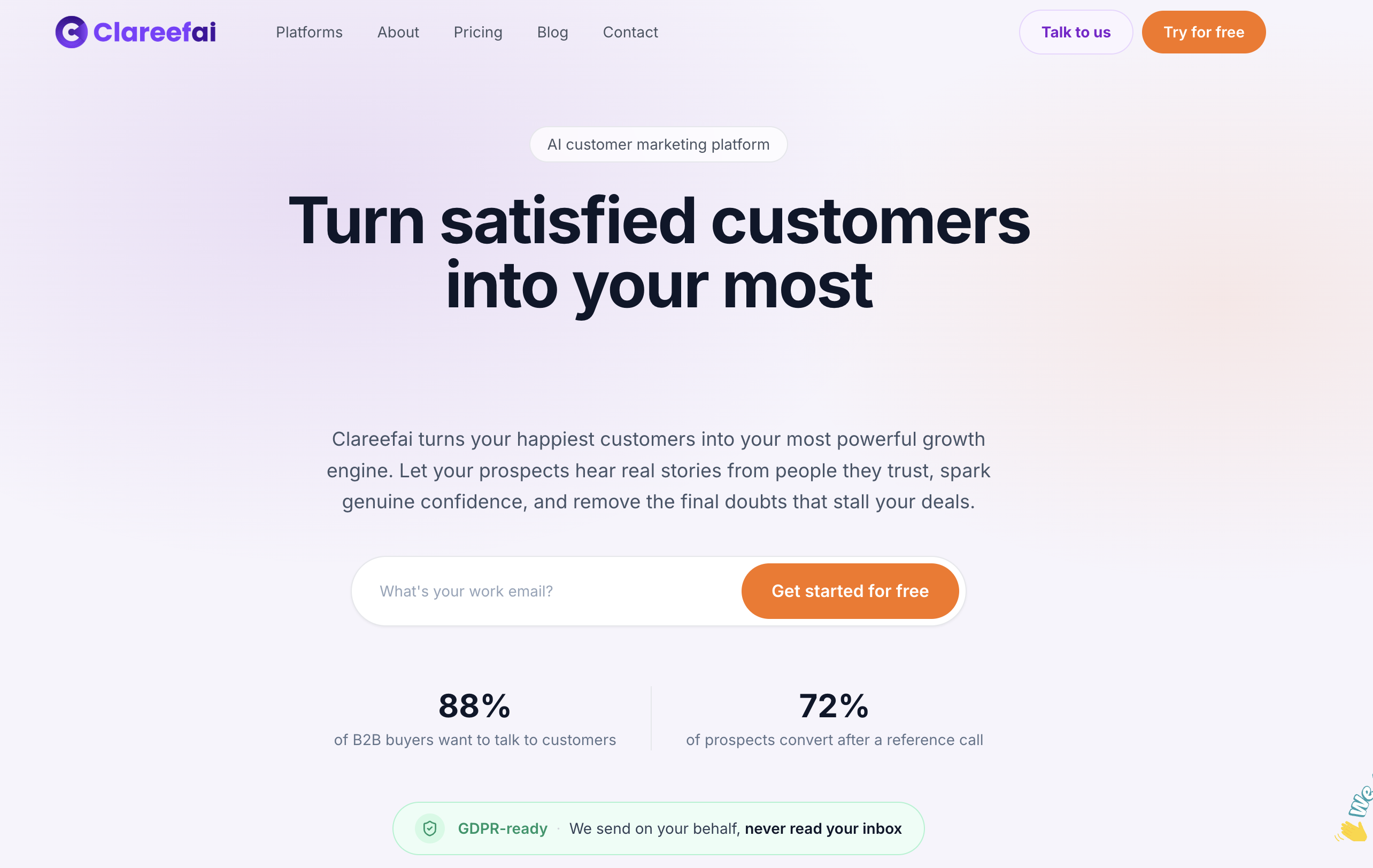
The platform verifies customer identities, date-stamps every piece of advocacy, manages CCPA and GDPR consent, and pushes content to your CRM and website automatically. Sales gets a live reference network. Marketing gets a library of verified, channel-ready content. Management gets a dashboard that ties advocacy activity to pipeline.
Ready to see it in action? Explore the platform or review a live use case showing how unified testimonial management supports win rate improvement.
Useful sources
- Navigating the consumer trust crisis — Basis Technologies. Covers how transparency in data practices functions as a primary trust driver; useful for privacy and consent sections.
- How to actually build trust in your brand (post-AI-spam edition) — Flux.LA. Covers chain-of-provenance signals, named case studies, and the value of disclosing limitations; primary evidence for the verification and common-mistakes sections.
- Brand credibility: what it is, why it matters, and how to build it — Think It Media. Supports the SLA and measurable-promise recommendations throughout the roadmap.
- How to Build Brand Trust in 2026: The Strategies That Actually Work — Avadhesh. Source for the response-speed and data-trust statistics cited in the why-it-matters section.
- Brand Authenticity in 2026: 7 Trust Principles That Increase Sales — Turbologo. Supports the long-term investment recommendations for hard-to-fake public assets.
Recommended
Share Article
Stay Updated
Get the latest insights on customer advocacy and SaaS growth delivered to your inbox.