ABM Social Proof: Match 5 Formats to Buyer Needs and Verify Stories

The fastest way to accelerate account-based marketing deals is to place account-specific, verified customer evidence directly at the touchpoints where each buying-committee stakeholder makes their decision, drawing on social proof strategies to boost engagement. Buyers already rank customer testimonials and case studies among their top trust builders, with 55% citing them as a key influence. Platforms that use verification-driven workflows show how that trust turns into pipeline.
TL;DR:
- Match proof to each committee role: finance needs cost or revenue outcomes, procurement needs reliability, IT needs technical validation, and champions need peer user stories.
- Use short case snippets during awareness, tailored quotes in outreach, detailed cases and ROI snapshots during intent, then reference calls near closing.
- Name the company, speaker’s role, measurable outcome, and date; refresh proof quarterly and avoid reusing testimonials across unrelated segments or relying on one metric.
- Run matched account segments with and without verified proof, then compare meeting conversion and win rates after a sales cycle, reporting sample size and duration.
- Verify each testimonial and disclose material ties to endorsers; FTC rules require truthful endorsements and clear disclosures in both visual and audible formats.
Table of Contents
- What Social Proof Looks Like in ABM
- Where to Place Social Proof Across ABM Campaign Stages
- Measuring Impact: Metrics, Experiments, and Proving ROI
- Applied Example: Clareefai’s Workflow for Account-Based Social Proof
- Author Perspective: Three Priority Moves for ABM Teams
- Clareefai: A Solution to Scale Verified, Account-Based Social Proof
- FAQ
- Sources
What Social Proof Looks Like in ABM
Mass-market social proof (a star rating, a generic quote on a homepage) rarely moves an enterprise buying committee. ABM calls for peer-specific proof: evidence from a company that looks like the target account, facing a similar problem, measured in similar terms. That specificity is what makes a testimonial feel like a signal instead of marketing copy.
A handful of formats do most of the work in ABM campaigns:
- Micro-case studies: a tight, 150-200 word story with a named outcome, built for a single account or segment.
- One-line executive quotes: a sentence from a peer executive that a prospect’s CFO or VP can repeat in an internal meeting.
- Video soundbites: 30-60 second clips that humanize a result and travel well on LinkedIn or landing pages.
- Reference calls: live conversations between a prospect and a verified customer in a similar role.
- Champion testimonials: proof from the day-to-day user who will defend the purchase internally.
Different formats speak to different members of the committee. Finance wants a number tied to cost or revenue. Procurement wants proof of reliability and risk reduction. IT wants technical validation. The end-user champion wants to hear from someone doing their job. Credible proof names the company, the role of the person speaking, a specific outcome, and a date, vague praise convinces no one on a buying committee that size.
Where to Place Social Proof Across ABM Campaign Stages
Social proof works best when it matches the question a buyer is asking at that moment, not when it is scattered evenly across every channel.
- Awareness: drop short case snippets into display ads or sponsored content to establish category credibility.
- Targeted outreach: pair a micro-case study with a tailored executive quote in personalized emails or LinkedIn messages.
- Intent stage: serve a detailed case study and an ROI snapshot on a personalized microsite once the account is actively researching.
- Close stage: schedule a live reference call and present validated metrics alongside the proposal.
- Post-close: enroll the new customer in an advocate program that feeds expansion and renewal campaigns.
A practical campaign sequence might run: a LinkedIn ad with a one-line proof point, a pinned testimonial on the account’s LinkedIn page, a personalized microsite with a matching-industry case study, a scheduled reference call once intent signals spike, and a champion webinar after close to seed the next expansion motion.
A few rules keep this from feeling generic. Do match the proof’s industry and company size to the target account whenever possible. Do refresh proof points quarterly so nothing goes stale. Don’t reuse the same testimonial across unrelated segments, buyers notice. Don’t lean on a single data point when a committee needs several angles of validation.
Measuring Impact: Metrics, Experiments, and Proving ROI
Social proof earns its place in the budget when you can show it moved a number. Four metrics capture most of the signal: engagement lift on assets that carry testimonials versus those that don’t, meeting-to-opportunity conversion rate, time from reference call to closed deal, and win-rate uplift on accounts exposed to verified proof.
Buying committees are growing larger and more finance-driven, which means a testimonial speaking directly to cost or revenue impact now carries more weight in committee deliberations than it did a few years ago.
A simple account-holdout test works well here: run matched segments of target accounts, one that sees verified proof at key stages and one that doesn’t, then compare meeting conversion and win rate after a full sales cycle. When presenting results to procurement or a CFO, package the expected lift alongside the sample size and the time window measured, vague claims about “better conversion” won’t survive a budget conversation.

Applied Example: Clareefai’s Workflow for Account-Based Social Proof
Our platform is built around the exact workflow above: find the right advocate, verify them properly, and get their story in front of the right account at the right moment. An AI-driven analysis scans testimonial and reference data to surface customers whose outcomes most closely match a target account’s industry, size, and use case, then centralizes the consent records, identity verification, and original quotes so nothing gets lost between collection and publication.
Role-based dashboards let sales, marketing, and management each see the advocacy data relevant to their work: sales teams can request a reference call, marketing teams can pull a verified quote for a campaign, and leadership can track advocacy impact across the pipeline. Our account-based social proof playbook and our use-case walkthrough on testimonial management show this process end to end for teams building their first advocate program at scale.
Author Perspective: Three Priority Moves for ABM Teams
If you’re starting from scratch, prioritize in this order: verify every piece of proof before it touches a campaign, map each format to a specific buying-committee role instead of publishing one testimonial everywhere, and measure with a real holdout group rather than trusting a gut feeling about what “worked.”
The lesson that surprises most teams: the bottleneck is rarely finding happy customers, it’s building a system that can verify and republish their stories fast enough to stay current. For deeper tactical templates, our B2B social proof workflow guide is a solid next stop.
— ClareefAi
Clareefai: A Solution to Scale Verified, Account-Based Social Proof
Running this playbook by hand across dozens of target accounts gets unwieldy fast, which is why platforms have been built to help verify, publish, and measure customer testimonials and references without the manual back-and-forth.
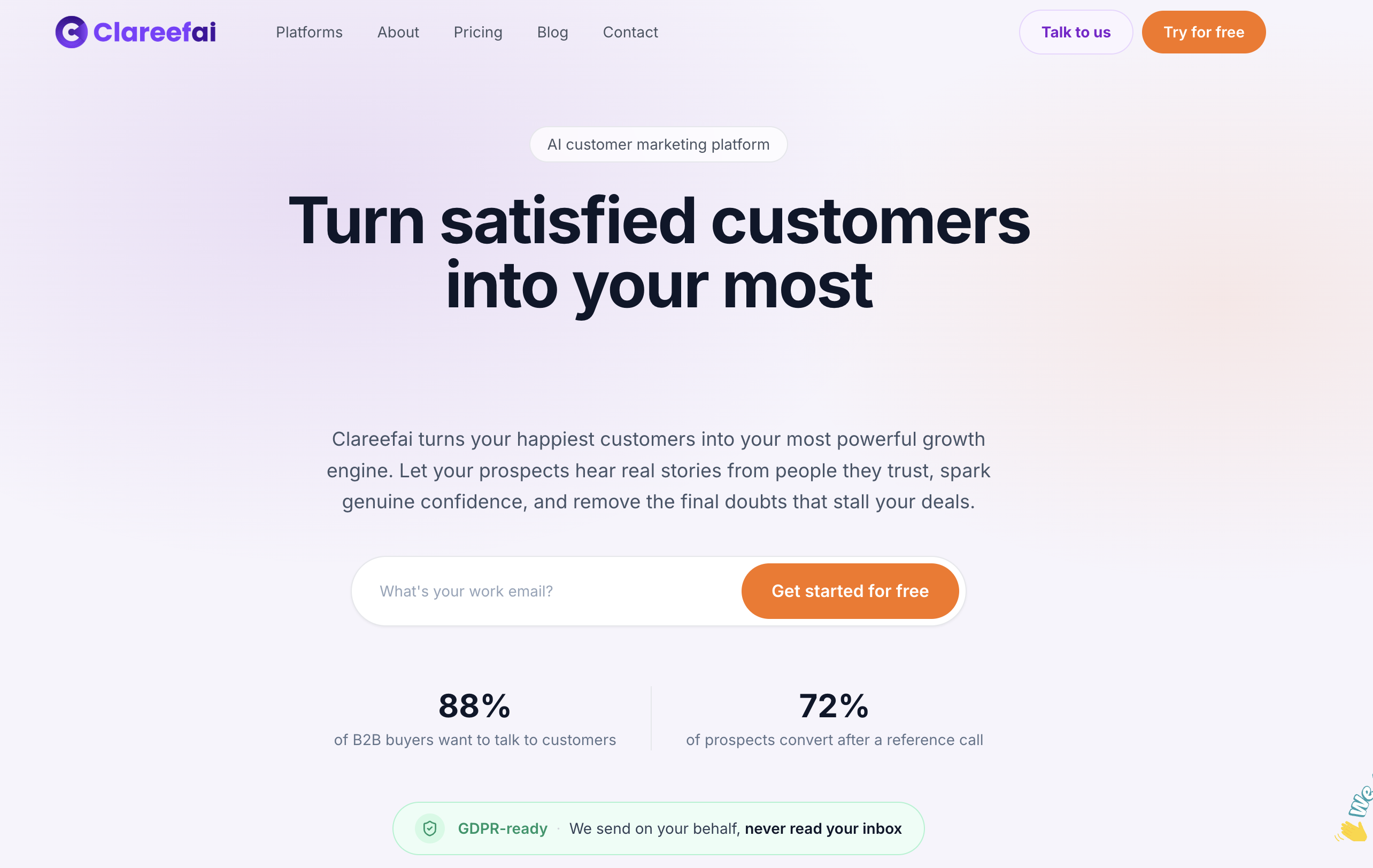
- Automated advocate identification that matches customer outcomes to target account profiles.
- Centralized storage for consent records, identity verification, and original quotes.
- Cross-channel publishing with analytics that tie proof exposure back to pipeline movement.
Plans start with Basic at $250 per month, with Professional and Enterprise tiers available as your advocate program grows. Compare the full lineup and find the right fit on our pricing page.
FAQ
What are some examples of social proof?
Common examples include customer testimonials, case studies, video reviews, star ratings, reference calls, and user-generated content shared on social platforms. In ABM specifically, the most effective formats are peer-specific: a micro-case study or executive quote from a company that resembles the target account.
What are examples of ABM?
Account-based marketing campaigns often include personalized microsites built for a single target account, LinkedIn ads featuring a tailored customer story, and executive-level reference calls scheduled during the consideration stage. Each tactic is built around one account or a tightly defined segment rather than a broad audience.
What does ABM stand for?
ABM stands for account-based marketing, a strategy that treats individual high-value accounts as their own market rather than targeting broad audiences. It typically involves coordinated outreach to multiple stakeholders within the same target company.
What is social proof?
Social proof is evidence that other people, often customers, have had a positive experience with a product or service, used to build trust with a new buyer. In B2B contexts, the most credible forms are verified and specific, naming the company, role, and outcome rather than offering vague praise.
Sources
Verification is what separates a testimonial that holds up from one that creates legal exposure. The FTC’s Consumer Reviews and Testimonials Rule, effective since October 2024, requires that testimonials be truthful and that any material connection between the advertiser and the endorser be disclosed, with enforcement possible under Section 5 of the FTC Act. The underlying endorsement guides in 16 CFR Part 255 add that endorsements must reflect honest opinions and that disclosures need to be clear and conspicuous in both visual and audible formats.
A repeatable workflow keeps this manageable:
- Content That Converts: 2025 B2B Buyer Insights (Redpoint Insights)
- B2B buying committee benchmarks | The Starr Conspiracy
Our six-step verification workflow for FTC testimonial guidelines walks through consent templates and disclosure placement in more detail, and our guide to spotting fake reviews covers the red flags that signal a testimonial won’t hold up to scrutiny. Governance matters as much as the templates: assign one owner (often marketing operations or legal) to maintain the audit trail, and store artifacts somewhere searchable, not scattered across inboxes.
Pro Tip: Keep a single verification record per testimonial, consent, source, and publish date together, so any team can answer a compliance question in minutes, not days.
Recommended
Share Article
Stay Updated
Get the latest insights on customer advocacy and SaaS growth delivered to your inbox.