Why Credibility Matters in Sales: A Playbook for Leaders
Credibility is the entry condition for consideration. Buyers decide whether you’re worth their time before you finish your first sentence, and only 1 in 4 Americans view salespeople as credible to begin with. That gap is your opportunity. Sellers who close it win faster deals, get forgiven for mistakes, and generate referrals without asking.
Credibility unlocks specific, measurable outcomes:
- Faster evaluation cycles because buyers stop verifying every claim
- Higher tolerance for slip-ups when something goes wrong
- More repeat business from the same accounts
- Referrals that arrive without a formal ask
Pro Tip: Before your next follow-up email, attach one verifiable proof point, a named customer result, a specific number, a short video clip. Vague reassurance doesn’t build trust; specifics do.
Key Takeaways
Credibility determines whether buyers shortlist you, forgive your mistakes, and refer you to others, and it now has to be established before the first live conversation happens.
| Point | Details |
|---|---|
| Credibility precedes contact | 78% of B2B buyers pick vendors they already knew about before formal research begins. |
| Trust changes buyer economics | Many buyers prefer a trusted seller over the lowest price on the table. |
| Mistakes get forgiven, sometimes | Trusted sellers are three times more likely to be forgiven after a slip-up. |
| Intimacy is the missing pillar | Most sellers overinvest in product knowledge and underinvest in understanding the buyer’s actual situation. |
| Scale it with verified proof | Clareefai verifies and organizes customer testimonials so credibility travels across the whole sales team, not just one rep. |
Table of Contents
- What Does Credibility in Sales Actually Mean?
- Why Does Credibility Matter More in Sales Today?
- How Do You Adapt Credibility Signals to Different Buyer Types?
- What Habits Build Credibility Before, During, and After the Call?
- How Do You Scale Credibility Across a Sales Team?
- What Mistakes Kill Credibility Fast, and What Should You Check Before Every Call?
- Sources
What Does Credibility in Sales Actually Mean?
Credibility in sales is the buyer’s belief that you’re competent enough to solve their problem, dependable enough to follow through, honest enough to trust with their money, and invested enough in their specific situation to give real advice instead of a script. Trust researchers at Rain Group break this down into four pillars: capability, dependability, integrity, and intimacy.
Most sellers over-invest in the first pillar and ignore the last one. They can recite product specs all day but can’t tell you what actually keeps their buyer up at night.
- Capability: Can you actually solve this problem?
- Dependability: Will you do what you say you’ll do?
- Integrity: Are you honest, even when honesty costs you the deal?
- Intimacy: Do you understand this buyer’s specific situation, not just their industry?
A rep who knows the product cold but treats every prospect the same way sounds competent and generic. A rep who combines that knowledge with a pointed question about the buyer’s actual bottleneck sounds like a partner. The difference shows up in close rates, not just in the room.
Why Does Credibility Matter More in Sales Today?
Buyers verify claims before you finish making them. Modern deals move fast, happen over video or email, and get fact-checked in real time, which means initial credibility signals matter more than ever because buyers can confirm or debunk what you say in as little as 30 seconds on their phone.
Forrester’s research shows A majority of B2B buyers pick vendors they already knew about before starting formal research, with an even higher share on enterprise deals. Credibility has to exist before the call even gets booked.
The payoff for building it runs deep. Dale Carnegie’s research found that many buyers would rather work with a salesperson they trust than take the lowest price on the table, and a large portion would likely buy again from a rep they trust. Customers who trust their salesperson are three times more likely to forgive a mistake instead of walking.
That forgiveness factor changes how failure plays out. A missed deadline from a credible rep gets a follow-up call and a second chance. The same miss from an unknown vendor gets a canceled contract. Credibility doesn’t prevent every stumble, it changes what happens after one.

Referrals follow the same logic. Buyers don’t recommend people they merely tolerated, they recommend people they trusted enough to bet their own reputation on the recommendation. That’s a compounding asset every deal either builds or drains.
How Do You Adapt Credibility Signals to Different Buyer Types?
Not every buyer trusts the same signals. Analytical buyers want data, case studies, and specifics. Show them numbers, cite sources, and skip the emotional appeal, because vague claims read as evasion to this group. Emotional buyers respond to stories and relationships. Lead with a relevant customer story and genuine interest in their situation, not a spreadsheet. Skeptical buyers assume you’re selling them something they don’t need. Lead with transparency about limitations and let third-party proof do the talking instead of your own claims.
Spotting the type early saves you from pitching the wrong signal to the wrong person:
- Analytical buyers ask detailed follow-up questions and request documentation unprompted
- Emotional buyers talk about team impact and ask about your company’s story
- Skeptical buyers push back hard on generic claims and ask “who else has actually used this”
What Habits Build Credibility Before, During, and After the Call?
Credibility isn’t a personality trait, it’s a sequence of habits repeated consistently. Break it into three phases.
- Before the call: Research the buyer’s company, recent news, and likely pain points. Sandler Training’s guidance is blunt on this: sellers earn more credibility through the questions they ask than the answers they give, so prep questions, not just talking points.
- During the call: Open with an insight relevant to their situation, not a company introduction. Listen more than you talk. When you don’t know something, say so, then follow up with the answer. Top performers lead with insight rather than a pitch, and admitting a limitation openly builds more trust than claiming your product does everything.
- After the call: Send exactly what you promised, on the timeline you promised. Document commitments in writing so nothing gets remembered differently later.
Watch for these traps that undo the work fast:
- Overpromising a delivery date or feature you haven’t confirmed internally
- Talking through 80% of the call instead of asking questions
- Badmouthing a competitor instead of stating your own differentiators
Pro Tip: Use an up-front contract at the start of a call, a quick agreement on time, agenda, and outcome (“In the next 20 minutes, I’ll walk through X, you tell me if it fits, and we decide together on next steps”). It signals respect for the buyer’s time and puts both sides on equal footing before the pitch even starts.
How Do You Scale Credibility Across a Sales Team?
One rep’s credibility lives and dies with that rep. Verified social proof spreads credibility across the whole team, because a documented customer outcome carries weight regardless of who’s presenting it. Buyers trust third-party opinions more than vendor claims, which is why a testimonial system that verifies identities and organizes proof by use case turns individual wins into a shared asset every rep on the team can use.
Building that system operationally means covering a few basics:
- Verify the customer’s identity and role before publishing anything
- Categorize testimonials by industry, use case, and buyer objection they answer
- Sync verified proof directly into the CRM so reps see it at the right pipeline stage
- Set a publishing cadence instead of collecting proof and letting it sit unused
- Track which testimonials actually get used in deals and which ones influence close rates
| Function | What it solves |
|---|---|
| Identity verification | Removes doubt about whether a review or quote is real |
| Categorization | Matches the right proof to the right buyer objection |
| CRM sync | Puts proof in front of reps at the moment they need it |
| Analytics | Shows which testimonials actually move deals forward |
Verified proof doesn’t replace one-to-one credibility. It backs it up. A rep who does the prep work and shows genuine understanding of the buyer’s situation, then adds a relevant, verified customer story, moves faster than one relying on either alone. For a deeper look at building that process, see this guide to improving B2B trust.
What Mistakes Kill Credibility Fast, and What Should You Check Before Every Call?
A handful of behaviors erode trust faster than anything else: promising a capability you haven’t confirmed, going silent after the call instead of following up on time, trashing a competitor instead of stating your own value, and making claims so vague they can’t be checked. Each one takes seconds to commit and weeks to recover from.
A short checklist before and after every call keeps these mistakes from happening by accident:
- Research the buyer’s company and recent context
- Confirm one specific, verifiable proof point to reference
- Set a clear agenda before diving into the pitch
- State any limitations honestly, don’t oversell
- Document every commitment made during the call
- Send the follow-up on the exact timeline promised
- Log the next step as a CRM task, not a mental note
Build this into your sales playbook as a required task template attached to every opportunity stage, and it stops depending on memory.
A Publisher’s View on Credibility in Remote-First Selling
Credibility used to build up over years of face-to-face relationship work. Remote-first selling compressed that timeline to a handful of calls and emails, which means every seller now needs to treat credibility as a repeatable competency, not a personality trait that shows up naturally over time. Sales leaders should measure credibility signals the same way they measure pipeline: track verified proof usage, response times, and follow-through rates as leading indicators of revenue, not soft metrics to check later.
Make Your Credibility Verifiable Before the First Meeting
Every tactic in this guide works better when buyers can confirm it’s real before they ever get you on a call. That’s the gap a verification system closes: instead of asking a prospect to take your word for a result, you hand them a verified customer story, checked identity and all, before the first meeting even happens.
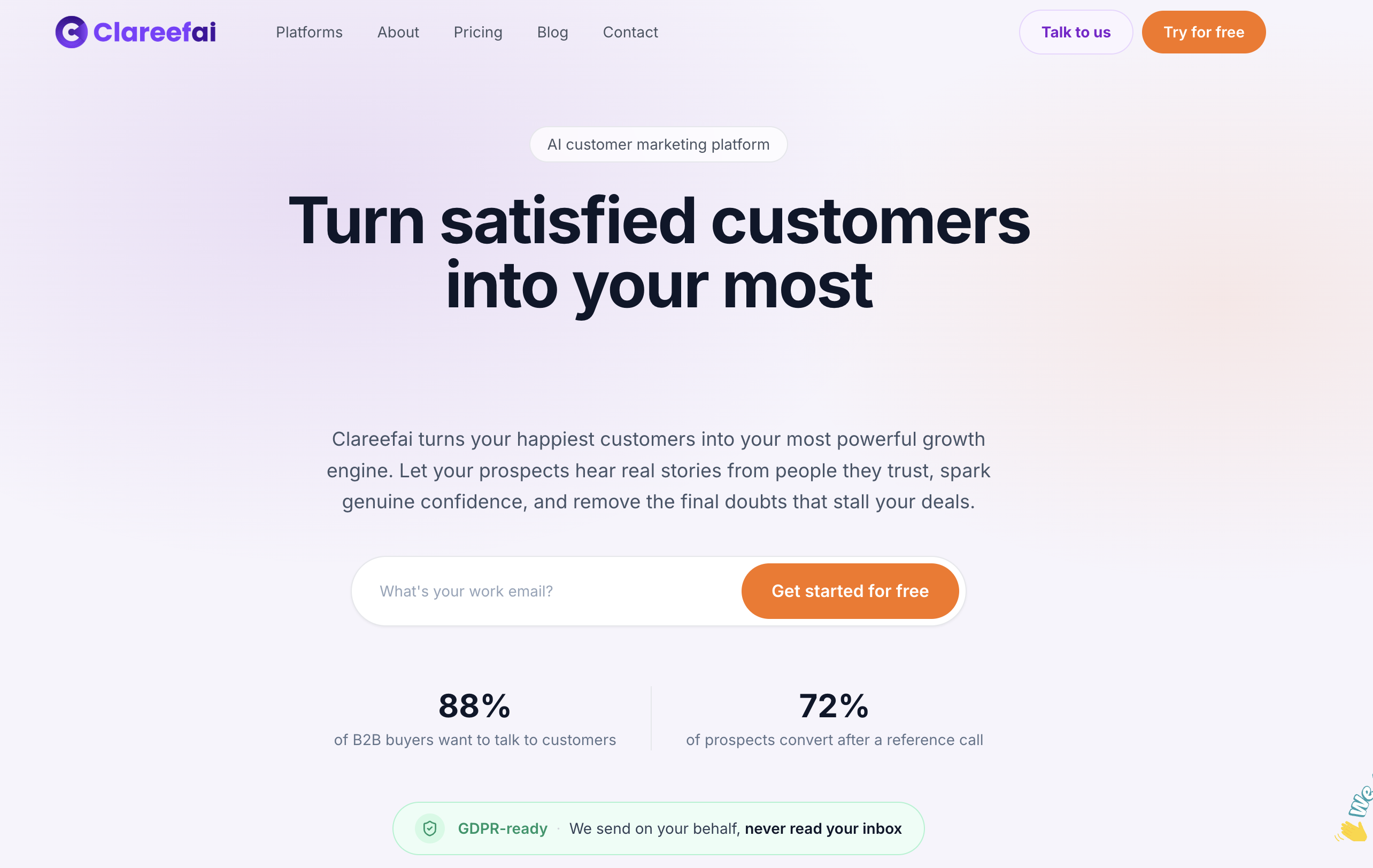
Clareefai organizes and verifies testimonials, video reviews, and reference calls so your sales team can attach real, checked proof to outreach at every funnel stage instead of relying on generic quotes nobody trusts. It syncs with your CRM, tracks which proof actually influences deals, and gives sales leaders a dashboard to measure advocacy impact instead of guessing at it. If closing the credibility gap sounds worth ten minutes, see how testimonial management boosts win rates or browse customer stories to see verified proof in action, then request a walkthrough of the sales solution.
Sources
- How Important Is Credibility in B2B Sales: A 2026 Guide | SyncGTM | SyncGTM
- Why Trust is the Most Important Tool for Driving Profitable Sales
- How Can Sellers Successfully Establish Credibility in Sales? - SalesFuel
- Trust-building in sales — Rain Group / Rain Sales Training
- 4 essential ingredients for building credibility - Sandler Training
Recommended
Share Article
Stay Updated
Get the latest insights on customer advocacy and SaaS growth delivered to your inbox.