Six Checkpoints to Make Your Testimonial Release Form Audit Ready

Before you publish any customer praise, whether it’s a quote on your homepage or a video ad, get a signed testimonial release that grants usage rights and documents whether anything of value was exchanged. That signature is your proof of permission and your paper trail if the FTC or a former customer ever asks questions. You’ll find ready-to-copy templates further down, but the short version is this: no signature, no publishing, no exceptions.
TL;DR:
- Most businesses need signed testimonial release forms whenever customer names, images, or videos are used in public marketing to protect against legal and FTC compliance issues.
- Release forms should include clear identification of parties, scope of content, channels, rights granted, attribution, disclosure of incentives, and revocation procedures, with simple templates suitable for different risk levels.
- FTC rules require disclosures for any testimonial involving payments, discounts, free products, or personal ties, with the disclosure visible alongside the testimonial during publication.
- Extra clauses are necessary for minors, health claims, or revocable content, along with consistent and timely collection, storage, and verification of signed releases.
- Automated platforms can streamline testimonial collection and compliance tracking, reducing legal risk and saving time for teams managing large volumes of feedback.
Table of Contents
- What Is a Testimonial Release Form and When Do You Need One?
- Key Components Every Testimonial Release Should Include
- Template Examples and How to Customize Them
- What Do FTC Rules Require for Testimonial Disclosures?
- Special Cases: Minors, Health Claims, and Revocation Rights
- How to Collect, Sign, and Store Releases Without a Legal Team
- How a Verification Workflow Reduces Legal and Compliance Risk
- Consent Builds Trust, Not Just Compliance
- Automate Testimonial Collection Without Losing the Paper Trail
- Sources
- FAQ
What Is a Testimonial Release Form and When Do You Need One?
A testimonial release form is a written agreement where a customer grants your business permission to publish their words, name, and often their image or voice, in your marketing. It’s a license, not a formality. Legal guides consistently frame it as protection against right-of-publicity claims, since using someone’s identity commercially without consent can expose you to legal action even when the testimonial itself is glowing.
You need one anytime a customer’s words or likeness show up in a public-facing channel: your website, paid ads, email campaigns, sales decks, social posts, or review platforms. A verbal “sure, go ahead” from a happy client feels sufficient in the moment, but it evaporates the second someone disputes it later. A signed testimonial consent form settles the question before it becomes one, and it gives you something concrete to hand over if regulators or a customer’s attorney come asking.
Key Components Every Testimonial Release Should Include
Every solid testimonial release template, whether you build it in-house or pull from a lawyer-drafted source, covers the same ground. Skip one of these and you’ve left a gap someone can exploit later.
- Party identification: full legal name, company (if a B2B testimonial), and contact information.
- Scope of content: the exact testimonial text, or a description of what photo/video will be captured.
- Media and channels: website, social, print, paid ads. Templates that name each channel give marketers more flexibility to reuse content later without going back for a second signature.
- Grant of rights: a non-exclusive license, not an assignment. Guides on this point recommend licensing language over an outright IP transfer, since a non-exclusive license is the safer default for text and imagery alike.
- Attribution and editing rights: first name only, full name, or anonymous; whether you can trim or lightly edit for length.
- Compensation disclosure: a checkbox or field noting if anything of value changed hands.
- Term and revocation process, signature block, capacity confirmation, and governing law.
Pro Tip: Add a single checkbox that asks “Was anything of value provided in exchange for this testimonial?” You’ll thank yourself later when you’re tagging content for FTC disclosure.
Template Examples and How to Customize Them
You don’t need a twelve-page contract for every five-star quote. Match the format to the risk.
-
Quick release (text and name only): One paragraph works fine for low-stakes, unpaid feedback. “I, [Name], grant [Company] a non-exclusive, worldwide license to use my testimonial, name, and title in its marketing materials across [channels], with no time limit unless revoked in writing.”
-
Long-form release (photo/video): Separate the photo and video clauses from the text clause. Add a distinct line for voice usage and specify whether footage can be edited, captioned, or repurposed into other formats down the line.
-
FTC disclosure line (when an incentive was given): “This testimonial was provided in exchange for [discount/free product/payment]. [Company] will disclose this connection wherever the testimonial appears.”
-
Customization checklist: swap in the customer’s name, list your actual channels instead of “all media,” set a compensation field even if it reads “$0,” and decide whether the license expires or runs indefinitely.
Lawyer-drafted options often ship in two formats: a signable contract for e-signature and a terms-and-conditions version you embed directly into an intake form, which speeds up collection for lower-risk cases while keeping the formal contract in reserve for anything paid or sponsored.
What Do FTC Rules Require for Testimonial Disclosures?
The Federal Trade Commission treats any testimonial where money, discounts, or free products changed hands as an endorsement, and endorsements carry disclosure obligations. The core rule: your endorsement must reflect an honest opinion, and any material connection between you and the endorser must be disclosed clearly and conspicuously. You also can’t present an outlier result as if it were typical.
A material connection is broader than a cash payment. It includes:
- Free products or services given in exchange for a review
- Discounts, credits, or affiliate commissions
- Employment relationships (an employee praising their own employer’s product)
- Family or personal ties between the reviewer and the business
Capture this on the release form itself, not in a separate email you’ll forget to file. A common audit control among compliant teams is surfacing the disclosure on the same page as the testimonial it applies to, not buried in a footer or a terms page nobody reads. The workflow is simple: capture incentive information on the release, tag the testimonial internally, then publish it with the disclosure sitting next to the quote, not hidden behind a click.
Special Cases: Minors, Health Claims, and Revocation Rights
A handful of scenarios need extra clauses beyond the standard template.
- Minors: A parent or legal guardian must sign, and you should limit attribution to a first name or initials. Keep these records in a separate, clearly labeled file.
- Health-related testimonials: If a testimonial discloses protected health information, you need a HIPAA authorization alongside the release, with narrowly defined permitted uses. HIPAA imposes stricter revocation requirements than a standard marketing release, so don’t reuse a generic template here.
- Photo and video: Use separate consent checkboxes for image, voice, and each distribution channel, since a customer may agree to a website photo but not a paid social ad using their face.
- Revocation: Recommend forward-looking revocation, meaning the customer can stop future use but understands materials already published or in production may remain live for a defined period.
How to Collect, Sign, and Store Releases Without a Legal Team
Getting the paperwork right matters less than actually collecting it consistently. Build this into your process:
- Ask at the right moment. Request testimonials right after a win, delivery, or renewal, when enthusiasm is highest, using a testimonial request email template to standardize the ask.
- E-sign everything. Use a service that timestamps the signature and logs the signer’s IP address and email, and store that alongside the exact testimonial text at the time of signing.
- Name files consistently and set a retention policy so releases stay findable years later, not just for the next campaign cycle.
- Audit before publishing. Confirm the signed release exists, check the disclosure flag, and compare the exact published wording against what was actually signed off, a step legal guides call out as essential before content goes live.
Pro Tip: Keep a single searchable log linking every published testimonial to its release file. When someone asks “can you prove you had permission for that?” months later, you want a five-second answer, not a scavenger hunt.
How a Verification Workflow Reduces Legal and Compliance Risk
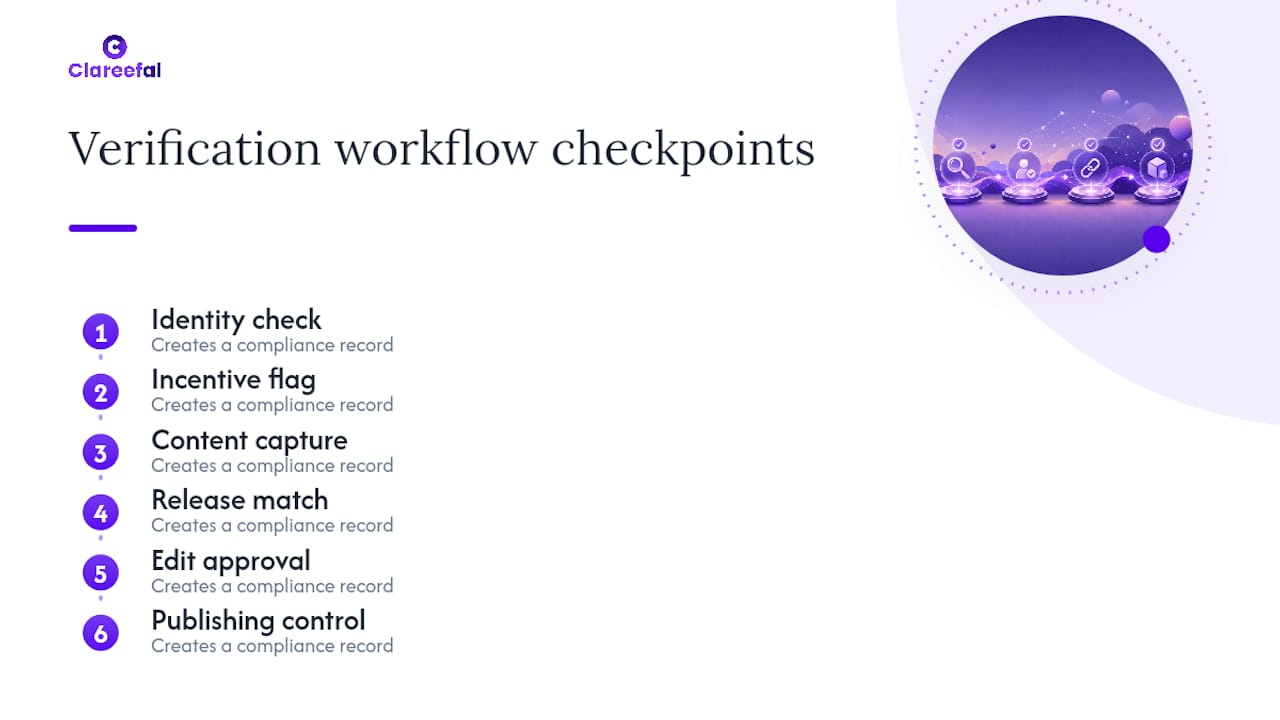
Clareefai’s own six-step verification workflow illustrates what a disciplined process looks like in practice: identity check, incentive flag, content capture, release match, edit approval, and publishing control. Each checkpoint creates a record you can produce during a compliance review, whether the question comes from the FTC or a customer’s lawyer. You don’t need software to replicate this. Building the same six checkpoints into a spreadsheet or shared drive gets you most of the protection, just with more manual effort at each step.
Consent Builds Trust, Not Just Compliance
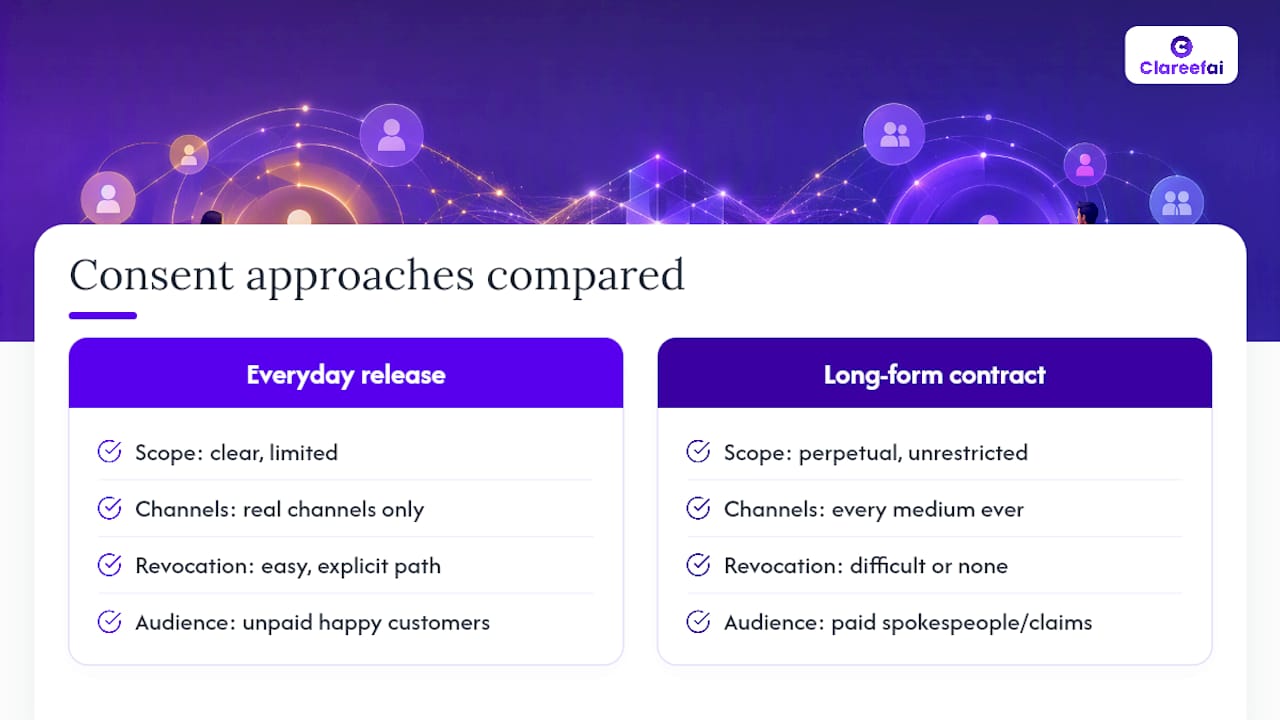
Overreaching licenses scare people off. Asking a happy customer to sign away perpetual, unrestricted rights to their name and likeness across every medium that might ever exist tends to produce hesitation, not enthusiasm, and hesitation kills your best testimonials before they’re written. The customers most willing to advocate for you are also the ones most sensitive to feeling used.
Keep everyday releases clear and limited, scoped to real channels with a real revocation path. Save the lawyer-drafted, long-form contract for paid spokespeople, health claims, or any campaign where the downside of getting it wrong is real money or real regulatory exposure. Consent, done right, is what makes a customer’s praise something you can actually stand behind. Businesses that treat feedback as a growth lever, not just a legal checkbox, tend to see it reflected in results, a point echoed in broader research on how customer feedback drives revenue growth.
— ClareefAi
Automate Testimonial Collection Without Losing the Paper Trail
Some software platforms replace the spreadsheet-and-email chase most teams run for testimonial releases with systems that handle collection, verification, and disclosure tagging in one place. Instead of manually matching published quotes to signed forms, these platforms capture the release at the point of collection, flag any incentive, and keep a searchable record tied to each published testimonial, exactly the kind of audit trail this article recommends you build by hand.

If you’re managing testimonials across a sales team or multiple product lines, that manual matching becomes the first thing that breaks under volume. Clareefai’s Basic plan starts at $250 per month, with Professional and Enterprise tiers for larger teams needing multi-channel publishing controls and deeper analytics. If you want to test the workflow before committing, check out the free plan or browse use cases for testimonial management to see which tier fits your current volume.
Sources
- Testimonial Form Template: Fields, Consent, and FTC Rules - LegalClarity
- Testimonial/Endorsement Release (Short Form) | Practical Law
- Testimonial Release Form — Selene the Lawyer
FAQ
What Are Testimonial Release Forms?
A testimonial release form is a signed document where a customer grants a business permission to publish their testimonial, name, and sometimes their photo or video, across specified marketing channels. It also typically records whether the customer received anything of value in exchange, which matters for FTC disclosure purposes.
How Do You Make a Testimonial Release Form?
Start with the core clauses: party identification, a description of the testimonial content, a non-exclusive grant of rights specifying channels, a compensation disclosure field, and a signature block with governing law. Lawyer-drafted templates typically offer both a signable contract and an embeddable terms version depending on how quickly you need to collect signatures.
What Is an Example of a Testimonial?
A testimonial can be as simple as a written quote (“This tool cut our onboarding time in half”) or as involved as a recorded video interview describing a customer’s results. Either format requires the same underlying release, though video adds separate consent for image and voice usage.
What Are Testimonial Documents Called Legally?
Depending on the context, you’ll see this document referred to as a testimonial release, testimonial consent form, or endorsement release. U.S.-focused templates specifically reference FTC guidelines, state publicity laws, and HIPAA considerations, since the legal exposure spans several distinct areas of law.
How Much Does Clareefai Cost?
Clareefai’s Basic plan is $250 per month, Professional is $624 per month, and Enterprise is $1250 per month, all listed on the pricing page. A free plan is also available for teams that want to test the collection and verification workflow first.
Recommended
Share Article
Stay Updated
Get the latest insights on customer advocacy and SaaS growth delivered to your inbox.