Audit Ready Review Incentives Policy for B2B Marketing and Sales Teams

Audit Ready Review Incentives Policy for B2B Marketing and Sales Teams
You can offer incentives for honest customer reviews, but only if the reward is never tied to positive sentiment and you disclose it clearly. Google is the exception: it prohibits incentives for its own reviews entirely, full stop. Every policy you write needs to nail down disclosure language, eligibility, fulfillment timing, and a recordkeeping trail before a single campaign goes live.
TL;DR:
- Incentives for reviews are allowed only if the reward is independent of review sentiment and all disclosures are clear and consistent across channels.
- Google explicitly bans incentivized reviews, including offers of free or discounted goods or services in exchange for Google reviews.
- Proper disclosure language must avoid implicit positive expectations, and all records of the review process should be logged with timestamps and fulfillment evidence.
- Focusing on metrics like response rate and feedback usefulness instead of star ratings helps avoid recreating the incentive conditions the FTC restricts.
- Building operational systems and employee training around strict policies ensures ongoing compliance and reinforces brand trust through transparent, honest review practices.
Table of Contents
- Building a Review Incentives Policy That Actually Holds Up
- Which Channels Allow Incentives, and Which Don’t
- Writing Disclosure Language That Won’t Get You in Trouble
- Keeping an Audit Trail That Proves You’re Compliant
- Measuring Program Success Without Rewarding Star Ratings
- A Copy-Ready Policy Snippet and Launch Checklist
- What Non-Compliance Actually Costs You
- Training Employees So the Policy Actually Gets Followed
- Handling Negative Reviews Without Undermining Your Own Policy
- What Effective Policies Look Like in Practice
- Why Compliance Is a Brand Reputation Strategy, Not Just a Legal One
- Building the System, Not Just the Policy
- How Clareefai Supports a Compliant Review Program
- Sources
- FAQ
Building a Review Incentives Policy That Actually Holds Up
A review incentives policy is only as strong as the clauses you write into it before launch, not the ones you add after a compliance question lands on your desk. The FTC’s guidance makes clear that a campaign document needs to spell out exactly who qualifies, what they get, when they get it, and how the disclosure appears. Skip any one of these and you’ve built a policy for review incentives that looks fine on paper but falls apart under scrutiny.
Here’s what belongs in every version you write:
- Eligibility and exclusions. Define who can participate, and explicitly exclude employees, contractors, and anyone using a test or internal account. Mixing insider reviews with customer reviews is one of the fastest ways to undermine your own credibility.
- The exact reward and fulfillment timeline. State the dollar value or product, and commit to a delivery window (say, within 10 business days) that applies regardless of what the customer wrote.
- Channels covered, with explicit exclusions. Name every platform where the incentive applies, and call out Google reviews as off limits by name, not by implication.
- Neutrality and disclosure language. Write the exact sentence customers see when asked to leave feedback, and the exact sentence that appears when the review publishes.
- Privacy, consent, and ownership. Clarify who owns submitted content, how you’ll use it, and how customers can request removal or correction.
Treat this as a living document, not a one-time memo. Our testimonial collection checklist is a useful adaptation point if you want a working draft rather than a blank page.
Which Channels Allow Incentives, and Which Don’t
The FTC sets the floor, but individual platforms can raise the bar higher, and Google does exactly that. Google Business Profile policy bars any free or discounted good or service offered in exchange for posting, changing, or removing a Google review, and it labels violations as fake, misleading content, not a gray-area infraction. That single rule should shape how you scope every campaign that touches Google.
Build a simple channel matrix before you launch anything:
- Allowed: Your own website testimonials or case study program, where incentives can apply with clear disclosure and no sentiment conditioning.
- Allowed with disclosure: Third-party review sites that permit incentivized reviews if the connection is stated plainly at submission and publication.
- Prohibited: Google reviews, and any platform whose terms of service explicitly ban incentivized posting.
Run every new campaign through a pre-launch checklist that flags the destination channel and routes it to legal review before it touches a customer inbox. A matrix like this turns “is this allowed?” into a five-minute lookup instead of a legal escalation.
Writing Disclosure Language That Won’t Get You in Trouble
Wording is where most incentive programs quietly go wrong. The FTC’s rule doesn’t just prohibit requiring a positive review, it prohibits implying one is expected, which catches a lot of well-meaning marketing copy off guard.
Use language like this:
- “Please share an honest review, positive or negative. Your feedback helps other customers and helps us improve.”
- “You’ll receive [reward] for submitting a review, regardless of your rating.”
Avoid phrases like:
- “Tell us how much you loved it.”
- “Help us reach five stars.”
- “Share your amazing experience with [product].”
Each of those sets an implicit expectation, even without a written rule forcing it. Store your approved disclosure copy in one place, apply it at both collection (before the customer writes anything) and publication (alongside the published review, where the platform allows it).
Pro Tip: Run every incentive email and landing page through a “would a regulator read this as a hint?” test before it ships. If a marketer skimming it for the first time assumes you want a positive review, a regulator will assume the same thing.
Keeping an Audit Trail That Proves You’re Compliant
A documented policy only protects you if you can show, months later, that you followed it. The Kelley Drye analysis treats disclosure as a production requirement, meaning it belongs in your records, not just your intentions.
- Capture the submission with disclosure text and a timestamp. Every incentivized review should log which disclosure language the customer saw and when.
- Fulfill rewards independently of sentiment. Keep evidence, like a send log or fulfillment confirmation, that the reward went out regardless of the review’s tone.
- Assign clear owners. Marketing runs the campaign, legal signs off on the policy, operations handles fulfillment, and someone specific owns the audit calendar.
- Build a remediation workflow. If you find an undisclosed incentivized review, update it, notify the hosting channel, and archive the correction with a date stamp.
This is exactly the kind of trail NAD’s Zuru decision shows regulators expect. The company wasn’t accused of paying for good reviews. It was asked to fix disclosure gaps and update past reviews where feasible, even though reimbursement had never been conditioned on sentiment.
Measuring Program Success Without Rewarding Star Ratings
The moment your team starts tracking average star rating as a success metric, you’ve quietly recreated the exact incentive structure the FTC’s rule is designed to catch; for insights on how to properly measure such success, see Why Measure SEO Performance for Agencies. Rewarding participation is fine. Rewarding sentiment is not, even informally, even if it never shows up in writing.
Track these instead:
- Response rate: the share of customers who engage with the review request at all.
- Verified reviewer rate: how many submissions come from confirmed, real customers rather than anonymous or unverifiable accounts.
- Submission completeness: whether reviews include enough detail to be useful to prospects, not just a star count.
- Insight-to-action rate: how often review feedback actually informs a product or service change.
Build your internal reports around these numbers, not average rating trendlines. If a dashboard exists that ties team bonuses or campaign “wins” to star rating improvement, retire it. Our guide to customer success metrics for B2B teams covers reporting formats built around program health rather than rating optimization.
A Copy-Ready Policy Snippet and Launch Checklist
Here’s a policy paragraph you can adapt directly:
“[Company] offers a fixed incentive to customers who submit a review of their experience. This incentive is provided regardless of whether the review is positive, negative, or mixed, and is never conditioned on the content or tone of the feedback. All incentivized reviews must include a clear disclosure statement at the time of submission and, where the hosting platform permits, at the time of publication. This program does not apply to Google reviews or any platform prohibiting incentivized feedback.”
Before any campaign launches, run through this checklist:
- Legal has signed off on the specific campaign, not just the general policy.
- Every destination channel is flagged as allowed, allowed with disclosure, or excluded.
- Disclosure text is stored with each submission record, not just in a marketing folder.
- Fulfillment has been tested to confirm it triggers independent of review content.
- A 30 day and 90 day audit is scheduled to spot check disclosure and fulfillment records.
Version and date every update to your policy document. A policy without a revision history is hard to defend if a regulator asks when a specific clause took effect.
What Non-Compliance Actually Costs You
The FTC treats undisclosed incentives as a violation of the FTC Act itself, not a minor labeling slip. That opens the door to enforcement actions, which can include monetary penalties, mandated corrective disclosures, and consent orders that bind your marketing practices for years afterward. The FTC’s own guidance is explicit that paying customers to alter or remove truthful negative reviews can violate the law, a detail sales teams under pressure to protect a rating often overlook.
Beyond direct enforcement, there’s reputational exposure that outlasts any fine. NAD referrals and industry challenges get covered in trade press, and once a brand is publicly associated with “paid reviews,” that label sticks regardless of how the case resolves. Prospects doing due diligence on a B2B vendor increasingly check for exactly this kind of history before a purchase decision.
There’s also a quieter risk: contract and partnership exposure. If your incentive program touches co-marketing agreements, reseller relationships, or affiliate programs, an undisclosed incentive can trigger breach clauses in partner contracts that have nothing to do with the FTC. Sales leaders often focus on the regulatory angle and miss this one entirely.
Non-compliance rarely announces itself immediately. It surfaces months later, in a complaint, a competitor’s tip to a regulator, or a routine platform audit, at which point remediation costs far more than compliance would have.

Training Employees So the Policy Actually Gets Followed
A policy document that lives in a shared drive and nowhere else in your team’s daily habits will fail the first time a sales rep improvises language on a customer call. Training has to be specific, repeatable, and tied to real scenarios your team actually encounters.
Start with the people closest to the customer relationship: sales reps, customer success managers, and anyone running outbound review requests. Walk them through the exact approved disclosure language and the specific phrases to avoid, using real examples of what “implied conditioning” sounds like in casual conversation, not just in written copy. A rep saying “we’d love a five-star review if you’re happy with us” over the phone is just as much a violation as a poorly worded email.
Build a short certification step into onboarding for anyone who touches review requests, and require a refresher whenever the policy updates. Pair this with a simple escalation path: if a rep isn’t sure whether specific wording crosses a line, there should be one obvious person to ask, not a guessing game. Our FTC testimonial guidelines walkthrough is a useful reference to build training materials around, since it maps directly to the verification steps your team needs to internalize.

Handling Negative Reviews Without Undermining Your Own Policy
The real test of a review incentives policy isn’t how it performs when customers are happy. It’s what happens when an incentivized customer leaves a negative review, and whether your team’s actual behavior matches the neutrality language you put on paper.
If fulfillment slows down, gets “reviewed,” or quietly stalls for a negative reviewer while positive reviewers get paid out immediately, you’ve created exactly the sentiment-conditioning pattern the FTC’s rule targets, regardless of what your policy document says. Track fulfillment timing across both positive and negative reviews and flag any gap for review.
Resist the instinct to ask incentivized customers to revise or remove a negative review. The FTC has been explicit that paying to alter or remove truthful negative feedback can itself violate the FTC Act, separate from the original incentive question. Instead, treat a negative incentivized review as a customer success signal: respond publicly where appropriate, follow up privately to resolve the issue, and let the review stand. That response pattern, visible to prospects reading the thread, often does more for credibility than a wall of five-star reviews ever could.
What Effective Policies Look Like in Practice
Companies that get review incentive programs right tend to share a few structural habits, not a single clever tactic. They separate the incentive decision from the content decision entirely, meaning fulfillment happens on a fixed schedule regardless of what a reviewer wrote, verified against a log rather than a manager’s judgment call.
They also treat disclosure as a design element, not legal boilerplate bolted on at the end. Effective programs put the disclosure sentence directly in the review request flow, where the customer sees it before writing anything, and again at publication where the platform allows it. That’s a meaningfully different experience from a policy buried in terms and conditions nobody reads.
The NAD’s Zuru matter is instructive here precisely because the company’s core practice, reimbursing customers for purchases, wasn’t the problem. The gap was disclosure, and the remediation required updating existing reviews and tightening disclosure practices going forward. That’s the template worth learning from: strong operational habits with a narrow disclosure gap are far easier to fix than a program built on conditioning reviews on sentiment from the start.
Why Compliance Is a Brand Reputation Strategy, Not Just a Legal One
Sales and marketing leaders sometimes treat review incentive compliance as a legal checkbox, separate from the “real” work of building brand trust. That framing gets the relationship backwards. A compliance-first incentive policy is a reputation strategy, arguably one of the most direct ones available to you.
Prospects doing vendor research can smell an inflated rating from a mile away, especially in B2B categories where the buying committee is comparing testimonials against actual reference calls. A review program that visibly includes negative feedback, discloses incentives plainly, and shows consistent fulfillment regardless of sentiment reads as more credible, not less, to a sophisticated buyer. The reviews that survive scrutiny are the ones worth showing prospects in the first place.
This is also where corporate ethics and commercial performance actually align instead of competing. A policy built around honest, disclosed incentives protects the company from regulatory risk while producing a body of feedback that’s genuinely useful for product decisions and sales enablement. Treating ethics and performance as separate tracks is a false choice; the companies that do this well have simply stopped treating them as separate.
Building the System, Not Just the Policy
Writing a compliant policy is the easy part. The harder work is building the operational muscle to enforce it consistently across every campaign, every rep, and every channel, month after month, without someone remembering to check manually each time.
That’s precisely where compliance and customer trust intersect. Verified, properly disclosed testimonials aren’t just legally safer, they’re more persuasive in a sales motion, because prospects can tell the difference between a curated highlight reel and evidence that holds up under scrutiny. Auditability isn’t a constraint on your review program. It’s what makes the program usable as an actual sales asset instead of a liability waiting to surface.
— ClareefAi
How Clareefai Supports a Compliant Review Program
Once your policy is written, the harder problem is proving you followed it, campaign after campaign, without a spreadsheet falling out of date. Clareefai automates the pieces that are easiest to let slip: verifying that a testimonial comes from a real, identifiable customer, capturing disclosure text alongside each submission, and keeping GDPR-compliant records your legal team can actually audit.
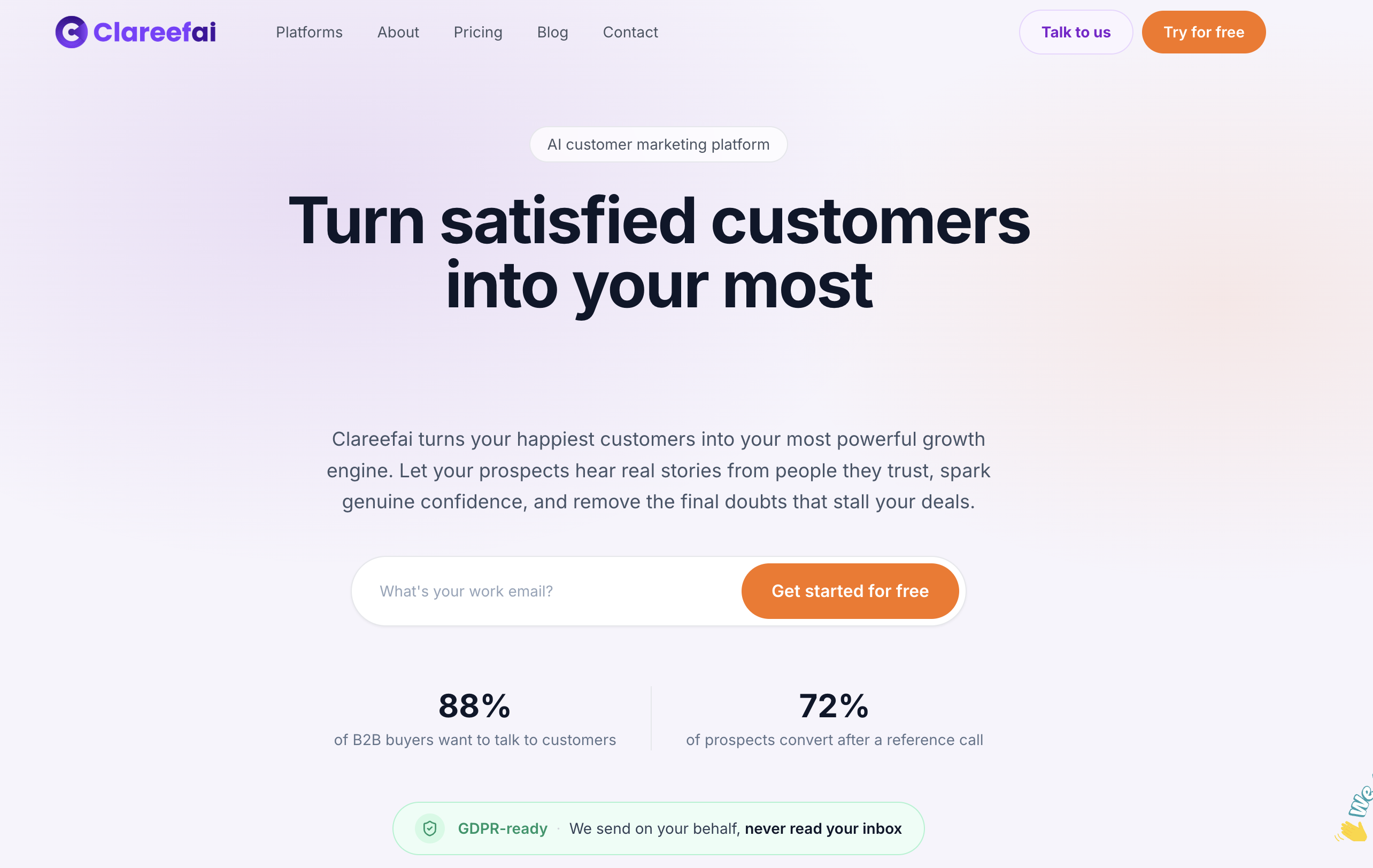
Instead of chasing down who said what and whether disclosure language was shown, dashboards surface verified promoters and their feedback in one place, ready to route into sales conversations or case studies. If you’re managing incentive campaigns across multiple channels, the platform’s integrations connect directly to your CRM so records stay current without manual entry. Plans start at $250 a month on the Basic tier, and if you’d rather test the workflow at no cost first, the free plan is a low-risk place to start capturing verified, disclosed reviews the right way.
This article is general information, not a substitute for advice from a qualified lawyer. Consult a qualified legal professional about your own circumstances before acting on anything here.
Sources
- The Consumer Reviews and Testimonials Rule: Questions and Answers | Federal Trade Commission
- Tips to get more reviews - Google Business Profile Help
- NAD Addresses Disclosure Requirements For Incentivized Reviews - Mondaq
- NAD addresses disclosure requirements for incentivized reviews | Kelley Drye
FAQ
Can You Legally Offer a Reward for a Customer Review?
Yes, as long as the reward doesn’t depend on the review being positive and you disclose the incentive clearly. The FTC’s rule permits incentivizing participation in honest feedback, not the sentiment of that feedback.
Does Google Allow Incentivized Reviews?
No. Google Business Profile policy prohibits offering free or discounted goods or services in exchange for posting, changing, or removing a Google review, and treats violations as fake content.
What Happens if a Review Incentive Isn’t Disclosed?
Undisclosed incentives can violate the FTC Act and have triggered NAD remediation actions requiring companies to update past reviews and tighten disclosure going forward, as seen in the Zuru case.
How Does Clareefai Help With Review Incentive Compliance?
Clareefai verifies that testimonials come from real customers and stores disclosure text with each submission record, giving legal and marketing teams an auditable trail. Pricing starts at $250 per month, with a free plan available for teams that want to test the workflow first.
What Metrics Should You Track Instead of Star Rating?
Track response rate, verified reviewer rate, submission completeness, and insight-to-action rate rather than average star rating. Tying rewards or recognition to rating improvement recreates the exact sentiment-conditioning problem the FTC’s rule prohibits.
Recommended
Share Article
Stay Updated
Get the latest insights on customer advocacy and SaaS growth delivered to your inbox.