B2B referral marketing is a structured way to turn satisfied customers and partners into introductions to buyers who look like them. It works when you start with verified advocates, ask at the right moment, hand the introduction to sales with its context intact, and measure referred deals separately. Clareefai is built around the first and last of those steps: finding and verifying the customers who will vouch for you, and showing the impact of their voices on revenue.
This guide covers the full routine for sales leaders, customer marketers, customer success managers and founders at B2B companies. It skips consumer “give $10, get $10” mechanics, which follow different rules.
TL;DR
- B2B referrals are one-to-one introductions between businesses. They are slower and more relationship-driven than consumer referrals, and one deal often involves a buying committee.
- Start with your best advocates, not your whole customer list. Ask after a recognized win, with a specific request that is easy to accept or decline.
- Pass context along with the name: why the customer thought the introduction was useful matters more than the attribution field.
- Recognition and relationship usually carry more weight than cash. If you pay, tie rewards to pipeline stages, not to raw submissions.
- Track referred deals separately in your CRM: win rate, sales cycle, deal size, retention and cost per referred customer.
Table of Contents
- What B2B referral marketing is, and what it is not
- Why B2B referrals behave differently from consumer referrals
- How to run the referral process step by step
- Designing incentives that fit B2B
- How to measure referral marketing
- Common reasons B2B referral programs stall
- A 30-day starter plan
- Perspective: referrals start with proof
- Put your advocates to work with Clareefai
- FAQ
- Sources
What B2B referral marketing is, and what it is not
A referral happens when someone who knows both sides makes a warm introduction. In B2B that someone is a customer, a partner, an agency or a consultant. They put their own credibility behind the vendor, then step back while your team runs the sale.
This is the difference from affiliate marketing. An affiliate is a performance marketer whose tracked link and cookie window are the product, and who rarely knows the buyer. One affiliate may send thousands of visitors. A referral partner may send three, but they are warmer. Affiliates are paid a commission on traffic they send; a referral partner is trusted by the buyer.
Business buyers lean on peers heavily. A longitudinal survey of 44,822 B2B customers covering 2017 to 2024 found customer loyalty ranked first in all three periods, and 62% to 86% of respondents had hired a supplier that had worked for them before or had been referred by a colleague. That is the case for treating referrals as a program with an owner, not a favor that happens by accident.
The main types of referral source
In practice, B2B teams work with four sources:
| Source | Who they are | Typical reward | Best for |
|---|---|---|---|
| Customer advocates | Happy users and champions | Recognition, credits, early access, sometimes cash | Same-industry lookalike buyers |
| Professional referrers | Consultants, agencies, advisors | Fees or commissions | Buyers who hire outside expertise |
| Channel and co-marketing partners | Vendors with overlapping buyers | Revenue share, joint campaigns | Adjacent products |
| Supplier and vendor networks | Companies that serve your customers | Reciprocity | Niche markets |
This article concentrates on the first row. Customer advocates are the source you control best, and they are the easiest to verify and showcase.
Why B2B referrals behave differently from consumer referrals
Three features of B2B change the playbook.
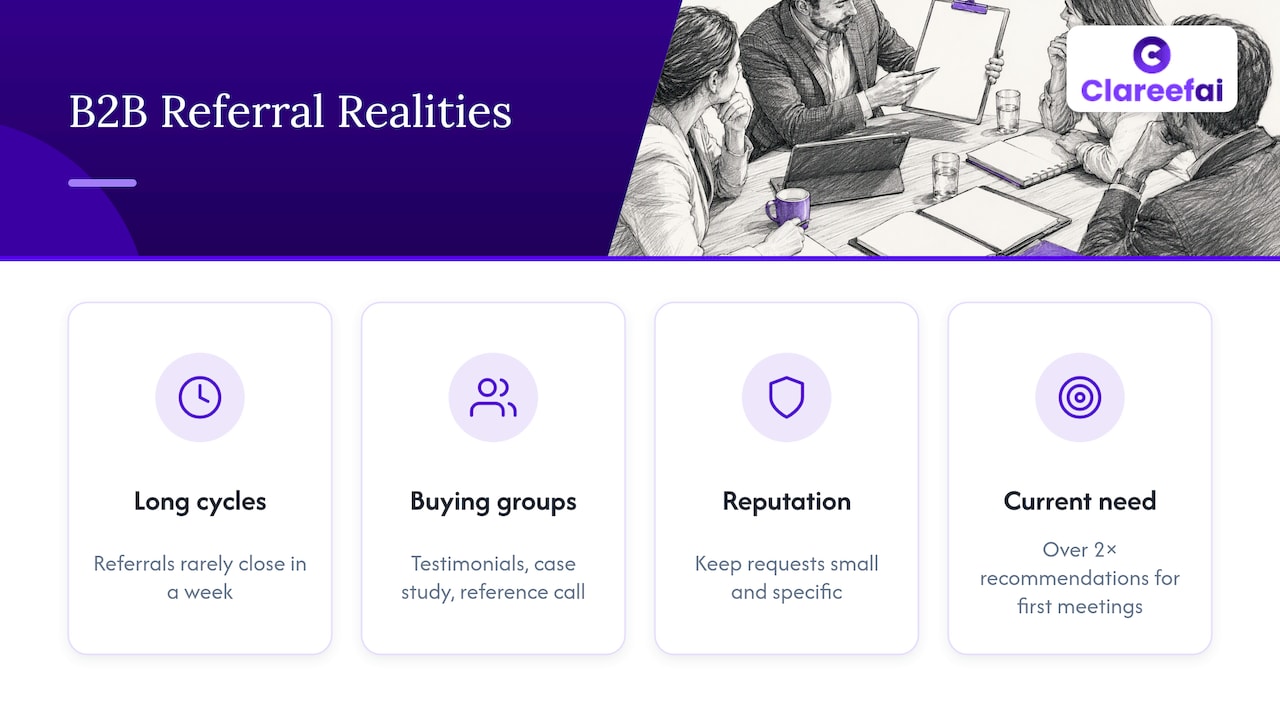
Cycles are long. A referral rarely closes in a week. Plan for months, and design rewards and reporting around that.
Many people decide. Buying groups can be large. One endorsing voice rarely closes a deal alone, which is why a referral should open the door and then be backed by proof: testimonials from similar companies, a case study and, near the end, a reference call.
Reputation is at stake. A customer who introduces you to a peer is spending their own credibility. If the introduction goes badly, they feel it. That is why a request has to be small, specific and respectful of their time.
The evidence on referrals as a way into a first meeting is also worth reading with care. HubSpot’s 2014 B2B sales research found that vendors use personal recommendations very commonly to obtain a first meeting, but referencing a real, current need was more than twice as effective. The takeaway: a referral opens the conversation, but the conversation still has to be about the buyer’s problem. Carry that problem into the introduction.
How to run the referral process step by step
The sequence below follows the workflow that B2B practitioners describe: define a referable buyer situation, ask after a recognized outcome, prepare an editable note, capture handoff facts, recheck the problem with the prospect, track each stage, and close the loop with the customer.
1. Define the buyer you want more of
Write one sentence: “A company like X, with problem Y, at stage Z.” Advocates can only refer someone if they can picture them. A vague request (“know anyone who might need us?”) produces silence. A specific one (“do you know another RevOps lead who is wrestling with the same renewal forecasting issue?”) produces a name.
The hard part is knowing which customers are worth asking. Clareefai uses AI-driven analysis to identify your most impactful customer advocates and matches them to prospects, so you start from the customers whose stories fit the buyer you want, not from whoever answers email fastest.
2. Pick the right advocates
The best referrals tend to come from your most satisfied, long-term customers. Look for:
- A recent, measurable win they would describe in their own words.
- A positive relationship with their account manager or customer success manager.
- Visible peers in their industry or role.
- Past willingness to give a testimonial, join a call or be named publicly.
Verified testimonials are a strong signal here. A customer who has already said, on the record, what you did for them has told you they are willing to be an advocate. Clareefai centralizes those testimonials and verifies customer identities, which gives you a ready-made list of promoters. For more on moving from happy customers to active advocates, see how to build advocates from happy customers.
3. Ask at the right moment, in the right way
Timing matters more than wording. Ask right after a recognized outcome: a successful go-live, a renewal, a quantified result, a positive NPS answer, a public thank-you. Your customer is proud, and the benefit is fresh.
Make the request:
- Specific. Name the type of person and the problem.
- Easy to decline. “If it’s not a fit, no problem at all” protects the relationship.
- Low effort. Offer a short note the customer can review and edit before sending, rather than asking them to compose an introduction from scratch.
- Single. One ask per conversation. Do not stack a referral request on a renewal negotiation or a support escalation.
A good first ask is often smaller than a referral: a short testimonial, a comment, or a video. These are easier to give, and they build the habit. Clareefai collects testimonials, comments and video reviews across customer touchpoints and automates the requests, so the first ask does not depend on a rep remembering to send it.
4. Capture the handoff facts
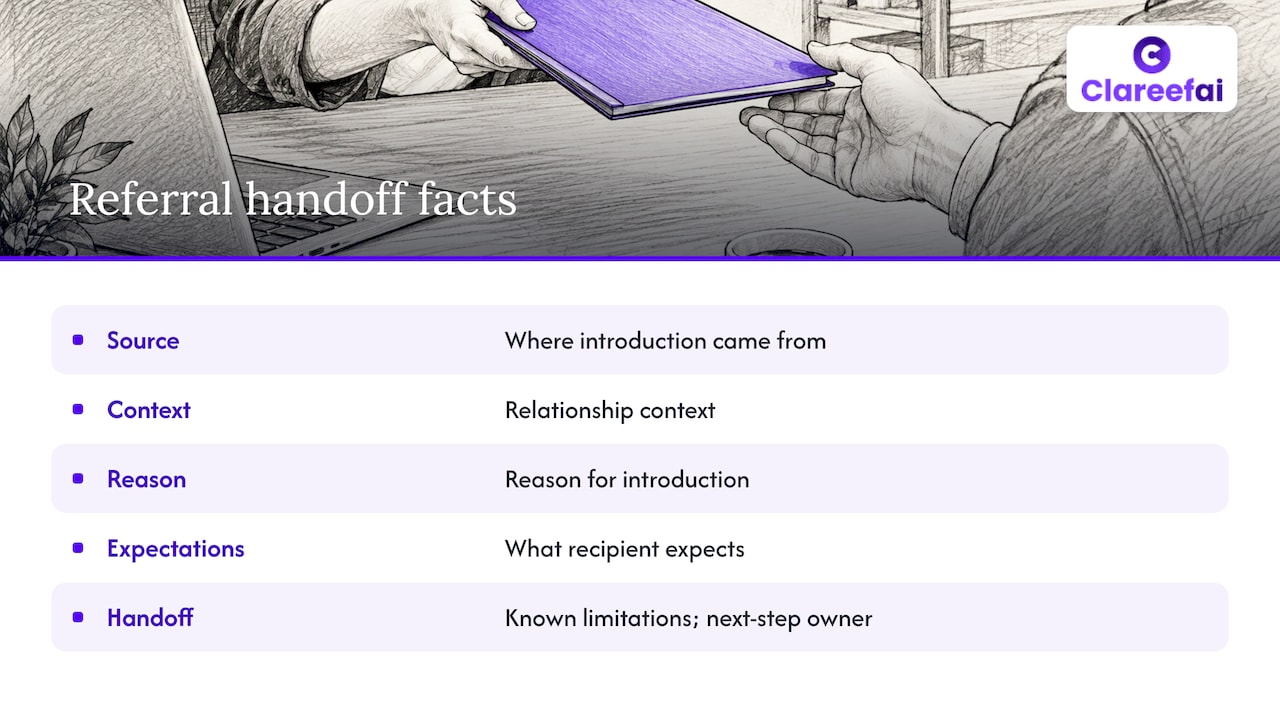
The introduction is where many referrals die. A name and an email is not a referral; it is a cold lead with a slightly warmer subject line. A useful handoff records six facts: where the introduction came from, the relationship context, the reason for the introduction, what the recipient expects, any known limitations, and who owns the next step. The same guide warns that attribution fields alone leave the salesperson unprepared, because the referrer’s reason for making the introduction is what makes the first conversation work.
This is the idea behind feedback contextualization: a quote or a recommendation means far more when you know who said it, in what role, about which problem. We explain it in feedback contextualization for B2B sales teams.
When referrals arrive from several places (a customer, a partner, a website form), you also need a clean route into sales. Qualification tooling can help; see this overview of AI lead qualification software for how teams capture lead details and pass qualified leads to a booking link.
5. Recheck the problem with the prospect
Do not assume the referrer described the need correctly. In the first call, confirm the problem directly. This respects the HubSpot finding above and avoids pitching to a story that has been retold twice.
6. Back the introduction with proof
A warm introduction gets you the meeting. Evidence closes the deal. Give the prospect testimonials from companies like theirs, a relevant case study and, as the deal advances, a reference call with a real customer. Reference calls work best when they are prepared and matched carefully; our guides on the reference call process, reference call etiquette and questions, prep and matching cover the details. Clareefai supports instant reference calls with real customers, so a rep does not have to hunt for an available advocate in the middle of a deal.
7. Close the loop
Tell the referrer what happened: the introduction was made, the conversation took place, the deal progressed or closed. People who never hear back stop referring. A thank-you with specifics costs nothing and keeps the advocate engaged.
Designing incentives that fit B2B
Before you decide what to reward, consider the evidence on how rewards behave. A field experiment on a fintech banking platform by Rubli and colleagues found that incentives doubled the likelihood of referring, that people responded about twice as strongly to rewards for themselves than for the friends they referred, and that previously rewarded users were far less likely to make further referrals. It is a consumer-platform study, so treat it as a pointer rather than a B2B benchmark. Still, it shows two design lessons: rewards move behavior, and one-off rewards do not build a lasting habit.
For B2B, a few practical rules follow.
- Lead with recognition. Executives and champions often care about status, access and being seen as an authority in their field. Featuring a customer’s story, inviting them to speak, or giving them early access to roadmap sessions can matter more than a gift card. We cover this in why recognition comes before rewards.
- Check company policy. Many buyers cannot accept cash or gifts because of procurement or compliance rules. Offer options such as account credits, donations or event access.
- Tie payment to a trigger. If you pay partners, pay only when a defined event occurs, such as a signed contract or first payment, and spell it out in the agreement.
- Share the benefit. Where the referred company also gains (an onboarding bonus, an extended trial), the introduction feels like a favor to both sides.
- Disclose material connections. In the US, the FTC’s Endorsement Guides, revised in 2023, call for clear disclosure of a material connection between an endorser and a brand. If advocates are paid or rewarded for public endorsements, make sure the disclosure is plain. Your legal counsel should confirm how this applies to your program.
How to measure referral marketing
Many B2B teams do not know what their referrals are worth because they do not track them. Fix that first. In your CRM, create a referral source field and capture the referrer, the account and the stage.
Then watch these measures, recommended by B2B SaaS referral practitioners:
- Referral-sourced opportunities and their win rate compared with your overall win rate.
- Retention of referred accounts compared with other channels.
- Cost per referred customer compared with the reward you paid.
- The share of eligible customers who have referred at least once.
Compare referred and non-referred customers acquired in the same period so that timing does not skew the result. The same source notes that there is no published B2B SaaS benchmark for these five metrics, so your own baseline is the benchmark.
SalesHive suggests tracking referrals per month, referral-to-qualified-meeting and referral-to-closed-won rates, deal size and sales cycle against non-referred deals. Its example is simple: a $12,000 program cost divided by four closed referred deals equals $3,000 per referred acquisition. Run the same arithmetic on your own numbers, and compare the result to your blended customer acquisition cost.
Also separate sourced from influenced pipeline. A referral that created the opportunity is sourced. A customer who joined a reference call late in the deal influenced it. Report both, and agree in advance which one earns payouts.
For testimonial and proof content, tie exposure to revenue. Our guide on connecting testimonial exposures in GA4 to CRM ROI shows how.
Common reasons B2B referral programs stall
- No owner. Marketing assumes sales runs it, and sales assumes customer success does.
- Asking everyone. Mass emails to the full customer base get few replies and risk annoying executives.
- Missing context. Introductions arrive as names without the reason, so the first call feels cold.
- No tracking. Without a referral field in the CRM, you cannot show the program’s value and it loses budget.
- No follow-up. Referrers never learn the outcome and stop.
- Reward-first design. A cash offer with no relationship behind it attracts low-fit leads.
Each of these is a process problem, and each is fixable with a named owner, a short list of verified advocates and a CRM field.
A 30-day starter plan
Week 1. Write the ideal-buyer sentence. Pull a list of customers with a recent win and a positive relationship.
Week 2. Collect testimonials or short videos from the top 10 to 20 on that list. These become your proof library, and they show who is willing to go further.
Week 3. Make the first referral requests, individually, with an editable introduction note. Add the referral source field to your CRM.
Week 4. Review requests, introductions, accepted conversations and qualified opportunities as four separate counts. Thank every referrer, whatever the outcome.
For a longer build, see how to stand up a customer reference program in 30 to 90 days and how to build a customer reference database.
Perspective: referrals start with proof
We built Clareefai on a simple idea: buyers trust people like themselves more than they trust your website. Referrals are that trust in motion, but most teams run them from memory and a spreadsheet.
The problem we see in the way B2B referral programs are designed is anonymity. A generic five-star review or an unverified quote does not help a prospect decide. A verified customer, in a known role, speaking about a problem the prospect shares, does. That is why our platform verifies identities and adds context to every testimonial, comment and video review.
Our approach is to make advocacy a system. AI-driven analysis helps identify the customers who will be your most impactful promoters. Automated collection gathers testimonials and reference input across touchpoints. Integrations with your CRM and review channels publish that proof where prospects look, and dashboards show how advocacy contributes to the pipeline.
Referrals then become the natural next step: the customer who has already spoken for you on the record is the one most likely to open a door for you.
ClareefAi
Put your advocates to work with Clareefai
If your referral program is still a list of names and good intentions, Clareefai gives you the structure: verified testimonials, AI-based promoter identification, instant reference calls, cross-channel publishing and advocacy analytics in one place.
Plans are billed monthly or annually with no long-term contract, and a free trial is available. Basic is $250 per month, Professional is $624 per month and Enterprise is $1,250 per month; see the Clareefai pricing page for what each tier includes, or explore how Clareefai helps marketers turn advocacy into content.
FAQ
What is the difference between affiliate and referral marketing in B2B?
Referral marketing relies on a person who knows the buyer and makes a warm, one-to-one introduction. Affiliate marketing pays publishers for traffic sent through tracked links, usually to a much wider audience. B2B referrals are slower and warmer, and they usually involve a sales handoff.
Should I pay customers for B2B referrals?
Start with recognition, access and relationship, because many business customers cannot accept cash. If you do offer rewards, choose credits or other options that fit your customers’ policies, and tie payment to a clear trigger such as a signed contract. Disclose rewards where endorsements are public.
When is the best time to ask for a referral?
Ask soon after a recognized success: a go-live, a measurable result, a renewal or a positive survey response. Keep the request specific and easy to decline, and avoid asking during a dispute or a price negotiation.
How do I know if my referral program is working?
Track referred opportunities in your CRM and compare their win rate, sales cycle, deal size and retention with your other channels. Divide program cost by closed referred deals to get a cost per referred customer, and compare it with your overall acquisition cost.
Sources
- Referral Partner vs Affiliate vs Reseller
- Effective Business-to-Business Sales Growth
- What Really Matters in B2B Selling (HubSpot, 2014)
- Customer Referrals: A Practical B2B Introduction Workflow
- B2B Referral Handoff: Keep the Context, Keep the Warmth
- AI Lead Qualification Software: A Buyer’s Field Guide
- Referral Reward Programs and Customer Acquisition (Rubli et al.)
- What Is a Referral Partner? B2B Referral Partnerships
- Referral Marketing Guide
- Referral Marketing Strategies in B2B SaaS
- How to Build a B2B Sales Referral Program