The Role of Brand Ambassadors in B2B Marketing and Sales
Brand ambassadors are paid or volunteer advocates who represent a company’s products and values across social, event, and sales channels. For B2B organizations, a well-run ambassador program shortens deal cycles by putting verified customer voices in front of prospects at exactly the right moment — turning referral conversions, reference calls, and testimonial-driven content into measurable pipeline.
The FTC endorsement guidance sets the disclosure floor for any compensated advocacy in the United States, and platforms like Clareefai help teams track KPIs like referral-to-opportunity rate and content-driven leads across every ambassador touchpoint.
Key Takeaways
The role of brand ambassadors in B2B marketing is most effective when programs combine verified customer advocates with clear KPIs, FTC-compliant contracts, and CRM-connected tracking from day one.
| Point | Details |
|---|---|
| Match ambassador type to goal | Customer advocates drive late-funnel conversion; influencers serve awareness; employees build employer brand. |
| Measure from day one | Assign referral codes, UTM links, and CRM tags before recruiting begins to attribute pipeline accurately. |
| Compliance is non-negotiable | FTC disclosure, employment classification, and data consent must be addressed in every ambassador contract. |
| Start small, prove ROI fast | Launch with employee ambassadors and top NPS promoters; use enterprise reference calls as the first measurable use case. |
| Clareefai scales verified advocacy | Clareefai automates promoter identification, testimonial capture, and CRM-connected publishing for B2B sales teams. |
Table of Contents
- What is a brand ambassador and which types should you use?
- What do brand ambassadors actually do day to day?
- Why do businesses invest in brand ambassador programs?
- How do brand ambassadors differ from influencers, advocates, and promotional staff?
- How do you design and run a brand ambassador program?
- How do you measure brand ambassador program success?
- What are the legal and compliance requirements for U.S. ambassador programs?
- Sample brand ambassador job description and campaign brief
- How do platforms scale verified customer ambassadors for B2B sales teams?
- What most ambassador programs get wrong — and how to fix it
- Clareefai helps you scale verified ambassadors without the manual overhead
- Sources
What is a brand ambassador and which types should you use?
A brand ambassador is someone paid or incentivized by an organization to represent its brand positively — a concept that has expanded well beyond celebrity spokespeople to include employees, loyal customers, micro-influencers, and campus representatives. The role sits at the intersection of marketing and sales: ambassadors create content, attend events, make referrals, and participate in reference calls that move prospects through the funnel.
Choosing the right type depends on your campaign goal and audience:
- Employee ambassadors — Internal team members who share product knowledge and company culture on LinkedIn or at industry events. Best for employer branding and thought leadership.
- Customer advocates — Satisfied buyers who provide testimonials, case studies, and reference calls. The highest-credibility option for B2B sales enablement because they speak from direct experience.
- Influencers — Content creators with established audiences who promote your brand in exchange for fees or product. Best for top-of-funnel awareness and product launches targeting a specific niche.
- Campus or promotional representatives — Students or event staff who represent the brand at specific venues or campuses. Effective for geographic expansion, trial programs, and recruitment marketing.
- Professional spokespeople — Contracted public figures or industry experts who lend authority to a brand. Useful for regulated industries or enterprise positioning where credibility carries a premium.
Word-of-mouth and in-person event activations remain among the most effective ambassador activities for driving trial and awareness, particularly for campus rep and employee programs.
What do brand ambassadors actually do day to day?
Ambassador duties span content creation, event participation, community engagement, and direct sales support. The specific mix depends on the ambassador type and the program’s objectives.
Content and social activities typically include publishing product reviews, unboxing or demo videos, LinkedIn posts, and social stories. A customer advocate might commit to two posts per month and one video testimonial per quarter. An employee ambassador might publish one LinkedIn article per month and share three company posts per week.
Events and in-person work cover trade shows, product demos, retail activations, and webinars. Promotional staff focus almost entirely here, while employee ambassadors split their time between events and digital channels.
Sales support activities are where B2B programs generate the most direct revenue impact. These include participating in reference calls with late-stage prospects, contributing to case studies, and providing quotes for sales decks. A customer advocate in an enterprise program might commit to two reference calls per quarter and one written case study per year.
Reporting and feedback round out the role. Ambassadors who track their own referral codes, flag content performance, and share market intelligence give program managers the data they need to optimize. Required skills across all types: clear communication, solid product knowledge, compliance awareness (especially disclosure rules), and the discipline to report consistently.
Why do businesses invest in brand ambassador programs?
Ambassadors strengthen trust and loyalty and can deliver higher engagement and organic reach than paid ads alone. For B2B teams, the business case is even more specific.
Key outcomes tied to ambassador activities:
- Increased qualified reach — Ambassadors extend your brand into networks you cannot buy, particularly peer communities and professional associations.
- Higher conversion rates — Prospects who engage with a verified customer reference or testimonial before a sales call close at higher rates than those who do not.
- Better-qualified leads — Referral leads from ambassadors arrive with context and pre-existing trust, reducing qualification time.
- Improved employer brand — Employee ambassador programs signal a healthy culture, which supports recruiting and retention.
- Amplified product launches — Coordinated ambassador content at launch creates social proof before paid media even runs.
Practical use cases worth tracking: referral conversion lift (the percentage increase in close rate for ambassador-referred opportunities), engagement lift on ambassador-created content versus brand-owned content, and the number of reference calls completed per quarter. For geographic expansion or campus recruiting, track trial sign-ups and application volume attributed to ambassador activity.
B2B ambassador strategies are most effective when they leverage satisfied customers as verified sales assets — case studies and reference calls that accelerate middle and late-funnel activity. That specificity is what separates a high-performing program from a loosely managed one.
How do brand ambassadors differ from influencers, advocates, and promotional staff?
These roles overlap in practice, but the differences in duration, authenticity, and measurement expectations matter when you are deciding where to invest.
| Role | Duration | Primary goal | Authenticity level | Where in the funnel |
|---|---|---|---|---|
| Brand ambassador | Ongoing (months to years) | Awareness, trust, and sales support | High — brand-aligned relationship | Full funnel |
| Influencer | Campaign-based (weeks to months) | Reach and awareness | Moderate — audience relationship | Top of funnel |
| Customer advocate | Ongoing, organic | Trust and conversion | Highest — direct experience | Mid to bottom funnel |
| Promotional staff | Event-specific (hours to days) | Trial and visibility | Low — tactical representation | Top of funnel |
Ambassadors commit to the brand over time and typically agree to exclusivity in their category, which is what separates them from influencers who may promote competing products in the same week. Customer advocates are technically a subset of ambassadors, but they operate more organically and carry the highest credibility because their experience is real and verifiable.
Promotional staff are the most tactical option. They represent the brand at a specific event and move on. They are not a substitute for a long-term ambassador relationship, but they are cost-effective for geographic reach at trade shows or retail activations.
For B2B programs, the most valuable combination is usually employee ambassadors for thought leadership plus customer advocates for late-funnel sales support. Influencers add value for product launches or brand awareness campaigns when the audience fit is strong, but they rarely move the needle on enterprise deal cycles.
How do you design and run a brand ambassador program?
Programs perform best when companies set clear goals, select ambassadors who genuinely believe in the brand, provide enablement resources, and measure outcomes consistently. Here is a practical checklist to build or scale one.
-
Define program goals and success metrics. Decide whether the program serves awareness, lead generation, sales enablement, or employer branding — and pick KPIs before you recruit anyone. Vague goals produce vague results.
-
Build your ideal ambassador profile. Specify the audience segment, channel presence, product experience, and time commitment you need. For B2B customer advocates, prioritize buyers who have achieved measurable outcomes with your product.
-
Source candidates. Pull from NPS promoters, top customers, engaged employees, and micro-influencers in your niche. Sprout Social’s program guidance recommends starting with loyal customers and employees before expanding to external influencers.
-
Screen for fit and commitment. Ask candidates: How do you currently talk about our product? What channels do you use? How much time can you commit monthly? Authenticity and availability matter more than follower count.
-
Onboard with a content kit. Provide brand guidelines, key messages, sample post templates, a disclosure guide, and a point of contact. Ambassadors who receive clear enablement produce better content and stay engaged longer.
-
Set compensation terms. Common models include:
- Stipend or payroll — Fixed monthly payment for a defined scope of work. Best for employee ambassadors or high-commitment external roles.
- Commission or referral fees — Payment per qualified lead or closed deal. Best for customer advocates in sales-heavy programs.
- Product or perks — Free access, early releases, event invitations. Works well for lower-commitment advocates and campus reps.
- Performance bonuses — Tied to KPIs like referral volume or content engagement. Adds accountability to any model.
TechTarget’s definition notes that formal ambassador employment requires contractual clarity on responsibilities, exclusivity, and performance expectations regardless of which compensation model you choose.
-
Draft the contract. Cover scope of work, channel restrictions, exclusivity terms, disclosure obligations, IP and usage rights for content, performance expectations, and termination triggers. Never rely on a handshake agreement for a compensated role.
-
Run a monthly check-in cadence. Share program updates, content performance data, and upcoming campaign briefs. Ambassadors who feel informed stay active; those who feel ignored go quiet.
How do you measure brand ambassador program success?
Measurement starts with deciding which KPIs map to your program goals before launch. Hootsuite’s research confirms that ambassadors can outperform paid ads on engagement and organic reach, but you need the tracking infrastructure to prove it.
Core KPIs for B2B programs:
- Referral conversions and referral-to-opportunity rate
- Content-driven lead volume (tracked via UTM links on ambassador posts)
- Number of reference calls completed per quarter
- Engagement rate on ambassador-created content versus brand-owned content
- NPS uplift in segments where ambassadors are active
Tracking methods that work:
Assign each ambassador a unique referral code and UTM parameter set. Tag ambassador-sourced contacts in your CRM so you can track them through the full pipeline. Use advocacy platform dashboards to monitor content output, engagement, and reference-call availability. Collect qualitative feedback from ambassadors quarterly to surface product and market intelligence.
A simple ROI framework for B2B: Divide incremental revenue from ambassador-sourced opportunities by total program cost (compensation, tooling, management time). If your program generates $400,000 in closed revenue from ambassador-referred deals and costs $80,000 to run, the return is 5:1. Track this quarterly and present it to sales and marketing leadership alongside the referral-to-opportunity rate to show both volume and quality.
A sample dashboard for leadership should include: total active ambassadors, referral leads generated, referral-to-opportunity conversion rate, reference calls completed, and content engagement rate. Keep it to five metrics so stakeholders can absorb it in under two minutes.
What are the legal and compliance requirements for U.S. ambassador programs?
U.S. program owners face three primary compliance areas: FTC disclosure, employment classification, and data privacy. Getting these wrong creates legal and reputational risk.
FTC disclosure. The FTC endorsement guidelines require that any material connection between a brand and an ambassador be clearly disclosed in every piece of content where that relationship could influence a viewer’s opinion. “Material connection” includes payment, free products, and employment. Disclosures must be clear, conspicuous, and placed where viewers will actually see them — not buried in hashtag strings. Your contract must require this language and specify which disclosure formats are acceptable for each channel.
Employment classification. Indeed’s employer guide notes that ambassadors can be employees or external contractors, and the distinction carries significant tax and benefits implications. If you control how, when, and where an ambassador works, the IRS may classify them as an employee regardless of what your contract says. Consult HR and legal before offering exclusivity or a fixed schedule to an external ambassador.
Data privacy. If you collect customer data for testimonial programs — names, emails, video recordings, or purchase history — you need explicit consent and a clear data-use policy. For any program touching EU-based customers, GDPR applies even when your company is U.S.-based.
Practical governance tips: Require ambassadors to keep copies of published posts. Audit content quarterly for disclosure compliance. Coordinate with legal before adding exclusivity or payroll terms to any external ambassador relationship.
Sample brand ambassador job description and campaign brief
Use this template as a starting point and adapt it to your program’s scope and compensation model. LinkedIn’s job description template and Indeed’s employer guidance both offer additional language you can pull from.
Brand Ambassador — Job Description (Template)
- Role summary: Represent [Company] across social, event, and community channels; create authentic content and participate in sales reference activities.
- Responsibilities: Publish [X] posts per month on [channels]; attend [X] events per quarter; complete [X] reference calls per quarter; submit monthly performance reports.
- Required skills: Strong written and verbal communication; genuine product experience; comfort with social media; willingness to disclose the brand relationship per FTC guidelines.
- Time commitment: [X] hours per month, [X]-month initial term.
- Compensation: [Stipend / commission / product perks / performance bonus — specify].
Campaign Brief Template
- Objective: [e.g., Generate 50 qualified referral leads for the Q3 product launch.]
- Target audience: [e.g., VP-level buyers in SaaS companies with 200–1,000 employees.]
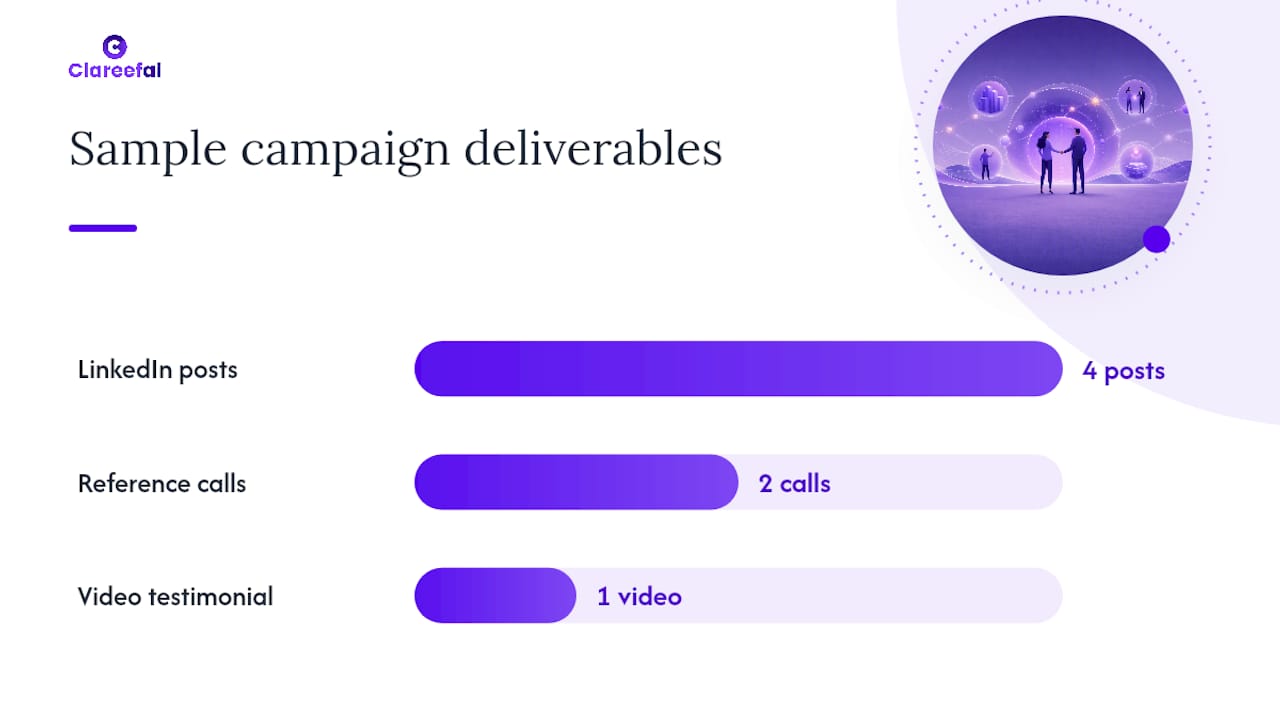
- Deliverables: [e.g., 4 LinkedIn posts, 1 video testimonial, 2 reference calls.]
- Timeline: [Start date] to [end date].
- KPIs: Referral leads generated, content engagement rate, reference calls completed.
- Success criteria: [e.g., 20 qualified leads, 5% engagement rate on posts, 100% reference-call availability.]
Screening questions for candidates:
- How do you currently talk about our product with peers or colleagues?
- What channels do you use most actively, and what is your typical engagement rate?
- Have you ever participated in a brand partnership or advocacy program before?
- How much time can you realistically commit each month?
How do platforms scale verified customer ambassadors for B2B sales teams?
Sprout Social’s program research confirms that converting satisfied customers into long-term advocates is more sustainable than relying on one-off influencer campaigns. The operational challenge is doing it at scale without overwhelming your customer success or marketing team.
A platform-supported workflow typically runs like this:
- Identify promoters using NPS scores, product usage signals, or CRM tags that flag high-satisfaction accounts.
- Verify identity and consent so every testimonial or reference is tied to a real, named customer who has agreed to participate.
- Request the testimonial or reference through automated outreach — a short email sequence that captures written, video, or survey-based feedback without requiring manual follow-up.
- Publish across channels using pre-approved templates that maintain brand consistency and FTC-compliant disclosure language.
- Link into CRM so sales reps can see which verified references are available for a specific prospect segment, industry, or use case — and request a reference call in one click.
The practical benefits for B2B sales teams are concrete: prospects who engage with a verified customer testimonial before a discovery call arrive with more context and fewer objections. Reference calls that are systematically available (rather than ad hoc) reduce the time sales reps spend hunting for a willing reference. Analytics dashboards show which testimonials and advocates are driving the most pipeline, so you can prioritize outreach to your most effective promoters.
Video testimonials add another layer of credibility because they are harder to fake and more engaging than text alone. Platforms that support video capture, consent management, and CRM publishing in a single workflow remove the friction that typically causes these programs to stall.
What most ambassador programs get wrong — and how to fix it
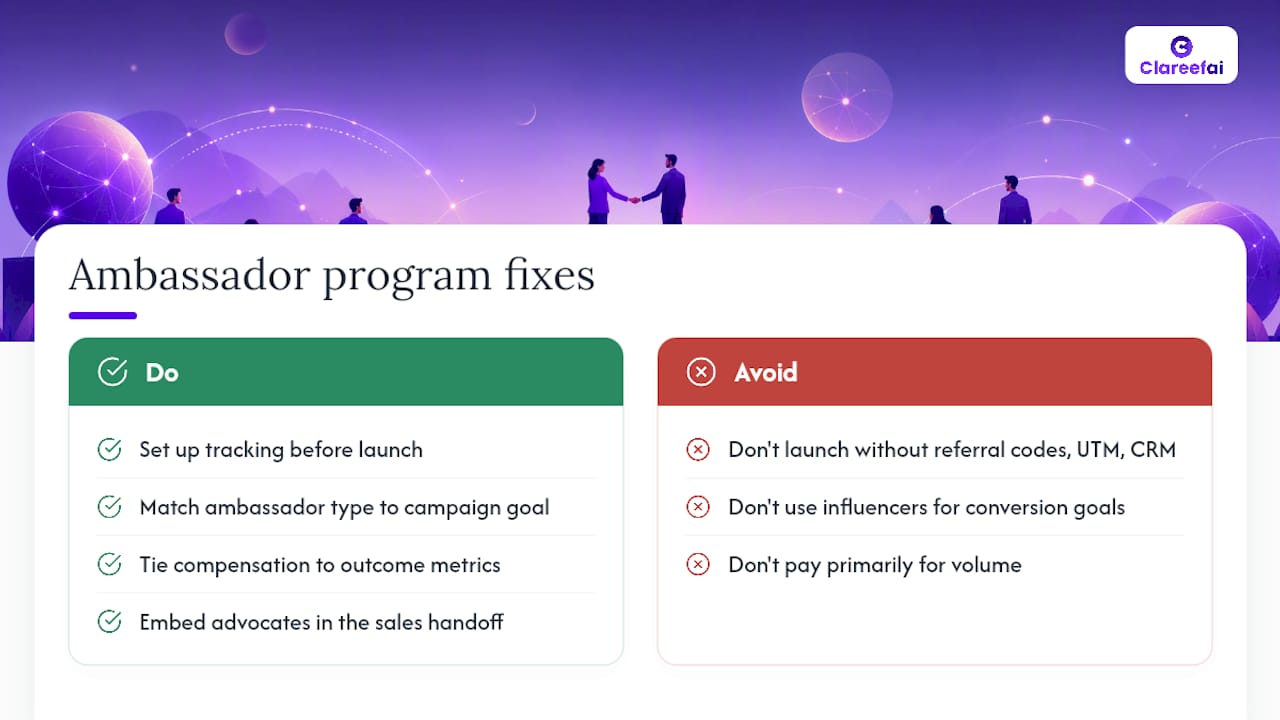
The most common failure mode is launching a program before the measurement infrastructure exists. Teams recruit ambassadors, send a welcome kit, and then struggle six months later to answer the question: “Is this working?” Without referral codes, UTM links, and CRM tagging in place from day one, you cannot attribute pipeline to ambassador activity, and the program loses executive support.
The second pitfall is mismatching ambassador type to campaign goal. Influencers are reach tools, not conversion tools. If your goal is to close enterprise deals faster, a customer advocate who can take a reference call is worth more than a creator with 50,000 followers who has never used your product. The authenticity gap is real, and sophisticated B2B buyers notice it.
Over-incentivizing is a subtler problem. When ambassadors are paid primarily for volume — posts published, reviews submitted — you get volume. You do not necessarily get quality or authenticity. Tie at least part of the compensation to outcome-based metrics: referral-to-opportunity rate, reference-call completion, or engagement rate on content. That alignment keeps the program honest.
Pro Tip: Embed your top customer advocates directly into the sales handoff process. When a new enterprise deal reaches the proposal stage, your CRM should automatically surface two or three verified references who match the prospect’s industry, company size, and use case. That one workflow change — connecting ambassador availability to sales stage triggers — consistently reduces late-stage deal friction without adding headcount.
For early-stage programs with limited budget, start with employee ambassadors and your top five NPS promoters. Provide a simple content kit, set three KPIs, and run a 90-day pilot. Prove the model with one use case — enterprise reference calls are the fastest path to a measurable ROI number — then expand.
Clareefai helps you scale verified ambassadors without the manual overhead
Most ambassador programs stall not because the concept is wrong, but because the operational work — identifying promoters, capturing consent, collecting testimonials, and making references available to sales — is too manual to sustain at scale.
Clareefai is built specifically for B2B teams who need verified customer advocacy to move faster. The platform uses AI-driven promoter identification to surface your most credible advocates from NPS and CRM signals, then automates testimonial collection with consent capture built in. Published testimonials sync across channels and connect directly to your CRM so sales reps can pull a relevant reference in seconds rather than days. Unified testimonial management has helped B2B teams improve win rates by making verified social proof available at every stage of the funnel.
Before you evaluate any platform, check three capabilities: identity verification for testimonials, native CRM integration, and an analytics dashboard that ties ambassador activity to pipeline. Clareefai covers all three. See how it works at Clareefai or review the solutions for marketers to see how advocacy content scales across your channels.
Sources
- What is brand ambassador? | Definition from TechTarget
- Brand ambassador - Wikipedia
- How to start a brand ambassador program from scratch | Sprout Social
- Brand ambassador | Brafton blog
- What is a brand ambassador? | Hootsuite blog
- What Is a Brand Ambassador? Guide for Employers | Indeed
- What Is a Brand Ambassador? | Column Five Media
Recommended
Share Article
Stay Updated
Get the latest insights on customer advocacy and SaaS growth delivered to your inbox.