Why Review Context Is Your B2B Conversion Edge in 2026
Contextualized reviews, those that include reviewer role, company profile, product version, verification status, date, and at least one outcome metric, are the most effective form of B2B social proof because they shorten committee review, reduce deal risk, and increase conversion for mid-market and enterprise buyers. If you want to move the needle on win rates this year, start here:
- Capture role and company size first. These two fields alone let every buying committee member self-qualify.
- Add one outcome metric per review. A single hard number (“reduced onboarding time by 40%”) outperforms three paragraphs of praise.
- Verify identity before publishing. A CRM match or signed opt-in is the minimum bar; video verification is the gold standard.
- Syndicate to at least one third-party platform. Forrester confirms that AI-powered answer engines rely on credible, peer-based citations, so your reviews need to exist where those engines look.
Teams that apply this approach consistently report shorter sales cycles and higher demo-to-win rates. AI answer engines are increasingly the first stop in B2B research, and only verified, contextualized proof gets cited.
Key Takeaways
Contextualized, verified reviews are the highest-leverage B2B conversion asset in an AI-driven buying environment, and a 90-day pilot is the fastest way to prove their impact.
| Point | Details |
|---|---|
| Context fields that matter most | Reviewer title, company ARR band, industry, outcome metric, and verification method are required at launch. |
| Verification is non-negotiable | CRM matching plus signed opt-in is the minimum; video verification is the strongest identity proof. |
| Display drives conversion | Layered, role-stamped proof (hero, mid-page, near-CTA) outperforms generic logo bars per CRO research. |
| AEO urgency is real | Forrester confirms AI answer engines prioritize credible, peer-based citations — unverified reviews get skipped. |
| Clareefai runs the program | Clareefai captures, verifies, role-stamps, and syndicates reviews with full audit trails and analytics dashboards. |
Table of Contents
- Why review context matters for B2B buying decisions
- Which contextual fields should you collect and why?
- How do you verify reviewers and build an audit trail?
- How should you display contextualized reviews so buyers and AI trust them?
- What governance and privacy controls does your program need?
- How do you measure the impact of contextualized reviews and prove ROI?
- What does a 90-day launch roadmap look like?
- Three scenarios showing review context in action
- The case for making review context your 2026 priority
- Clareefai accelerates your verified review program
- Sources
Why review context matters for B2B buying decisions
In B2B sales, “review context” means the structured metadata that surrounds a customer’s words: their job title, company ARR band or team size, industry vertical, the specific product module or version they used, the use case they solved, a before-and-after outcome metric, the date of the review, and proof that the reviewer is who they say they are. That is the definition this guide uses throughout. It has nothing to do with academic literature reviews or research methodology.
Context reduces committee friction because it lets each stakeholder self-match. A VP of Engineering reading “Director of Engineering at a 600-person SaaS company, reduced deployment time from 14 days to 3” does not need to ask your sales rep whether the product fits their environment. The review answers it.

G2’s buyer behavior research shows that a large majority of B2B buyers are more likely to purchase after reading a trusted peer review. The operative word is trusted. A review from “John D., happy customer” does not clear that bar for a $200,000 annual contract. A review from a named, verified VP of Operations at a mid-market logistics company, with a linked case study and a CRM-matched identity, does.
The Edelman Trust Barometer reinforces this: vendor self-description consistently scores lower in trust than verified customer stories. Every dollar you spend on provenance and third-party validation closes a gap that your own marketing copy cannot.
Which contextual fields should you collect and why?
Not all fields carry equal weight. Prioritize the ones that answer the buying committee’s most common objections.
Required fields at launch:
- Reviewer name and title — establishes peer credibility; a title match is the fastest self-qualification signal for any committee member
- Company name and ARR band or team size — use a band (“$10M–$50M ARR”) rather than exact revenue to reduce friction and protect reviewer privacy
- Industry or vertical — lets prospects in the same sector immediately see relevance
- Product module or version — prevents the “but we’d use a different configuration” objection
- Use case — one sentence describing the problem solved
- Baseline and outcome metric — the BIO structure (Baseline, Intervention, Outcome) recommended by high-ticket B2B conversion research is the clearest format; generic praise signals marketing fluff to procurement
- Review date — a two-year-old review without a date reads as stale; a dated review reads as current evidence
- Verification method — CRM match, video, or signed opt-in
- Publish permission — explicit written consent, scoped to specific channels
Optional at launch, high value later:
- Links to supporting artifacts (contract, implementation ticket, NPS score)
- Reference call availability flag
- Product configuration details
Pro Tip: Ask for ARR band instead of exact ARR. A dropdown with five ranges (“Under $5M,” “$5M–$25M,” “$25M–$100M,” “$100M–$500M,” “Over $500M”) gets a response rate far higher than a free-text revenue field, and the resulting data is more useful for segmentation.
How do you verify reviewers and build an audit trail?
Verification is what separates a credible review program from a collection of unverifiable claims. Here is the process, ordered by effort:
- CRM identity match. Confirm the reviewer’s email and company name exist in your CRM as an active or closed-won account. This is your baseline check.
- Contract or account cross-check. Match the review date against the customer’s contract start date. A review claiming 12-month results from a customer who signed 4 months ago is a red flag.
- Signed opt-in with scope. Collect a written consent form that names the specific channels where the review will appear (website, G2, sales decks). Store this alongside the review record.
- Reference call validation. For enterprise accounts, a 15-minute recorded reference call confirms the reviewer’s identity and gives you a richer asset.
- Video verification. A short on-camera statement is the strongest identity proof available and doubles as a high-conversion asset for pricing pages.
Your audit trail record should include: reviewer email, CRM account ID, contract reference, consent form timestamp, verification method used, publishing channels authorized, and a retention date. U.S. practice generally supports retaining consent records for the life of the published asset plus three years, though your legal team should confirm based on your specific verticals.
Third-party platform syndication (G2, TrustRadius) adds an independent trust layer. TrustRadius research documents that buying committees weight peer reviews on third-party platforms far more than vendor-hosted content alone, because the platform’s own moderation acts as a second verification step.
Anonymous reviews carry real risk. They reduce trust with AI answer engines and with procurement teams running due diligence. The case against anonymous reviews is straightforward: if you cannot prove who said it, neither can your prospect.
How should you display contextualized reviews so buyers and AI trust them?
Placement and formatting determine whether a review actually influences a decision or gets scrolled past.
- Hero placement: Lead with a role-stamped quote from a peer title that matches your ICP. The goal is immediate self-qualification. A CFO quote on a pricing page, a Director of Engineering quote on an integrations page.
- Mid-page case snippets: Compact cards (role, company size, one metric, one sentence) placed after your feature explanation give buyers a proof checkpoint before they commit to reading a full case study. CRO teardown research confirms that layered, specific proof outperforms generic logo bars for B2B SaaS landing-page conversion.
- Near-CTA micro-strip: A tight strip of three to five role-stamped quotes plus security badges and a “no credit card required” note reduces last-second abandonment. First-week testimonials work especially well here because they address the fear of a slow start.
- Structured data: Implement
ArticleandClaimReviewschema on HTML case study pages. Role-stamped metadata in schema markup lets large language models extract and cite specific outcomes. This is the technical foundation of AEO for review content. - Syndication channels: Publish consistently to G2, TrustRadius, your CRM’s reference module, and sales decks. Role-stamped video testimonials and HTML case studies syndicated across platforms reduce the cross-checking friction that buying committees generate during late-stage evaluation.
Consistency across channels matters because AI answer engines cross-reference sources. A review that appears only on your website carries less weight than one that appears on your site, G2, and in a linked case study with matching metadata.
What governance and privacy controls does your program need?
U.S.-based programs need a minimum governance layer before publishing any contextualized review.
Consent workflow: Collect explicit written permission scoped to named channels. If you later want to add a channel (say, a new review platform), collect a fresh consent. California’s CCPA and similar state-level frameworks give consumers and business contacts the right to request deletion of their personal data, so your consent record must be linkable to the published asset for fast removal if requested.
Data storage: Keep verification records (CRM match, signed opt-in, video file) in a secure, access-controlled system. Store provenance data alongside the testimonial record in your CRM or CMS so any team member can pull the full audit trail without a manual search.
Sensitive verticals: In healthcare, financial services, and legal, mask or omit any detail that could identify a patient, client, or regulated transaction. When in doubt, use ARR bands and role titles rather than company names.
Retention policy: Align your retention period with your legal team’s guidance. A reasonable default is the life of the published asset plus three years for consent records.
The Edelman trust data makes the business case for this investment clear: verified customer stories outperform vendor self-description in buyer trust, and a governance failure (a disputed review, a consent violation) can erase that advantage quickly.
How do you measure the impact of contextualized reviews and prove ROI?
You need five core KPIs and one A/B test running before you can defend the program budget.
Core KPIs:
- Page-level conversion rate lift — compare conversion on pages with contextualized reviews vs. pages with generic testimonials or no proof
- Demo-to-win rate — track whether deals that used role-stamped references in the sales cycle close at a higher rate
- Average sales-cycle length — measure whether contextualized proof reduces days from first meeting to signed contract
- Reference asset utilization rate — how often sales reps actually use the verified reviews in active deals
- AI citation rate — how often your case studies or reviews appear in AI-generated answers for relevant queries (track via brand monitoring tools)
Sample A/B test design:
- Control: landing page with a generic logo bar and one unattributed quote
- Treatment: same page with a role-stamped hero quote, two mid-page case snippets, and a near-CTA micro-strip
- Primary metric: demo request conversion rate
- Secondary metric: time on page and scroll depth
- Minimum sample: 500 unique visitors per variant before reading results
| KPI | Benchmark signal | Source |
|---|---|---|
| Peer review purchase influence | The large majority of B2B buyers are more likely to purchase | G2 Buyer Behavior Report |
| Vendor trust gap | Verified customer stories outperform vendor self-description | Edelman Trust Barometer 2025 |
| Layered proof vs. logo bar | Specific, layered proof outperforms generic social proof | iVanHub CRO Teardown |
Tag each proof asset in your analytics platform with reviewer role, company size band, and industry vertical. That tagging lets you filter conversion data by segment and identify which proof types move which buyer personas.
What does a 90-day launch roadmap look like?
Weeks 1–2 (Pilot selection): Identify 10–15 customers who are strong advocates, span at least three industry verticals, and represent your ICP’s ARR bands. Sales and customer success own this step.
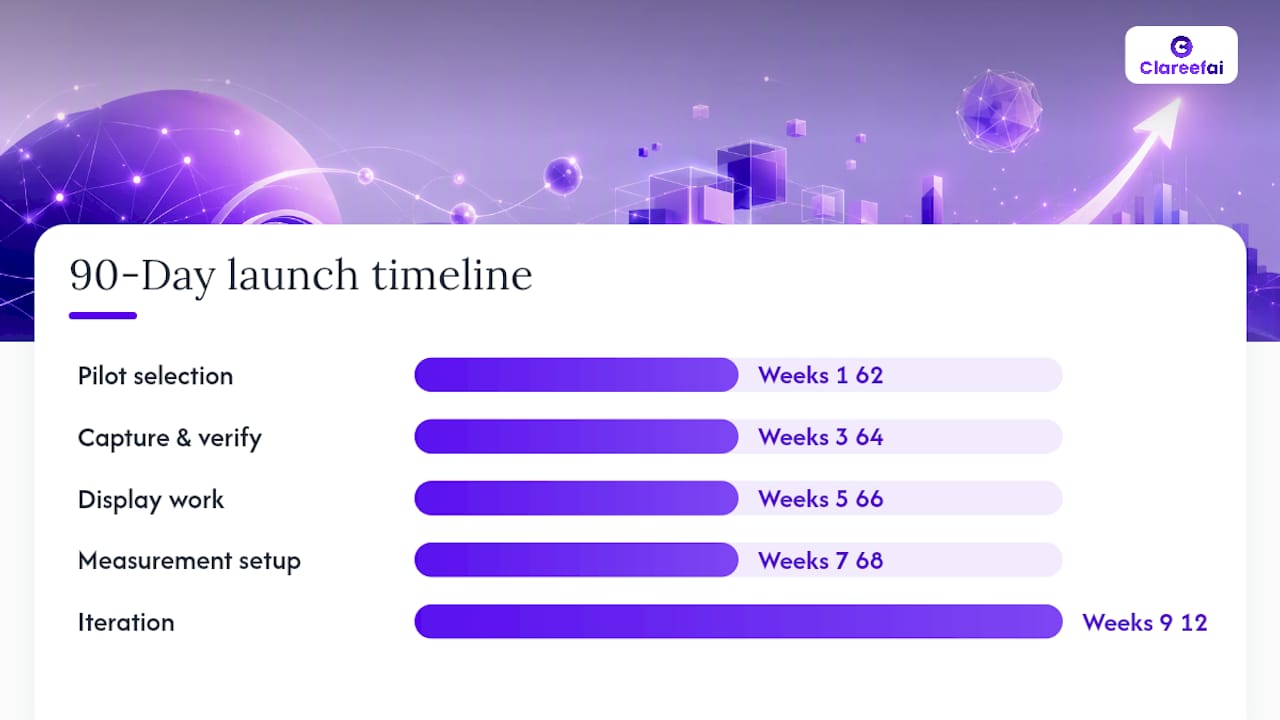
Weeks 3–4 (Capture and verify): Run structured interviews or async video requests. Collect all required fields. Complete CRM matching and signed opt-ins. Legal reviews the consent template once; CS applies it at scale.
Weeks 5–6 (Display work): Marketing updates landing pages with role-stamped snippets and ClaimReview schema. Publish to G2 and TrustRadius. Add proof assets to sales deck templates in CRM.
Weeks 7–8 (Measurement setup): Analytics tags proof assets by segment. A/B test launches on the highest-traffic conversion page. Sales leadership sets demo-to-win tracking in CRM.
Weeks 9–12 (Iteration): Read A/B test results. Identify the two or three proof assets with the highest engagement. Scale capture to 30–50 reviews using the verified workflow.
| Role | Responsibility | Handoff |
|---|---|---|
| Customer Success | Identify advocates, run capture interviews | Passes verified records to Marketing |
| Marketing | Format, schema markup, publish, A/B test | Passes assets to Sales |
| Sales | Deploy in decks, track reference utilization | Reports win-rate data to Analytics |
| Legal | Approve consent template | One-time review; CS applies at scale |
| Analytics | Tag assets, build KPI dashboard | Reports to all roles at week 8 |
Integration checklist: Add ARR band, industry, and verification-status fields to your CRM contact and opportunity records. Update your CMS with ClaimReview schema templates. Connect your review platform (G2, TrustRadius) via API for consistent syndication. Configure analytics event tracking for proof-asset interactions.
Three scenarios showing review context in action
Scenario 1: The technical evaluator
A Director of Engineering evaluating a DevOps platform reads a generic quote: “Great tool, highly recommend.” She moves on. The same page, updated with a role-stamped review from a Senior DevOps Engineer at a 500-person SaaS company, describing a specific Kubernetes integration completed in 11 days with zero downtime, stops her scroll. The technical metadata answers her objection before she can raise it.
Scenario 2: The economic buyer
A CFO approving a $180,000 annual contract needs peer validation, not feature lists. A review from “a satisfied customer” does nothing.
Scenario 3: Procurement and legal
A procurement manager running a security review sees a near-CTA micro-strip with three role-stamped quotes, a SOC 2 Type II badge, a CCPA compliance note, and a “no long-term contract” line. Each element addresses a specific procurement objection. The verification status displayed on each review (CRM-matched, signed opt-in) tells her the claims are auditable.
The case for making review context your 2026 priority
AI-driven search has changed the first mile of B2B research faster than most teams have adapted. Buyers now arrive at your demo request page having already read an AI-generated summary of your category, and that summary cites peer reviews, not your homepage copy. If your reviews lack role, company size, outcome metrics, and verification proof, they will not be cited. You will be invisible in the channel that increasingly shapes shortlists.
The committee dynamics compound this. Mid-market and enterprise deals involve five to ten stakeholders, each with a different objection. A single generic testimonial cannot answer all of them. A library of role-stamped, verified, outcome-specific reviews can. The social proof placement research and UGC playbook guidance both point to the same conclusion: specificity wins.
The leadership ask is concrete: fund a 90-day cross-functional pilot, assign a CS lead and a marketing lead, and run the A/B test. The measurement framework in this guide gives you the data to scale or adjust after week 12.
Pro Tip: After your pilot, attach a “test note” to each proof asset: the audience segment it was shown to, the page or context, and the observed conversion lift. That record makes future tests reproducible and turns your best assets into a composable library.
Clareefai accelerates your verified review program
Verified, contextualized reviews are a program, not a one-time project. Clareefai is built to run that program at scale.
The platform handles the full workflow: AI-powered promoter identification surfaces your strongest advocates, structured capture collects all required contextual fields, CRM matching and signed opt-ins create the audit trail, and automated schema exports make your reviews machine-readable for AI answer engines. Role-specific dashboards give sales, marketing, and customer success each own view of advocacy performance, and cross-channel syndication keeps your proof consistent across your site, G2, TrustRadius, and sales decks.
A 90-day pilot on Clareefai typically yields 30–50 verified, role-stamped reviews ready for A/B testing, with full provenance records stored securely and linked to your CRM. See how the platform improves win rates with unified testimonial management, or explore the marketing team solution to book a demo and scope your pilot.
Sources
These are the primary sources used throughout this guide. Each one is worth bookmarking for your own program design and A/B test validation.
- A New Case For B2B Review Sites Has Entered The Chat
- Social Proof Placement for B2B SaaS Landing Pages: A CRO Teardown | iVanHub
- Edelman Trust Barometer, 2025 (B2B technology cut)
Recommended
Share Article
Stay Updated
Get the latest insights on customer advocacy and SaaS growth delivered to your inbox.